
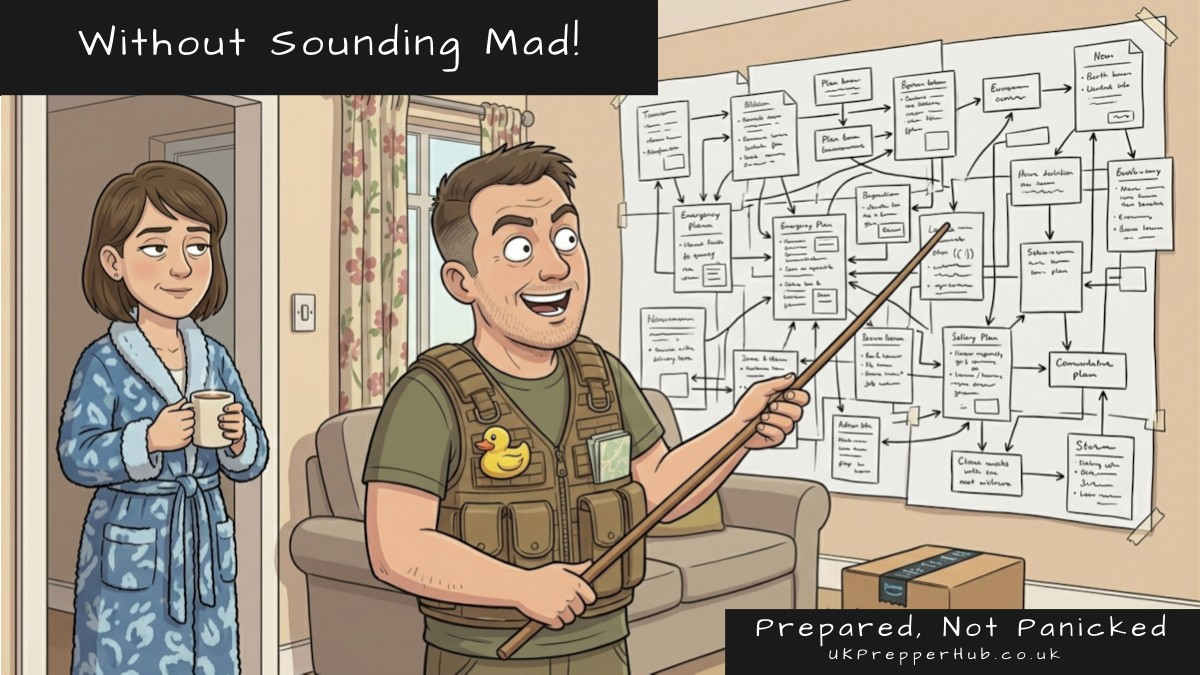
You have read about having a family emergency plan. You understand the logic of having a 72-hour kit, a water reserve, a plan for a power cut. You have started thinking about what your household would do in a flood, or a prolonged grid failure, or a scenario where the supply chain is disrupted for a week. And then you mention it to your partner, or your parents, or a friend — and the reaction is somewhere between scepticism and gentle mockery. “You’re not going full doomsday prepper are you?” “That’s a bit much, isn’t it?”
This conversation is one of the most common obstacles in household preparedness, and one of the least discussed. The practical steps are well documented. The social dynamics of persuading the people you live with to take them seriously are not. Here is a realistic guide to getting your family emergency plan agreed — without an argument.
Why the Resistance Happens
The instinctive resistance to an emergency plan talk is not irrational. It comes from a reasonable association: in mainstream culture, the image of the person with a bunker full of freeze-dried food and a tin-foil hat is a figure of fun. “Prepper” carries a specific connotation — American, extreme, slightly unhinged. Most people’s mental image of emergency preparedness is not a sensible household safety measure. It is a personality type they do not want to be.
There is also a psychological mechanism called normalcy bias — the tendency to underestimate the likelihood and impact of disasters because we have not personally experienced them. People who have lived through a serious flood, a prolonged power outage, or an evacuation do not need persuading that preparation is sensible. People who have not yet experienced any of these have a strong default assumption that they will not. Talking about preparation can feel, to the listener, like you are asserting that something bad is definitely going to happen — which triggers defensiveness rather than engagement.
What Actually Works: Framing Your Family Emergency Plan
The most effective approach to preparedness conversations is not about emergencies. It is about convenience and peace of mind.
Nobody objects to having a spare tyre. Nobody argues against contents insurance. Nobody questions why a first aid kit lives in the bathroom cabinet. These are all preparations for events that might never happen, accepted without social friction because they are framed as prudent routine rather than fear-driven hoarding.
“I want us to have a plan in case of a long power cut this winter” lands better than “I’m worried about grid collapse.” “I’d like to have a week’s worth of food in so we’re not completely stuffed if the supermarket runs out of something” lands better than “I’m preparing for supply chain failure.” The substance is the same. The framing determines whether your partner engages or checks out.
Use Recent Events, Not Abstract Threats
Abstract future threats are easy to dismiss. Recent events that affected real people in the UK are much harder to ignore.
The 2021 petrol crisis saw forecourts run dry within days of a shortage being announced — people who had a small fuel reserve were comfortable, everyone else queued for hours. The 2020 empty supermarket shelves during the pandemic were experienced by almost every UK household. Storm damage in winter 2023-24 left thousands of homes without power for multiple days. The NHS cyber attack in 2024 disrupted hospital appointments across London. These are not hypotheticals. They happened to ordinary people in ordinary UK circumstances.
“Remember when the petrol stations ran out?” is a conversation opener that does not require anyone to accept a worldview. It points to something that already happened and invites a practical response.
Start Small and Specific
Introducing the full scope of emergency preparedness in one conversation is almost always counterproductive. A conversation that starts with “I want us to build a 72-hour emergency kit, store two weeks of water, back up all our documents, and make a family emergency plan” sounds like a lifestyle overhaul. A conversation that starts with “I’d like to get a decent torch and keep it somewhere we can find it in a power cut” sounds like a reasonable Tuesday.
The practical approach: one thing at a time, anchored to something concrete and near-term. A torch before winter. A spare phone charger and a power bank. A few extra tins added to the weekly shop. Each small step normalises the practice without requiring anyone to adopt an identity or a worldview.
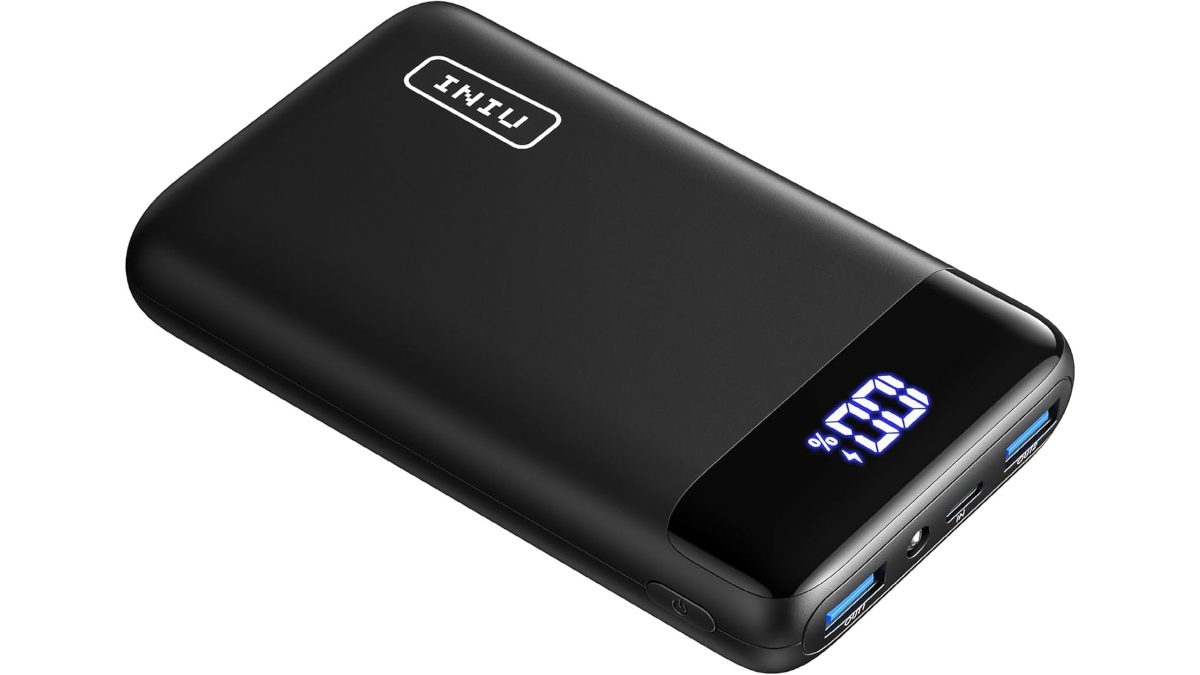
INIU 20,000mAh Power Bank
We tested it so you don’t have to — here’s the one thing most power banks get wrong, and why this one doesn’t.
Involve Rather Than Inform
Being told what the household is going to do — even with good intentions — triggers resistance in most adults. Being asked to contribute to a shared family emergency plan does not. “I’ve been thinking about what we’d do in a power cut — do you have any ideas?” invites participation. “I’ve decided we need to keep emergency supplies” sounds like a unilateral announcement.
Questions that involve rather than inform: “If we had to leave quickly, what would you want to make sure we had?” “If the power went out for three days in January, what would be our biggest problem?” People who come to a conclusion themselves are far more committed to it than people who were told it by someone else. The conclusion you want them to reach is the same one you have already reached — the goal is to let them get there themselves.
The Children Argument
For households with children, the most effective framing is often the children themselves. No parent needs persuading that having a plan in case of a house fire, a power cut, or a disruption that affects school runs and food supply is a good idea when children are involved. The preparedness conversation reframed around “what would we do if this happened with the kids” tends to land very differently from the same conversation framed around general resilience.
Involving children in the process in age-appropriate ways also shifts the dynamic considerably. A younger child can learn where the torch is kept, what to do if the lights go out, and why there are extra tins in the cupboard — framed as something practical and slightly exciting rather than alarming. Knowing what to do feels empowering to children; not knowing is what makes disruption frightening. An older child or teenager can contribute more meaningfully: helping decide what goes in a grab bag, learning where important documents are kept, or understanding the household’s plan for making contact if mobile networks are overloaded.
Children who have been included in the planning are far less likely to panic when something actually disrupts their normal routines. There is also a useful secondary effect: it is considerably harder for a sceptical adult to remain resistant to a family emergency plan once their own children have already engaged with the idea, asked sensible questions, and found it entirely unremarkable. Sometimes the most persuasive voice in the room is not the one who raised the subject first.
The One Thing Worth Saying Explicitly
At some point in the conversation, the following is worth saying directly: this is not about expecting disaster. It is about not being helpless when something manageable goes wrong — as things sometimes do. A solid family emergency plan is not a bunker. It is a household that can cope with a week-long power cut, a week of supply disruption, or an unexpected evacuation, without panic and without being entirely dependent on systems that occasionally fail. That is not extreme. That is the same logic as car insurance and a smoke detector.
One Last Trick Worth Trying
Sometimes the conversation itself is the obstacle. If every time you raise the subject it turns into a debate about whether you’re being reasonable, try removing yourself from the equation entirely.
Print this guide off and leave it on the kitchen table. Or forward it to your partner with a one-line message: “I found this — thought it was worth a read.” Let someone else make the case. A second voice, even a written one, carries different weight than the same point made by the person who is already invested in the outcome.
A family emergency plan does not need to start with a formal conversation. It can start with a piece of paper left next to the kettle, a link sent without comment, or a question raised over dinner that does not feel like an agenda. The goal is not to win an argument. It is to get your household to a place where a power cut, a flood, or a week of disruption does not catch anyone completely off guard.
And if you are reading this on a printed-out page — your partner is already thinking about making a family emergency plan.
Build Your Resilience
Further Reading: Related Guides
All our guides can be found listed on our resilience hub.
Gear We’ve Tested & Reviewed
All our reviews can be found on our reviews and resources page.
📡 Find Us Everywhere
Daily briefings, prep guides, and real-time updates across every platform. Pick yours.
Free. No commitment. Stay anonymous on WhatsApp & Telegram.
Stay Informed on UK Preparedness
Join our newsletter for UK-specific preparedness tips, product recommendations, and real-world advice for households.
Subscribe to Our Newsletter