
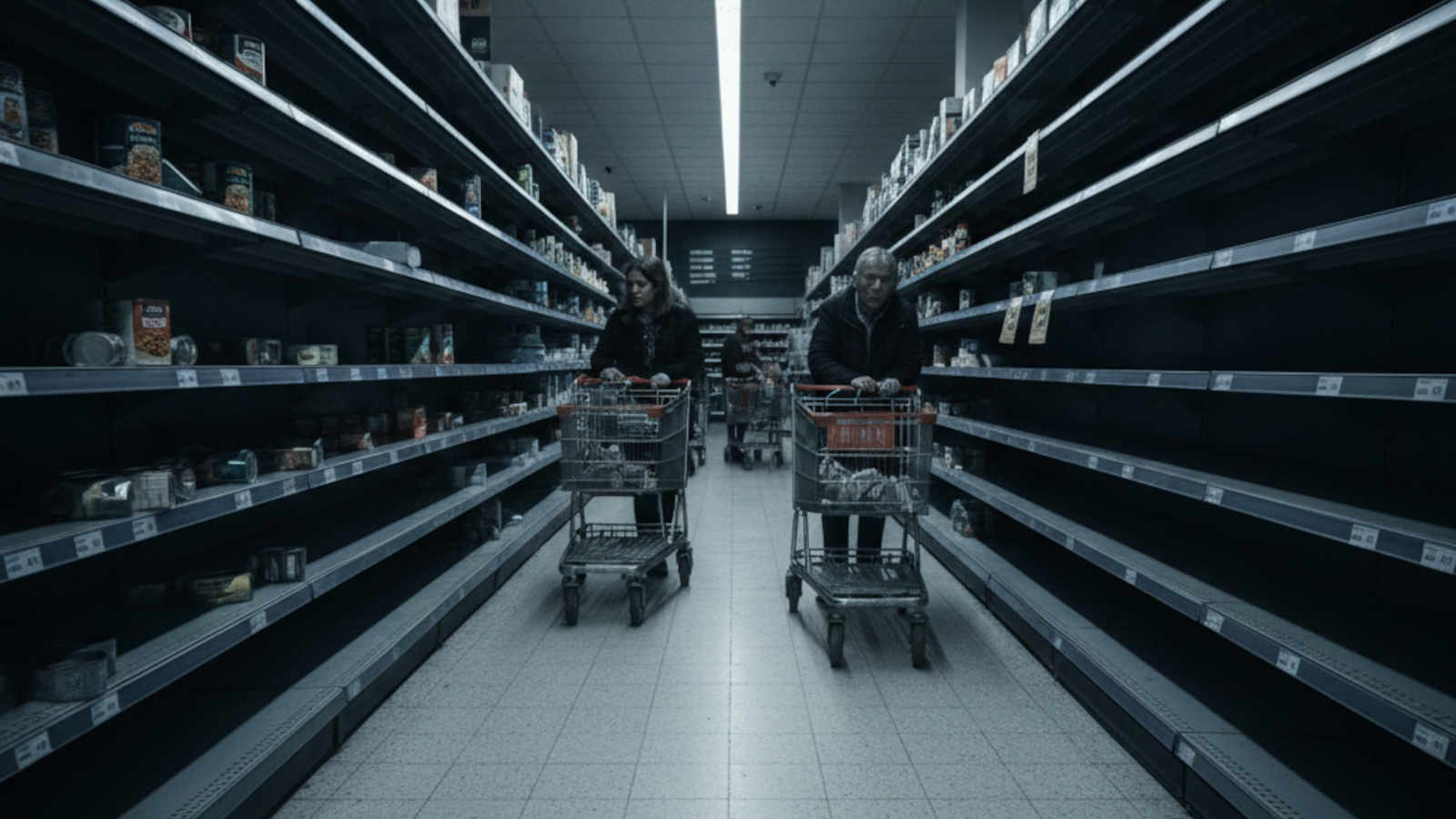
UK supermarkets often appear well-stocked, but appearances can be deceiving. Many major chains operate on “just-in-time” delivery systems, keeping only a few days’ worth of stock on site. While efficient under normal conditions, this system leaves very little room for disruption.
⚠ Just-In-Time Delivery: Efficient but Vulnerable
Just-in-time delivery reduces storage costs and keeps products fresh. However, even minor disruptions — road closures, fuel shortages, severe weather, or staffing problems — can quickly empty shelves.
During the COVID-19 pandemic, this vulnerability became clear. Overnight, panic buying caused shortages of:
- Toilet rolls
- Flour
- Yeast
- Milk
- Bread
- Pasta and other staple foods
Many households went days without essential items, showing just how fragile the system can be.
💻 Cyber Attacks Expose Another Weakness
Supply chains aren’t just disrupted by weather or pandemics. Cyber attacks on supermarket systems have become a real concern.
In 2025, both Co-op and Marks & Spencer (M&S) suffered cyber incidents that disabled their card payment systems. During these attacks:
- Both supermarkets displayed “cash only” signs on their doors
- Customers who normally rely on cards or contactless payment were unable to shop
- Essential items became harder to obtain, particularly for households without cash on hand
Sources:
This demonstrates that supply chain vulnerability isn’t limited to physical logistics — even digital failures can immediately affect access to essential goods.
🏡 Practical Household Preparedness
Households can take simple, realistic steps to reduce the impact of such disruptions:
- Maintain a small reserve of non-perishable food and water (3–7 days’ worth)
- Stock essential hygiene items like toilet rolls, soap, and sanitary products
- Keep a small amount of cash on hand, as card systems can fail unexpectedly
- Consider easy-to-store baking ingredients such as flour and yeast
- Be aware that just-in-time supply systems can be disrupted by both physical and digital events
Even modest preparation ensures that you’re not left scrambling when shelves are temporarily emptied.
🌨 Lessons From Disruptions
- Pandemic shortages demonstrated how quickly essentials can vanish
- Severe weather delays deliveries and blocks supply routes
- Cyber attacks show that modern supermarkets can become inaccessible overnight
Preparedness is about reducing stress, maintaining comfort, and ensuring your household can cope when events disrupt normal supply.
The “Just-in-Time” Trap Explained
To understand why shelves empty so quickly, you have to realise that modern UK supermarkets are no longer “warehouses”—they are simply the final destination on a constantly moving conveyor belt.
Under the Just-in-Time (JIT) model, retailers keep minimal stock on-site to reduce overheads and ensure maximum freshness. Instead of having weeks of tins in the backroom, they rely on a seamless, hourly flow of HGVs arriving at the loading bay.
If that “conveyor belt” stops for just 24 hours—due to a strike, a motorway closure, or a digital glitch—the system begins to collapse. By 48 hours, the visible gaps appear. By 72 hours, the supermarket is effectively out of business. This efficiency is a miracle of modern logistics, but for a household, it is a high-risk trap. For more on how local weather can snap this thin thread, see our guide on being Snowed In & Cut Off.
3 Immediate Triggers for UK Shelf Shortages
Supply chain failure rarely happens because the world runs out of food; it happens because the food cannot get to you. In the UK, there are three primary “choke points” that can cause empty shelves almost overnight:
1. Ferry and Port Delays
The UK imports approximately 30% of its food from the EU. The Port of Dover and the Eurotunnel act as a massive “bottleneck” for our food security. Any disruption here—whether through industrial action, post-Brexit regulatory friction, or extreme weather in the Channel—immediately halts the arrival of fresh produce, citrus, and meat.
2. HGV Driver Shortages
A shortage of just 5,000 to 10,000 drivers is enough to create regional “blackouts” of specific goods. If there aren’t enough drivers to move trailers from the distribution hubs (like Daventry or Magna Park) to your local town, it doesn’t matter how much food is in the country; it won’t be on your plate.
3. Panic Buying Psychology
Modern “stockouts” are often a demand problem rather than a supply problem. When the media reports a minor delay, the public reacts by purchasing two weeks’ worth of goods instead of one. Our JIT system cannot handle a 300% surge in demand over a single weekend. This “Social Contagion” turns a small ripple into a total wipeout of essential staples like bread, milk, and eggs.
Cyber Vulnerabilities
As we have seen with recent incidents at M&S and Co-op, it isn’t just physical trucks that keep the shelves full. Digital systems manage everything from inventory tracking to the final checkout. When these networks are hit, the “digital supply chain” snaps. You can read our full analysis of this in When Payment Systems Fail.
Frequently Asked Questions
Question: What is just-in-time delivery in UK supermarkets?
Answer: Just-in-time (JIT) is a logistics system where supermarkets keep minimal stock on-site, relying on frequent daily deliveries to replenish shelves. While cost-effective, it means any disruption to transport or digital systems can lead to empty shelves within 48-72 hours.
Question: How long would food last in UK shops if deliveries stopped?
Answer: Most major UK supermarkets carry only 2 to 4 days of fresh stock. In a total delivery halt, fresh produce, bread, and milk would vanish in 24 hours, followed by dry goods within 3 to 5 days due to panic buying.
Question: Why are UK supply chains so fragile?
Answer: Fragility stems from a reliance on the JIT system, a shortage of HGV drivers, heavy dependence on cross-channel ports like Dover, and the increasing risk of cyber attacks on digital payment and logistics networks.
Question: How much food should I store for a supply chain disruption?
Answer: For most UK households, a 2-week supply of non-perishable food is a realistic and effective buffer against temporary supply chain shocks caused by weather, strikes, or IT failures.
📡 Find Us Everywhere
Daily briefings, prep guides, and real-time updates across every platform. Pick yours.
Free. No commitment. Stay anonymous on WhatsApp & Telegram.
Stay Informed on UK Preparedness
Join our newsletter for UK-specific preparedness tips, product recommendations, and real-world advice for households.
Subscribe to Our Newsletter