
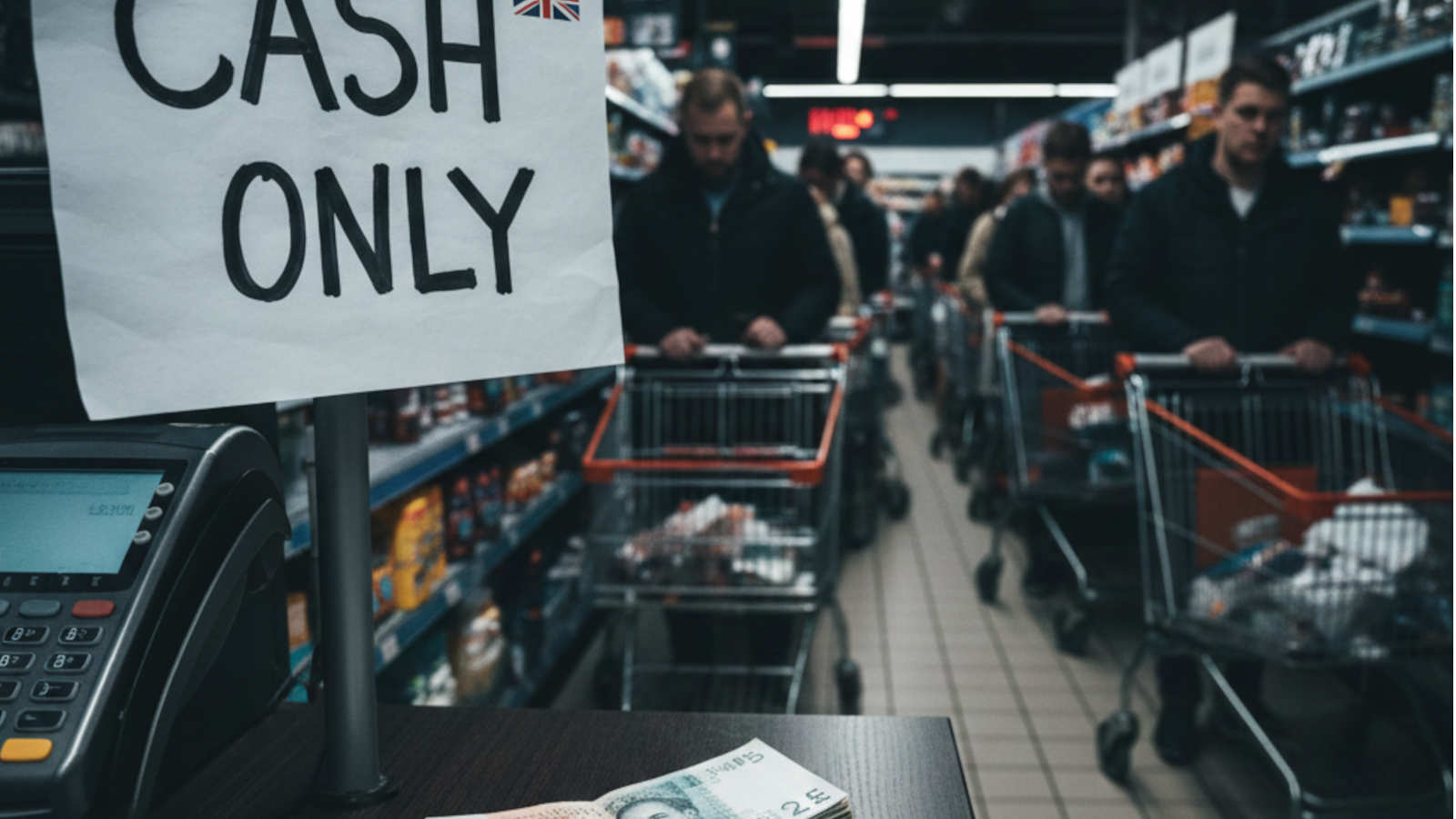
Most UK households today rarely carry cash. Contactless cards, mobile payments, and digital banking dominate daily transactions. While convenient, this cashless reliance introduces a hidden vulnerability: when payment systems fail, buying essentials becomes difficult or impossible.
⚠ Lessons from Recent Supermarket Cyber Attacks
In 2025, both Co-op and Marks & Spencer (M&S) experienced cyber attacks that disabled their card payment systems. During these incidents:
- Stores displayed “cash only” signs on their doors
- Customers without cash were unable to purchase essential items
- Panic and confusion spread among shoppers reliant on digital payments
These events highlighted a critical point: even modern, well-run stores are vulnerable to digital disruption. Sources:
🏦 The Risk of a Fully Cashless Society
A cashless society is convenient, but it leaves households exposed during:
- Cyber attacks affecting payment networks
- Power or internet outages
- Technical faults at banks, card processors, or retailers
Even short disruptions can make buying food, medicine, or fuel difficult, particularly for vulnerable groups like the elderly or those who rely on physical cash.
Why Retailers Struggle During Card Machine Failures
When card payment systems go down, it isn’t just a minor inconvenience for a shop; it’s a total operational breakdown. Most modern UK retailers, from local Co-ops to massive Tesco hubs, rely on a constant internet connection to authorise transactions.
When this digital link is severed—whether by a cyber attack, a local fibre-optic cut, or a banking glitch—the following “domino effect” occurs:
- Offline “Floor Limits”: In the past, shops could take “offline” payments up to a certain amount. Today, many modern till systems are programmed to block any transaction that can’t be verified in real-time to prevent fraud.
- Staff Training Gaps: Many younger retail workers have never been trained to use manual “zip-zap” credit card imprinters (which are now virtually extinct) or even how to manage a purely cash-based float for an entire shift.
- The Change Shortage: Shops typically only keep enough coins and small notes to provide change for a “normal” day. If every customer suddenly pays with a £20 note, the till runs out of £5 notes and £1 coins within the first hour, forcing the store to close its doors entirely.
Legal Tender vs. The Right to Refuse Cash
There is a common myth in the UK that a shop “must” take your money because it is “Legal Tender.” This is a misunderstanding of English law that can lead to unnecessary frustration at the checkout.
The Reality of Legal Tender In the UK, “Legal Tender” has a very narrow technical meaning. It only means that if you owe someone a debt, they cannot sue you for non-payment if you offer to pay them in legal tender. It does not mean that a shopkeeper has to accept it for a new transaction.
The Right to Refuse A retailer or service provider is entitled to choose which payment methods they accept. If a supermarket puts up a sign saying “Cards Only” or “Exact Change Only,” they are legally allowed to do so. This is why having a “Plan B” is essential—you cannot rely on the law to force a shop to take your cash during a digital outage.
Recommended Emergency Cash Denominations
If payment systems fail, you don’t want to be the person handing over a £50 note for a loaf of bread. To be truly resilient, your emergency cash “stash” should be broken down into small, usable denominations that don’t rely on the shop having change.
- £5 and £10 Notes: These are your most valuable assets. Most “Cash Only” scenarios in shops fail because the retailer runs out of change. Being able to pay with exact or near-exact amounts ensures you can complete your purchase.
- £1 and £2 Coins: Essential for vending machines, car parks, and small “honesty box” purchases. Coins are also vital if you need to use older public payphones or coin-operated services.
- Avoid £20 and £50 Notes: While easier to store, these are often refused by small shops during a crisis because they cannot verify them or provide change. Keep these only as a secondary reserve.
| Incident Type | Impact on Payments | Survival Strategy |
| Local IT Outage | Card machines fail in one shop | Use cash or go to another retailer |
| Bank Network Failure | All cards from one bank fail | Have a backup account with a different bank |
| Power Cut | ATMs and card readers go dark | Physical cash at home is the only option |
| Cyber Attack | Nationwide payment disruption | 7 days of cash and stored supplies |
💡 How to Prepare
Being prepared for payment disruptions doesn’t require panic or hoarding. Practical steps include:
- Keep a small amount of cash at home for emergencies — enough to cover a few days of essentials.
- Know nearby alternative stores or services that may still accept cash.
- Have backup payment options such as prepaid cards or mobile wallets that can work offline.
- Include cash in your household emergency plan, alongside food, water, and medical supplies.
These small steps ensure that you can still access essentials when digital systems fail, reducing stress and inconvenience.
Frequently Asked Questions
Question: Can UK shops refuse to take cash?
Answer: Yes. In the UK, businesses are generally free to accept or refuse any form of payment, including cash, provided they do not discriminate against protected groups. There is no law forcing a retailer to accept physical money.
Question: How much emergency cash should I keep at home?
Answer: A sensible baseline for UK households is enough to cover 3 to 7 days of essential purchases, such as food, fuel, and medicine. This should be kept in small denominations (£5 and £10 notes) for ease of use.
Question: What happens if card machines go down in a supermarket?
Answer: Most retailers will switch to ‘Cash Only’ operations. If you do not have physical money, you will be unable to complete your purchase, often leading to long queues and abandoned trolleys.
Question: Is cash still legal tender in the UK?
Answer: “es, Bank of England notes are legal tender, but ‘legal tender’ has a very narrow technical meaning regarding the settlement of debts. It does not mean a shop must accept cash for a transaction.
🌍 Wider Context
Cashless vulnerabilities aren’t unique to supermarkets. Banks, ATMs, and even public transport can be affected by cyber attacks, technical faults, or power outages. By planning ahead, households can maintain resilience and self-sufficiency even when the digital world falters.
📡 Find Us Everywhere
Daily briefings, prep guides, and real-time updates across every platform. Pick yours.
Free. No commitment. Stay anonymous on WhatsApp & Telegram.
Stay Informed on UK Preparedness
Join our newsletter for UK-specific preparedness tips, product recommendations, and real-world advice for households.
Subscribe to Our Newsletter