
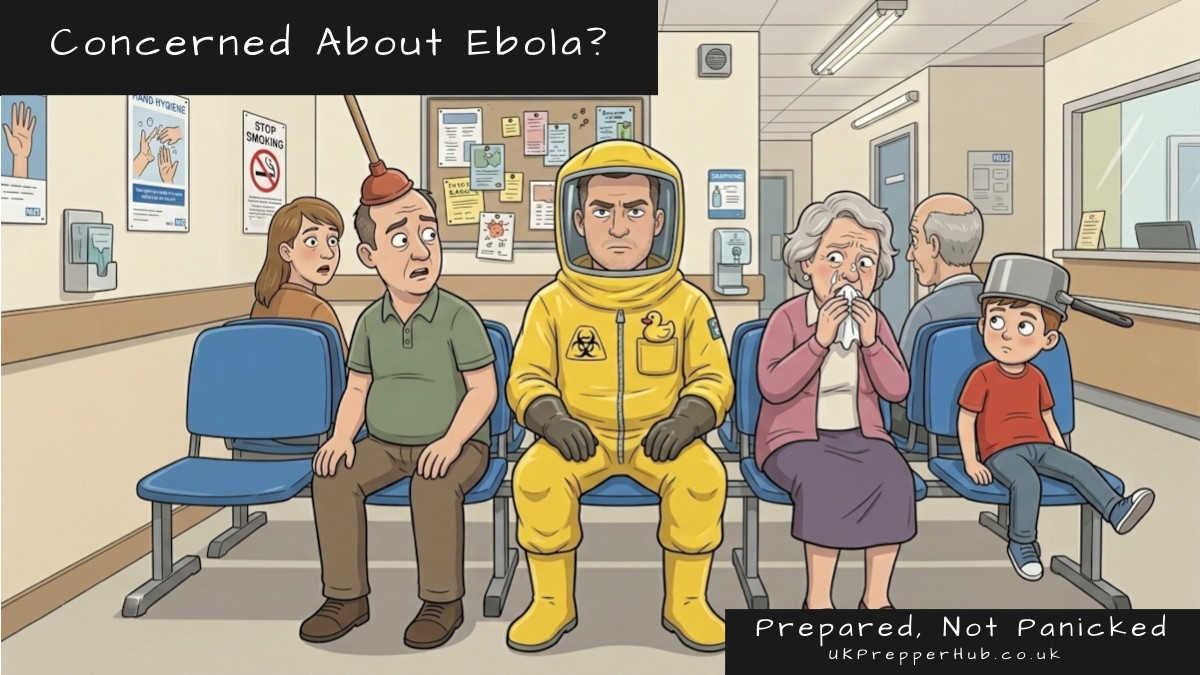
Ebola is in the news again. Outbreaks in central Africa generate significant media coverage — the name alone carries weight, and the images from previous large outbreaks are remembered. UK searches for “Ebola UK risk” spike every time an outbreak is declared. The question this special report answers is a simple one: should a UK household be concerned?
The short answer is: not in the way the headlines suggest. The longer answer explains why that is, what the genuine risk picture looks like, and what would need to change before Ebola became a realistic household concern in the UK. Understanding that distinction is more useful than either panic or dismissal.
How Ebola Actually Spreads — and Why That Matters
Ebola is a haemorrhagic fever caused by the Ebola virus. Its fatality rate in outbreaks has ranged from 25% to 90% depending on the strain and the healthcare context. It is, when it spreads, extremely serious.
What it is not is airborne. Ebola spreads through direct contact with the bodily fluids of a symptomatic person — blood, sweat, vomit, other secretions. It does not spread through air, water, food, or casual contact with someone who shows no symptoms. A person is not infectious during the incubation period (2 to 21 days after exposure). This transmission profile is why Ebola outbreaks, despite their severity, do not become global pandemics in the way that respiratory viruses do.
This is the crucial fact that headlines frequently obscure. A disease with a 60% fatality rate that spreads only through direct contact with bodily fluids of symptomatic patients is, paradoxically, less of a pandemic risk than influenza. It is catastrophic in healthcare and community settings where those exposures occur. It is not transmissible in a supermarket, on public transport, or in most normal UK daily life settings.
The UK Risk Picture
The UK has robust infectious disease surveillance and response infrastructure. The UK Health Security Agency (UKHSA) monitors high-consequence infectious diseases (HCIDs) — a category that includes Ebola — through a network of designated specialist centres and NHS protocols. When a case is identified, the response is co-ordinated, fast, and well-resourced.
Imported cases of Ebola in the UK have occurred. They are extremely rare. In each case, the infectious disease protocols prevented onward spread. Healthcare workers treating confirmed cases wear full personal protective equipment in specialist HCID units. Contact tracing is initiated immediately. The system works because the transmission route — direct bodily fluid contact — is something that can be practically controlled with appropriate measures.
For a UK household with no recent travel to an active outbreak region, the probability of encountering Ebola is, for practical purposes, negligible.
When to Pay Attention — and When Not To
The practical framework for reading Ebola news:
- An outbreak declared in a central African country: Monitor but do not panic. This is the normal pattern of Ebola’s endemic presence in the region. UKHSA will update UK risk assessments. Travel advice for the affected region will be updated.
- An imported case confirmed in the UK: UKHSA will issue a public statement. If you have had no contact with the confirmed case, your risk is not elevated. Follow UKHSA guidance.
- Evidence of sustained community transmission in a high-travel-connectivity city: This would be the scenario that warrants more active attention. It has not occurred.
- Change in transmission profile (airborne spread): This would be a categorically different situation. It has not occurred and is not anticipated by virologists studying the virus.
The honest assessment: Ebola in the news is a tragedy for affected communities and a serious public health challenge for the countries experiencing outbreaks. For UK households without travel exposure to active outbreak regions, it does not warrant significant household preparedness changes beyond the general measures that apply to any serious infectious disease: good hygiene, awareness of NHS and UKHSA guidance, and knowing the symptoms that warrant urgent medical attention.
Symptoms and When to Seek Help
If you have recently returned from an area with an active Ebola outbreak, or have had direct contact with a confirmed or suspected case, and develop the following symptoms:
- Sudden high fever
- Severe headache
- Muscle pain and weakness
- Vomiting, diarrhoea, stomach pain
- Unexplained bleeding or bruising
Do not go to A&E or a GP surgery. Call 999 and explain your travel history and symptoms. NHS 111 is also appropriate if symptoms are not immediately severe. This allows the appropriate response to be co-ordinated before you arrive anywhere.
The Broader Lesson
Ebola is an example of a category of threat that generates disproportionate public anxiety relative to the actual UK risk. The name is frightening. The fatality rate is frightening. The images from outbreaks are frightening. And none of that changes the transmission biology.
A useful habit when evaluating any infectious disease news: look first at how it spreads. Airborne respiratory transmission is what enables pandemic spread. Direct bodily fluid contact is what limits it, even in severe diseases. That single piece of information shifts the risk picture significantly.
Build Your Resilience
Further Reading: Related Guides
All our guides can be found listed on our resilience hub.
Gear We’ve Tested & Reviewed
All our reviews can be found on our reviews and resources page.
📡 Find Us Everywhere
Daily briefings, prep guides, and real-time updates across every platform. Pick yours.
Free. No commitment. Stay anonymous on WhatsApp & Telegram.
Stay Informed on UK Preparedness
Join our newsletter for UK-specific preparedness tips, product recommendations, and real-world advice for households.
Subscribe to Our Newsletter