
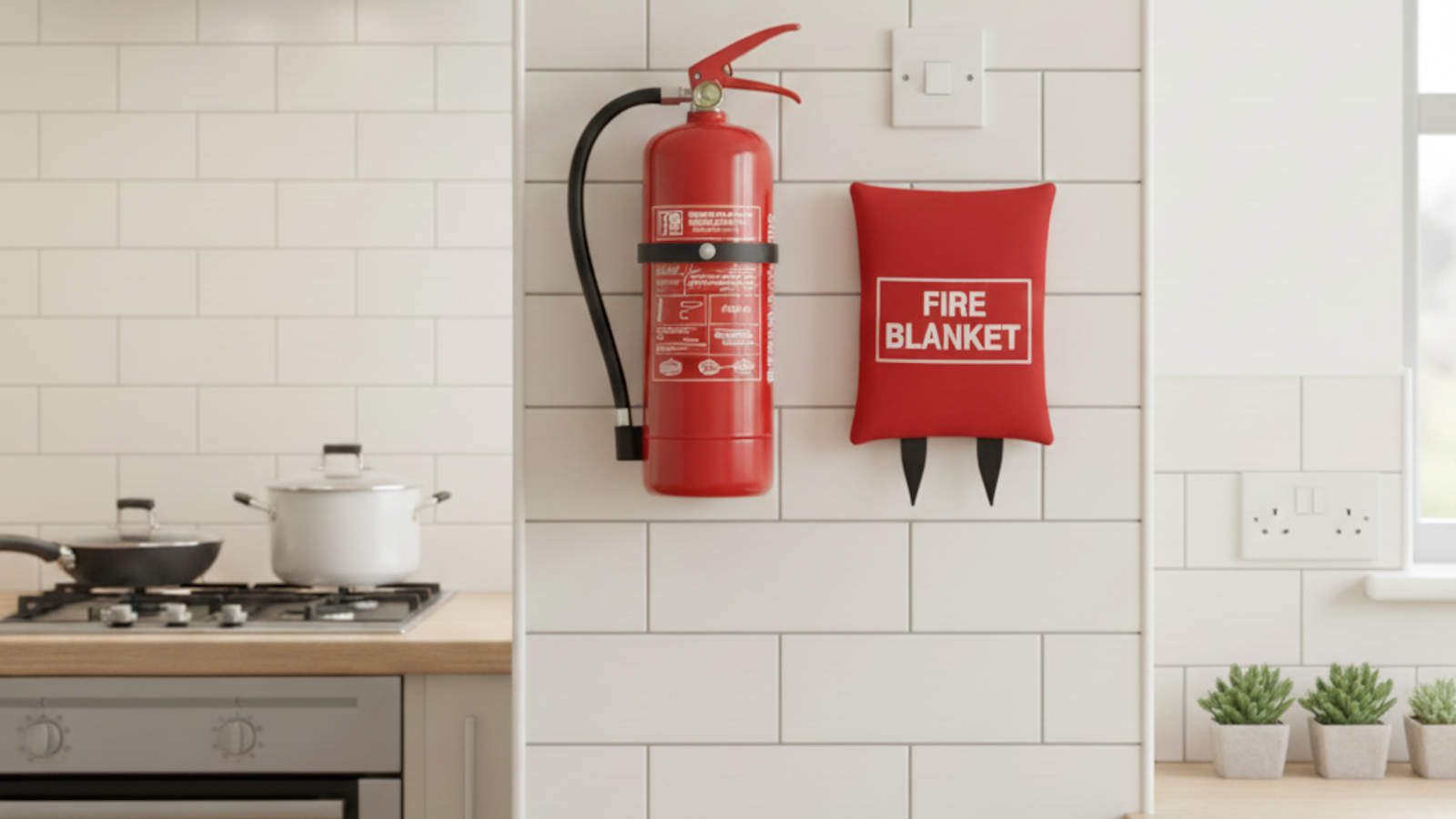
A fire extinguisher mounted on the wall looks reassuring. It becomes considerably less reassuring when you discover it’s in the wrong room, set at the wrong height, or — and this one stings — not rated for the type of fire you’re actually trying to put out. Fire extinguisher placement matters. So does knowing what you’ve actually bought.
This guide covers both: which equipment belongs where, and why having one without the other leaves a gap most people don’t notice until it’s too late.
Do you actually need both?
Yes — and the reason comes down to fire classification. A standard ABC dry powder extinguisher handles Class A fires (wood, paper, fabric), Class B (flammable liquids like petrol and spirits) and Class C (gas). It does not cover Class F: burning cooking oil or fat. That’s the chip pan. That’s the most common cause of house fires in the UK.
A fire blanket smothers a burning pan of oil by cutting off the oxygen. It’s the correct tool for a kitchen oil fire — not the extinguisher. The two work together, not instead of each other. If you’re only buying one, buy the combo.
FireShield Home Fire Safety Pack
A 600g aerosol extinguisher and a 1m fire blanket on one wall mount — the two tools that cover almost every domestic fire scenario, for under £25.
Our Full Review: FireShield Home Fire Safety Pack →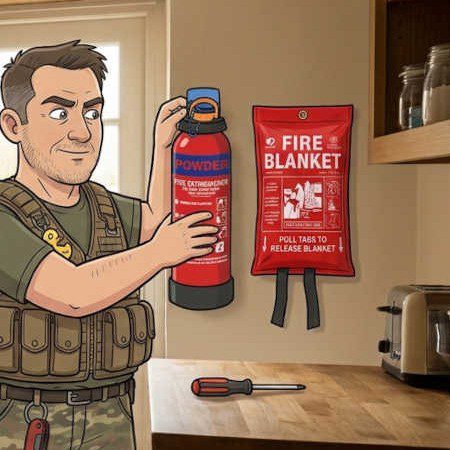
Which type of extinguisher for home use?
For most UK homes, an ABC dry powder extinguisher is the practical all-rounder. It covers the most likely fire scenarios outside the kitchen: electrical faults, flammable liquids in a garage or workshop, and general combustibles. A 500g–1kg unit is compact enough to mount anywhere and light enough for anyone to use.
CO2 extinguishers are better for electrical fires and leave no residue — popular with people who’ve just looked at the price of a new TV. The catch: they’re not rated for Class F fires either, and they’re heavier and more expensive for a smaller discharge. For a single household extinguisher, ABC dry powder is the sensible choice.
Wet chemical extinguishers are the professional kitchen option — designed specifically for Class F fires. For a domestic kitchen, a fire blanket does the same job at a fraction of the cost.
🐔 Chicken Licken
Did You Know?
ABC dry powder extinguishers are not rated for chip pan oil fires — the correct tool for a burning pan is a fire blanket, not an extinguisher. I’ve been saying this for years.
Fire Extinguisher Placement: Room by Room
The rule of thumb is near the exit of the room, not beside the hazard. If the hob catches fire, you need to reach the extinguisher without crossing the flames to get to it. Mount it at shoulder or waist height on a proper wall bracket — not shoved under the sink.
- Kitchen — by the door, not next to the hob. The fire blanket lives here too (see below).
- Garage or workshop — near flammable liquids, power tools, or the car. A second unit here is worthwhile if you spend time in there.
- Utility room or boiler room — where heating equipment and white goods live.
- Multi-storey homes — one per floor is the recommendation, not one for the whole house. A fire on the ground floor shouldn’t mean climbing through it to reach the only extinguisher.
Check the pressure gauge monthly — the needle should be in the green. Check the safety pin and hose at the same time. Most dry powder extinguishers have a 5-year service interval and a 10-year replacement life; check your manufacturer guidance.
🦆 Keith
Don’t Be Keith
Keith bought a CO2 extinguisher because it looked more professional and “doesn’t leave powder everywhere”, then discovered it’s not rated for chip pan fires and he doesn’t have a fire blanket. He does have a laminated copy of the PASS method on his fridge, which is technically progress.
Where to place your fire blanket
The kitchen. Full stop. Mounted on the wall beside the door — not in a drawer, not in the cupboard under the sink, not in the utility room. You need it within arm’s reach of the cooker, accessible in under three seconds, not behind a door you might not be able to open if the fire is already between you and it.
The standard mounting position is on the wall to the side of the hob, at a comfortable grab height. The release tabs should hang down visibly — not tucked away so you have to hunt for them while something is on fire.
If you have a log burner or open fire, a second blanket nearby is worth considering. They’re inexpensive and compact.
How to use them
Fire extinguisher — the PASS method:
- Pull the safety pin
- Aim at the base of the fire, not the flames
- Squeeze the handle
- Sweep from side to side
Stand back. Keep a clear escape route behind you — never let the fire get between you and the door. If the fire doesn’t go out within a few seconds of discharge, get out and call 999.
Fire blanket — chip pan or hob fire: Turn off the heat if you can do so safely. Hold the blanket by the corner tabs to shield your hands, then lay it gently over the pan — don’t throw it. Leave it in place until the pan has completely cooled (at least 30 minutes). Lifting it early reintroduces oxygen and the fire reignites.
Fire blanket — clothing fire: Wrap around the person, guide them to the floor.
Prepper note: when you add kit, add risk
Emergency preparedness often means bringing things into the home that increase fire risk: gas camp stoves, portable heaters, candles, extra fuel storage. If your setup includes any of these, your fire safety kit needs to keep pace. One extinguisher and one blanket is the minimum — not the ceiling.
📡 Find Us Everywhere
Daily briefings, prep guides, and real-time updates across every platform. Pick yours.
Free. No commitment. Stay anonymous on WhatsApp & Telegram.
Frequently Asked Questions
Do I need a fire extinguisher on every floor?
Recommended, yes. Fire can spread quickly and you may not be able to reach a single extinguisher on another floor. One per floor is the sensible approach for a multi-storey home.
Can I use an ABC dry powder extinguisher on a chip pan fire?
No. ABC dry powder is not rated for Class F fires (burning cooking oil or fat). The correct tool for a chip pan fire is a fire blanket. This is why having both matters.
Where exactly should a fire blanket hang in the kitchen?
On the wall beside the hob, at a comfortable grab height. Not in a drawer, not behind a door. You need it within arm’s reach in under three seconds.
How often should I check my fire extinguisher?
A quick visual check monthly — pressure gauge in the green, safety pin intact, hose undamaged. Full service every 5 years, full replacement at 10 years (check your manufacturer’s guidance).
How long should I leave a fire blanket on a pan after putting the fire out?
At least 30 minutes until the pan is completely cold. Lifting it early reintroduces oxygen and the fire can reignite.
Build Your Resilience
Further Reading: Related Guides
All our guides can be found listed on our resilience hub.
Gear We’ve Tested & Reviewed
All our reviews can be found on our reviews and resources page.
Stay Informed on UK Preparedness
Join our newsletter for UK-specific preparedness tips, product recommendations, and real-world advice for households.
Subscribe to Our Newsletter