
The police knock at 2am. Your street is flooding. You have minutes to leave.
Most people in that situation do not freeze because they are scared. They freeze because they are suddenly trying to make fifteen decisions simultaneously — where are we going, how are we getting there, what do we need, who do we tell, what about the dog — for the very first time, under pressure, in the dark, in their pyjamas.
This guide does not ask you to run a drill. It asks you to make those decisions now, once, calmly, while nothing is happening. That is the functional equivalent of a drill — without standing in the garden at 11pm with a stopwatch.
The Honest Truth About “Evacuation Drills”
Most preparedness guides will tell you to run a formal home evacuation drill. And technically, they are not wrong. Timed drills work well in offices, schools, and venues because there are trained fire marshals, designated assembly points, and a legal obligation to practise.
In a two-bedroom flat in Coventry, the drill is usually: nobody does it.

🦆 Keith
Don’t Be Keith
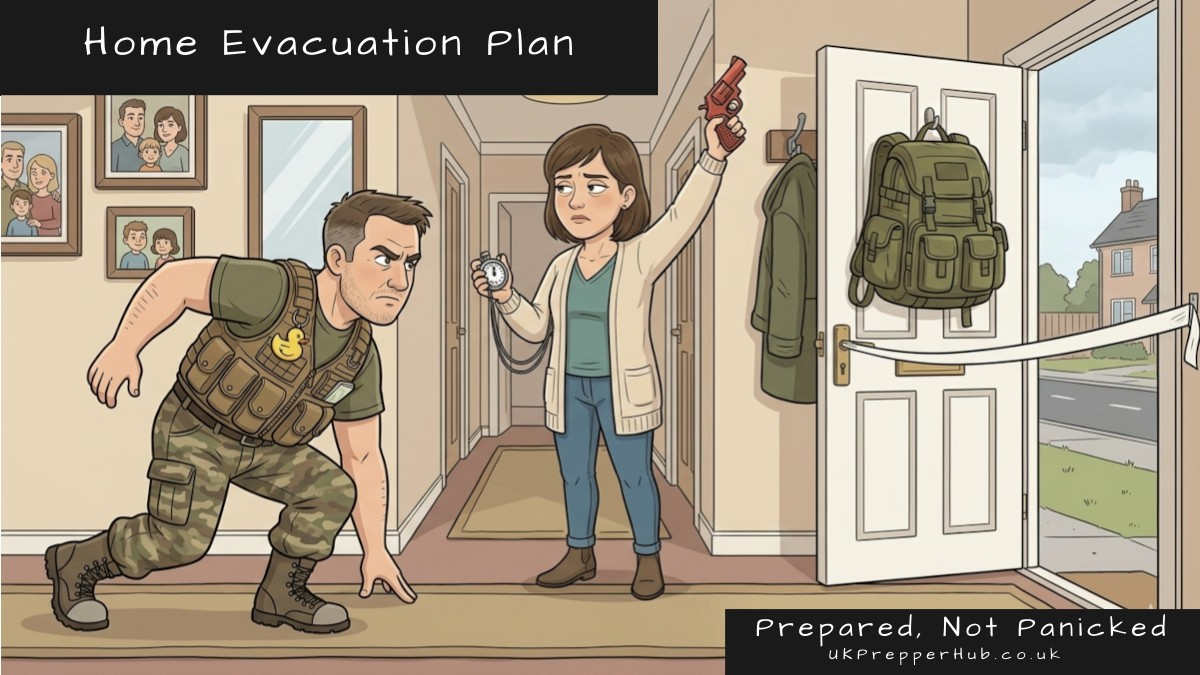
Keith spent three weeks designing a colour-coded evacuation procedure with laminated role cards for each household member. His wife has never read hers. He times himself to the car. His personal best is 4 minutes 37 seconds.
She was still looking for her phone charger at 6 minutes 12 seconds. He has this on a spreadsheet.
The honest version of an evacuation drill is sitting down for ten minutes and thinking through the five decisions below. Write the answers somewhere. Tell the people you live with. That is it.
Decision 1: Do I Actually Need to Leave?
Before anything else: leaving is not always the right call. In most UK emergencies — power cuts, severe weather, supply disruption — staying home is safer, more comfortable, and more sensible than heading out.
The situations that genuinely require leaving are specific: flooding that threatens your property, a structural risk to the building, a gas leak or chemical incident requiring you to vacate the area, or a formal evacuation instruction from police or local authority.
If you have not thought through the “stay or go” question in advance, you will make it badly under stress. Our Bug-In vs Bug-Out guide covers exactly this decision for UK households — the realistic scenarios, the default answer (stay home), and the specific exceptions that genuinely warrant leaving.
Complete Guide
Bug-In vs Bug-Out
The debate between “bugging out” (leaving your home during a crisis) and “bugging in” (sheltering in place) is one of the most discussed topics in preparedness circles.
Read the Full Guide: Bug-In vs Bug-Out →
Decision 2: Where Are You Going?
This is the decision most households have never made, and it is the one that causes the most paralysis when it matters.
You need a pre-arranged answer before anything happens. Not a vague “we’ll figure it out” — an actual destination.
Option 1 — Friends or Family
This is almost always the better choice if it is available. You know the address. They know you are coming. There is a spare bedroom, a kettle, and someone who is pleased to see you. If you have friends or family within reasonable distance who would take you in during an emergency, speak to them now and confirm it. It costs nothing and removes an entire layer of stress.
The one caveat: if the emergency affects a wide area — a regional flood, a severe storm — your preferred contact may be in the same affected zone. Have a second option.
Option 2 — A Council Rest Centre
If friends and family are not available or not accessible, your local council will open an emergency rest centre. This is what the news calls an emergency shelter — a leisure centre, school hall, or community building that councils pre-designate for exactly this purpose.

🐔 Chicken Licken
Did You Know?
The official term is “Rest Centre” — Chicken Licken has been pointing this out for years. It is a sports hall. With camp beds. And forty strangers. And a queue for the single toilet. The council calls it a Rest Centre. We call it what it is: an Emergency Shelter. Chicken Licken is not wrong. He is just less surprised than everyone else when it is not particularly restful.
Rest centres are free, open to anyone, and require no booking. They provide warmth, water, basic food, and somewhere to sleep. They are not comfortable — but they are safe, and they are there.
How to find yours: Your local council website will publish the active rest centre location during an emergency — it is not usually pre-listed during normal times, but it appears quickly when needed. Save your council’s emergency planning page in your phone now. The GOV.UK council finder will get you there in seconds.
Our 72-Hour Grab Bag guide covers what rest centres actually provide — and crucially what they do not — in detail.
Complete Guide
72-Hour UK Grab Bag
The ‘get out quick bag’ for rapid home evacuation in the event of fire, flood, or other incidents. Every essential for 3 days away from home in one bag.
Decision 3: How Are You Getting There?
By car is the most common answer, but it comes with assumptions worth checking. Does everyone in the household know the route? Is there enough fuel? In a flood evacuation, some roads will be impassable — do you know an alternative?
On foot or by bike may be necessary if roads are blocked, a vehicle is unavailable, or the distance is short. If you have a bike, know the route. If you do not, know how long the walk takes.
Someone collecting you — if you rely on a family member or friend to collect you in an emergency, have that conversation explicitly now. “Would you come for me if I had to leave in a hurry?” is a reasonable thing to ask someone you trust. Get a yes or a no. Do not assume.
If fuel runs low or roads become impassable, a folding bike is one of the most practical ways to cover short distances during a local emergency. Our Two-Wheeled Contingency guide covers exactly this scenario.
Complete Guide
The Two Wheeled Contingency
This guide makes the case for adding a bike to your resilience planning, covers what to look for if you’re buying one specifically for this purpose, and explains how to set up a bike you already own for emergency use.
Read the Full Guide: The Two Wheeled Contingency →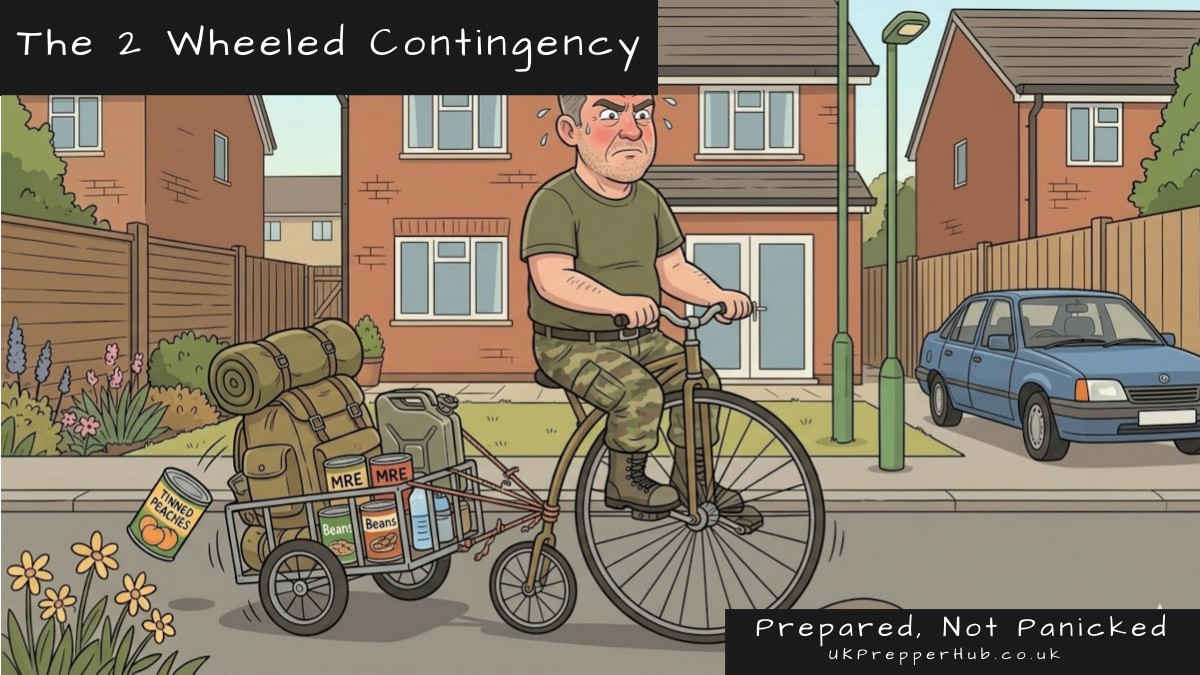
Decision 4: Who Needs to Know?
A simple communications plan prevents the second crisis that happens alongside the first one — the relatives who cannot get hold of you and assume the worst.
Decide now:
- Who do you contact first when you have to leave? (One person — usually the person you are most likely to go to, or a family member who will relay to others)
- How do you contact them? Phone call first, text if no answer. Have their number saved and also written down — phones die, get lost, or break.
- Where do you tell people you are going? Even a text saying “flooding, heading to [name]’s, all fine” stops three hours of panic for everyone else.
- What if you cannot make contact? Agree a fallback — “if you cannot reach me, I will be at [rest centre location or address], check in at [time].”
That is the entire plan. Write it on a piece of paper and keep it in your grab bag alongside your other documents. One piece of paper, four bullet points.
Decision 5: Is Your Bag Ready?
This is where the planning either holds together or falls apart.
If you have to leave in minutes, you cannot pack from scratch. You cannot think clearly about what you need while simultaneously getting dressed, locating the children, and listening to what the officer on your doorstep is telling you. The bag needs to already exist.
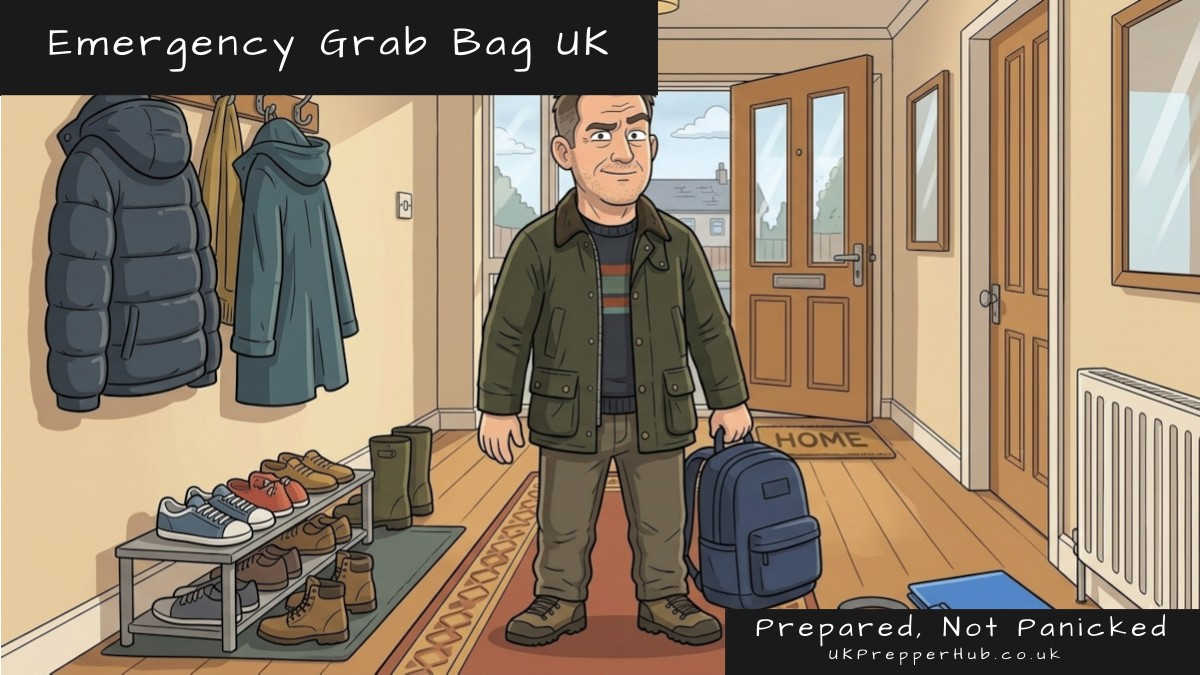
A pre-packed grab bag removes the entire “what do I take?” problem from the evacuation equation. Documents, medication, cash, a change of clothes, a phone charger, a torch — already in a bag, by the door, ready to pick up and go.
This is why a grab bag is not a prepper affectation. It is the practical solution to the single biggest cause of bad evacuations: trying to think under pressure about things you could have thought about in advance.
📋 Calm Clarissa
I’ve written the whole bag out as a printable grab bag checklist, one tick box per item, so it’s packed long before anyone knocks on the door. Free to download, obviously.
Download the Free Checklist →Complete Guide
72-Hour UK Grab Bag
The ‘get out quick bag’ for rapid home evacuation in the event of fire, flood, or other incidents. Every essential for 3 days away from home in one bag.
Pets and Dependants
Pets
Rest centres vary on their pet policies — some accept animals in a separate area, others cannot. If you have pets, your evacuation plan needs to account for them before you need to use it.
Know in advance: does your chosen destination accept your pet? If heading to a rest centre, call ahead if you can, or check your council’s emergency planning page for their policy. Have your pet’s vaccination records and microchip documentation in your grab bag — some facilities require proof of current vaccinations.

🐾 Weekend Warrior
Pet Tip
Pickle has a pre-packed emergency bag. It contains her food, her lead, her vaccination records, her microchip registration, a folding water bowl, and one tactical tennis ball. Pickle has confirmed that the tennis ball is non-negotiable. I have also confirmed which local rest centres accept dogs. Pickle considers this the bare minimum level of planning.
Dependants and Carers
If you care for someone — an elderly relative, a disabled family member, a child — your evacuation plan is more complex than a single household’s. The person you care for may need additional time to prepare, additional equipment, or support from services you need to notify.
Our Emergency Carer Backup Plan guide covers this specifically — what to plan for, who to notify, and how to ensure continuity of care during a household emergency.
Complete Guide
Emergency Backup Plan for Carers
If you’re caring for someone with additional needs—whether that’s an autistic child, a partner with severe anxiety, an adult with learning disabilities, or someone recovering from a stroke—you already know that routine is everything. You need a plan.
Read the Full Guide: Emergency Backup Plan for Carers →
The One Thing to Do Today
You do not need to do all of this at once. But if you do one thing today:
Decide where you are going if you ever have to leave in a hurry. One destination. One phone number. Write it down.
Everything else in this guide builds on that single decision. The bag, the route, the communications plan — all of it only works if you know where you are heading. That is the decision most households have never made. Make it now, while it is easy, and it will not need to be made at 2am when it is not.
Frequently Asked Questions
What is the difference between a rest centre and an emergency shelter?
Nothing — they are the same thing. “Rest Centre” is the official local authority term. “Emergency shelter” is what the news calls it, and what most people understand. It is a pre-designated building — usually a leisure centre, school hall, or community venue — opened by the council to provide temporary shelter during a local emergency. It is free to use and requires no booking.
What if I do not have a car?
Plan your route on foot or by public transport in advance. Most rest centres are within walking distance of the communities they serve. If you have mobility issues that would prevent walking, contact your local council’s emergency planning team — most councils maintain a register of vulnerable residents who may need transport assistance during evacuations. Register now rather than in the middle of an emergency.
How long will I be at a rest centre?
It varies significantly. A short-term gas leak evacuation may resolve in a few hours. A serious flood event may mean two or three nights away. Councils arrange longer-term temporary accommodation if you cannot return within 72 hours. Your grab bag should cover 72 hours as a baseline.
Do rest centres accept pets?
Policies vary by council and by venue. Some rest centres have separate provision for animals; others cannot accommodate them. Check your local council’s emergency planning page for their current policy, and have your pet’s vaccination records accessible in your grab bag if needed.
What if I need to leave at night?
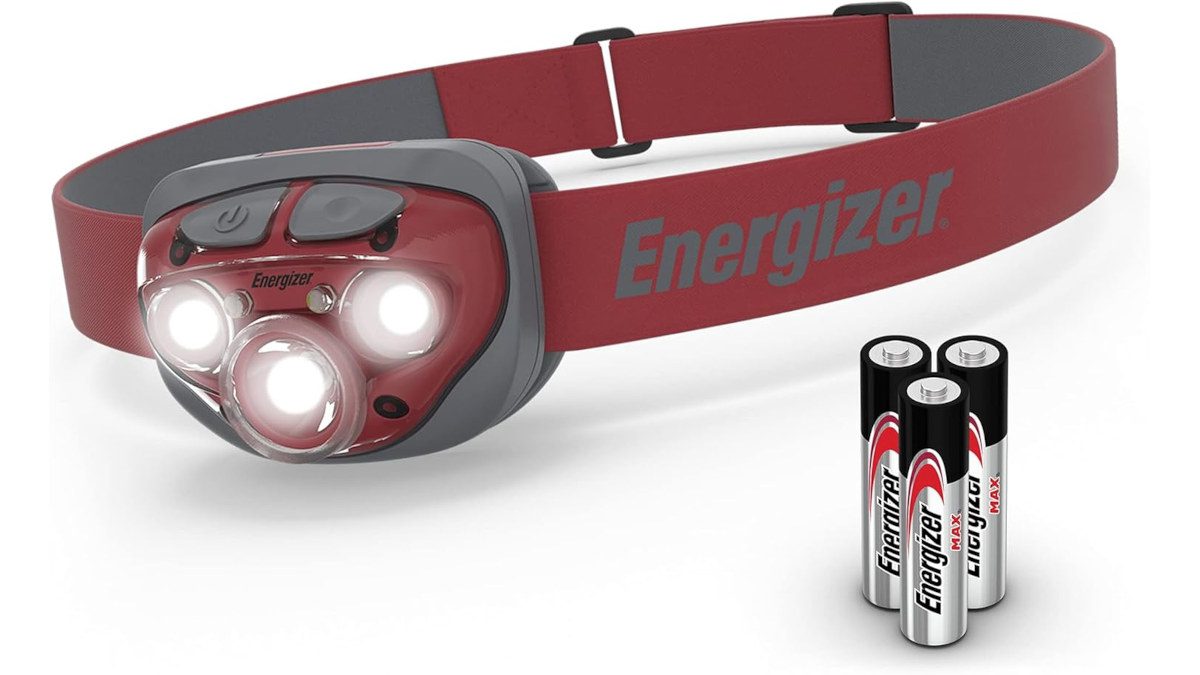
A head torch is more useful than a handheld torch during an evacuation — it keeps your hands free while you manage bags, children, pets, and doors. Keep one in or near your grab bag.
Energizer Vision HD+ Head Torch
Is this the most versatile head torch for your kit? Does it deliver what it promises? Does it have longevity?
Build Your Resilience
Further Reading: Related Guides
- Bug-In vs Bug-Out
- 72-Hour Grab Bag Checklist
- Emergency Carer Backup Plan
- UK Home Flood Defence
- Two-Wheeled Contingency
- Protecting Your Important Documents
All our guides can be found listed on our resilience hub.
Gear We’ve Tested & Reviewed
- Energizer Vision HD Head Torch
- Lepro Torch
- SentrySafe 1160
- FireShield Home Fire Safety Pack
- LifeStraw Go Water Filter Bottle
All our reviews can be found on our reviews and resources page.