
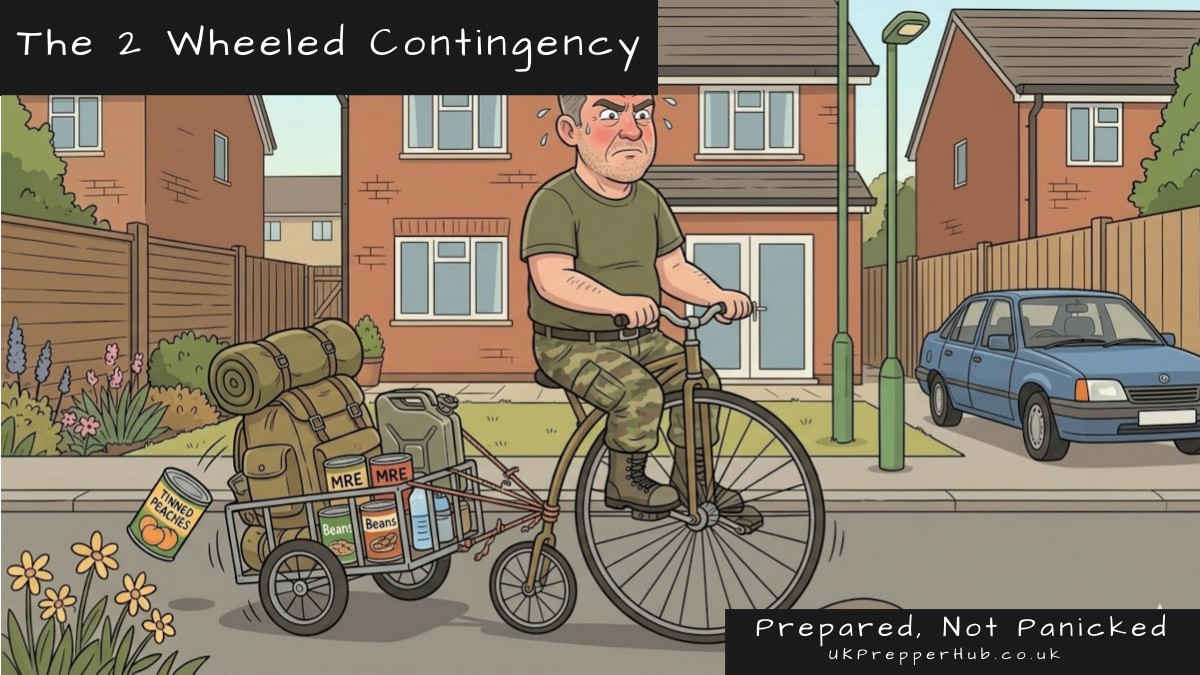
When the motorway turns into a car park and the trains have stopped, most people sit and wait. They wait for the queue to move, for the replacement bus that never comes, for a taxi that’s been booked by a thousand other people at the same moment. They wait because they have no other option.
A bike changes that calculation entirely.
A bicycle moves at 10–15 miles per hour through traffic that isn’t moving at all. It uses no fuel, requires no signal, needs no road that’s been declared clear by the authorities. It fits down cycle paths, through parks, along canal towpaths, and past the tailback that’s stretching back to the last junction. In a gridlock scenario, a bicycle isn’t just useful — it’s the fastest vehicle on the road.
This guide makes the case for adding a bike to your resilience planning, covers what to look for if you’re buying one specifically for this purpose, and explains how to set up a bike you already own for emergency use. It’s not about cycling as a hobby or a fitness pursuit. It’s about having a reliable, human-powered transport option that works precisely when everything else doesn’t.
The Resilience Case for Two Wheels
It helps to think about the specific scenarios where a bike becomes the most sensible option available:
Gridlock and road closures. A major road traffic accident, a flooded road diversion, a protest or event that closes city centre streets — in any of these, a bike bypasses the problem entirely. You’re not in the queue; you’re past it.
Fuel shortages. The September 2021 UK fuel crisis saw petrol stations run dry across the country within days of the story breaking. Queues stretched to hours. A bike needs no fuel. If supply chain disruption or a shortage hits again — and given recent history it’s a case of when, not if — a bike keeps moving regardless.
Public transport failure. Rail strikes, signalling failures, bus service withdrawals — all increasingly common in the UK. A bike converts a stranded commute into a manageable journey. Fifteen miles by bike is an hour’s ride. The same distance on foot is a five-hour walk.
Local scouting and assessment. After a major flood, storm, or infrastructure failure, knowing what’s happening in your local area matters. Which roads are passable? Is the supermarket open? Is the bridge still accessible? A bike lets you cover a five-mile radius in twenty minutes, assess the situation, and return — without using fuel, without adding to congestion, and quietly enough that you’re not drawing attention to yourself.
Short supply runs. If your car is out of action, fuel is unavailable, or you simply want to conserve resources, a bike handles the 90% of journeys that are under five miles far more efficiently than any motorised alternative.
If You Already Own a Bike
Before spending anything, check what you have. A bike that’s been sitting in the shed for two years might be closer to road-ready than you think — or it might need a morning’s attention and £20 of parts. Either way, starting with what you own is the right first move.

🦆 Keith
Don’t Be Keith
Keith buys a bicycle for the garage, inflates the tyres once in 2018, discovers in a crisis that the brakes don’t work and he hasn’t ridden since 2004.
The Pre-Season Check
Do this every autumn and spring, ideally with the bike on a stand or leaned against a wall where you can work around it comfortably.
Tyres: Check tread wear and look for cracks in the sidewall. Inflate to the pressure marked on the tyre sidewall (usually 60–100 PSI for road tyres, lower for mountain bike tyres). A tyre that’s been flat for months may have a damaged inner tube that needs replacing. Do this now, not when you need the bike.
Brakes: Squeeze each lever and check the pads make firm contact with the rim (or disc rotor). Brake cables stretch over time — if the lever pulls close to the handlebar before the brake engages, the cable needs adjusting or replacing. This is a five-minute job with a 5mm Allen key and is not worth skipping.
Chain: A dry, rusty chain is the most common reason a neglected bike feels horrible to ride. Apply chain lubricant liberally, work the pedals backwards to distribute it, and wipe off the excess. A chain that’s been neglected for years may need replacing — a new chain costs £10–15 and transforms the ride quality.
Gears: Run through all the gears under light pedalling load. They should shift cleanly without hesitation or chain skipping. If they don’t, the cables may need adjusting — again, a basic job that any local bike shop will do for a few pounds if you’re not confident doing it yourself.
Lights: UK law requires a white front light and a red rear light when riding in darkness or poor visibility. Check both work. Replace batteries or charge rechargeable units. A flashing rear light is highly visible and recommended even in daylight on busy roads.
If your existing bike passes this check, you’re largely ready. The sections below on kit and carrying capacity apply equally to any bike.
The Case for a Folding Bike
If you don’t own a bike, or you’re considering a dedicated emergency/resilience bike, a folding bike deserves serious consideration — and not just for the obvious reasons.
The conventional objection to folding bikes is that they’re a compromise: smaller wheels, heavier than a comparable full-size bike, slightly less efficient on long distances. All of this is true, and for a cyclist who rides daily for fitness or sport, a full-size road or hybrid bike is the better choice. But for resilience purposes, the folding bike’s unique advantages matter far more than its limitations.
It Lives in the Boot
A full-size bike requires a roof rack, a tow bar rack, or a van. A folding bike fits in a car boot — even a small one. This means it’s always with you. You don’t need to have planned ahead, loaded the car the night before, or remembered to bring it. It folds in 20–30 seconds and goes in the boot alongside your Get Home Bag and winter vehicle kit. When you need it, it’s there.
Complete Guide
The Get Home Bag
The Get Home Bag is built for a single journey home — on foot if necessary — from wherever you happen to be. It’s leaner, lighter, and focused entirely on the specific challenge of self-propelled movement across urban or suburban terrain in UK conditions. Once you’re home, its job is done.
Read the Full Guide: The Get Home Bag →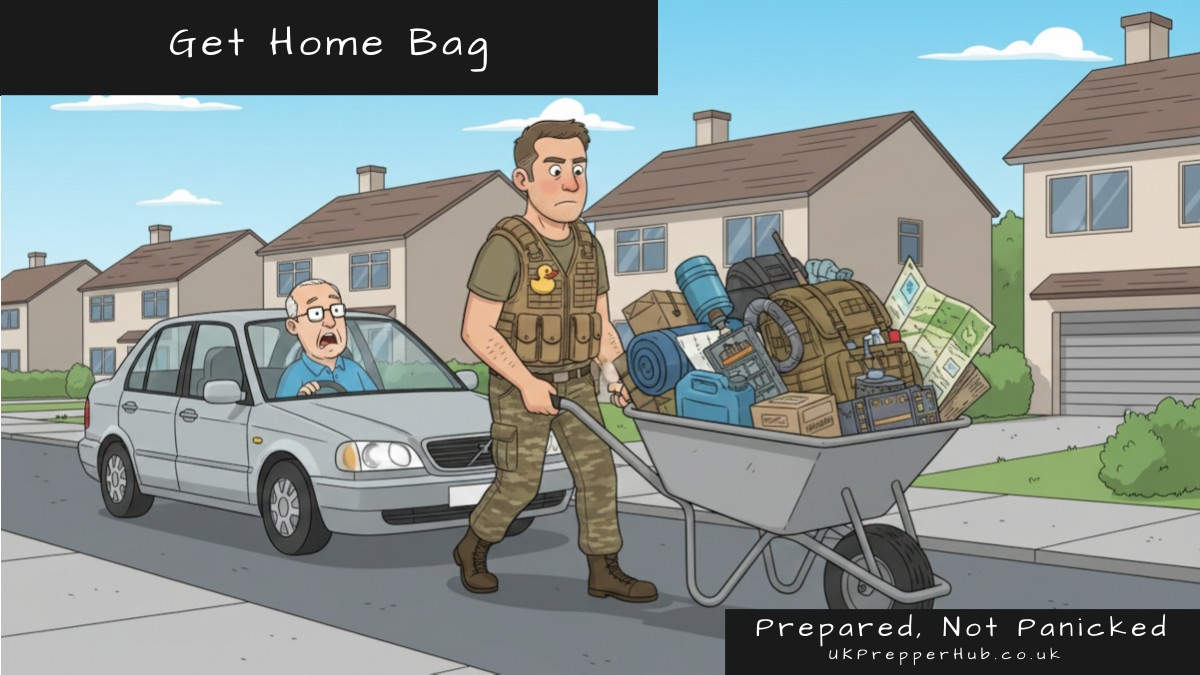
Complete Guide
Winter Driving Tips
Everything you need to do before winter hits the roads: tyres, battery, visibility kit, and what to keep in the boot in case you don’t make it home.
Read the Full Guide: Winter Driving Tips →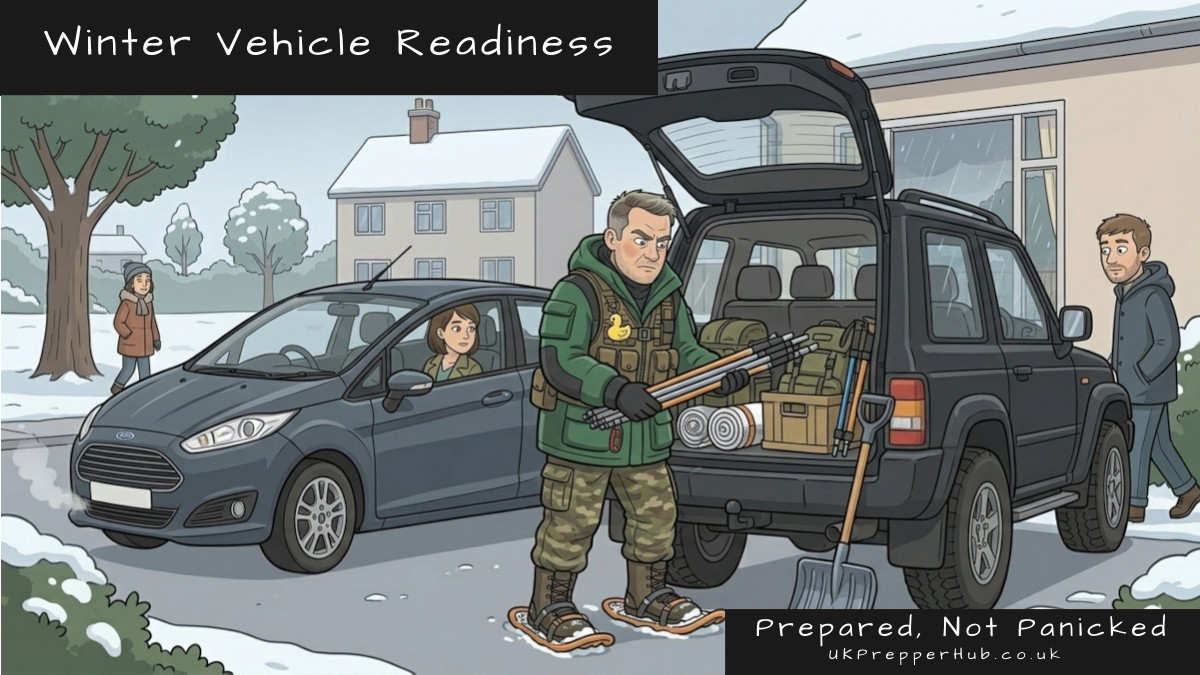
It Goes on Public Transport
A folded bike is allowed on virtually every form of UK public transport — trains (including most peak-hour services, unlike full-size bikes), buses, the tube, the Overground. This means it bridges the gap between transport modes in a way a full-size bike simply can’t. If the train gets you within five miles of home before terminating due to a fault, you unfold the bike and complete the journey. No compromise needed.
It Stores at Work
A folding bike fits under a desk, in a locker, or in a corner of an office without requiring dedicated cycle storage. In a flat or house without a shed or garage, it can be stored indoors without taking over the hallway. This removes one of the most common practical barriers to bike ownership in urban UK life.
What to Look For
Folding bikes range from under £200 to over £1,500. For resilience purposes, the sweet spot is £300–600 — enough to get a genuinely reliable, well-built bike without paying for racing components you don’t need.
The dominant name in UK folding bikes is Brompton, and for good reason — they fold smaller than anything else, are built to last decades, and hold their resale value remarkably well. A new Brompton starts at around £1,000; second-hand examples are widely available and often excellent. Alternatives at lower price points include the Tern Link, the Dahon Mariner, and own-brand folding bikes from Halfords and Decathlon. These are entirely adequate for resilience use and significantly cheaper.
Key specifications to look for: 16–20 inch wheels (smaller folds more compactly; larger rolls faster), at least 6 speeds for UK terrain, a folded size that genuinely fits your boot (measure before you buy), and a weight under 14kg if you’ll be carrying it on public transport.
A dedicated folding bike review is coming to the UK Prepper Hub.
Essential Bike Kit for Emergency Use
A bike without the right supporting kit is a half-prepared solution. The items below transform a bare bike into a genuinely capable emergency transport tool.
Puncture Repair
The single most likely mechanical failure, and the most important to be prepared for. You need two things: a pump and either a puncture repair kit or a spare inner tube (faster roadside fix than patching). A compact frame-mounted pump or a mini pump stored in a saddle bag takes up negligible space. Carry at least one spare inner tube in the correct size for your wheels — sizes are marked on the tyre sidewall. A tyre lever set (usually comes with repair kits) helps remove the tyre without damaging the tube further.
Practice changing a tube at home before you need to do it on a wet pavement at dusk. It takes five minutes once you know how.
Bike Lock
If you’re leaving the bike anywhere — even briefly — a lock is non-negotiable. A stolen bike in an emergency leaves you stranded again. A D-lock (also called a U-lock) offers the best security for its weight; cable locks alone are inadequate against any determined thief. For resilience use where you need something portable, a compact D-lock or a folding lock offers a good balance of security and packability.
Lights
Even if you don’t plan to cycle in darkness, conditions in the UK can change fast. A rechargeable front and rear light set is a small investment that removes any limitation on when you can ride. USB rechargeable lights have largely replaced battery models and are vastly more convenient — charge them when you charge your phone.
Helmet
Not legally required in the UK for adults, but strongly recommended — particularly if you’re riding in unfamiliar conditions, on busy roads, or while tired and stressed. A modern helmet is lightweight, well-ventilated, and not the sweaty discomfort of older designs. Keep it with the bike, not in a separate location.
Carrying Capacity
In an emergency, you’ll likely need to carry things: your Get Home Bag, supplies from a shop, equipment. A bike without carrying capacity means everything goes on your back, which is tiring and affects handling. Options in rough order of practicality:
A handlebar bag is the most accessible — contents are visible and reachable without stopping. A pannier bag clips to a rear rack and carries significant weight low and stable — the most efficient way to carry heavy loads on a bike. A saddle bag is small but perfect for puncture kit and tools. A cargo net or bungee over the rear rack handles awkward items that don’t fit in a bag.
Not all bikes have rack mounts — folding bikes in particular often don’t. Check compatibility before buying panniers. Many folding bikes have proprietary rack systems (Brompton’s is notably good); others work with universal clip-on racks.
Weather Kit
A waterproof cycling jacket lives with the bike or in the saddle bag. Cycling in a standard waterproof jacket works, but a cycling-specific one has longer rear coverage (no gap at the lower back when leaning forward) and is cut for the riding position. Waterproof cycling trousers or overshorts handle the lower half. Cycling gloves — even lightweight ones — make a significant difference to comfort and grip in cold or wet conditions.
Basic Multi-Tool
A cycling multi-tool (Allen keys, screwdrivers, chain tool) handles 95% of roadside adjustments — a slipped gear cable, a loose stem bolt, a saddle height adjustment. Compact, lives permanently in the saddle bag. A chain lubricant in a small dropper bottle rounds out the basics.
Navigation
A handlebar phone mount turns your phone into a cycle computer and navigation device. Combined with offline maps (Google Maps offline, OsmAnd, or Komoot for route planning), it gives you turn-by-turn navigation without data dependency. This is significantly safer than holding the phone or stopping to check it, and means you can follow an unfamiliar route confidently.
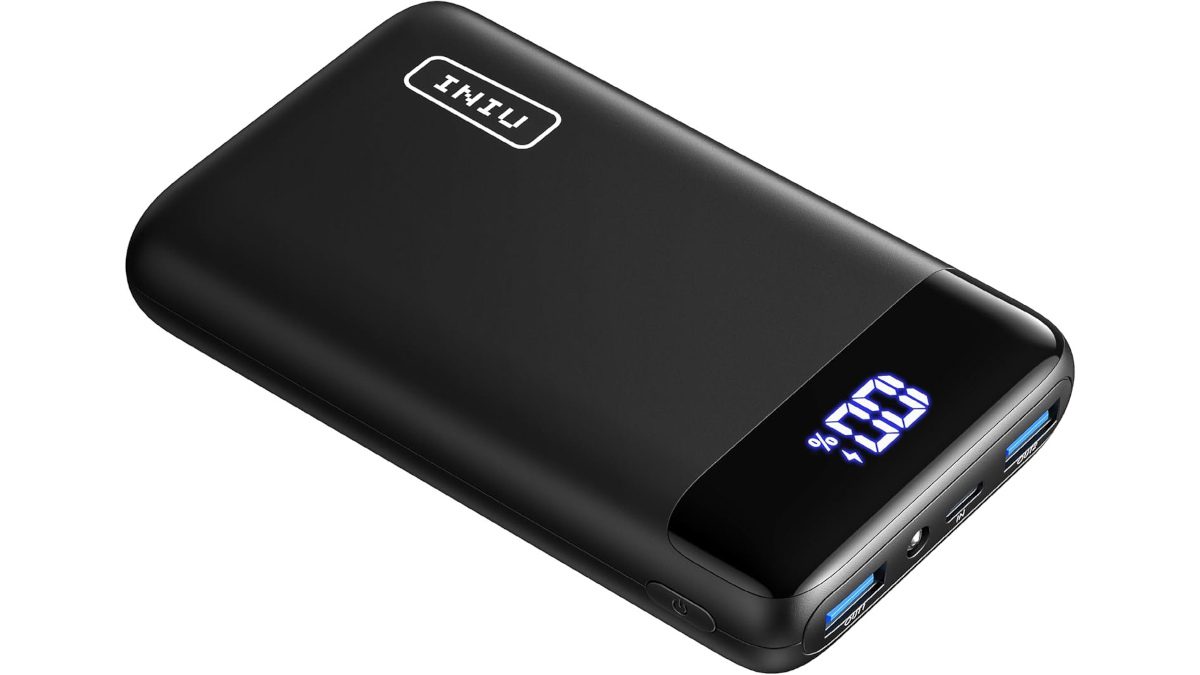
INIU 20,000mAh Power Bank
We tested it so you don’t have to — here’s the one thing most power banks get wrong, and why this one doesn’t.
Planning Your Bike Routes
Road cycling during a major disruption isn’t the same as leisure cycling on a quiet Sunday. Traffic behaviour changes, roads may be partially blocked, and you may be riding in conditions or at times you wouldn’t normally choose. Some route planning principles worth internalising:
Know your options before you need them. Cycle the key routes between home and work, home and the supermarket, home and the nearest town centre — in good conditions, at a relaxed pace, ideally more than once. Note the pinch points, the sections with no pavement or cycle path, the roads that would be genuinely dangerous in heavy traffic. Have a primary route and at least one alternative.
Prefer cycle paths, towpaths, and parks. These remove you from motor traffic entirely. The UK’s canal network alone provides hundreds of miles of flat, traffic-free towpath connecting urban centres. Sustrans’ National Cycle Network covers 12,000+ miles of signed routes across the UK, much of it off-road. Download the Sustrans map or the Komoot app for your area and identify which sections you could use.
Avoid major A-roads where possible. In gridlock, a major A-road is simultaneously your fastest route and your most dangerous one — frustrated drivers, narrow lanes, and HGVs don’t mix well with cyclists. A slightly longer route via quieter roads or cycle paths is usually the better choice.
Plan for traffic-free hours if possible. Early morning — before 7am — most UK roads are quiet enough that cycling feels safe even on routes you’d avoid at rush hour. If you have any choice about when you travel, use it.
Scouting: The Underrated Use Case
Beyond getting home, a bike has a specific resilience application that rarely gets discussed: local intelligence gathering after an emergency.
When a major flood, severe storm, or infrastructure failure affects your area, knowing what’s actually happening locally is genuinely valuable. Are the roads passable? Has the supermarket reopened? Is the pharmacy accessible? Which streets are flooded and which aren’t? This information helps you make decisions — whether to go out at all, which route to take, whether neighbours need help, what supplies are genuinely needed.
A bike lets you cover a five-mile radius in twenty to thirty minutes, assess conditions across multiple routes, and return with accurate, current information. A car can’t navigate a partially flooded street safely; a bike can pick its way through with the rider walking sections if needed. It’s quieter than a car, draws less attention, and uses no fuel. For post-event assessment of your local area, it’s the ideal tool.
This is the kind of capability that the phrase “know your area” actually implies — and a bike makes it practical rather than theoretical.
Security and OPSEC on Two Wheels
In a prolonged disruption, a bike is a visible asset. Most people don’t have one readily available, which means yours may attract attention you’d rather not have. A few practical points:
Don’t leave a quality bike unsecured anywhere, even briefly. Lock it to something immovable with a quality D-lock every time you stop. In extended disruption scenarios, consider where you store it at home — inside rather than in an unsecured shed.
A plain, older-looking bike attracts significantly less attention than a new, expensive one. This isn’t a reason to buy a bad bike, but it is a reason to avoid flashy colours and visible high-end components if resilience use is the primary purpose. A muddy, slightly worn Brompton looks like a commuter bike. A pristine carbon road bike looks like an expensive target.
For more on operational security during emergencies, see our Household OPSEC Guide.
Complete Guide
Household OPSEC Guide
OPSEC is a military term that’s filtered down to civilian life. OPSEC is short for “OPerational SECurity”. At its core, it means protecting information that could be used to harm you.
Action Checklists
✅ Existing Bike — Pre-Season Check (April and October)
- Tyres inflated to correct pressure, tread checked, no sidewall cracking
- Spare inner tube in correct size stored in saddle bag
- Brakes adjusted — pads making firm contact, levers not pulling to bar
- Chain cleaned and lubricated
- Gears shifting cleanly through all positions
- Front and rear lights working — batteries replaced or units charged
- Helmet present and undamaged
- D-lock with bike or in bag
- Multi-tool in saddle bag
- Carrying solution in place: pannier, handlebar bag, or cargo net
✅ Folding Bike Boot Kit
- Folding bike stored in boot, folded and secured
- Pump stored with bike or in boot box
- Spare inner tube (correct size) in saddle bag
- Puncture repair kit as backup
- D-lock
- Front and rear lights — charged
- Helmet (can live in boot alongside bike)
- Cycling gloves and waterproof jacket
- Phone mount fitted to handlebar
- Offline maps downloaded
- Multi-tool in saddle bag
✅ Before You Ride in an Emergency
- Tyres inflated — check by feel if no gauge available
- Lights on and working
- Phone charged and mounted — offline maps loaded
- Route planned with alternative identified
- Someone knows your route and ETA
- Hi-vis layer on or accessible
- Carrying solution fitted and loaded
- Helmet on
Build Your Resilience
Further Reading: Related Guides
All our guides can be found listed on our resilience hub.
Gear We’ve Tested & Reviewed
All our reviews can be found on our reviews and resources page.