
This post contains affiliate links. Learn more
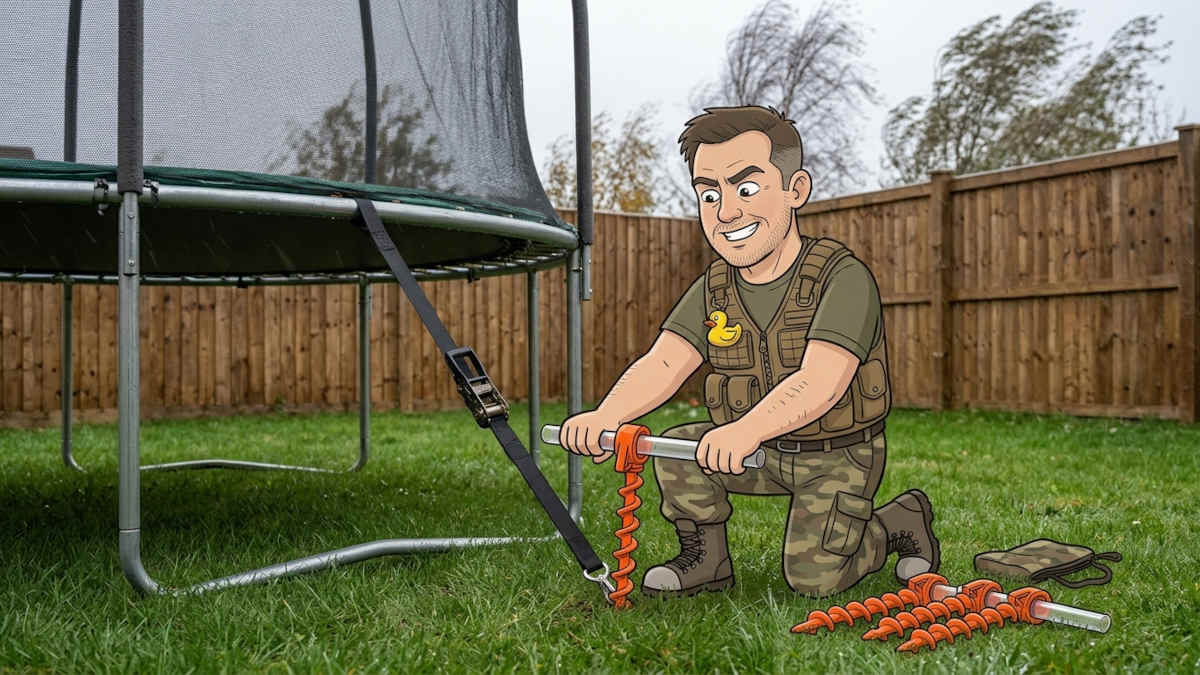
My garden polytunnel is basically a giant plastic parachute, and every storm season the wind does its best to launch it over the fence. What holds it down is a set of orange screw-in ground anchors and straps. They work really well, they’re solid, and they’ve kept it on the ground through storms. That’s the reason I’d recommend this style of anchor to anyone with a trampoline, a gazebo or a greenhouse to worry about.
This review covers the Andes heavy duty ground anchors, sold in a pack of four. They’re the same design as the set I use on the polytunnel: a long plastic thread you wind into the ground, an eye at the top to tie down to, and a clear tube that turns out to be the cleverest part of the whole thing.
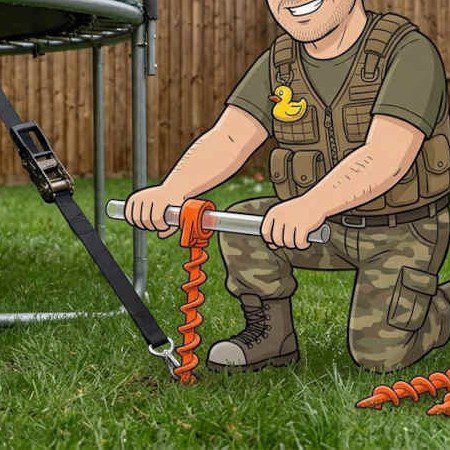
Andes Heavy Duty Ground Anchors (Pack of 4)
Screw-in heavy duty ground anchors with a clever T-bar handle, made to hold trampolines, gazebos and polytunnels down when a storm arrives.
Current Price at time of writing: £9.99
Rated: 4.6/5 ⭐ from 46 reviews
Why Ordinary Pegs Pull Out in a Storm
A normal knock-in peg is held by friction along a thin spike. That’s fine for a tent on a still night. In a storm, the ground is usually soaked, the soil softens, and the wind doesn’t pull steadily. It snatches, gust after gust, and every snatch works the peg a little looser until it pops out and whatever was attached to it heads off down the garden.
A screw thread works differently. Instead of a thin spike, you’ve got a wide spiral biting into a long column of soil. To pull it out, the wind has to drag up all the earth sitting on top of the thread, not just overcome a bit of friction. That’s why these heavy duty ground anchors hold where pegs give up.
How These Heavy Duty Ground Anchors Work
Each anchor is a thick plastic screw with a deep thread. The screw itself is 24.5cm long, or 29cm including the handle at the top, and 3cm across. The top has an eye for your strap, rope or tie-down to clip through. You’ll also see this kind of thing sold as heavy duty earth anchors or ground screws. They’re bright orange, which matters more than it sounds: you can find them again in long grass, and you’re less likely to trip over one in the dark.
The pack gives you four heavy duty ground anchors, four clear tubes and a carry bag to keep the lot together. You line the point up where you want it, push down and turn. In soft or damp ground they wind in by hand. When the ground is harder, that’s where the tube comes in.
The Clear Tube Is the Clever Bit
Each anchor comes with a clear tube, 25cm long, and it does two jobs. In storage, it slides over the screw and covers the thread, so the anchors don’t snag the bag, scratch anything they’re packed with or catch your hand when you reach in for one.
In use, you take the tube off and pass it through the tie-down eye at the top of the anchor. Now it’s a T-bar handle. Holding both ends gives you far more leverage than gripping the top of the screw, so you can wind the anchor down into firm ground without straining your wrists. It works the same way in reverse when you come to take them out.
It’s one of those details you don’t notice in the photos, but once you’ve used it you wouldn’t want an anchor without it.
Holding a Polytunnel Down Through UK Storms
A polytunnel is about the worst thing you can try to keep on the ground in high winds. It’s big, it’s light, and its whole shape catches air like a sail. When a gust gets under the cover, the frame wants to lift. If the fixings let go, you’re not just replacing the polytunnel, you’re hoping it doesn’t land on the car, the house or the neighbour’s greenhouse.
Mine is held down with this style of screw-in ground anchor, with straps over the frame tied down to the anchors. It’s held through the storms. They’re solid, and they work really well.
That’s the real test of heavy duty ground anchors, or heavy duty earth anchors, or whatever the shop calls them. If they’ll hold a giant garden parachute through a British storm, they’ll hold most things you want kept in place.
Will Heavy Duty Ground Anchors Hold a Trampoline?
Trampolines are the classic storm casualty. They’re light for their size, the mat and the safety net catch the wind, and once one gets moving there’s not much stopping it. Every named storm brings a fresh batch of photos of trampolines in roads, on railway lines and on top of other people’s sheds.
A trampoline anchor needs to do exactly what the polytunnel anchors do: stop the frame lifting. Screw an anchor into the ground beside each leg, run a strap over the frame or round the leg, and tension it down to the eye. If these heavy duty ground anchors hold a polytunnel down, a trampoline is well within what they can do. If one does lift, look at how it was fitted before blaming the anchor: it wasn’t screwed in fully, the strap wasn’t tight, or there were too few anchors for the size of the trampoline.
One pack gives you four anchor points. For a bigger trampoline with more legs, buy a second pack so every leg has one. Do it before the storm warning, not during it. Screwing anchors in and tensioning straps in the dark and the rain is nobody’s idea of fun.
Gazebos, Garden Furniture and Greenhouses
A gazebo anchor is the job these were sold for in the first place, along with tents, windbreaks and tarpaulins. The legs of a pop-up gazebo hold almost nothing against the wind on their own, and the roof is a sail. One anchor per leg with a strap or guy line turns it from a kite into something that stays put.
These heavy duty ground anchors are just as useful as everyday garden anchors. A garden bench, a log store, a cold frame, a rotary washing line, a lightweight greenhouse, a water butt stand: anything that can’t come inside before a storm and has a way to strap it down. The listing even suggests one in the pub beer garden to tie the dog’s lead to, and I can’t argue with that.
Getting the Best From Them
- Screw each of the heavy duty ground anchors in until the eye sits at ground level. An anchor left half out has half the grip.
- Use ratchet straps rather than rope where you can. They let you take up all the slack, and a tight strap stops the item rocking, which is what works an anchor loose.
- Set the anchors a little out from the item you’re holding down, so the strap pulls down and slightly outwards.
- In very dry, hard ground, use the tube as a T-bar handle, and wet the spot first if you can.
- After a storm, walk round and check each strap is still tight before the next one arrives.
You can leave them in place for the whole storm season, or unscrew them and put them back in the bag until they’re needed. Either way, it’s worth having a set ready before the forecast turns.
What They’re Not For
These heavy duty ground anchors are for holding things down in soil and grass. They’re not foundation screws for decking, sheds or garden rooms, which are a different, much bigger metal product. They won’t go into a patio, paving or concrete either, so for a gazebo on hard standing you’ll need weights instead. And they’re not a security anchor for locking a motorbike or bicycle to.
For what they are made for, holding light things with a lot of surface area down in the wind, the Andes heavy duty ground anchors do the job properly and pack away small.
Andes Heavy Duty Ground Anchors (Pack of 4)
Screw-in heavy duty ground anchors with a clever T-bar handle, made to hold trampolines, gazebos and polytunnels down when a storm arrives.
Current Price at time of writing: £9.99
Rated: 4.6/5 ⭐ from 46 reviews
What the Rest of the Team Think

🦆 Keith the Prepper
I’ve put them under the trampoline, the gazebo, the wheelie bins and the bird table. My wife asked whether the bird table was really at risk. I said the next storm doesn’t care about her opinion of the bird table.
⭐⭐⭐⭐⭐

🪖 Black Panther
In my previous role we used steel pickets and a sledgehammer. Civilians don’t need either. Screw it in, tube through the eye, strap it down. Simple drills save lives. Carry on.
⭐⭐⭐⭐

🤡 Camping Clown
I bought the galvanised steel helical ones. They cost about the same as a weekend away and needed a bar the length of my arm to wind in. The orange plastic ones went in quicker. I’m not entirely sure why I did that.
⭐⭐⭐⭐⭐
🐾 Weekend Warrior
These are going in the perimeter at the bug-out location, bro. Pickle’s long line goes on one at the campsite and she has never once pulled it out. She has tried. She’s a very determined Pomeranian.
⭐⭐⭐⭐⭐

🐕 Pickle
Snorgle!
⭐⭐⭐⭐⭐ (The orange stick does not move. I have checked. Many times.)

🐔 Chicken Licken
Every storm there’s a photo of a trampoline somewhere a trampoline should never be. I’ve been saying for years the next one would come from our street. Not any more. Ours is going nowhere.
⭐⭐⭐⭐⭐

📋 Calm Clarissa
Four heavy duty ground anchors, four straps, one line ticked off the storm list. Janet asked why our gazebo was still standing after the weekend when next door’s was in the hedge. Because I prepared, Janet.
✅✅✅✅✅

💄 Survivl Gurl
Orange is SO not my colour, but my gazebo stayed exactly where I put it for the whole shoot, and the wind tried. Hide them under a plant pot and nobody needs to know.
⭐⭐⭐⭐

🌿 Aroura
I ask the earth to hold the polytunnel, and it does, one slow turn at a time. There’s something calming about working with the soil instead of hammering at it. Namaste 🙏
⭐⭐⭐⭐⭐
Pros and Cons
Pros
- A deep screw thread grips far more soil than a knock-in peg
- The clear tube covers the thread in storage and doubles as a T-bar handle
- Proven in the wind: this style holds a polytunnel down through UK storms
- Bright orange, so easy to find in grass and less of a trip hazard
- Comes with a carry bag, and the heavy duty ground anchors screw back out for reuse
Cons
- Four heavy duty ground anchors in a pack, so a bigger trampoline needs a second pack
- Need soil or grass: no good on patios, paving or concrete
- Hard, dry ground takes more effort to wind into
- Straps are sold separately
Frequently Asked Questions
Are these just screw in tent pegs?
They’re sold alongside camping gear and people often search for them as screw in tent pegs, but they’re a different thing from the knock-in pegs most of us picture. A 24.5cm plastic thread winds deep into the ground and grips a whole column of soil, which is why we call them heavy duty ground anchors. Tent pegs come out in a gust. These are made to stay in.
How many ground anchors do I need for a trampoline?
Use one anchor per leg, with a strap from the frame or leg down to each anchor. One pack gives you four heavy duty ground anchors, so for a bigger trampoline with more legs, buy a second pack.
Do they work in hard ground?
Yes, with more effort. Take the clear tube off and pass it through the eye at the top of the anchor to use it as a T-bar handle, which gives you the leverage to wind it in. Wetting dry ground first makes it easier.
What should I tie to the anchors?
Ratchet straps are the best choice for storm prep, because you can pull them really tight. Run the strap over the frame of the trampoline, gazebo or polytunnel and down to the eye on each of your heavy duty ground anchors, then tension it.
Can I use them on a patio or decking?
No. They need soil or grass to screw into. For a gazebo or furniture on hard standing, use weights instead.
Can I leave them in the ground all winter?
Yes. Heavy duty ground anchors like these can stay in place for the storm season, or unscrew them and keep them in the carry bag until the next storm warning.
Build Your Resilience
Further Reading: Related Guides
- Storm Damage Prevention: How to Prepare for a Storm
- Emergency Home Tool Kit
- How to Prepare for a Power Cut
All our guides can be found listed on our resilience hub.
📡 Find Us Everywhere
Daily briefings, prep guides, and real-time updates across every platform. Pick yours.
Free. No commitment. Stay anonymous on WhatsApp & Telegram.
Stay Informed on UK Preparedness
Join our newsletter for UK-specific preparedness tips, product recommendations, and real-world advice for households.
Subscribe to Our Newsletter