
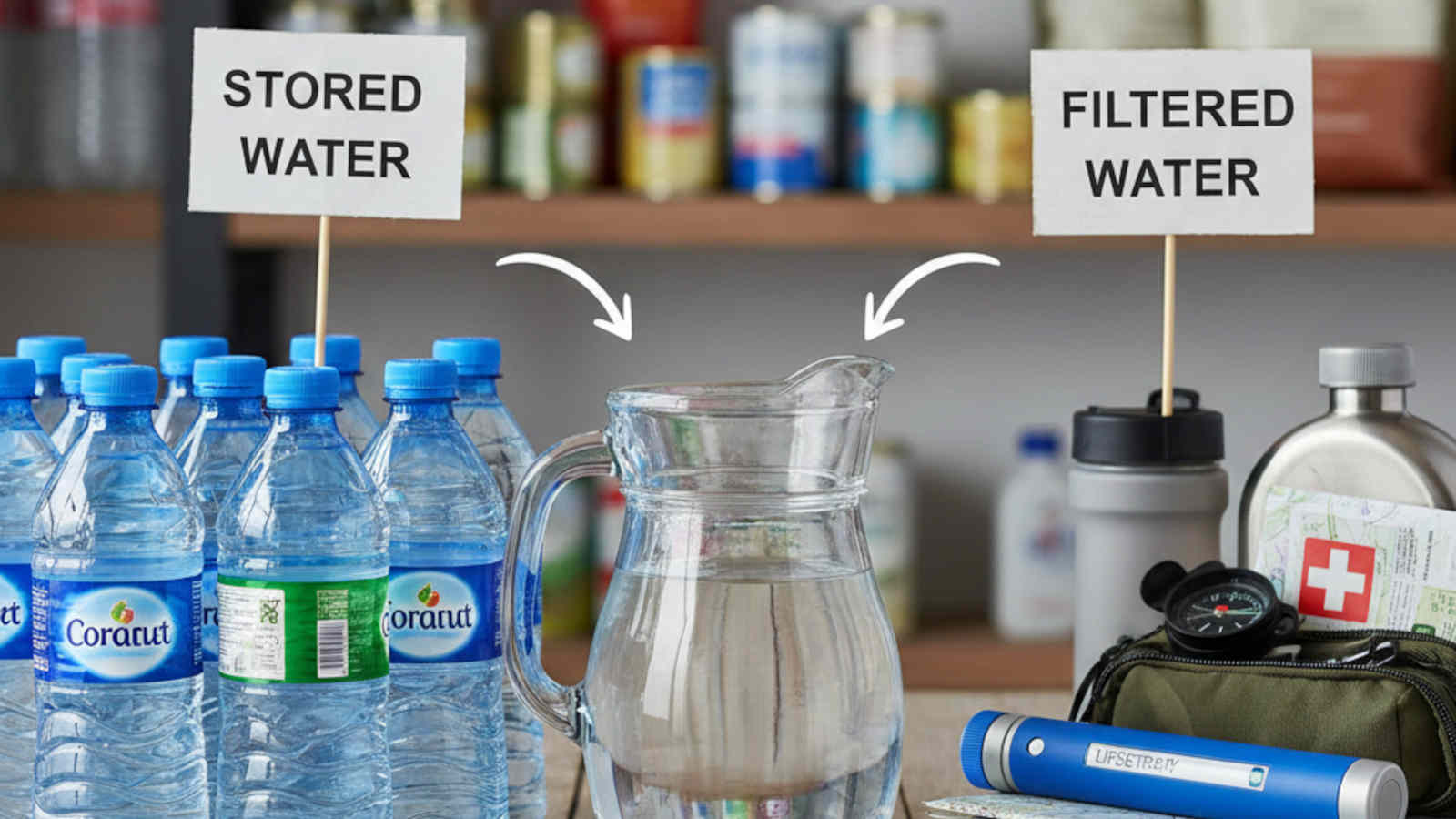
Portable water filters are popular with hikers, campers, and preppers — but they are often misunderstood. They are useful tools, not complete solutions.
If you are preparing for disruptions such as power cuts, water supply issues, or severe weather, stored bottled water remains the safest and most reliable option. Filters have limitations that cannot be ignored.
This guide explains why filters alone are not enough, why bottled water should be prioritised, and how to store it properly.
What Portable Water Filters Actually Do
Portable water filters are designed primarily to address biological contamination.
Most common portable filters remove:
- Bacteria
- Protozoa (such as Giardia and Cryptosporidium)
- Sediment and debris
Some also reduce:
- Chlorine
- Certain tastes and odours
They do not reliably remove:
- Heavy metals
- Dissolved chemicals
- Industrial pollutants
- Agricultural runoff
This is not a flaw — it is a design limitation.
What Portable Water Filters Cannot Make Safe
Heavy Metals Cannot Be Reliably Removed
Rainwater and surface water can contain heavy metals such as:
- Lead
- Zinc
- Copper
- Cadmium
These can enter water from:
- Roofing materials
- Gutters and downpipes
- Storage containers
- Atmospheric pollution
Most portable filters do not remove heavy metals.
Boiling does not remove heavy metals.
UV treatment does not remove heavy metals.
Removing heavy metals requires:
- Reverse osmosis
- Distillation
- Specialised adsorption media
These are not practical or reliable in emergency, off-grid situations.
Disease Risk Still Exists
Portable filters reduce risk, but do not guarantee safety.
Illnesses associated with untreated or poorly treated water include:
- Salmonella
- Leptospirosis
- Giardiasis
- E. coli infections
These illnesses are well documented and can be severe. Safe drinking water must be predictable, not “probably fine”.
The NHS confirms that contaminated water can cause serious gastrointestinal illness and dehydration, particularly in vulnerable people.
https://www.nhs.uk/conditions/diarrhoea-and-vomiting/
Why Stored Bottled Water Is Still Essential
Bottled Water Is Predictable and Safe
Commercially bottled water:
- Is treated and tested
- Has known quality
- Requires no equipment
- Requires no power
- Carries no filtering uncertainty
This makes it the baseline for emergency water planning.
The UK government’s emergency guidance explicitly recommends storing drinking water in advance.
https://www.gov.uk/government/publications/preparing-for-emergencies/preparing-for-emergencies
How Much Water Should You Store?
The Minimum
- 2 litres per person per day for drinking
- Additional water for hygiene and cooking
A Sensible Target
- 3 days minimum
- 7 days preferred
Example:
- 2 adults × 2 litres × 3 days = 12 litres
- 2 adults × 2 litres × 7 days = 28 litres
Supermarkets sell 5-litre bottles for around £1.50, making this affordable and easy to scale. A rough estimate of 1x 5-litre bottle per day for 2 people is going to be pretty close.
How to Store Bottled Water Safely
Storage Location
- Cool
- Dark
- Dry
- Away from fuels or chemicals
Freezing Warning (Important)
Water expands when frozen.
If bottles freeze:
- They may split
- Seals can fail
- Contamination risk increases
Avoid storing bottled water in:
- Unheated sheds
- Garages prone to frost
- Outdoor storage
Shelf Life
Most bottled water:
- Has a best-before date of 1–2 years
- Remains safe if unopened and properly stored
- Should be rotated periodically
The date relates to packaging integrity, not water spoilage.
📋 Calm Clarissa
My printable water checklist covers exactly this: how much to store per person, the containers, and when to swap it for fresh. Free to download, obviously.
Download the Free Checklist →Where Portable Water Filters Do Still Have Value
This does not mean portable filters are useless.
They are valuable for:
- Backup drinking water when bottled supplies run low
- Outdoor use
- Short-term emergency use
- Treating water for non-drinking purposes
Rainwater Still Has an Important Role
Rainwater is extremely useful, just not for drinking.
Safe uses include:
- Flushing toilets
- Washing clothes
- Cleaning
- Garden irrigation
Using rainwater for these purposes preserves stored drinking water, which is exactly what preparedness is about.
The UK Environment Agency supports rainwater harvesting for non-potable uses.
https://www.gov.uk/government/publications/rainwater-harvesting-code-of-practice
The Honest Bottom Line
- Portable water filters reduce biological risk only
- They do not make unknown water reliably safe to drink
- Heavy metals remain a serious, unresolvable issue in most setups
- Stored bottled water is the safest, simplest, and most reliable solution
Filters are a backup tool, not a replacement.
Don’t just think about it — buy bottled water now while it’s on your mind.
Water storage is one of those things people plan to “do later” and never get around to.
A few inexpensive supermarket bottles could make the difference between coping and crisis.
Frequently Asked Questions
Can I drink rainwater if I filter and boil it?
No. Boiling and most filters do not remove heavy metals or chemical contamination.
Are portable filters better than nothing?
Yes, but they should be treated as a last-resort drinking option, not a primary plan.
Is bottled water really necessary?
Yes. It provides known safety without equipment, power, or guesswork.
📡 Find Us Everywhere
Daily briefings, prep guides, and real-time updates across every platform. Pick yours.
Free. No commitment. Stay anonymous on WhatsApp & Telegram.
Stay Informed on UK Preparedness
Join our newsletter for UK-specific preparedness tips, product recommendations, and real-world advice for households.
Subscribe to Our Newsletter