
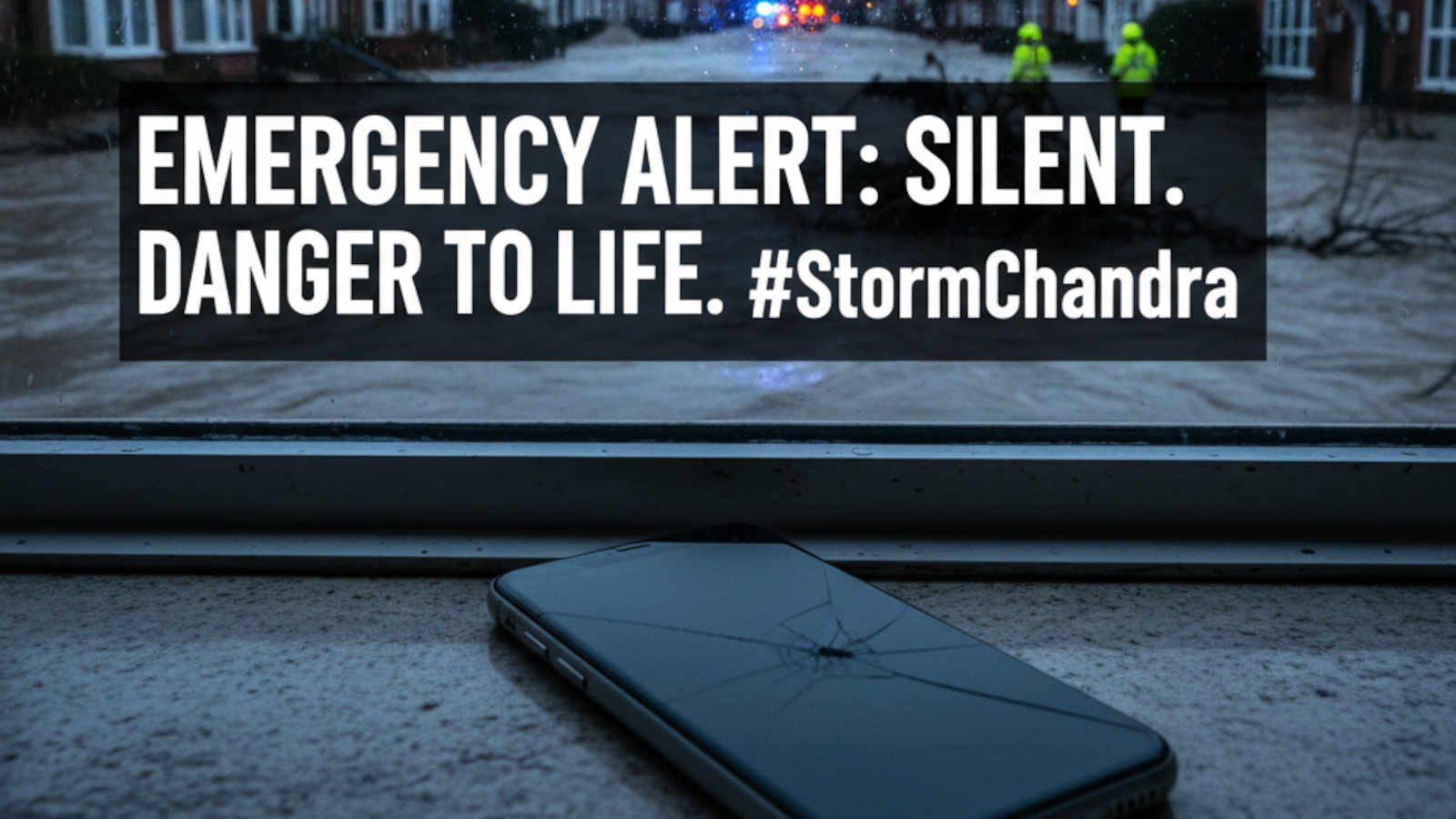
As Storm Chandra ravages the UK, the numbers tell a stark story:
- Red “Danger to Life” Flood Warning for Ottery St Mary
- 75mph Amber-level gales in Northern Ireland
- Major road closures including the A66 and M48
- 334 active flood warnings across the country
And yet, across the nation, millions of phones remain silent. There has been NO Emergency Alert triggered.
For the prepper community, this isn’t a glitch—it’s a revelation. The government’s £27 million Emergency Alert system, launched with promises to warn us of “life-threatening emergencies,” has failed the very test it was designed for. If a Red “Danger to Life” flood warning doesn’t trigger a national mobile alert, what will?
Why the System Failed to Activate
1. The “Catastrophic” Threshold
Internal Cabinet Office guidelines reveal the real problem: the Emergency Alert is reserved for “catastrophic” events. In government terms, this means nationwide threats—not regional ones, no matter how severe.
A town-wide flood with fast-flowing water killing residents? Local matter. Hand it to the Environment Agency and police. By the time officials decide an event is “big enough” for a national alert, the water is already in your hallway.
For preppers, the lesson is clear: Never assume the siren means safety. The absence of a siren doesn’t mean safety either.
2. It’s Not Automated—It’s Bureaucratic
Many assume the system is linked directly to Met Office and Environment Agency computers. It isn’t.
Every alert requires a human being in a government office to:
- Assess the situation
- Draft the message
- Seek approval
- Send it
During a rapidly evolving storm like Chandra—which escalated from Amber to Red in the early morning hours—this bureaucratic chain is simply too slow. By the time the paperwork clears, the situation has changed.
3. Fear of “Alert Fatigue”
Government officials are openly terrified of “over-using” the system and training the public to ignore alerts (the “crying wolf” problem).
So they do the opposite: they under-use it. They’ve created what you might call “alert absence.”
If a Red warning doesn’t trigger your phone, what message does that send? That the danger isn’t real. That you can ignore the official warnings. That the system isn’t serious.
It’s the worst possible outcome.
4. Back to the Old Ways
In Ottery St Mary on Tuesday morning, the response relied on:
- Door-to-door knocking by emergency services
- Sirens on police cars
- Social media posts from local councils
- Word of mouth
While effective for those awake, online, and checking their phones, it completely misses vulnerable groups: the elderly asleep, those without internet, people focused on immediate survival rather than scrolling Twitter.
The system was supposed to bypass all of this. Instead, we’re back where we started.
🧠 UK Prepper Hub Actionable Insight: Build Your Own Alert Chain
You are your own first responder. The government has just proven it.
Stop waiting for your phone to scream at you. Instead:
☑️ Read the Met Office Matrix, Not Just the Colour
Don’t just look at the icon. Dive into the Met Office “Impact vs. Likelihood” matrix. A Yellow warning with “High Impact” might be more dangerous than an Amber with “Low Likelihood.” The colour is marketing. The data is truth.
☑️ Monitor Live River Levels in Real-Time
Use RiverLevels.uk to watch your local rivers 24/7. You’ll see the actual water height, flow rate, and trend. This isn’t a forecast—it’s reality. If your river is rising fast and you’re in a flood zone, you don’t need government permission to evacuate.
☑️ Set the 03:00 Alarm During Major Storms
The most critical updates happen between 02:00 and 05:00 AM. Why? Because that’s when overnight rainfall totals are known, river gauges show actual peak flows, and the Met Office typically issues upgraded warnings.
If you’re in a warning zone during an active storm, set an alarm. Check the latest updates before the morning rush. You’ll know before most people wake up.
The Real Takeaway
Storm Chandra hasn’t just exposed a flawed system. It’s shown you something more important: the system was never your safety net.
Your safety net is knowledge. Monitoring. Preparation. Self-reliance.
The government’s silence during this storm isn’t a failure of technology. It’s a reminder that you can’t outsource your survival to institutions that move slowly, fear overreach, and have different definitions of “catastrophic” than you do.
Next time, don’t wait for the alert. Be the alert.
Stay Informed on UK Preparedness
Real emergencies don’t wait for government approval. Join our newsletter for UK-specific preparedness tips, real-world advice, and the kind of actionable intelligence that actually protects your household.
📡 Find Us Everywhere
Daily briefings, prep guides, and real-time updates across every platform. Pick yours.
Free. No commitment. Stay anonymous on WhatsApp & Telegram.
Stay Informed on UK Preparedness
Join our newsletter for UK-specific preparedness tips, product recommendations, and real-world advice for households.
Subscribe to Our Newsletter