
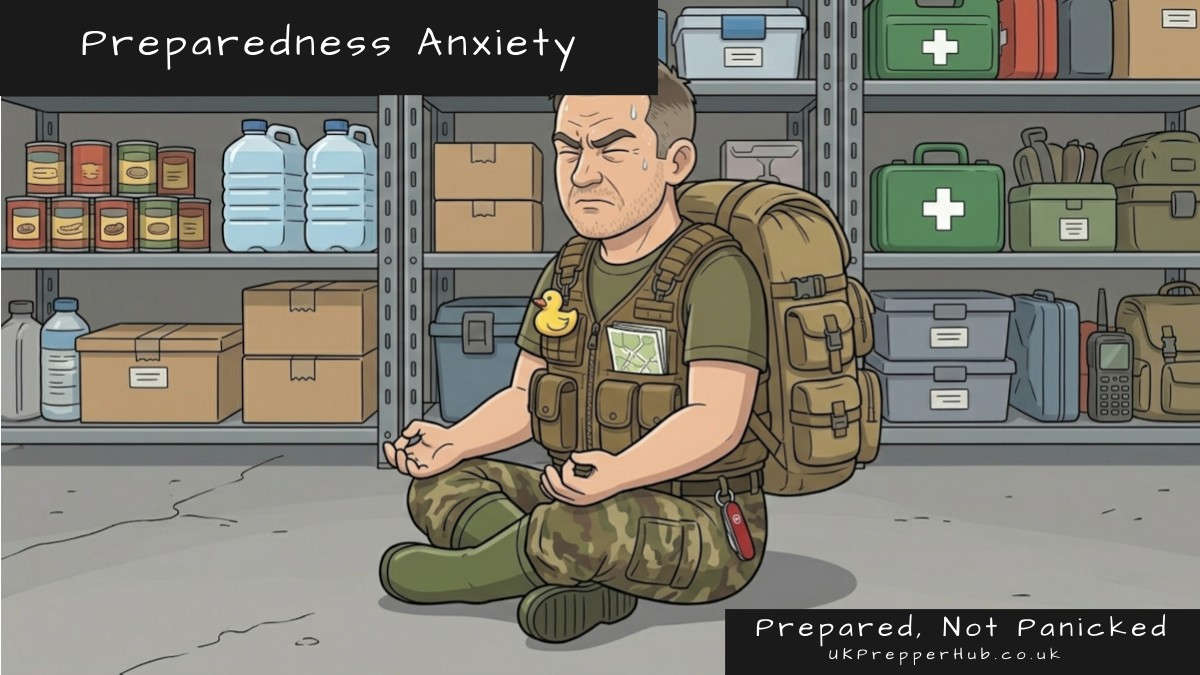
Emergency preparedness has an anxiety problem. For some people, reading about risks, building supplies, and thinking about worst-case scenarios is genuinely calming — it converts a vague, uncontrollable dread into a set of manageable actions. For others, the same process feeds anxiety rather than resolving it. And for a third group, the preparedness community itself — with its forums, threat-assessment posts, and constant risk inventories — becomes a source of distress that makes the original anxiety worse.
Understanding which category you fall into, and what the psychological evidence says about healthy versus problematic preparedness behaviour, is part of being genuinely prepared — not despite mental health considerations, but because of them.
A 2025 GOV.UK survey of UK risk perception found that 66% of adults expect the number of emergencies or disasters to increase over the next decade. That level of background concern is real — and understanding how preparedness activity interacts with anxiety matters more than ever.
The Difference Between Preparedness Anxiety and Healthy Preparation
Healthy preparedness is goal-directed and has an endpoint. You identify a risk, you take a reasonable action to mitigate it, and then you stop thinking about that risk. You have food reserves — you no longer need to worry about not having food reserves. The action resolves the anxiety.
Problematic preparedness anxiety is a loop. Taking an action provides brief relief but does not resolve the underlying fear. The focus moves to the next threat, or the same threat now seems more severe, or new risks are identified that urgently require attention. The preparation never reaches a point of sufficiency. This pattern resembles health anxiety and obsessive-compulsive disorder behaviours — and responds to similar therapeutic approaches.
The questions that distinguish them: Does preparing make you feel better, or does it briefly relieve discomfort before the anxiety returns? Do you feel more in control after taking preparedness steps, or do they reveal new things to worry about? Can you go a day without thinking about emergency scenarios, or does the absence of preparedness activity feel threatening?
News Consumption and Doomscrolling
The 24-hour news cycle, social media, and the structure of online communities that focus on risk all have a documented relationship with anxiety. Research from the American Psychological Association consistently shows that heavy news consumption correlates with elevated stress — even when the consumer reports the news as important to follow. The mechanism is simple: news is negative-biased by commercial incentive, repetitive, and presents threats as imminent even when they are remote. Social media amplifies the most emotionally activating content.
Practical approaches that work:
- Scheduled, bounded news consumption. Two specific points in the day — not on waking, not before sleeping — limits the dose without abandoning awareness.
- Source quality over volume. BBC News, the Guardian, and UKHSA provide information of calibrated quality. Forums and social media amplify the most alarming signals. Trusting fewer, better sources reduces noise.
- A rule for preparedness forums. If reading a preparedness community is leaving you more anxious, not less, that community is not serving its stated purpose for you. Walking away is permitted.
Helping Children Manage Emergency Fear
Children pick up adult anxiety about threats before they pick up the information about those threats. They register stress in the household — adults’ tense conversations, preparedness activity that feels urgent — and interpret it as evidence that something frightening is imminent.
Age-appropriate conversations about emergency preparedness are genuinely protective: research consistently shows that children who have been told what to do in an emergency feel less anxious about that emergency than children who have received no preparation. The goal is not to shield children from the knowledge that emergencies occur, but to give them a sense of agency within that knowledge.
For younger children: simple, concrete plans. “If there’s ever a fire, we go outside and meet at the big tree. Want to practice?” The rehearsal is the reassurance.
For older children: honest, proportionate information. “Sometimes things like big storms can cut the power. We have supplies so we’ll be fine. You’d actually get to use the camping lantern.” Framing preparedness as practical rather than alarming changes the emotional register entirely.
After an Emergency: What to Expect
Being present in, witnessing, or being affected by a serious emergency — a fire, a flood, a violent incident — produces a predictable psychological response. Acute stress reactions are normal: intrusive thoughts, nightmares, hypervigilance, difficulty concentrating, emotional numbing. These symptoms are not weakness. They are the nervous system’s normal processing response to an abnormal event.
In the majority of cases, these symptoms reduce naturally over the first few weeks. The factors that support recovery: returning to normal routine as quickly as is possible, maintaining social connections, allowing yourself to talk about the experience if and when you want to, and avoiding using alcohol as a coping mechanism.
If symptoms persist beyond four to six weeks, intensify rather than decrease, or significantly impair functioning — work, relationships, daily tasks — this is the point at which to seek professional support. Post-traumatic stress disorder is treatable. NICE-recommended treatments (trauma-focused CBT and EMDR) have strong evidence bases. GP referral is the starting point. In major incidents, NHS IAPT services and specialist trauma teams are typically commissioned.
Preparedness as Psychological Protective Factor
The counterintuitive finding from disaster psychology research is that people who have made practical preparations for emergencies consistently report lower levels of anxiety about those emergencies than people who have made no preparation. Having a plan — even an imperfect one — restores a sense of agency. Agency is the antidote to helplessness, and helplessness is the psychological core of most anxiety.
The point of preparedness is not to eliminate risk. It is to convert a diffuse, uncontrollable threat into a set of manageable actions — and to stop there. You have a grab bag. You have food. You have a plan. That is enough. Close the tab.
Complete Guide
How to Make a Blackout Box
Most households aren’t prepared for even a short power cut, and the stress comes from small, avoidable problems like lack of light, heat, or a way to cook. This guide shows you exactly how to fix that with a simple, practical setup so a blackout becomes manageable rather than disruptive.
Read the Full Guide: How to Make a Blackout Box →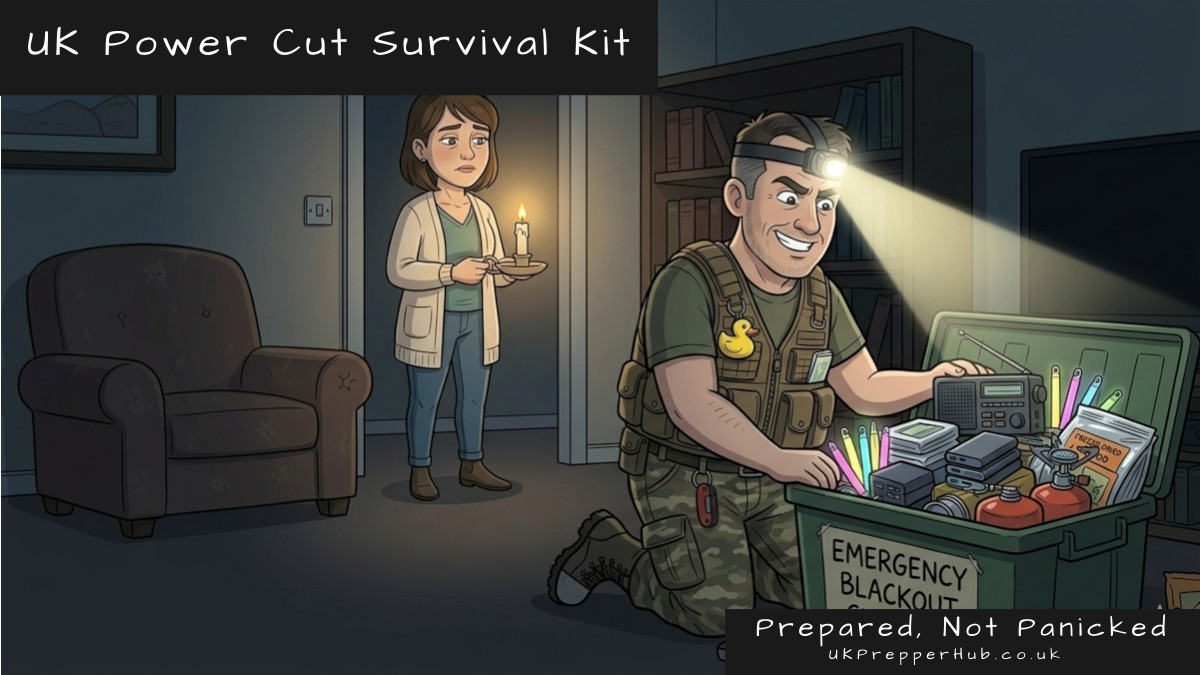
If You Need Support
If anxiety about emergencies or world events is significantly affecting your daily life, professional support is available. You do not need to be in crisis to reach out.
- Mind: mind.org.uk — 0300 123 3393
- Samaritans: 116 123 (free, 24/7)
- NHS Talking Therapies: self-refer at nhs.uk — no GP referral needed in most areas
Build Your Resilience
Further Reading: Related Guides
All our guides can be found listed on our resilience hub.
Gear We’ve Tested & Reviewed
All our reviews can be found on our reviews and resources page.
📡 Find Us Everywhere
Daily briefings, prep guides, and real-time updates across every platform. Pick yours.
Free. No commitment. Stay anonymous on WhatsApp & Telegram.
Stay Informed on UK Preparedness
Join our newsletter for UK-specific preparedness tips, product recommendations, and real-world advice for households.
Subscribe to Our Newsletter