
Nuclear and radiological incidents generate a specific kind of public anxiety — partly because the risks are invisible and poorly understood, partly because the consequences of the worst-case scenarios are genuinely catastrophic, and partly because most of what people know about radiation comes from fictional dramatisations rather than factual guidance. The result is a category of risk where both dismissal and panic are common, and clear-headed practical knowledge is rare.
This is what a nuclear incident in the UK actually looks like, what the science says about radiation exposure and protection, and what the official guidance — from the UK Health Security Agency, NRPB, and nuclear emergency planners — actually recommends.
Nuclear Incident Risk in the UK: The Real Picture
The UK has fourteen operational nuclear sites, including power stations at Hinkley Point, Sizewell, Torness, and Heysham, plus the Sellafield reprocessing facility in Cumbria. All are regulated by the Office for Nuclear Regulation (ONR) under some of the most stringent safety regimes in the world. UK civilian nuclear power stations use different reactor designs from Chernobyl and have multiple passive safety systems. A Chernobyl-scale accident is not possible at a UK power station — the physics of the reactor design do not permit it.
The realistic nuclear risk categories for UK households, in order of probability:
- A nuclear power station incident — a serious accident that releases radiation. This has not occurred in the UK. Emergency planning zones exist around all UK nuclear sites; households within these zones receive information and, in some areas, iodine tablets in advance.
- A radiological dispersal device (dirty bomb) — conventional explosive used to scatter radioactive material. Not a nuclear detonation, but a radiation contamination event in the affected area. The immediate blast radius causes conventional explosive injury; the radiation contamination area would be managed by emergency services with decontamination and evacuation.
- A nuclear detonation — the extreme tail risk. The National Risk Register includes nuclear attack as a credible threat. The practical guidance for this scenario is different from a power station incident.
The Science: What Radiation Actually Does
Radiation exposure is measured in millisieverts (mSv). UK background radiation averages around 2.7mSv per year — from soil, building materials, radon gas, and cosmic rays. A chest X-ray delivers about 0.1mSv. A transatlantic flight delivers about 0.1mSv. The dose at which health effects become statistically significant starts at around 100mSv in a single exposure. At 1,000mSv (1 Sv), acute radiation syndrome begins. Fatal doses are in the range of 4–6 Sv without treatment.
This context matters because it frames what “radiation” means in practice. Proximity to a nuclear power station in normal operation delivers negligible additional radiation. A dirty bomb event several streets away, evacuated quickly, may deliver a meaningful but not immediately dangerous dose. Distance, time, and shielding are the three variables that determine exposure — and they are all somewhat controllable.
Shelter in Place: Why Staying Indoors Is Often the Right Response
In a nuclear power station incident or a dirty bomb event, the immediate official guidance will almost certainly be to shelter in place — stay indoors, close windows and doors, turn off ventilation. This is counterintuitive for people whose instinct is to get away, but it is often the correct response because:
- A building provides significant shielding from external radiation — brick and concrete absorb gamma radiation
- Staying indoors keeps you out of the contaminated air or fallout plume
- Roads during an emergency are congested — a vehicle offers far less protection than a building and leaves you exposed to outdoor conditions for longer
- Official evacuation routes will be coordinated — spontaneous departures create traffic that prevents them
Sheltering effectively means: close all windows and doors, turn off air conditioning and ventilation systems, move to an interior room on a middle floor (away from windows and maximising building material between you and outside), and wait for official guidance via BBC radio or the emergency alerts system.
Complete Guide
Home Emergency Kit
The no-nonsense guide to building a home emergency kit that actually works — eight essentials, realistic costs, and a clear steer on what you don’t need.
Read the Full Guide: Home Emergency Kit →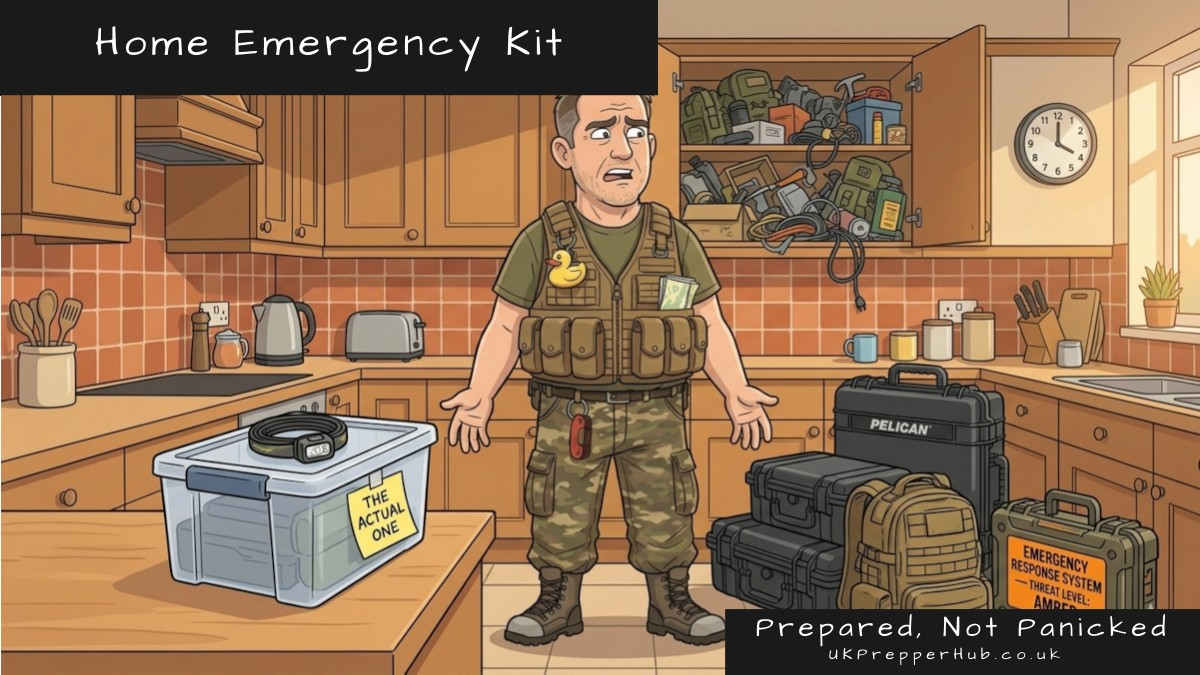
Iodine Tablets: What They Are and Who They Are For
Potassium iodate tablets (KI tablets) are distributed by some local authorities to households within the detailed emergency planning zones around UK nuclear sites. They protect specifically against radioactive iodine — one component of nuclear fallout — by saturating the thyroid gland with stable iodine before it can absorb the radioactive form.
They protect only against radioactive iodine, not against other forms of radiation. They are taken only on the instruction of emergency authorities — not preemptively. If you live near a UK nuclear site and have been issued tablets, check the instructions and the expiry date, and follow official guidance during any incident. Do not take KI tablets for a dirty bomb event unless specifically instructed, they are only relevant for nuclear fission events that release radioactive iodine.
In the Event of a Nuclear Detonation: the FEMA and UKHSA Guidance
In the scenario of a nuclear detonation — the extreme tail risk — the survival guidance is counterintuitive but evidence-based. The Nagasaki and Hiroshima survivor data, and subsequent research, show that a significant proportion of deaths in a nuclear event are from fallout rather than the immediate blast — and fallout can be substantially survived with the right response in the first 24–48 hours.
The guidance: if you see a bright flash, get behind the most solid available structure immediately and cover your head. Do not look at the flash. After the blast wave passes, move indoors to the most substantial building available. Stay indoors for at least 24 hours — ideally 48 — as radioactive fallout decays rapidly in the first hours. The dose received in the first 24 hours of fallout is many times higher than subsequent days. Shelter and time are your two most effective protections.
Build Your Resilience
Further Reading: Related Guides
All our guides can be found listed on our resilience hub.
Gear We’ve Tested & Reviewed
All our reviews can be found on our reviews and resources page.
📡 Find Us Everywhere
Daily briefings, prep guides, and real-time updates across every platform. Pick yours.
Free. No commitment. Stay anonymous on WhatsApp & Telegram.
Stay Informed on UK Preparedness
Join our newsletter for UK-specific preparedness tips, product recommendations, and real-world advice for households.
Subscribe to Our Newsletter