
This post may contain affiliate links Learn more
⛔ Out of stock: no like-for-like replacement yet
This item has sold out on Amazon UK, and right now we can’t find a direct replacement we’d be happy to recommend. Rather than point you at something that only half does the job, we’d suggest grabbing one of our free checklists in the meantime. They link back to our guides and reviews, so you can come back in a few days once stock is replenished. We’re checking for alternatives every day and will add one here as soon as we find one we trust. We’re not a supermarket that swaps your out-of-stock toilet roll for a melon.
When the power goes out, your phone becomes your only window to the outside world — news updates, emergency alerts, contact with family. But your phone battery won’t last forever, and mobile networks get congested fast when thousands of households are all trying to use them at once. What you actually need during a power cut is a dedicated radio: something that pulls in BBC local and national broadcasts independently, doesn’t drain your phone, and keeps working however long the outage lasts.
The FosPower Emergency Radio does exactly that — and it does it without needing mains power, without needing charged batteries, and without needing anything you might have forgotten to prepare in advance. That’s a genuinely useful thing to have in a kitchen drawer or a grab bag, and this review will tell you honestly whether it’s worth your money.
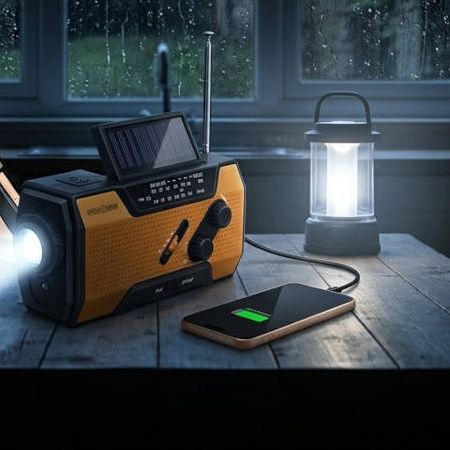
FosPower Emergency Radio
The rechargeable radio that keeps you informed when the power goes out — no mains, no problem.
Current Price at time of writing: £29.99
Rated: 4.5/5 ⭐ from 36,410 reviews
What It Actually Is
The FosPower is a compact AM/FM emergency radio with four independent power sources, a built-in torch, an SOS alarm, and a small USB power bank output for emergency phone charging. It’s about the size of a large paperback book, weighs very little, and comes in a choice of colours, including high-visibility orange, which is easy to spot in a dark cupboard. Black is the colour most often in stock.
The model reviewed here is the A1. It carries an IPx3 water resistance rating, meaning it’ll handle rain and splashes without issue — a useful reassurance for grab bag use or outdoor emergencies. There is a newer A6 model with a redesigned enclosure, but the core functionality and internal battery are identical. The A1 is the straightforward, sensible choice at a lower price.
Four Power Sources: Why This Actually Matters
Most emergency radios have one or two power options. The FosPower has four, and that redundancy is the single most important feature for preparedness use.
USB charging. Under normal conditions, charge it from a mains USB adapter, a laptop, a car port, or a power bank. Keep it topped up as part of your regular routine and it’s ready whenever you need it. This is how most people will primarily charge it day-to-day.
AAA batteries. The FosPower also runs on AAA batteries as a backup power source — a genuinely battery powered emergency radio option, not just wind-up or solar-dependent. If you’re already stocking AAA batteries for your head torch, you have a power source for this radio too. No separate battery format to manage, no compatibility headaches.
Hand crank (also called a wind-up radio). Turn the handle and generate power directly. No electricity, no sunlight, no batteries required — just effort. A few minutes of cranking gives you enough power to listen to a broadcast, check an emergency update, or charge your phone slightly. It’s not fast, and it’s not a substitute for a charged battery, but it means this radio can never truly run out of power as long as you have functioning arms.
Solar panel. The built-in solar panel provides a slow trickle charge in daylight. Leave it on a windowsill during the day and it maintains the internal battery passively. It won’t recharge a flat battery quickly, but during a multi-day outage it meaningfully extends runtime without any effort on your part.
The practical point is this: for the radio to be genuinely useless during an emergency, all four power sources would have to fail simultaneously. That’s an unlikely scenario. One of them will always be available.
AM/FM Only — and That’s the Right Call
The FosPower receives AM and FM only. No DAB, no DAB+.
For some readers this will feel like a limitation. It isn’t. DAB radios consume significantly more power than analogue AM/FM receivers — some DAB radios draw four to five times the power of an equivalent FM set. In an emergency context, where battery life and hand-crank efficiency both matter, AM/FM is the sensible choice. You’ll get substantially more listening time per charge, per crank, and per set of batteries.
More importantly, BBC Radio 4, BBC local radio stations, and talkSPORT all remain available on FM. In any genuine UK emergency — storms, power cuts, flooding, grid disruption — the BBC’s local and national FM broadcasts are the authoritative source of emergency information. The FosPower receives all of them clearly.
The analogue tuning dial is also worth noting specifically: no menus, no digital interface, no setup required. You turn a dial and find a station. Under stress, in the dark, with cold hands, that simplicity matters. Older household members and children can operate it without instruction.
What About NOAA Weather Alerts?
The product specifies it is capable of receiving NOAA weather alerts. NOAA is the US weather alert system and is not broadcast in the UK. This feature is completely irrelevant for British households and you should ignore it entirely.
It doesn’t affect anything else about the radio’s performance. AM and FM reception in the UK is unaffected. It’s simply a feature that exists for the US market and does nothing here — not a fault, just noise in the spec sheet.
FosPower Emergency Radio
The rechargeable radio that keeps you informed when the power goes out — no mains, no problem.
Current Price at time of writing: £29.99
Rated: 4.5/5 ⭐ from 36,410 reviews
The Torch: Practical, Not Powerful
There are two light sources: a 1W LED flashlight with an adjustable zoom beam, and a 4-LED reading light located on top of the unit, under the solar panel — lift the panel up to use it. The reading light is well-positioned for illuminating a small area or reading by without pointing a beam at someone’s face.
The torch is adequate for navigating a dark house, finding things in cupboards, and getting around during a power cut. It is not a high-lumen tactical torch and it won’t flood a large outdoor space with light. Your head torch remains the right tool for serious illumination — think of the FosPower’s torch as a useful secondary light source, not a replacement for dedicated emergency lighting.
Emergency Phone Charging
The FosPower can charge phones and small devices via USB from its internal battery. This is worth being clear about: it’s an emergency top-up function, not a replacement for a dedicated power bank.
The internal 2000mAh battery, after powering the radio and torch, won’t fully recharge a modern smartphone. What it will do is give you enough charge for a few calls, a run of text messages, or checking emergency updates when nothing else is available. One UK reviewer reported taking a phone from 5% to 27% in five minutes — which is the kind of boost that could matter when you’re trying to reach family during a crisis.
If phone charging is a priority, pair this radio with a dedicated power bank. The two complement each other: the radio handles information, the power bank handles device charging. Both earn their place in a grab bag.
The SOS Alarm
There’s a loud SOS alarm built in. It’s genuinely loud and it produces both a siren sound and a flashing light. On the A1 it’s activated by a switch on the underside of the unit rather than a push button, so accidental triggering isn’t really a concern.
For most UK households in most UK emergencies, you will never use this. A power cut doesn’t require an SOS alarm. A flood evacuation doesn’t require an SOS alarm. It’s a feature carried over from outdoor survival use cases that happens to be present on this device.
That said, it does have one realistic UK household application: if an elderly person living alone falls and cannot reach a phone, a loud SOS alarm that attracts a neighbour’s attention could genuinely matter. Worth knowing it’s there. Worth not building your emergency plan around it.
Build Quality: Honest Assessment
The FosPower A1 feels solid enough for home and grab bag use. The IPx3 water resistance rating means it should handle rain and splashes — reassuring for outdoor emergencies or wet evacuation scenarios, though it’s not designed to be submerged. The plastic casing is reasonably sturdy, the hand crank feels well-attached, and the controls are simple and clearly labelled.
Other reviewers are divided on sturdiness — some find it solidly built for the price, others describe it as feeling a little light. The honest position is that it’s adequate for its intended use case. It’s a home emergency device and grab bag addition, not a piece of field equipment designed to be dropped repeatedly. Treat it accordingly and it should serve you well.
Pros and Cons
Pros
- Four independent power sources — genuinely cannot run out of power
- AAA batteries — uses the same batteries as your head torch, no separate format to stock
- AM/FM only — better battery life than DAB, all UK emergency broadcasts covered
- Simple analogue controls — no menus, works under stress, accessible to elderly users
- IPx3 water resistant — handles rain and splashes
- Compact and lightweight — grab bag ready
- Solar charging maintains battery passively on a windowsill
- Emergency phone top-up when nothing else is available
- 37,000+ reviews, 4.6 stars — well-established track record
- Limited lifetime warranty
Cons
- NOAA weather alerts are US-only and irrelevant in the UK — ignore this feature
- Phone charging is emergency top-up only, not a power bank replacement
- SOS alarm button easy to trigger accidentally
- Build quality adequate rather than robust — not a ruggedised outdoor device
- No DAB — though this is arguably the right trade-off for battery efficiency
FosPower Emergency Radio
The rechargeable radio that keeps you informed when the power goes out — no mains, no problem.
Current Price at time of writing: £29.99
Rated: 4.5/5 ⭐ from 36,410 reviews
Who Is This For?
The FosPower Emergency Radio is for UK households who want reliable access to broadcast information during power cuts, storms, and outages — without depending on charged batteries, mains power, or internet connectivity. It’s for people who want a simple, no-fuss device that works when everything else has stopped working.
It’s particularly well suited to households with elderly members who find digital interfaces frustrating, households building a grab bag who need compact multi-function kit, and anyone who’s ever sat in a power cut wondering what’s actually happening and when the power is coming back.
Buy it, keep it charged via USB as part of your normal routine, leave it on a sunny windowsill occasionally, and know it’ll be there when you need it.
What the Rest of the Team Think

Keith

Black Panther

Camping Clown

Weekend Warrior

Pickle
Translation: “The antenna is just the right length to carry in my mouth. Weekend Warrior prefers I don’t do this but has stopped arguing about it.”

Chicken Licken

Calm Clarissa

Surviv’l Gurl

Aroura
Frequently Asked Questions
Does the FosPower receive DAB radio?
No — it receives AM and FM only. For UK emergency use this is not a limitation: all BBC national and local emergency broadcasts are available on FM, and AM/FM reception consumes far less power than DAB, giving you significantly longer battery and hand-crank runtime.
Does NOAA work in the UK?
No. NOAA is a US weather alert system and is not broadcast in the United Kingdom. This feature is irrelevant for UK owners and should be ignored.
Can it fully charge a smartphone?
Not reliably. The 2000mAh internal battery is primarily for powering the radio, torch, and alarm. It can provide an emergency top-up — enough for calls and messages — but is not a substitute for a dedicated power bank.
How long does hand cranking charge the battery?
Hand cranking is slow — it’s intended to provide enough power to listen to a broadcast or make an emergency call, not to recharge the battery fully. A few minutes of cranking gives useful short-term power. For full recharging, USB or solar is more practical.
Does it work with AAA batteries?
Yes — AAA batteries are supported as a backup power source alongside the internal rechargeable battery, solar panel, and hand crank.
Is the SOS alarm useful for UK households?
Rarely. It’s designed for outdoor survival scenarios. The one realistic UK household application is attracting a neighbour’s attention during a medical emergency when a phone is out of reach. Be aware the button is easy to press accidentally.
Is it suitable for a grab bag?
Yes — it’s compact, lightweight, and IPx3 rated for splash resistance. The hand crank means it remains functional even if the battery has depleted during storage.
Build Your Resilience
Further Reading: Related Guides
- Emergency Radio Guide
- How to build a blackout box
- How to make a “grab bag”
- How to Prepare for a Power Cut
- Power bank and battery strategy
- Storm Damage Prevention
All our guides can be found listed on our resilience hub.
📡 Find Us Everywhere
Daily briefings, prep guides, and real-time updates across every platform. Pick yours.
Free. No commitment. Stay anonymous on WhatsApp & Telegram.
Stay Informed on UK Preparedness
Join our newsletter for UK-specific preparedness tips, product recommendations, and real-world advice for households.
Subscribe to Our NewsletterFosPower Emergency Radio
When the power goes out, information and light matter more than almost anything else. The FosPower Emergency Radio is a compact backup device designed to keep you informed, illuminated, and able to charge a phone — using several different power sources, not just one.
Product SKU: B07FKYHTWP
Product Brand: FosPower
Product Currency: GBP
Product Price: 29.99
Product In-Stock: InStock
4.6
Pros
- Four independent power sources — genuinely cannot run out of power
- AAA batteries — uses the same batteries as your head torch, no separate format to stock
- AM/FM only — better battery life than DAB, all UK emergency broadcasts covered
- Simple analogue controls — no menus, works under stress, accessible to elderly users
- IPx3 water resistant — handles rain and splashes
- Compact and lightweight — grab bag ready
- Solar charging maintains battery passively on a windowsill
- Emergency phone top-up when nothing else is available
- 37,000+ reviews, 4.6 stars — well-established track record
- Limited lifetime warranty
Cons
- NOAA weather alerts are US-only and irrelevant in the UK — ignore this feature
- Phone charging is emergency top-up only, not a power bank replacement
- SOS alarm button easy to trigger accidentally
- Build quality adequate rather than robust — not a ruggedised outdoor device
- No DAB — though this is arguably the right trade-off for battery efficiency