
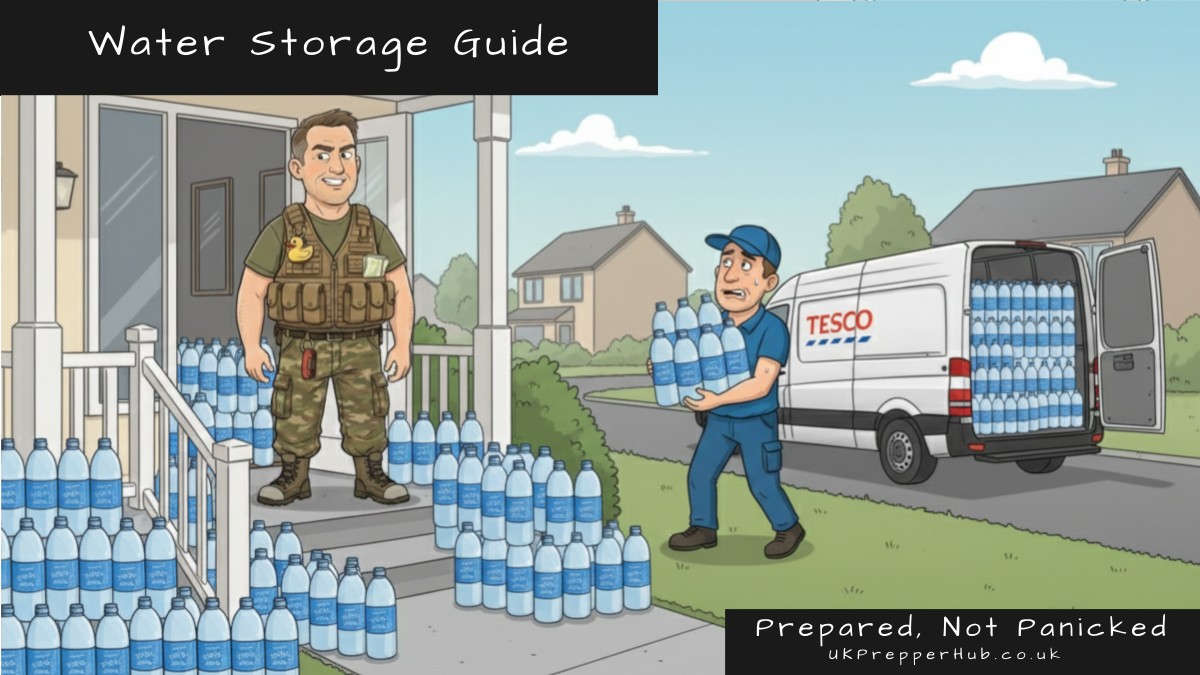
Introduction: The 3-Day Deception
While the UK is a rain-rich nation, our domestic water supply is a high-pressure, electricity-dependent system. If the pumps fail—due to a grid collapse, cyber attack, or a major burst main—the average UK home has less than 24 hours of water stored in its internal plumbing.
Water is the ultimate “single point of failure.” Without it, hydration stops, hygiene collapses, and within 48 hours, the modern home becomes a biohazard risk. This guide moves beyond “buy a few bottles” and looks at the tactical reality of long-term water security for UK households.
Historical Context: When the Taps Ran Dry
The “99.9% reliability” promised by water companies like Thames Water or United Utilities is a fragile veneer. We look at three events that define the UK’s water vulnerability:
- The 2007 Gloucestershire Floods: The Mythe water treatment works was flooded, leaving 350,000 people without running water for 17 days. People were forced to queue at bowsers in the rain—a logistical nightmare that proved “just-in-time” delivery fails during crisis.
- The 2018 “Beast from the East”: The rapid thaw caused thousands of pipes to burst simultaneously. In London and the SE, over 200,000 people lost supply. The “Big Thaw” is a recurring UK threat that most are unprepared for. Power cuts often accompany water supply failures—see our power cut survival guide.
- The Thames Water Financial Crisis (2024-25): The aging infrastructure and underinvestment in Victorian-era pipes mean that even without a natural disaster, structural failure is now a statistical certainty rather than a possibility.
The Science of Hydration: Calculating Your “Buffer”
UK government advice often suggests 2-3 litres per day. For a prepper, this is dangerously low.
- The Drinking Minimum: 2 Litres (for metabolic function).
- Hygiene & Cooking: 2 Litres (hand washing, basic food prep).
- The “Total Loss” Calculation: You should aim for 5 Litres per person, per day.
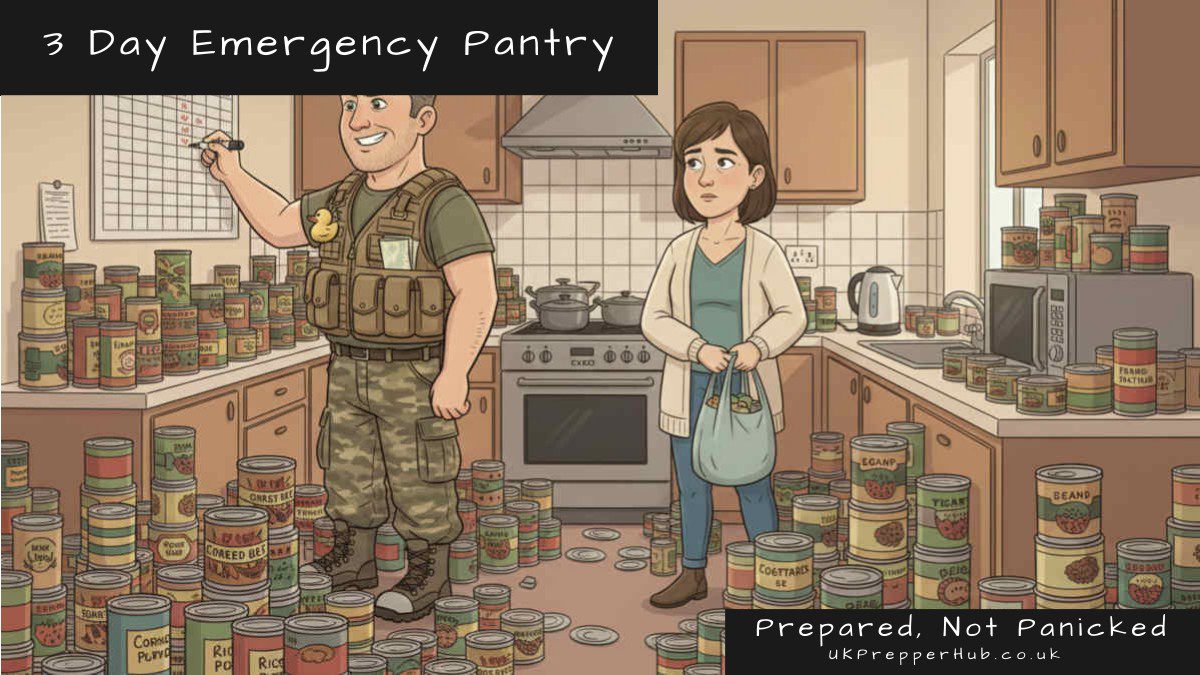
Water and food go hand-in-hand during emergencies. While you’re building your water buffer, don’t forget to establish a 3-day emergency pantry of shelf-stable food that doesn’t require cooking or refrigeration.
Complete Guide
3-Day Emergency Pantry
The low-barrier start: A shopping list of shelf-stable meals that require zero refrigeration.
Storage Levels:
- Level 1 (The 72-Hour Bridge): 15 Litres per person. This handles most “burst main” scenarios.
- Level 2 (The 14-Day Resilience): 70 Litres per person. This is the benchmark for major infrastructure failure or a pandemic scenario.
Tactical Storage: Containers and Placements
Not all plastic is created equal. Storing water in the wrong vessel can lead to chemical leaching or bacterial blooms.
A. The PET Bottled Water Strategy (Rotation)
The simplest method is buying 5L or 2L supermarket bottles.
- Pro: Cheap and factory-sealed (sterile).
- Con: The plastic is thin and prone to micro-leaks over 12+ months.
- Strategy: Rotate these into your daily use every 6 months.
B. Jerry Cans & Blue Barrels (Long-Term)
For Level 2 resilience, use BPA-Free, Food Grade HDPE (High-Density Polyethylene) containers.
- The “Water Brick” or 10L Jerry Can: These are easier to carry than 25L drums. Remember, 20L of water weighs 20kg. If you have to move your supply, can you lift it?
- The Stackable Advantage: Store them in the “dead space” of your home—the bottom of wardrobes, under stairs, or in the garage.
C. The Bathtub Reservoir (Immediate Action)
The moment a “Red Alert” is issued for weather or infrastructure, the “Bathtub Hack” is your first move.
- The WaterBOB: Do not just fill a dirty tub. A “Bathtub Liner” (like a WaterBOB) holds up to 300 litres in a sterile food-grade bag inside your tub. This is your “Grey Water” for flushing toilets or “Plan B” drinking water.
During flood warnings, this strategy also applies—see our flood defence guide.
Complete Guide
UK Home Flood Defense
Even small floods can damage flooring, walls, furniture, and utilities. Knowing how to act fast and prepare your home makes recovery faster and safer.

📋 Calm Clarissa
I’ve put all of this into a printable water checklist: how much to store, the containers to store it in, and a six-monthly rotation check. Free to download, obviously.
Download the Free Checklist →The “Flat Water” Myth: Maintenance & Safety
Water does not “go bad” if it is sterile, but it does lose oxygen and tastes “dead.”
Darkness is Mandatory: Sunlight + Water = Algae. Always store water in an opaque container or a dark cupboard.
Re-Aeration: Before drinking stored water, pour it back and forth between two clean containers. This re-introduces oxygen and fixes the taste. Alternatively, a LifeStraw Go filter bottle removes the stale taste while also filtering any potential contaminants from long-term storage.
LifeStraw Go Series Water Filter Bottle
Two-stage filter bottle that removes bacteria, parasites and microplastics as you drink, for grab bags, the car and any tap away from home.
Our Full Review: LifeStraw Go →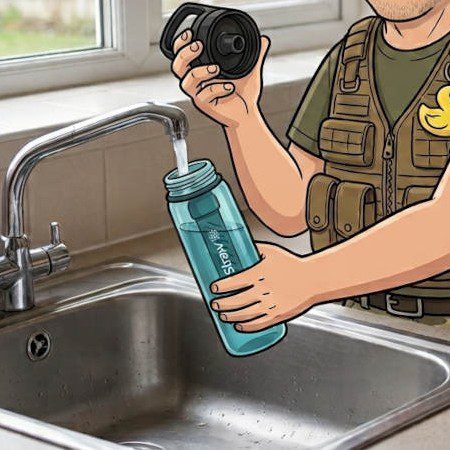

🦆 Keith
Don’t Be Keith
Keith stores water in old plastic containers in the loft, rotates nothing, and is confused when it tastes of 2011.
Frequently Asked Questions
Can I store water in old milk cartons?
NO. Milk proteins are almost impossible to fully remove from the plastic pores. Even a microscopic amount will cause a bacterial explosion in your water supply within weeks.
Does stored water need bleach?
If you are filling from a UK tap, it is already chlorinated. If storing for over 1 year in a Jerry Can, you can add 2 drops of unscented, thin household bleach (4-6% chlorine) per litre, but only if the seal has been compromised. But for better and safer options see our guide Water Purification & Safety
What about the loft tank?
In most modern UK homes, the loft tank is “Header” water for the central heating or hot water, often containing dust, dead insects, or rust. It is not potable unless boiled or filtered and purified.
Build Your Resilience
Further Reading: Related Guides
- Water Purification & Safety
- Emergency Hygiene Guide
- Emergency Sanitation Guide
- How to Prepare for a Power Cut
- UK Home Flood Defence
- How to Unfreeze Pipes
- Home Emergency Kit
All our guides can be found listed on our resilience hub.
Gear We’ve Tested & Reviewed
- Aquatabs 8.5mg Water Purification Tablets
- LifeStraw Go Series Water Filter Bottle
- Forest Fundamentals Millbank Filtration Bag
All our reviews can be found on our reviews and resources page.