
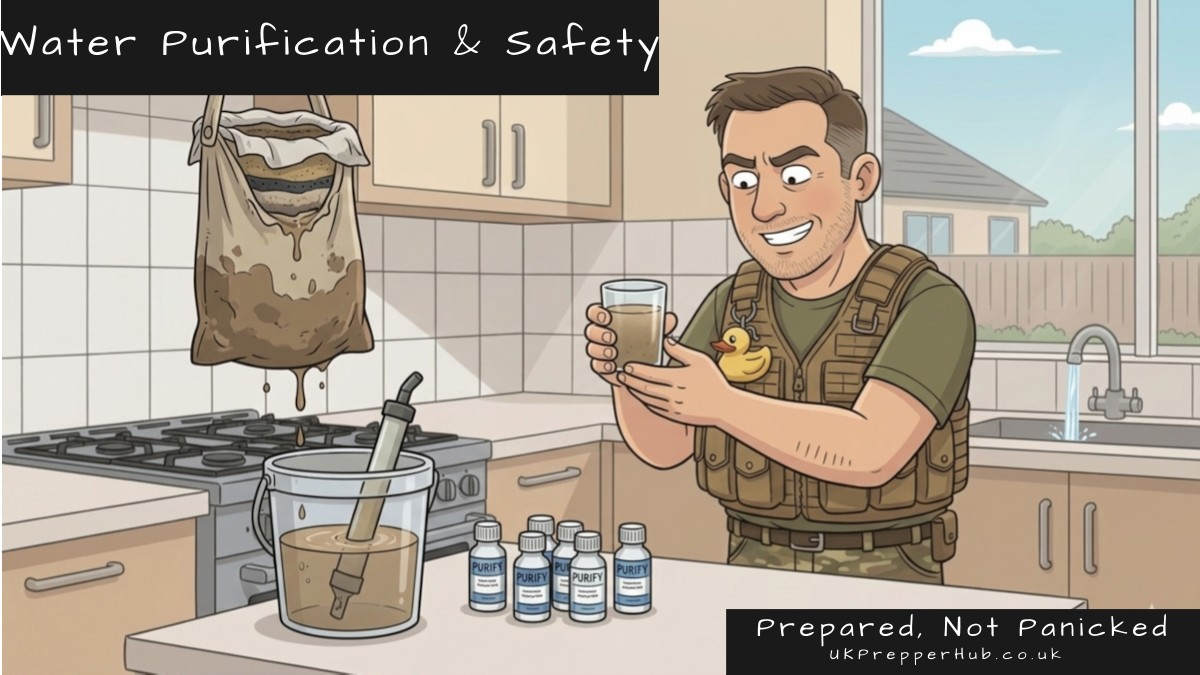
When the taps run dry—whether from burst mains, contamination alerts, or prolonged power cuts—knowing how to make water safe becomes critical. But here’s what most survival guides won’t tell you straight: there is no purification tablet or filter on the market that will remove heavy metals, agricultural chemicals, road traffic pollution, or field runoff.
This isn’t about camping trips or “prepping for the apocalypse.” This is about understanding the fundamental limitations of water purification technology and knowing which method actually works for the contamination you’re facing.
Understanding Water Contamination in the UK
Before you buy any purification kit, you need to understand what you’re filtering. UK water contamination falls into three distinct categories, and no single method removes all three.
Biological Contamination
This is what most purification products target: bacteria, viruses, protozoa, and parasites. Common sources in UK emergencies include:
- Sewage overflow from storm drains during flooding
- Agricultural runoff containing livestock waste (E. coli, Cryptosporidium)
- Wildlife contamination in streams and rivers
- Biofilm growth in stored water after 3+ days
- Cross-contamination during “boil water” notices
Good news: Biological threats are relatively easy to neutralise with boiling, UV light, or chemical treatment.
Chemical Contamination
This is where purification tablets and basic filters fail completely. UK chemical threats include:
- Pesticides and herbicides from agricultural runoff (glyphosate, neonicotinoids)
- Nitrates from fertiliser leaching into groundwater
- Pharmaceuticals (antibiotics, hormones) from sewage treatment plants
- Industrial solvents (benzene, toluene) near urban areas
- Fuel and oil contamination from roads and motorways
- PFAS (“forever chemicals”) from industrial sites and firefighting foam
Critical limitation: Standard camping filters and purification tablets do not remove these. You need activated carbon filtration at minimum—and even that won’t catch everything.
Heavy Metal Contamination
The silent threat. Heavy metals accumulate in your body over time and cause serious health problems. UK sources include:
- Lead from old plumbing (homes built pre-1970)
- Copper from corroded pipes during water stagnation
- Arsenic in groundwater (parts of Cornwall, Devon, Somerset)
- Cadmium and mercury near industrial sites or former mines
- Zinc from galvanised pipe degradation
Critical reality check: Purification tablets, UV sterilisers, and hollow-fibre filters cannot remove heavy metals. You need ion exchange resins or reverse osmosis—technologies not found in portable survival kits.
Boiling: The Gold Standard (With Limitations)
Boiling is the only purification method that requires zero equipment and works in every emergency. It kills all biological threats—bacteria, viruses, protozoan cysts, parasites—with complete reliability.
How Long to Boil
NHS guidance is clear: one minute of rolling boil at sea level. At altitude (above 2,000 metres—irrelevant for most of the UK), extend to three minutes.
Don’t overcomplicate this. Once you see large bubbles breaking the surface continuously, that’s a rolling boil. Hold it for 60 seconds. Done.
What Boiling Doesn’t Remove
Boiling is brilliant for pathogens. It’s useless for:
- Heavy metals (lead, arsenic, mercury)—these remain and may even concentrate as water evaporates
- Chemicals and pesticides—heat doesn’t break down most organic compounds
- Particulates (dirt, sediment)—you’ll need to filter or settle these first
- Bad taste from chlorine, iron, or sulphur—flavour issues persist
Practical advice: If your water source is biologically contaminated but chemically clean (rainwater collection, stored mains water during a boil notice), boiling is perfect. If you’re taking water from a river near farmland or roads, boiling alone isn’t enough.

🐔 Chicken Licken
Did You Know?
Boiling kills every biological threat, but does nothing to heavy metals — and as water boils down, the metals left behind actually concentrate. People assume boiling fixes everything. I’ve been saying it doesn’t for years. I’ve been saying it.
Fuel Efficiency
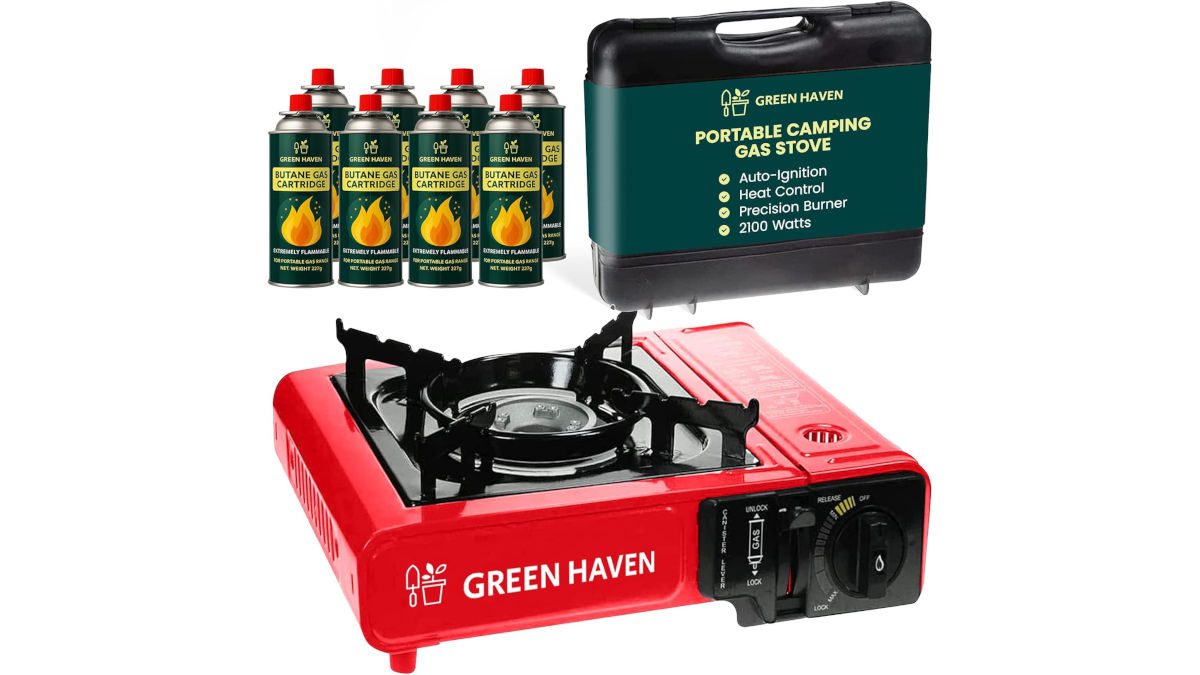
One litre of water requires about 0.1 kWh of energy to boil — roughly 10–15 minutes on a camping stove using one butane canister. For a family of four drinking 8 litres per day, that’s 1–2 canisters daily. Stock accordingly.
Portable Gas Stove with Carry Case & 8 Butane Cartridges
Boils the kettle and cooks a proper meal on top of your hob when the power goes, with no electricity at all.
Purification Tablets: Convenient but Limited
Water purification tablets (chlorine dioxide, iodine, or sodium dichloroisocyanurate) are compact, lightweight, and effective against biological threats. They’re excellent for emergency top-up when you can’t boil.
What Tablets Actually Do
Purification tablets release chemical disinfectants that destroy bacteria and viruses within 30 minutes to 4 hours (check packet instructions). Some brands claim protozoan effectiveness, but treatment times extend significantly—often 4+ hours for Giardia and Cryptosporidium.
Critical Limitations
Tablets do not remove:
- Heavy metals (lead, arsenic, copper)
- Agricultural chemicals (pesticides, herbicides, nitrates)
- Road pollution (fuel, oil, brake dust)
- Industrial contaminants (solvents, PFAS)
- Particulates (sediment, dirt)—pre-filter required
Tablets also leave an aftertaste (chlorine or iodine), which some people find unpleasant. Vitamin C powder neutralises iodine taste but doesn’t remove contaminants.
When to Use Tablets
Ideal scenarios:
- Treating stored rainwater during power cuts when you can’t boil
- Backup disinfection for suspect mains water during “boil water” notices
- Emergency treatment of clear spring or stream water in rural areas (low chemical risk)
- Topping up camping supplies or emergency kits
Avoid tablets for: Urban streams, farm runoff, industrial areas, or any water with visible pollution or strong odours. The biological threat may be handled, but chemical contamination remains.
Aquatabs 8.5mg Water Purification Tablets
Drop a tablet in, wait 30 minutes, drink: 100 Aquatabs in a resealable pouch for the grab bag, the car and the mountain stream.
Our Full Review: Aquatabs →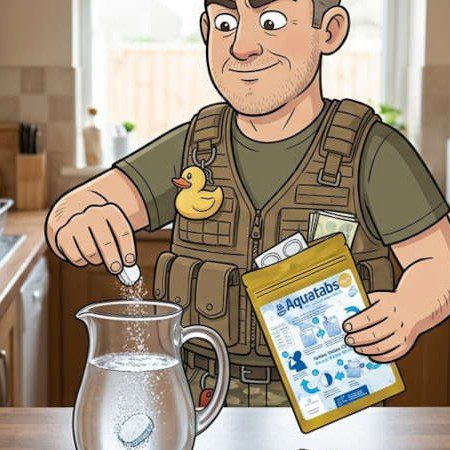
Portable Water Filters: What They Actually Remove
Camping filters and survival straws are marketed as “complete purification systems.” They’re not. Understanding filter specifications is essential to avoid false security. If you purchase a fine filtration system, ensure you pass any water first through a
Forest Fundamentals Millbank Bag
A handmade UK canvas Millbank bag that strips the mud, silt and grit out of water butt, pond or stream water, so your tablets and filters can do their job.
Our Full Review: Forest Fundamentals Millbank Bag →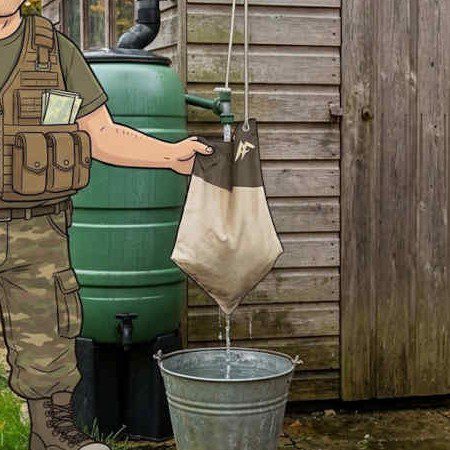
Filter Types and Micron Ratings
Portable filters use different technologies, each with distinct limitations:
Hollow-fibre membrane filters (0.1 to 0.01 microns):
Do not remove: Viruses (too small), chemicals, heavy metals, dissolved salts
Remove: Bacteria, protozoa, sediment, particulates
Typical examples: Sawyer Mini, LifeStraw Go Series, MSR filters
LifeStraw Go Series Water Filter Bottle
Two-stage filter bottle that removes bacteria, parasites and microplastics as you drink, for grab bags, the car and any tap away from home.
Our Full Review: LifeStraw Go →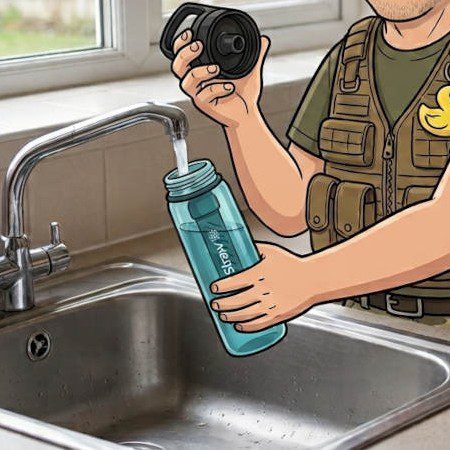
Activated carbon filters:
- Remove: Chlorine, bad taste/odour, some organic chemicals (pesticides, VOCs)
- Typical examples: Brita-style filters, inline carbon blocks
- Do not remove: Bacteria, viruses, heavy metals (unless specifically ion-exchange enhanced), nitrates, fluoride
Ceramic filters (0.2 to 0.9 microns):
- Remove: Bacteria, protozoa, sediment
- Often combined with activated carbon for taste improvement
- Do not remove: Viruses, chemicals (unless carbon-enhanced), heavy metals
The Virus Problem
Most portable filters do not remove viruses. Viruses are 0.004 to 0.1 microns—smaller than bacteria. A 0.1-micron filter catches bacteria but lets viruses through.
In the UK, viral contamination is less common than in developing countries (our sewage treatment generally works), but during flooding or sewage overflow events, viruses become a real risk. If you’re filtering floodwater or urban streams, you need either:
- A purifier (not just a filter) with 0.01-micron rating or smaller, or
- Chemical post-treatment (tablets), or
- Boiling after filtration
The Heavy Metal and Chemical Reality
This bears repeating: standard camping filters do not remove heavy metals or agricultural chemicals.
If your filter doesn’t explicitly state “removes lead,” “removes arsenic,” or “NSF 53 certified for heavy metals,” then it doesn’t remove them. Marketing terms like “99.9% of contaminants” refer only to bacteria and protozoa—not chemicals or metals.
Activated carbon helps with some organic chemicals (pesticides, solvents), but it’s not a guarantee. Carbon saturates over time and loses effectiveness—manufacturers rarely tell you when that happens.
When Portable Filters Work
Best use cases:
- Clear streams in rural upland areas (low chemical/heavy metal risk)
- Rainwater harvesting (paired with first-flush diverters to remove roof debris)
- Pre-filtering sediment before boiling or chemical treatment
- Improving taste of treated mains water during emergencies
- Daily carry water bottles that double as emergency filtration — the LifeStraw Go Series filter bottle is ideal for this
🐔 Chicken Licken
Did You Know?
UK tap water meets strict safety standards but boil water notices do happen — the solution is simpler than most people think
📋 Calm Clarissa
My printable water checklist has the tablets, filter bottle and filter bag from this guide, plus how much clean water to store so you rarely need them. Free to download, obviously.
Download the Free Checklist →Frequently Asked Questions
Can I use my Brita filter in a water emergency?
A Brita-style activated carbon filter removes chlorine taste and some organic chemicals, but won’t kill bacteria or viruses. In a genuine emergency with suspect mains water, use boiling or purification tablets as your primary method. Run the water through your Brita afterwards to improve the taste if you want — but don’t rely on it as your safety measure.
How long do water purification tablets take to work?
For Aquatabs and similar chlorine-based tablets, 30 minutes at temperatures above 15°C. In cold water (below 15°C), extend to 60 minutes. For protozoa like Cryptosporidium or Giardia, contact time extends significantly — often 4 hours or more. Always check the specific packet instructions, as formulations vary.
Is rainwater safe to drink in the UK?
Rain itself is essentially distilled water — biologically clean when it falls. The problem is what it picks up from your roof: bird droppings, moss, lead from old flashing, and atmospheric pollutants. Always collect with a first-flush diverter and treat before drinking. Boil it, use tablets, or run it through a quality filter. Do not drink it directly off the roof.
Does boiling remove chemicals and heavy metals?
No. Boiling kills biological threats reliably. But agricultural chemicals, industrial pollutants, and heavy metals are not removed by heat. Some chemicals can actually concentrate as water evaporates during boiling. If chemical or heavy metal contamination is your risk, you need activated carbon filtration or distillation — not boiling alone.
Can I drink floodwater if I boil it?
Only as a last resort. Floodwater in urban or agricultural areas typically contains sewage, agricultural chemicals, heavy metals, and fuel or oil contamination. Boiling handles the biological element only. If you have any alternative — stored water, rainwater, even heavily treated mains supply — use that instead. If floodwater is genuinely your only option, combine settling, filtration, activated carbon, and boiling as best you can. Understand it may still not be fully safe.
How much emergency water should I store per person?
The NHS emergency minimum for drinking is 2 litres per person per day. In practice, add at least a litre for basic cooking and hygiene — so 3 litres per person per day is a more realistic working figure. For a 72-hour supply, that’s 9 litres per person. For a household of four over 72 hours, 36 litres minimum. See our Emergency Water Storage guide for container selection, rotation schedules, and how to scale for longer scenarios.
Build Your Resilience
Further Reading: Related Guides
- Emergency Water Storage
- How to Prepare for a Power Cut
- 72-Hour Grab Bag
- Get Home Bag
- UK Home Flood Defence
- Emergency Hygiene Guide
All our guides can be found listed on our resilience hub.
Gear We’ve Tested & Reviewed
- LifeStraw Go Series Water Filter Bottle
- Aquatabs 8.5mg Water Purification Tablets
- Forest Fundamentals Millbank Filtration Bag
All our reviews can be found on our reviews and resources page.