

Is Russia a threat to the UK? Ask the retired couple who watched a Russian frigate fire warning shots across their yacht in the Channel. Ask the fighter controllers at RAF Lossiemouth who’ve scrambled jets more than once this year. Ask the National Cyber Security Centre, which has spent 2026 warning that Russian state hackers are hijacking home and business routers to reach the systems that keep Britain running. Or ask the UK’s own Chief of the Defence Staff, who put it in plain English in June: Britain is being “probed, challenged, tested” — in the sky, at sea, beneath the waves, and now online too.
None of this means an invasion is coming, and nobody here is telling you to dig a bunker in the back garden. What follows is a dated, sourced look at what’s actually happened — going back two years, not two weeks, across four separate domains — and a calm, practical read on what it genuinely means for a UK household. Spoiler: it’s not about jets over your house. It’s about the same boring basics we’ve been banging on about all along.
So, Is Russia a Threat to the UK? Two Years of Evidence
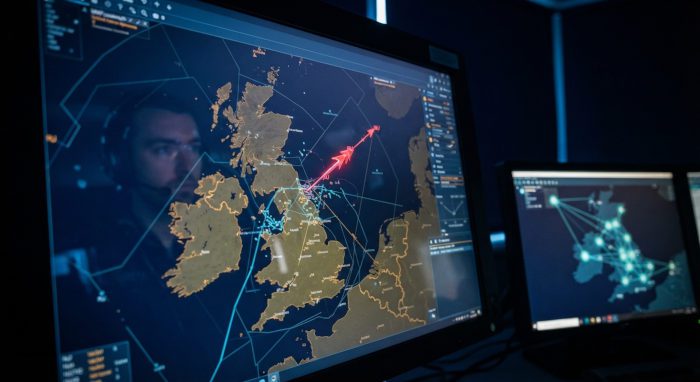
Start with 2024. Over several nights that November, unidentified drones were spotted circling RAF Lakenheath, RAF Mildenhall and RAF Feltwell — three of the biggest US airbases in Europe, with proposals to station nuclear weapons at Lakenheath in the years ahead. A later investigation linked three individuals with alleged Kremlin ties to the sightings, including one man who’d reportedly posed as a fruit picker while scouting land near the base. Around 60 British troops were deployed to help the US Air Force get to the bottom of it.
Through 2025, the pattern kept surfacing. In July, the Royal Navy shadowed the Russian submarine Novorossiysk as it surfaced and sailed through the North Sea and Channel. In November, the Russian intelligence-gathering vessel Yantar — a ship specifically built to survey, map and potentially interfere with undersea cables — entered UK waters for the second time that year, and pointed lasers at RAF pilots sent to monitor it. By December, the Navy was three days into another operation tracking the Kilo-class submarine Krasnodar through the Strait of Dover. The Royal Navy’s own figures put it simply: a 30% rise in Russian vessels transiting UK waters over the past two years.
Then 2026 picked up where 2025 left off. In April, RAF Typhoons scrambled from Lossiemouth after a suspected Russian bomber approached the Shetland sector — while, over the same weeks, four Royal Navy ships spent a month shadowing a Russian frigate, landing ship and submarine through the Channel and North Sea. In June, the frigate Admiral Grigorovich fired warning shots across the bow of a British-registered yacht 20 nautical miles off the Isle of Wight. In July, a Russian Bear-F aircraft repeatedly buzzed the carrier HMS Prince of Wales at low altitude in the Norwegian Sea, dropping ten sonobuoys and ignoring radio contact, before two F-35s escorted it away. Days later, the frigate Neustrashimy ran an unannounced 30-minute live-fire drill with its main gun 46 miles off Plymouth — without filing the routine international safety notice ships normally give before live firing near one of the busiest shipping lanes on Earth.

Chief of the Defence Staff Sir Richard Knighton summed up the pattern in June: Russia has been “probing, challenging, testing our defences,” and is “raising the stakes and risks crossing a line.”
Beneath the Waves: Why the Cables Matter More Than the Jets

Jets and warships make headlines. What doesn’t get reported nearly as often is the thing GCHQ is actually most worried about: the seabed. GCHQ has publicly warned that Russia is targeting the UK’s subsea cables and pipelines directly, describing a “highly capable” undersea sabotage capability actively scoping British infrastructure. Around 300 sanctioned “shadow fleet” vessels transited in or near UK waters between January and March 2026 alone — and one of them, the tanker MV Indri, was tracked loitering for 48 hours directly over an undersea cable west of Ireland on its way home.
This isn’t a new theory. It’s exactly what the Yantar was built to do back in 2025 — map the exact cable and pipeline routes that carry the UK’s internet traffic, power interconnectors and gas supply to and from Europe.

🐔 Chicken Licken
Did You Know?
The surprising fact that undersea cable damage causing outages is already common from anchors and fishing trawlers alone — deliberate sabotage doesn’t need to be dramatic to be effective, it just needs to happen at the wrong moment
Complete Guide
Off Grid Communications
When mobile networks go down and the internet disappears, most households are completely cut off — and most people have no backup plan. This guide covers every practical option for staying in contact during a UK emergency, from emergency radio and walkie-talkies to mesh networks and satellite communicators.
Read the Full Guide: Off Grid Communications →
The Gas Question
Energy think tank E3G has flagged something UK households rarely hear about: gas supply into Britain is concentrated at just four locations. Take one of those out — deliberately, or through an “accident” that’s hard to prove either way — and the ripple effect wouldn’t be theoretical. Industry body OEUK is now pushing for North Sea oil, gas and wind infrastructure to be formally classed as critical national infrastructure, specifically because of the Russian threat picture.
Complete Guide
Heating Without Electricity
Maintaining core body temperature is your absolute priority. However, desperation often leads to dangerous choices. This guide outlines how to heat your home—and yourself—safely when the radiators go cold.

The Cyber Front

The fourth domain doesn’t need a warship at all. In July 2026, the NCSC joined 18 agencies across 12 countries to warn that a Russian FSB-linked group known as “Centre 16” has been exploiting weak security on ordinary routers — including home and small business routers, not just corporate networks — to gain footholds inside critical national infrastructure. Sectors named as targets: communications, energy, healthcare, government, and financial services. Separately, a suspected Russia-linked breach exposed UK government credentials providing access to organisations including the NHS, energy suppliers and pharmaceutical companies. The UK’s own cyber chief now says the most serious attacks on Britain come from Russia, Iran and China — and hostile states were behind three-quarters of all attacks on UK critical infrastructure between June 2025 and May 2026.
It’s not hypothetical elsewhere, either. The UK and EU formally attributed a December 2025 cyberattack on Poland’s power grid to Russia’s FSB — proof that when one of these attempts actually lands, the result is exactly the kind of thing this report keeps coming back to: ordinary people losing power.
Complete Guide
Household OPSEC Guide
OPSEC is a military term that’s filtered down to civilian life. OPSEC is short for “OPerational SECurity”. At its core, it means protecting information that could be used to harm you.
It’s Not Just the UK Being Tested
This is a pattern across NATO’s whole northern and eastern flank, not a UK-specific grudge. In March 2026, a Russian Su-30 fighter breached Estonian airspace near Vaindloo Island for around a minute, prompting a formal diplomatic protest. Across the Baltic more broadly, suspected shadow-fleet cable sabotage has become frequent enough that it’s driving a visible ramp-up in regional NATO defence posture. The UK is one target among several allies being leaned on at the same time — which, if anything, makes the pattern easier to read as deliberate rather than coincidental.
What This Actually Means for Your Household
Here’s the bit that matters. None of the above means tanks on the beach. What it describes is “grey-zone” pressure — deliberately calibrated to stay just inside what’s legally defensible while still making a point. Naval expert Emma Salisbury called the Plymouth live-fire incident exactly that: designed to generate “visible reassertion of Russian naval presence” without crossing into anything that forces a direct military response.
The realistic risk to a UK household from any of this isn’t invasion. It’s a cut cable, a damaged pipeline junction, a hijacked router, or a compromised interconnector causing a short, localised loss of power, gas or broadband — the same kind of disruption a bad storm causes, just with a different cause written on the incident report. Which means the sensible response is exactly the boring one we’ve always recommended: know how you’d cope without power, without gas central heating, and without a working phone signal for a day or two.

🦆 Keith
Don’t Be Keith
Keith reads this article and immediately starts pricing up a fallout shelter and a decommissioned military radio set, while still not owning a torch that works or having changed his router’s default password
Complete Guide
Power Cut Survival Guide
The master 72-hour blueprint. Vital steps for staying warm, connected, and safe when the UK grid fails during extreme weather.
Build Your Resilience
Further Reading: Related Guides
Gear We've Tested & Reviewed
📡 Find Us Everywhere
Daily briefings, prep guides, and real-time updates across every platform. Pick yours.
Free. No commitment. Stay anonymous on WhatsApp & Telegram.
Stay Informed on UK Preparedness
Join our newsletter for UK-specific preparedness tips, product recommendations, and real-world advice for households.
Subscribe to Our Newsletter