
For around £25, the Baofeng UV-5R gives you a handheld radio that can transmit and receive across two entire frequency bands — the same VHF and UHF spectrum used by professional services, marine operators, aviation, and licensed amateur radio users. It stores 128 programmable channels, outputs 5 watts of power, picks up FM radio, and includes a built-in torch. It costs less than a takeaway for two.
It is also the radio that causes more confusion — and more quiet, unintentional law-breaking — than almost any other piece of kit in UK prepper circles.
This guide covers what the Baofeng UV-5R actually is, what you can and cannot legally do with it in the UK, how to transmit legally, and whether it belongs in your emergency kit. No assumed knowledge. No jargon without an explanation.
What Is the Baofeng UV-5R?
The Baofeng UV-5R is a dual-band handheld radio made by Baofeng (also branded as Pofung), a Chinese manufacturer that began producing affordable radios in the early 2010s. “Dual band” simply means it covers two separate frequency ranges rather than one. In the UV-5R’s case, those two bands are VHF and UHF.
VHF stands for Very High Frequency — specifically the range from 136 to 174 megahertz (MHz) on the UV-5R. VHF signals travel well in open country and are used by aviation, marine services, and some amateur radio operators. The 2-metre amateur radio band (144–146MHz) lives in VHF.
UHF stands for Ultra High Frequency — the UV-5R covers 400 to 520MHz. UHF is better at penetrating buildings and urban environments. It is the band used by PMR446 walkie talkies (446MHz), many business radios, and the 70-centimetre amateur radio band (430–440MHz).
Megahertz is just a way of counting radio waves — how many times per second the signal oscillates. Higher numbers mean shorter waves, which behave differently in the real world. What matters practically is this: covering both VHF and UHF gives the UV-5R remarkable versatility. A single radio at this price point can reach across both the bands that most matter for emergency communication.
The UV-5R transmits at 5 watts on high power or 1 watt on low power. For comparison, PMR446 walkie talkies transmit at 500 milliwatts — half a watt. On high power, the UV-5R produces ten times that output. This is part of what makes it popular, and part of what makes it legally complicated.
Other specifications: a backlit LCD screen showing channel number and frequency, 128 programmable channel slots, a built-in FM broadcast radio receiver, a torch function on the top of the unit, and a 1800mAh rechargeable lithium-ion battery. It is a physically small radio — fits in a jacket pocket — with a removable stubby antenna and a standard SMA connector that accepts a wide range of aftermarket antennas. The whole package weighs around 200 grams with battery.
This is why it became the prepper community’s default recommendation: it does everything radios costing five or ten times as much can do, it is widely available, and the price of getting it wrong is a £25 mistake rather than a £250 one. The catch is that doing it right requires understanding what you have actually bought.
BAOFENG UV-5RM Plus
Brief description of why this product is worth considering. ‘teaste’tpyetext like “is this the best?”.
Our Full Review: BAOFENG UV-5RM Plus →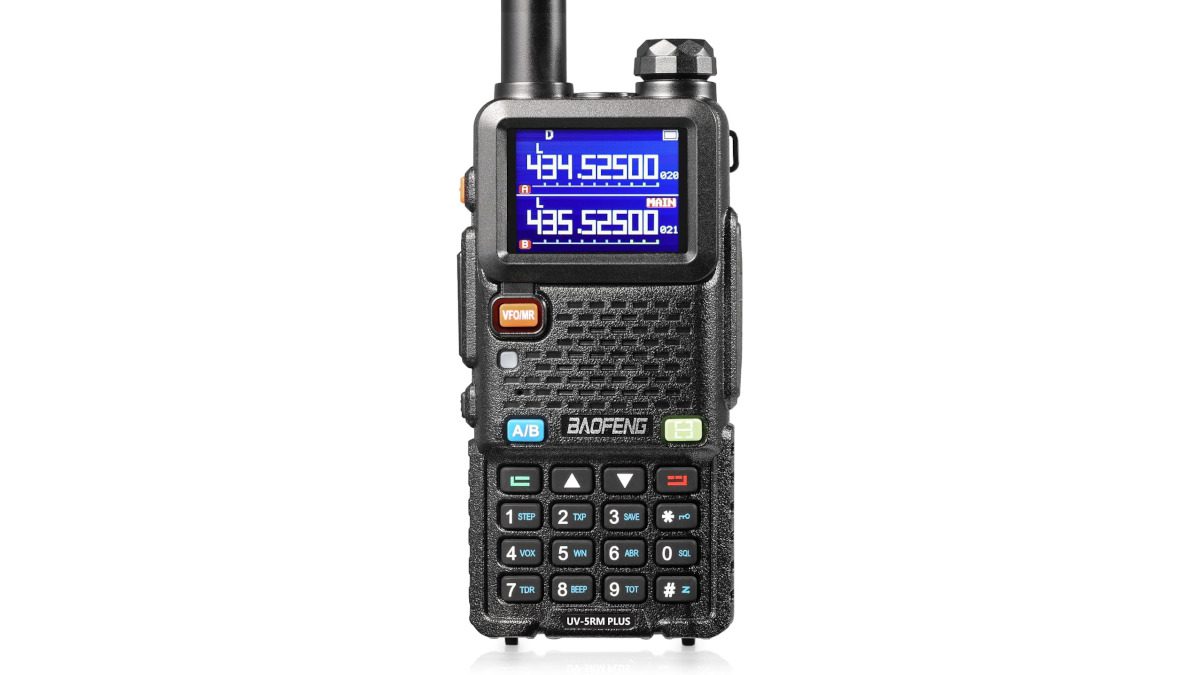
What Is Legal in the UK — and What Is Not
This is the section most Baofeng guides skip or bury in vague disclaimers. Here it is plainly.
Owning a Baofeng UV-5R is completely legal. No licence is needed to buy one, have one, or keep it in your kit. There is no registration requirement. You can order one today and hold it in your hand without breaking any law.
Receiving — listening — is legal on all frequencies. You can tune the UV-5R to any frequency it can receive and listen freely. Aviation chatter, marine weather broadcasts, local amateur radio activity — all of this is accessible without any licence. (You must not disclose what you overhear from private communications, but the act of listening is not an offence.)
Transmitting is where the law applies. To transmit legally in the UK, you need the appropriate licence for the frequency you are using. For the vast majority of what the UV-5R covers, that means an amateur radio licence. Without one, the only legal use of the UV-5R’s transmit function is silence.
Three specific mistakes are common in UK prepper communities and all three are illegal.
Transmitting on PMR446 frequencies. PMR446 (446.0–446.2MHz) falls within the UV-5R’s UHF range, so it is technically possible to programme those frequencies into the radio and key up. This is not legal. PMR446 is a licence-exempt service but it comes with strict equipment conditions: the radio must be CE-approved for PMR446 use, must have a fixed (non-removable) antenna, and must not exceed 500 milliwatts output power. The UV-5R runs 5 watts with a removable antenna and has no CE certification for PMR446. Transmitting on PMR446 with a UV-5R breaches Ofcom regulations.
Transmitting on marine VHF frequencies. The UV-5R’s VHF range covers the international maritime VHF band (156–174MHz). Transmitting on marine channels without a Short Range Certificate and a properly licensed maritime radio is illegal, and in a genuine maritime emergency it creates dangerous interference with distress communications.
Transmitting on aviation, emergency service, or business frequencies. Anything else within the UV-5R’s range — aviation, commercial operators, emergency services — requires specific authorisation. Transmitting on aviation frequencies is a serious criminal offence. There is no grey area and no emergency exemption that justifies doing it.
What you can legally transmit on — with the right licence — are the amateur radio bands within the UV-5R’s range: the 2-metre band (144–146MHz, VHF) and the 70-centimetre band (430–440MHz, UHF). The path to that licence is considerably more straightforward than most people assume.

🦆 Keith
Don’t Be Keith
Keith owns three Baofengs. They are programmed to PMR446 frequencies, Channel 19 CB, and a police frequency he found on a forum in 2019. He has never once looked into whether any of this is legal. None of it is. He refers to the whole setup as his communications suite.
Motorola T42 PMR446 Twin Pack
A £27 twin pack of Motorola PMR446 radios that run on AAA batteries — licence-free, instant pair, and the easiest first step in a household emergency comms setup.
Our Full Review: Motorola T42 Twin Pack →
The Foundation Licence: The Legitimate Path
Amateur radio licensing in the UK comes in three tiers: Foundation, Intermediate, and Full. For most preppers, Foundation is the only level you need to consider. It gives you legal access to the UV-5R’s two most useful bands and takes considerably less effort to obtain than its name might suggest.
The Foundation licence exam consists of around 26 multiple-choice questions. There is no morse code — that requirement was removed from UK amateur licensing decades ago. The exam covers basic radio theory (frequencies, propagation, how signals travel), operating procedures (how to establish contact, how to identify yourself), and licence conditions (what you can and cannot do). The RSGB provides free study materials on its website and most people pass comfortably with a few evenings of reading.
Exams can be taken online or at a local amateur radio club — the RSGB website lists clubs by location. The exam fee is approximately £27.50. Processing takes a few days and Ofcom then assigns you a personal callsign: a unique identifier in the format M6XXX or M7XXX that you use whenever you transmit, so other operators know who they are hearing. The callsign is yours for life as long as you hold the licence.
With a Foundation licence, you are authorised to transmit on the amateur radio bands — including the 2-metre (144–146MHz) and 70-centimetre (430–440MHz) bands that fall within the UV-5R’s range. Foundation licence holders can operate up to 10 watts on HF bands and up to 50 watts on VHF and UHF. The UV-5R’s 5-watt output is well within these limits.
For preppers specifically, the Foundation licence opens up things worth knowing about. The UK amateur radio repeater network is a system of relay stations positioned on hilltops, tall buildings, and elevated sites around the country. A repeater receives a signal on one frequency and simultaneously re-transmits it on another, at higher power and from a better location — extending range far beyond what a handheld radio can achieve on its own. A UV-5R programmed with local repeater frequencies can communicate across ranges that would be impossible otherwise.
The Foundation licence also provides access to RAYNET — the Radio Amateurs’ Emergency Network — a volunteer organisation that provides communications support to local authorities and emergency services during civil emergencies across the UK. RAYNET groups are active across the country and have supported major incidents including flooding, search and rescue operations, and large-scale events. If resilient communications in a genuine emergency scenario are the reason you are interested in this radio, this is the community worth knowing about.
The RSGB website (rsgb.org) is the place to start: free study materials, club finder, and online exam booking.
Receive-Only: What You Can Monitor Without Any Licence
Even if you never transmit, the Baofeng UV-5R has genuine practical value as a monitoring device. Here is what you can hear with no licence required.
Aviation communications. The VHF air band (118–136MHz) carries air traffic control communications at UK airports. The UV-5R can receive this range. During major disruptions — airspace closures, security incidents, significant weather — monitoring ATC provides a real-time picture of what is actually happening far faster than news sources or official channels. You are hearing the conversations between aircraft and ground controllers as they happen.
Marine VHF. Channel 16 (156.8MHz) is the international maritime distress and calling channel, monitored continuously by HM Coastguard. Weather forecasts, small craft warnings, and safety announcements are broadcast on marine VHF channels at regular intervals. During a coastal flooding event, storm, or any maritime emergency in your area, this is where operational information is broadcast openly. You do not need any licence to listen.
Amateur radio activity. The 2-metre and 70-centimetre bands carry continuous amateur radio activity in the UK. During genuine emergencies, local amateur radio operators often establish informal nets that share ground-truth information — road conditions, local flooding, infrastructure status — faster than official channels. Listening costs nothing and requires no licence.
FM broadcast radio. The UV-5R includes a standard FM broadcast receiver covering 65–108MHz. Not sophisticated, but it works as a conventional FM radio when you need it.
A note on police frequencies. UK police and emergency services have almost entirely migrated from analogue VHF and UHF to digital encrypted systems — primarily Airwave (TETRA), which is being supplemented by a newer digital network. These digital transmissions sound like noise on an analogue receiver. Even if you tuned to the right frequency, you would hear nothing intelligible. The practical answer to “can I listen to police with a Baofeng” is: not meaningfully, and you are wasting channels trying.
Programming with CHIRP
The UV-5R’s factory programming software — variously labelled VIP Software or BaoComm depending on your source — has a well-earned reputation for being difficult to install, unstable on modern operating systems, and genuinely unpleasant to use. Fortunately, almost nobody who takes this radio seriously uses it.
CHIRP is the standard solution. It is free, open-source radio programming software that works with the Baofeng UV-5R and several hundred other radio models. The principle is simple: you download CHIRP onto your computer, connect the UV-5R via a programming cable, and work in a clean spreadsheet-style interface where each row is a channel. You enter the frequency, give it a name, set any tone squelch settings (we will cover those in a moment), and write the data back to the radio. It takes minutes rather than hours, and the result is reliable.
CHIRP also supports importing frequency lists shared by the amateur radio community. Someone in your area has likely already built a channel list of local repeaters, calling frequencies, and marine channels — you can import their file directly rather than building from scratch. The CHIRP forums and RadioReference.com are good sources for these.
One term you will encounter: CTCSS tones (Continuous Tone-Coded Squelch System). Many repeaters and shared frequencies use a sub-audible tone transmitted alongside the voice signal. Your radio only opens its speaker when it hears the correct tone — preventing it from opening every time any random signal appears on the frequency. CHIRP lets you set these tones easily. Without the correct tone programmed in, a repeater may not respond to your transmissions even if you are on the right frequency.
To use CHIRP you need a programming cable — a cable with a 2.5mm/3.5mm dual-plug connector at the radio end and USB at the computer end. Many UV-5R packages include one; check before assuming. Generic cables work. Branded Baofeng cables work. The clone cables with cheap chips occasionally cause driver issues on Windows — if programming fails, the cable is usually the culprit.
CHIRP is available at chirp.danplanet.com.
What to Look for When Buying
Model variants. The UV-5R is the original and most widely available. The UV-5R+ introduced minor hardware refinements — improved receiver filtering, slightly better build quality — but covers the same frequencies and uses the same accessories. The UV-82 is a physically larger radio with a dual push-to-talk button design that some users prefer for one-handed operation; again, same frequency coverage and CHIRP compatible. Start with the UV-5R unless you have a specific reason to go otherwise.
Counterfeits. The Baofeng market on Amazon and similar platforms is heavily affected by counterfeits and low-quality clones that use inferior components, misrepresent their output power, and often perform significantly worse than the genuine article. A genuine Baofeng UV-5R should cost between £20 and £35 in the UK. Anything below £15 is almost certainly counterfeit. Check seller reviews carefully, look at seller history, and be wary of prices that seem too good. A counterfeit radio may transmit at a fraction of its rated power and receive poorly — undermining the entire reason you bought it.
The programming cable. Often included with the radio, sometimes not. Essential for CHIRP. Confirm it is in the box before ordering, or add one to your basket. Budget around £5–8 for a standalone cable.
Antenna upgrade. The stock antenna shipped with the UV-5R is functional but not impressive. The Nagoya NA-771 is the most widely recommended aftermarket antenna for this radio — it fits the standard SMA connector, improves both transmit range and receive sensitivity noticeably, and costs under £10. It is a straightforward, cost-effective upgrade worth making.
Spare battery. Genuine Baofeng replacement 1800mAh packs are available cheaply. Having a charged spare removes range anxiety on longer deployments and provides a very easy way to extend operating time without needing a power source.
Is It Worth Buying?
Without a Foundation licence, the UV-5R is a capable receive-only scanner that costs £25 and fits in a pocket. That has value. Aviation monitoring, marine weather, amateur radio activity — these are genuinely useful listening sources in an emergency context, and the UV-5R accesses all of them cheaply.
With a Foundation licence, it becomes a radio you can actually transmit on across two amateur radio bands, with access to the UK repeater network and RAYNET infrastructure. The combination of the licence (an afternoon’s study and £27.50) and the radio (£25) gives you a genuinely capable emergency communications setup for under £60 total.
The mistake most people make is buying it assuming they can use it on PMR446 or CB frequencies, discovering the legal reality, and leaving it in a drawer. The alternative — getting the Foundation licence and using it properly — is within easy reach of anyone motivated enough to read a guide this long.
BAOFENG UV-5RM Plus
Brief description of why this product is worth considering. ‘teaste’tpyetext like “is this the best?”.
Our Full Review: BAOFENG UV-5RM Plus →Frequently Asked Questions
Do I need a licence to own a Baofeng UV-5R in the UK?
No. The radio is legal to buy and own in the UK without any licence or registration. You only need a licence to transmit — and only on the frequency ranges that require one.
Can I use the Baofeng UV-5R on PMR446 channels?
Not legally. PMR446 is a licence-exempt service, but it requires CE-approved equipment operating at a maximum of 500mW with a fixed antenna. The UV-5R runs at 5 watts with a removable antenna and has no CE certification for PMR446 use. Transmitting on PMR446 with a UV-5R breaches Ofcom regulations regardless of power setting. If you want legal two-way comms on PMR446, use a CE-approved PMR446 radio.
Will a Baofeng UV-5R communicate with my PMR446 walkie talkies?
Technically the frequencies overlap, but doing so is illegal — see above. Additionally, the different power levels and equipment types make this an unreliable and legally problematic combination. Use PMR446 radios to communicate with PMR446 radios.
What is the Foundation licence and how hard is it to get?
The Foundation licence is the entry-level UK amateur radio licence administered by the RSGB and issued by Ofcom. It involves a multiple-choice exam of around 26 questions covering basic radio theory, operating procedures, and licence conditions. Free study materials are available on the RSGB website. The exam can be taken online or at a local radio club. It costs approximately £27.50 and most people pass with a few evenings of study. Once issued, you receive a personal callsign and are authorised to transmit on amateur radio bands including 144–146MHz and 430–440MHz — the two main bands covered by the UV-5R.
Can I listen to police frequencies with a Baofeng UV-5R?
In practice, no — not usefully. UK police and emergency services have migrated from analogue radio to encrypted digital systems (primarily Airwave TETRA). These transmit on the same frequency bands but the signal sounds like noise on an analogue receiver. You will not hear intelligible voice communications. The practical answer is that there is nothing useful to hear even if you tune to the right frequency.
What is the range of a Baofeng UV-5R?
Range varies significantly with terrain, antenna, and obstacles. In open flat countryside, handheld-to-handheld range might be 3–5 miles. In urban environments with buildings in the way, this can drop to under a mile. With a good external antenna or access to a local repeater (available with a Foundation licence), range increases considerably. No single number is accurate for all conditions — treat any manufacturer range claim with healthy scepticism.
What is the difference between the UV-5R, UV-5R+, and UV-82?
The UV-5R is the original model. The UV-5R+ introduced improved receiver filtering and minor build refinements. The UV-82 is a larger radio with dual push-to-talk buttons and slightly better build quality. All three cover the same frequency ranges, use the same accessories and batteries, and are programmed via CHIRP in the same way. For most users, the standard UV-5R is sufficient.
Is the Baofeng UV-5R waterproof?
No. The UV-5R has no IP rating for water resistance. It will tolerate light splashes but should not be used in rain or near water without protection. Aftermarket silicone cases and covers are available cheaply and provide basic splash resistance. Do not submerge it.
What antenna should I buy for the UV-5R?
The Nagoya NA-771 is the most widely recommended upgrade antenna for the UV-5R. It fits the standard SMA connector, improves performance on both VHF and UHF bands noticeably, and costs under £10. It is a straightforward upgrade that is worth making from the start.
Build Your Resilience
Further Reading: Related Guides
Gear We've Tested & Reviewed
All our reviews can be found on our reviews and resources page.