
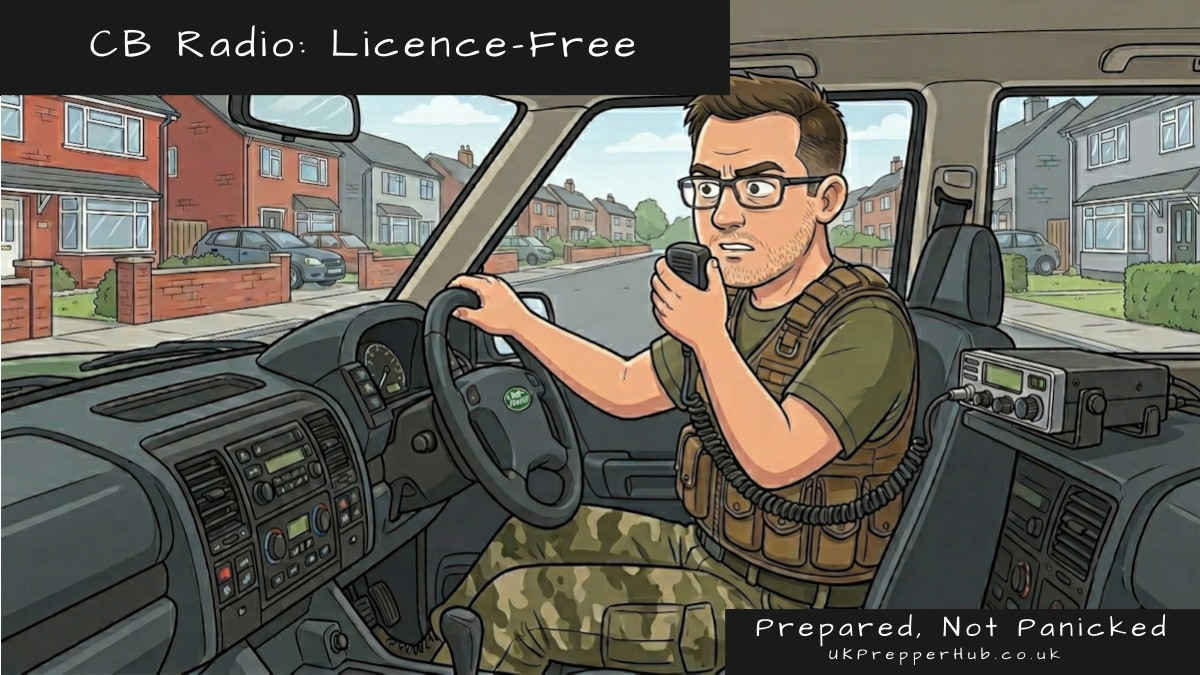
Your PMR446 walkie talkie is a solid first step. But it runs at 500 milliwatts and operates on line-of-sight UHF frequencies. The moment a hill, a row of houses, or a stretch of dense woodland gets between you and whoever you are trying to reach, the signal starts to break up.
CB radio is the next rung up. It operates on 27MHz — a lower frequency that behaves very differently from PMR446. It bends around obstacles more willingly, penetrates terrain more effectively, and under the right conditions travels considerably further. Legal power in the UK is 4 watts in standard AM mode, or 12 watts in SSB (Single Sideband) mode — a more efficient way of using the airwaves that gets significantly more signal from the same equipment, and eight to twenty-four times the power of a PMR446 radio.
No licence. No registration. Covered by Ofcom licence exemption since 2006. Buy a radio, connect an antenna, start transmitting.
What Is CB Radio?
Citizens Band radio has been part of the UK landscape since the early 1980s, when the government legalised it after years of illegal use driven largely by the lorry-driving community. The equipment evolved, the community stayed, and 40 years later CB remains one of the most practical short-to-medium range emergency communication tools available without a licence or any formal qualification.
The UK operates CB radio on 40 channels in the 27MHz band. Standard AM (Amplitude Modulation) mode is legal up to 4 watts. SSB — Single Sideband — is a more efficient transmission mode that concentrates the signal and is legal up to 12 watts in the UK, giving considerably more range from the same antenna. Most entry-level CB radios cover AM. SSB radios cost a little more but offer significantly greater reach when you need it.
At 27MHz, CB signals behave differently to PMR446’s 446MHz. Lower frequencies travel further and penetrate obstacles more easily. Under certain atmospheric conditions, 27MHz signals can travel extraordinary distances via ionospheric reflection — a phenomenon known as “skip”. In an everyday emergency context, what matters is simpler: CB reaches further than walkie talkies, without a licence.
How Far Does It Reach?
Range depends on three variables: power, antenna, and terrain.
On a mobile antenna — a vertical whip fitted to a vehicle roof — most 4-watt AM CB radios achieve reliable communication at 1 to 5 miles across typical mixed UK terrain. Clear line of sight pushes that further. SSB at 12 watts with a good antenna can reach 15 to 30 miles under favourable conditions.
The single biggest factor, beyond transmit power, is the antenna. A long, well-positioned antenna will consistently outperform a short one. This is why vehicle-mounted CB installations — with a roof-mounted whip giving good elevation above ground — outperform handheld CB units, which necessarily compromise on antenna length for practical portability.
A home base station setup — a CB radio connected to a proper external antenna mounted on the roof or chimney — can achieve ranges well beyond a vehicle installation. For serious off-grid communication planning, a home base station with an external antenna is the configuration worth working towards.
The Three Channels Every UK Household Should Know
CB radio has 40 channels, but in an emergency context, three matter most.
Channel 9 — Emergency. The internationally recognised CB emergency channel. If you need assistance, call on Channel 9. If you want to monitor for distress calls in your area during a crisis, leave a set scanning Channel 9. It is the closest CB radio has to a formal emergency frequency standard in the UK.
Channel 14 — UK National Calling Channel. The agreed UK general calling frequency. If you want to make contact with an unknown station in your area, start here. Once contact is established, agree a working channel and move off 14 to keep the calling channel clear for others.
Channel 19 — Road Users. Predominantly used by lorry drivers, hauliers, and commercial road users. During any significant road infrastructure event — fuel shortages, major accidents, motorway closures — Channel 19 becomes a live feed of what is actually happening on the roads near you. Not official. Often far more current than any news report.

🐔 Chicken Licken
Did You Know?
Channel 19 isn’t just truck drivers chatting. In any fuel shortage, road closure or supply disruption, those drivers have the real picture while everyone else is waiting for a news bulletin. I’ve been saying it for years — a CB in the car, parked on Channel 19 during any major incident, and you’ll know what’s happening before the reporters even get there.
CB Radio in Your Vehicle
A vehicle-mounted CB installation is the most practical starting point for most households. A radio fitted in the cab, powered from the vehicle’s 12V electrical system, and connected to a roof-mounted or magnetic-mount whip antenna gives you two-way communication capability every time you drive.
Installation is straightforward: route a power cable from the radio to the vehicle fuse box, run the antenna coaxial cable from the radio to the roof. Most mobile CB radios include the necessary cabling and connectors. A magnetic-mount antenna gets you operational in under an hour; a permanent drilled-roof installation takes longer but delivers cleaner signal and a more secure antenna mount.
In a fuel shortage, a major accident, or any extended road disruption, a vehicle CB lets you gather real intelligence — queue locations, road conditions, fuel availability — before committing to a route. Channel 19 is your frequency for this.
Running CB Radio Off-Grid: The 12V Advantage
One of CB radio’s most useful properties for emergency preparedness is one that often gets overlooked: virtually every mobile CB radio runs on 12V DC — the same voltage as your car battery.
This opens up a capability that extends well beyond vehicle use.
A leisure battery — a deep-cycle 12V battery designed for sustained discharge — can power a CB radio base station at home, completely independently of the mains grid. Keep the leisure battery maintained with a small solar panel and an MPPT charge controller (a device that regulates the energy coming from the panel and maximises how efficiently it charges the battery), and you have a communications setup that functions regardless of what is happening with the national power supply.
A 20 to 30 watt solar panel and a 100Ah leisure battery will run a CB radio base station comfortably for extended periods, even during shorter UK winter daylight hours. The radio itself draws relatively little current — typically 1 to 2 amps on receive, up to 4 or 5 amps when transmitting at 4 watts AM.
This is the same 12V principle used in off-grid caravans, narrowboats, and remote agricultural setups across the UK. It works, it is not complicated, and it transforms a CB radio from a vehicle accessory into a genuinely independent home communications hub that keeps operating when the grid does not.
We will be covering 12V off-grid power setups — solar panels, leisure batteries, and charge controllers — in a dedicated guide later in this cluster.
What to Look for When Buying
The CB radio market is well established and genuine value is available at all price points. A few decisions before buying.
Mobile, base station, or handheld? Mobile radios — designed for vehicle installation — are the most practical starting point for most households. Base station radios are designed for fixed home use with external antennas and typically include more features. Handheld CB radios exist but are the weakest option: short antenna, limited power, restricted battery life. Start with a mobile radio.
AM only, or SSB? Entry-level CB radios cover AM mode, which is legal up to 4 watts. SSB radios add Single Sideband capability — legal up to 12 watts in the UK — and deliver noticeably more range. Worth the extra cost if reaching further matters to you.
12V compatibility. Standard mobile CB radios operate on 12V DC and connect directly to a vehicle battery or leisure battery with no modification. Base station radios often require a separate 12V power supply unit — factor this into the budget if home base station use is the goal.
Budget for the antenna separately. A better antenna improves range more than spending extra on radio features. For vehicle use, a half-wave whip or loaded whip is a sound choice. For home base station use, a rooftop external antenna is the goal.
Well-regarded brands in the UK include President, Midland, and Thunderpole. All have solid reputations, strong UK availability, and operate within UK legal specifications out of the box.
THUNDERPOLE T-800 CB Radio
A £65 12V CB radio from one of the UK’s oldest CB brands — no licence, no registration, 80 channels, and a direct button to Channel 19 where the real road intelligence lives.
Our Full Review: THUNDERPOLE T-800 CB Radio →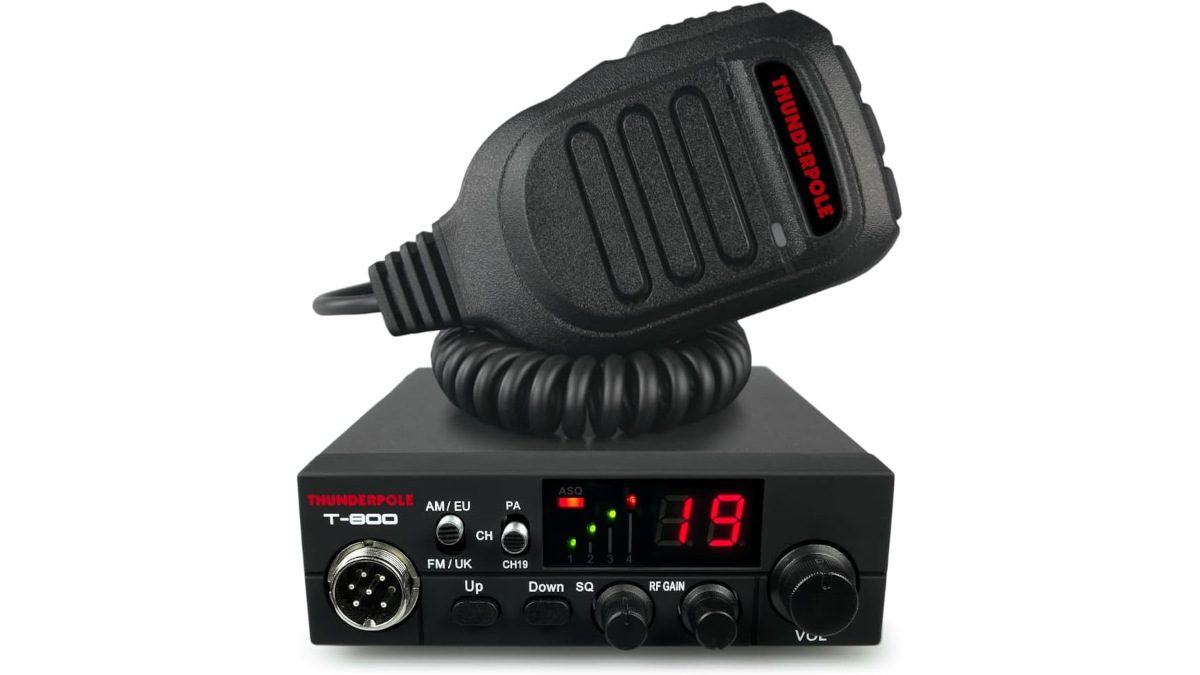
The Limitations — and What Comes Next
CB radio is not without trade-offs worth knowing about before you buy.
The antenna is physically larger than PMR446 equipment. A proper quarter-wave whip for 27MHz is around 2.7 metres; practical loaded antennas reduce this considerably, but a CB installation will always be more visible than a compact walkie talkie.
27MHz is also subject to atmospheric interference in ways that higher frequencies are not. Ionospheric conditions can cause distant signals — sometimes from mainland Europe — to bleed onto UK channels. In a local emergency operating over short ranges, this is largely irrelevant. In the right atmospheric conditions, it can be a nuisance on otherwise quiet channels.
Like PMR446, all CB transmissions are unencrypted and receivable by anyone with a receiver on the same channel. This is a feature as much as a limitation — Channel 9 monitoring works precisely because transmissions are open — but CB is not a platform for sensitive communication.
For households that want to go further — mesh networking without infrastructure, off-grid text-based communication, or licensed operation at greater power — the next tiers in this cluster cover LoRa, Meshtastic, and amateur radio. For the majority of UK households planning for a grid-down scenario, CB radio is a practical, affordable, and immediately deployable upgrade from PMR446 walkie talkies.
Frequently Asked Questions
Do I need a licence to use CB radio in the UK?
No. CB radio was deregulated in the UK in 2006 under Ofcom’s IR 2027 exemption. You can buy a CB radio and transmit legally on all 40 UK CB channels without any licence, registration, or call sign. The only requirement is that the equipment operates within the specified power and frequency limits.
What is the difference between AM and SSB on CB radio?
AM (Amplitude Modulation) is the standard CB mode, legal up to 4 watts in the UK. SSB (Single Sideband) is a more efficient transmission mode — rather than broadcasting a full waveform, it strips out the parts that carry no information and concentrates the signal, making the same power output go further. SSB is legal up to 12 watts in the UK, giving substantially more range than 4-watt AM. Most entry-level radios cover AM only; SSB radios cost more but deliver noticeably better performance.
Can I use a CB radio as a home base station?
Yes. A mobile CB radio connected to a 12V power supply and a rooftop external antenna makes an effective home base station. Dedicated base station CB radios are also available and typically include more features designed for fixed-location use, such as built-in power supplies and a wider range of antenna connector options.
How does CB radio compare to PMR446 walkie talkies?
PMR446 radios transmit at 500mW on UHF frequencies (446MHz). CB radios transmit at up to 4 watts AM or 12 watts SSB on the 27MHz band. In practical terms, CB provides greater range — particularly across mixed terrain — better penetration of obstacles, and access to Channel 19 for road-user intelligence. The trade-offs are larger antenna requirements and bulkier equipment overall.
What channel should I monitor during an emergency?
Channel 9 is the recognised international CB emergency channel and the primary frequency for distress calls. Channel 14 is the UK national calling channel, used for making initial contact with unknown stations. Channel 19 is monitored by lorry drivers and commercial road users and provides real-time road intelligence during infrastructure disruptions.
Can I run a CB radio without mains power?
Yes. Most mobile CB radios operate on 12V DC — the same as a car battery. A leisure battery maintained by a small solar panel and MPPT charge controller provides a fully off-grid, mains-independent power source for a home CB base station. The radio’s power draw is low enough that even a modest solar setup can sustain it for extended periods.
Are CB radios legal to use anywhere in the UK?
Yes, within the UK. CB radio is covered by Ofcom licence exemption and can be used across England, Scotland, Wales, and Northern Ireland on the designated 40-channel band without restriction. The exemption covers both AM and SSB modes within the specified power limits.
Build Your Resilience
Further Reading: Related Guides
Gear We've Tested & Reviewed
All our reviews can be found on our reviews and resources page.