

Right now, in the Thames Estuary less than two miles off Sheerness, engineers are cutting the masts off a wreck that has sat there, loaded with live wartime explosives, since 1944. SS Richard Montgomery is a sunken American Liberty ship carrying an estimated 1,400 tonnes of unexploded munitions — bombs, fragmentation clusters, white phosphorus — that nobody has dared touch in 82 years. The government’s own risk modelling says a full detonation would throw a column of debris 3,000 metres into the air and send a five-metre tsunami into Sheerness. This month, for the first time ever, someone is finally working on it.
That should be a bigger story than it is. It isn’t currently news-cycle material — no UK prepper site has covered it, and most people who’ve heard of it think of it as a local Kent curiosity rather than what government-commissioned research has called one of the largest unintentional stockpiles of live explosives in the world. This is what’s actually happening with the SS Richard Montgomery, what the risk genuinely is, and — because this is UK Prepper Hub — what it means if you’re one of the households who’d actually feel it.
What Is the SS Richard Montgomery?
SS Richard Montgomery was a Liberty ship — one of over 2,700 mass-produced American cargo vessels built to keep the Allied war effort supplied. She was built in 1943 in Jacksonville, Florida, and in August 1944 left the US loaded with roughly 7,000 tonnes of munitions, bound for the Allied invasion effort in Cherbourg, France.
She never got there. Arriving in the Thames Estuary, she was directed to anchor at the Great Nore Anchorage off Sheerness to await a convoy. On 20 August 1944, in a Force 8 gale, she dragged her anchor and ran aground on a sandbank about 250 metres from the Medway Approach Channel. The ship had a draft of 31 feet in water only 24 feet deep — she was, in effect, too heavy for where she’d been told to sit. As the tide dropped, her hull cracked along a structural weak point and she began to break in two.
A stevedore crew worked frantically to unload the cargo using the ship’s own equipment, managing to remove roughly half of it — some 3,000 to 5,000 tonnes, depending on the source — before the forward holds flooded completely on 25 September 1944 and the salvage effort was abandoned. The ship settled onto the sandbank in two pieces, and everything left in the aft holds has stayed exactly where it was ever since.
The subsequent inquiry made uncomfortable reading at the time. Several nearby ships had noticed the SS Richard Montgomery drifting towards the sandbank and sounded their sirens to raise the alarm — but the ship’s chief officer never reacted, and never woke the captain, a failure he was later unable to explain. The board of inquiry found that the harbourmaster’s own choice of anchorage had put the ship in danger in the first place, and reinstated the captain to full duty within a week.
How the Wreck Is Actually Watched, Day to Day
Since 1973, SS Richard Montgomery has been designated under the Protection of Wrecks Act as a dangerous wreck, with a no-entry exclusion zone marked on official Admiralty charts. Medway Ports is contracted by the Maritime and Coastguard Agency to maintain a ring of warning buoys around the site, keep warning notices fastened to the masts, and monitor the wreck under 24-hour radar surveillance from an operations room that has the wreck in sight. Divers were used for early surveys, but since the early 1990s most monitoring has switched to high-resolution sonar, given how poor underwater visibility is on site — supplemented periodically by ultrasonic hull-thickness testing to track how quickly the structure is deteriorating.
The official position, restated in every survey since 2000, is that the risk of a major explosion is “believed to be remote” and, if anything, decreasing over time as the ordnance sits in seawater. That’s the exact assumption Professor Alexander has pushed back on directly — and it’s worth noting that “remote” was never the same claim as “zero,” which is presumably why the monitoring contract has run continuously for over 50 years rather than being quietly wound down.
What’s Still Down There
According to the Maritime and Coastguard Agency’s own background report, the wreck still holds around 1,400 tonnes of ordnance: 286 2,000lb high-explosive bombs, 4,439 1,000lb bombs, 1,925 500lb bombs, over 500 fragmentation bombs plus nearly 2,300 cases of fragmentation clusters, and various smoke bombs, booster charges and pyrotechnics — some of them filled with white phosphorus, which is stable underwater but can ignite spontaneously if it’s ever exposed to air.
Nobody has ever gone back for it, and there’s a specific, well-documented reason why. In 1967, a similar operation was attempted on a Polish cargo wreck called Kielce, which had sunk off Folkestone in 1946 carrying a much smaller cargo of wartime munitions. During preliminary work to neutralise it, Kielce detonated — with a force equivalent to a 4.5-magnitude earthquake, digging a 20-foot crater in the seabed and bringing what contemporary reports described as “panic and chaos” to Folkestone, several miles away. Kielce sat in deeper water, further from land, and carried only a fraction of what SS Richard Montgomery is still holding. The MCA’s own 2000 report is explicit about the lesson: the wreck “should not be disturbed by moving it or attempting to unload it” — doing so could increase the risk of exactly the kind of accident that happened with Kielce.
What Would Actually Happen If It Went Off
This isn’t guesswork — it’s been formally modelled more than once. In 1970, the Royal Military College of Science produced an assessment of a full-cargo detonation for the government, cited in a 2019 House of Lords debate by Lord Harris of Haringey: a 3,000-metre-high column of water and debris, and a five-metre-high tsunami that “would overwhelm Sheerness,” with the wave potentially carrying burning white phosphorus toward the petrochemical and LNG storage facilities on the Isle of Grain — which today holds around 1 million cubic metres of liquefied natural gas.
In January 2022, New Scientist commissioned researchers at Defence Research and Development Canada to independently model the same scenario. Their conclusion, as reported at the time: “A blast on this scale would be one of the world’s biggest non-nuclear explosions, causing widespread destruction and death.” For scale, the 1917 Halifax Harbour explosion — still one of history’s largest accidental non-nuclear detonations — destroyed roughly 400 acres of a Canadian city and killed around 2,000 people from a smaller quantity of explosives than what’s still sitting in SS Richard Montgomery’s holds.
The impact isn’t confined to Kent, either. On the Essex side of the estuary, Thorpe Bay’s waterfront properties sit directly across the water from the wreck, and Canvey Island has been specifically named in impact modelling for the predicted tsunami. Southend, five miles away, would still expect broken windows and structural damage. This is a two-county risk, not a Sheerness-only story.
Why the Masts Are Coming Down Right Now
The three masts of the SS Richard Montgomery have been visible above the water at every state of the tide for 82 years — they’re the reason the wreck is a known local landmark rather than an invisible hazard. But they’re also ageing structure sitting directly on top of the cargo, and that’s the actual reason this work is happening now: as the masts corrode, there’s a real, documented concern that they could eventually collapse onto the wreck under their own weight, potentially disturbing the ordnance beneath or scattering it. This isn’t a new worry — plans to remove the masts were first announced back in 2020, originally targeted for June 2022, and have been delayed repeatedly since.
The current £9.5 million operation, confirmed by the Department for Transport on 14 July 2026, involves building an underwater platform so specialist engineers from marine contractor Resolve can cut the three masts below the waterline over several weeks. Work began in early September and, as the BBC reported, is expected to finish by the end of the month, though the DfT has been clear that weather could push that back. An independent expert assessment — commissioned specifically for this operation — concluded it can be carried out “without increasing the risk posed by the explosives remaining onboard.” The masts themselves will go to the Historic Dockyard Chatham for conservation and eventual public display, a concession to genuine local sentiment: Kevin McKenna, the Labour MP for Sittingbourne and Sheppey, has called them “far more than wreckage” and “a cherished landmark.”
Even that reassurance hasn’t stopped the delays telling their own story. The most recent hold-up, reported locally, was caused by unidentified objects discovered near the masts during preparatory work — a reminder that even routine engineering near this wreck doesn’t stay routine for long. And not everyone accepts the government’s own underlying logic for why it’s taken 82 years to get here. Professor David Alexander, an expert in emergency planning and risk management at UCL, put it bluntly: “I think over the last 77 years the government has thought to itself ‘well, the longer we leave it, the safer it gets.’ It appears if you talk to experts in explosives, that is the opposite of the truth.”
The National Security Angle Nobody’s Talking About
Everything above is about accidental risk — degradation, collision, structural failure. There’s a separate, more recent thread that’s had far less attention: the possibility that a static, well-mapped, 82-year-old stockpile of live explosives sitting in one of the world’s busiest shipping estuaries is also a genuinely attractive target for deliberate harm.
Professor Alexander has been explicit about this too, describing the wreck as “a sitting duck” and “a national security threat hiding in plain sight” — a “perfect hybrid warfare target: high impact, low cost, and plausibly deniable.” Major Andrew Fox, a former Army officer and security specialist, has separately characterised this kind of “grey zone” activity — deniable, low-cost sabotage against infrastructure rather than open military action — as one of the biggest current threats to UK national security. LBC has also reported that an ally of Vladimir Putin reportedly suggested on Russian state television that Moscow should target the Montgomery specifically.
The precautions taken reflect that this isn’t dismissed as fantasy. A no-fly zone for drones was imposed within one nautical mile of the wreck in mid-2025 “for reasons of public safety” — a measure that wouldn’t exist if the only concern were slow structural decay. And the gap between “monitored” and “actually protected” has shown up in practice more than once: a Danish tanker carrying toluene reportedly had to be diverted just six minutes before entering the exclusion zone, and on one occasion it took 62 minutes for police to respond when a group of historians approached the wreck by boat.
Complete Guide
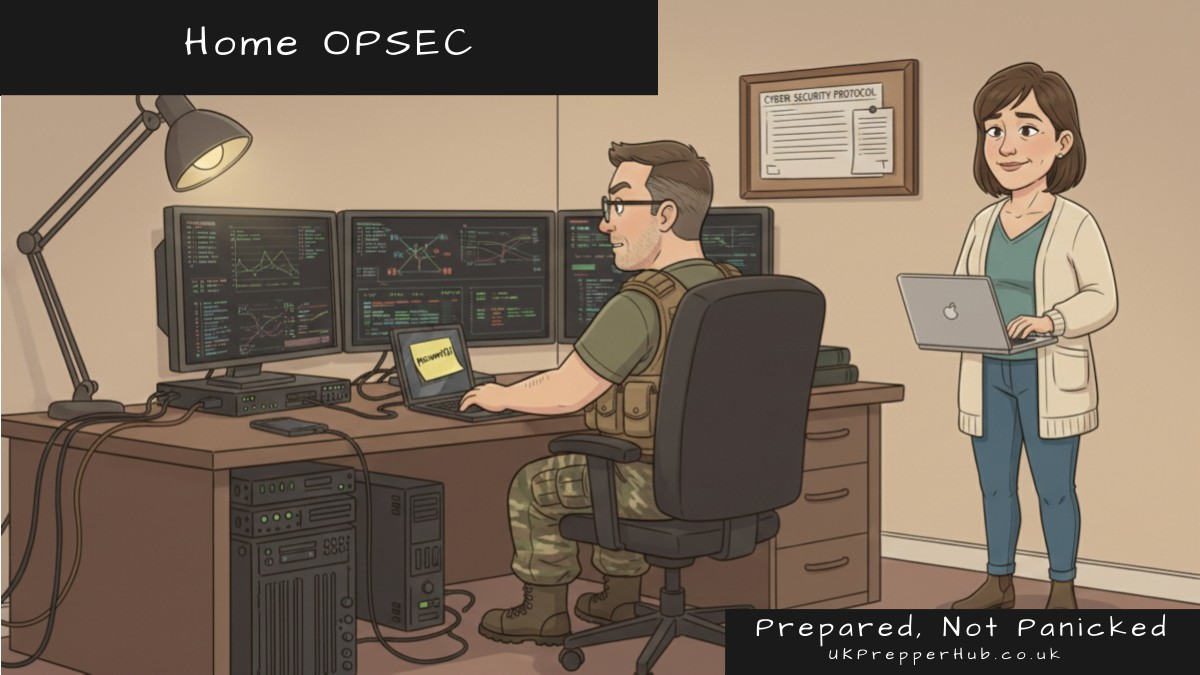
Household OPSEC Guide
OPSEC is a military term that’s filtered down to civilian life. OPSEC is short for “OPerational SECurity”. At its core, it means protecting information that could be used to harm you.
Even fiction keeps circling back to it. The wreck appeared, unnamed, as the central threat in the second series of Sky’s political thriller COBRA in 2021. This month, former Kent MP Gordon Henderson published a new spy novel, Operation Doppelganger, built around a plot to blow up the Montgomery. Writers keep reaching for it because the premise doesn’t need exaggerating — the ship, the cargo, and the consequences are all real.
Is There Actually a Plan If the Worst Happens?
Formally, yes. Responsibility for contingency planning sits with the Kent and Medway Resilience Forum, which brings together the emergency services and other first responders for the area. A government minister, Baroness Barran, told the House of Lords in 2019 that the Forum “is kept closely updated about the results of the survey and has wider plans for the safety of the area.”
In practice, the same 2019 debate raised concerns that have never really been resolved. Lord Harris of Haringey pointed out that the Isle of Sheppey and the Isle of Grain both have limited road access — meaning it’s genuinely unclear how emergency services would converge at speed, or how large numbers of residents would evacuate quickly, if it ever came to that. Lord Addington raised the same point independently. Professor Alexander has since gone further, calling Sheppey’s single road bridge “a single point of failure” and stating that no serious contingency reportedly exists for an actual major-explosion scenario — a striking claim given how long this risk has been known about.
There’s also a genuine missed-opportunity thread worth knowing about: a Dutch salvage firm, Smit, reportedly offered at one point to safely dispose of the wreck’s cargo, but the offer was never formally tendered. Lord Greenway, in the same 2019 debate, noted that a full removal has been estimated to cost tens of millions of pounds and would likely require evacuating Sheerness for the duration — which is presumably a large part of why, 82 years on, “leave it and monitor it” has remained the only policy anyone has actually implemented.
What This Actually Means for Your Household
If you live in Sheerness, on the Isle of Sheppey, in Southend, or anywhere else directly on the Thames Estuary, this is about as close to a genuinely named, government-modelled, worst-case local risk as it gets — and the honest read from the experts quoted above is that the local evacuation plan may not hold up to real-world geography if it’s ever tested. Knowing your own evacuation routes, keeping your documents somewhere grab-and-go, and having a bag already packed isn’t paranoia here — it’s exactly the kind of low-effort preparation that costs nothing and matters enormously if a single road bridge is ever the only way off an island for thousands of people at once.
For everyone else, the lesson is more general, and it’s one this site keeps coming back to: there are real, quietly-managed risks that your own government has already modelled in detail, budgeted for, and debated in Parliament — and most people have never heard of them, because they’re not dramatic enough for a news cycle until something actually goes wrong. Programme Yarrow and Exercise Turnstone were the same story in a different shape. This is just the one sitting in plain sight, with its masts visible at every low tide, for anyone who’s ever looked out across the Thames Estuary and wondered what those three shapes on the horizon actually were.

🐔 Chicken Licken
Did You Know?
I’ve been saying for years that something out there was going to be real, and it turns out one of them actually is — 1,400 tonnes of live WWII explosives, sitting under three rusting masts in the Thames, and the government’s own paperwork agrees with me for once
Complete Guide
Home Evacuation Plan
Most households freeze during an evacuation — not from fear, but from making fifteen decisions simultaneously under pressure for the first time. This guide walks you through the five decisions to make now, calmly, before you ever need them.
Read the Full Guide: Home Evacuation Plan →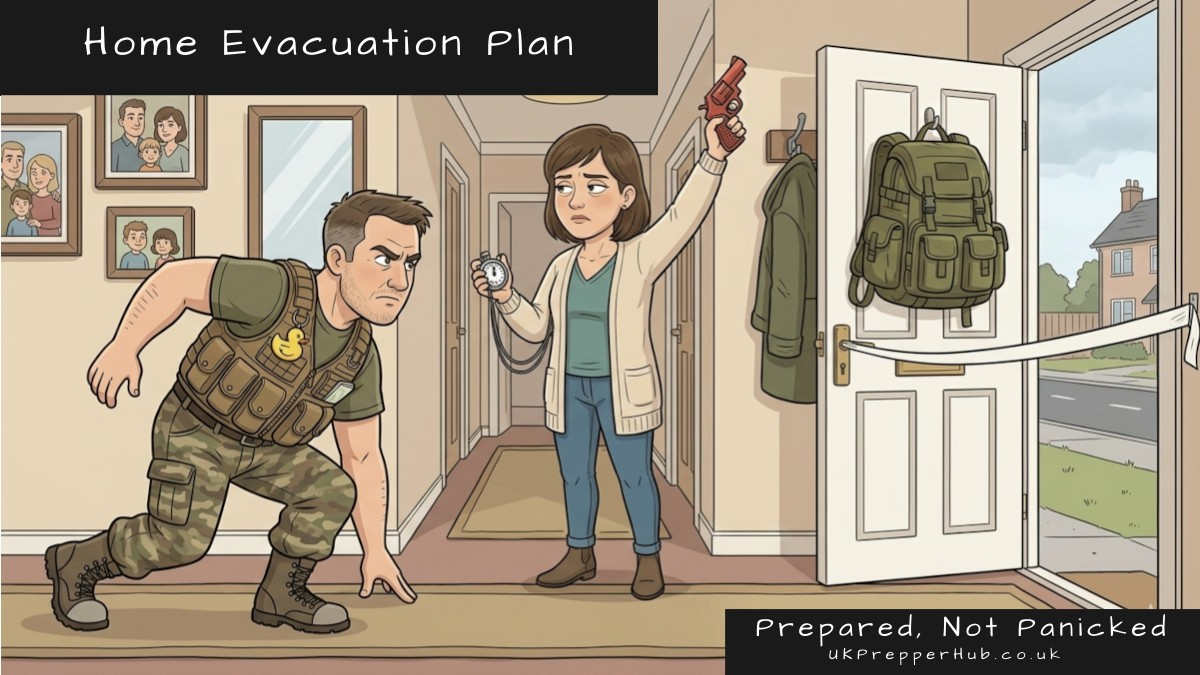

🪖 Black Panther
In My Previous Role…
“Grey zone hybrid warfare tactics” to anyone who’ll listen after reading one LBC article, while an actual named UCL professor and a former Army officer have been on the record about this exact threat for months — civilian version: just know where your local resilience forum’s advice is published
Complete Guide
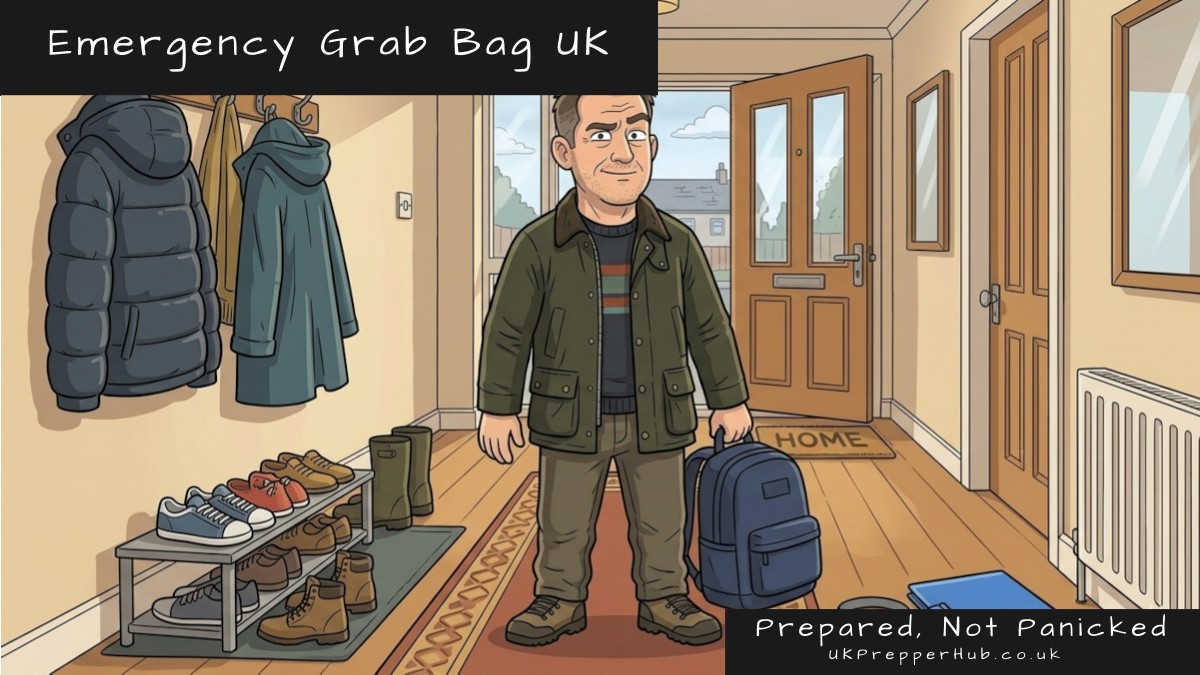
72-Hour UK Grab Bag
The ‘get out quick bag’ for rapid home evacuation in the event of fire, flood, or other incidents. Every essential for 3 days away from home in one bag.
Complete Guide
Protecting Your Important Documents
ost fireproof boxes don’t take A4. Most fireproof wallets don’t work. This guide covers what to actually buy, how to add digital backups, and how to waterproof your documents for 20p.
Read the Full Guide: Protecting Your Important Documents →
Frequently Asked Questions
What is the SS Richard Montgomery?
SS Richard Montgomery is a wrecked American Liberty ship that ran aground in the Thames Estuary near Sheerness in August 1944 while carrying wartime munitions. Around 1,400 tonnes of explosives remain in its holds to this day, and the wreck has been under continuous government monitoring since it sank.
Is the SS Richard Montgomery going to explode?
The official government position is that the risk of a major explosion is “believed to be remote,” and monitoring surveys have found the wreck to be in a stable condition. However, named experts in emergency planning have publicly disputed the assumption that the risk decreases simply with the passage of time.
Why are they removing the masts if disturbing the wreck is dangerous?
The masts sit above the waterline, separate from the cargo holds where the explosives are stored. The current operation only involves cutting the external mast structure, which an independent expert assessment concluded can be done without increasing the risk to the explosives themselves — unlike touching the cargo, which official reports have explicitly warned against.
What would actually happen if the SS Richard Montgomery exploded?
Government modelling from 1970, cited in Parliament, found a full detonation could throw a 3,000-metre column of water and debris into the air and generate a five-metre tsunami capable of overwhelming Sheerness. A 2022 assessment commissioned by New Scientist concluded it would be one of the world’s largest non-nuclear explosions.
Is there an evacuation plan if the worst happens?
Responsibility formally sits with the Kent and Medway Resilience Forum. However, MPs and named experts have repeatedly raised concerns that the limited road access to the Isle of Sheppey — a single bridge — makes a fast, large-scale evacuation genuinely difficult in practice.
Build Your Resilience
Further Reading: Related Guides
All our guides can be found listed on our resilience hub.
📡 Find Us Everywhere
Daily briefings, prep guides, and real-time updates across every platform. Pick yours.
Free. No commitment. Stay anonymous on WhatsApp & Telegram.
Stay Informed on UK Preparedness
Join our newsletter for UK-specific preparedness tips, product recommendations, and real-world advice for households.
Subscribe to Our Newsletter