
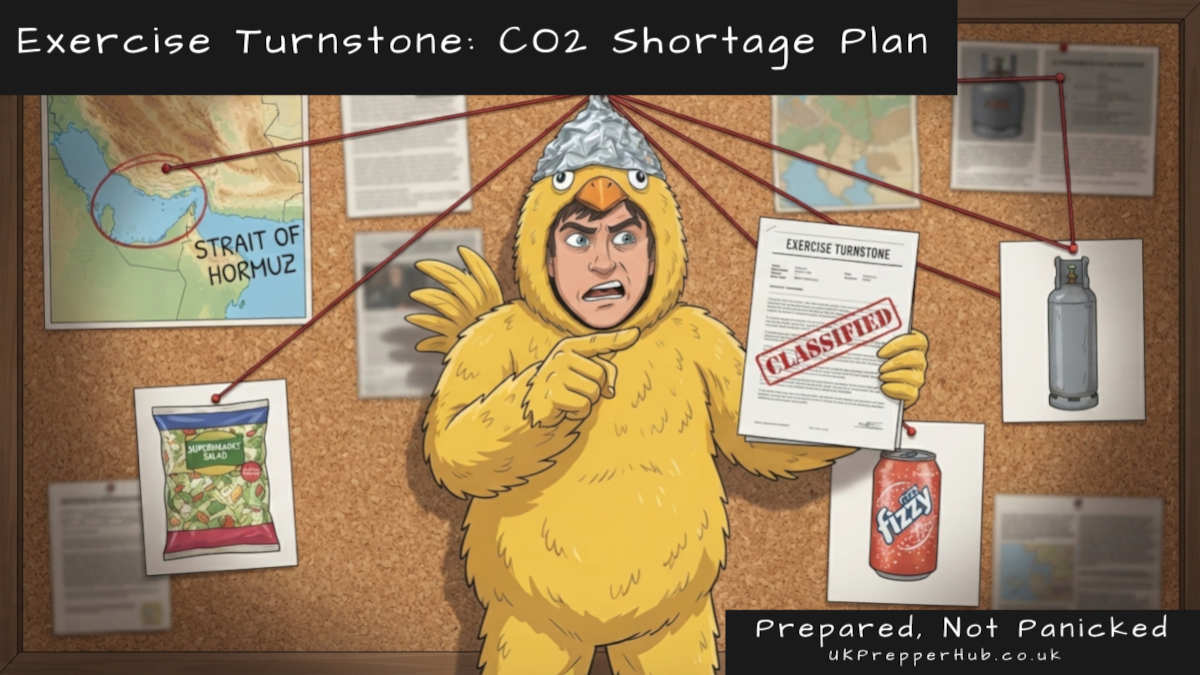
Somewhere in Whitehall, officials from Number 10, the Treasury and the Ministry of Defence have already war-gamed what happens if UK supermarket shelves run short of salad, sausages and fizzy drinks — not because of anything happening in Britain, but because of a war three thousand miles away. It’s called Exercise Turnstone, and unlike most things that get badged “secret government plan” online, this one is genuinely real, genuinely recent, and its trigger event — a war that’s closed one of the world’s busiest shipping lanes — is still unresolved as you read this.
No dramatic reveal needed here. Just what the exercise actually modelled, why a Gulf shipping lane can empty a British fridge, and the one thing that’s already happened once before — so this isn’t some hypothetical dressed up as news.
What Is Exercise Turnstone?
Exercise Turnstone is a classified scenario-planning exercise run by the government’s emergency committee, Cobra, with officials from Number 10, the Treasury and the Ministry of Defence rehearsing the UK’s response to a severe carbon dioxide (CO2) shortage. It was reported on in April 2026, based on documents seen by journalists — there’s no public gov.uk page for it by name, the same pattern as Programme Yarrow (the government’s separate week-long blackout plan) before that became public knowledge either.
The exercise modelled a deliberately stacked “reasonable worst-case scenario”: the Strait of Hormuz still closed with no permanent peace deal reached, combined with a hypothetical mechanical failure at one of the UK’s own domestic CO2 plants at the same time. In other words, government didn’t just plan for one bad thing happening — it planned for several bad things happening together, which is exactly the kind of joined-up thinking a household’s own preparedness should copy.
The Real Crisis Behind the Plan
Exercise Turnstone isn’t a plan for something that might one day happen. The trigger event is real, ongoing, and unresolved. On 28 February 2026, the US and Israel launched coordinated airstrikes on Iran, and Iran retaliated with missile strikes on Israeli cities and US Gulf bases. By early March, Iran claimed control of the Strait of Hormuz; by late March, the Iranian Revolutionary Guard Corps had announced the Strait closed to vessels serving the US, Israel and their allies, laying sea mines and boarding merchant ships. The US responded in kind, blockading Iranian ports in return.
A truce brokered in mid-June briefly ended the fighting, only for Iran to strike commercial shipping again in July, breaking it. As of the most recent confirmed reporting in late August 2026, the US says it has cleared over a hundred suspected mines from the Strait — but the crisis remains unresolved, with each side disputing who actually controls the waterway. At the peak, roughly 20,000 mariners and 2,000 ships were stranded in the Persian Gulf, and Brent crude hit $126 a barrel, its highest level in four years. This is being described as the largest disruption to world energy supply since the 1970s oil crisis — and it’s still going on.
How a War in the Persian Gulf Ends Up in Your Fridge
This is the part that doesn’t make obvious sense at first, so it’s worth being straightforward about the mechanism rather than just asserting it. No CO2 is physically shipped through the Strait of Hormuz. The link is indirect, running through gas prices and straight into the UK’s own co2 supply chain — the exact same two-step chain that caused a real UK CO2 crisis once already, in 2021.
- Step one — the Strait closes. Iran’s ongoing conflict has largely blocked shipping through the Strait of Hormuz since February 2026. Qatar alone supplies 12–14% of Europe’s LNG (liquefied natural gas) through this route, and roughly 20% of the world’s LNG transits it.
- Step two — gas prices spike. Choke that route and global gas prices rise, the same way Brent crude hit $126 a barrel during this crisis — its highest level in four years.
- Step three — the fertiliser plants stop. Almost none of the UK’s food-grade CO2 is made on purpose. It’s a byproduct of ammonia and fertiliser manufacturing, which uses natural gas as a feedstock. When gas gets too expensive, those plants become commercially unviable and cut production or shut down.
- Step four — no plant output, no CO2. Less fertiliser and bioethanol production means less CO2 as a byproduct — and CO2 is what keeps bagged salad and packaged meat fresh, carbonates drinks, and is used to stun animals before slaughter.
That’s the whole trick of this story: a shipping lane most people couldn’t point to on a map, connected to your salad bag by nothing more than a gas price and a fertiliser plant’s balance sheet. Nobody preps for that chain reaction — which is exactly why it’s worth understanding once, properly, rather than dismissing it as too obscure to matter.
The 18% Scenario — What Government Is Actually Planning For
In the compounded worst case, officials modelled UK CO2 supply falling to just 18% of normal levels. Their own expected real-world effect if that happened isn’t empty shelves — it’s reduced product variety in shops. That’s worth stating plainly rather than dramatising it, because it’s the actual government framing, not ours.
CO2 touches far more than fizzy drinks. It’s used in food packaging (the gas that extends the shelf life of bagged salad and meat), brewing, the humane slaughter of pigs and poultry, and — less obviously — healthcare, where dry ice (solid CO2) cools blood supplies, vaccines and transplant organs in transit, and even in some UK nuclear reactor cooling systems. That breadth is the real story here: CO2 is one of those genuinely invisible inputs that touches food, health and energy all at once, and almost nobody has a mental model for it being a single point of failure.
Government has already acted on this once. The mothballed Ensus bioethanol plant in Teesside — CO2 is a byproduct of bioethanol production — was restarted and now runs at full capacity specifically to shore up domestic supply. Ministers are also understood to be considering invoking the Civil Contingencies Act 2004, a real piece of UK legislation that grants temporary emergency powers, to compel CO2-producing factories to switch to 100% output if the situation worsens.
Business Secretary Peter Kyle put it plainly: “people should go on as they are, enjoying their meats, enjoying all the salads.” Health Secretary Wes Streeting added that “the likelihood of us needing to activate these worst-case scenario plans is reassuringly low.” Reassurance and contingency planning aren’t contradictory — that’s what a functioning worst-case plan is supposed to sound like.
Worth knowing what the Civil Contingencies Act actually is, since it’s the legal mechanism being discussed here. It’s a real, standing piece of UK legislation, not something invented for this scenario — it grants ministers temporary powers to act during a genuine national emergency, and has existed since 2004 precisely so government has a lawful route to compel action (like forcing a factory to change what it produces) without needing to pass fresh emergency legislation from scratch while a crisis is already underway. Its use here is still “under consideration,” not enacted — worth being precise about that distinction rather than implying it’s already happened.
What We Don’t Actually Know
In the interest of not overstating this: no CO2 shortage has actually reached UK shop shelves as of the most recent reporting. This is contingency planning for a scenario that hasn’t materialised, not a live supply crisis — worth saying plainly so this piece doesn’t read as more alarming than the facts support. There’s also no official government page confirming “Exercise Turnstone” by name; it’s known through consistent reporting across multiple outlets, the same evidentiary standard Programme Yarrow met before it eventually became public knowledge too. And no date has been confirmed for whether the Civil Contingencies Act will actually be invoked — it remains one option among several, not a decision already taken.
This Isn’t Theoretical — The 2021 Crisis That Already Happened
Here’s the bit that makes Exercise Turnstone worth taking seriously rather than filing under “government hypothetical”: this has already happened once, for a completely different reason.
In September 2021, CF Industries — which produced around 60% of the UK’s food-grade CO2 at the time — shut down its Billingham fertiliser plant because soaring gas prices made CO2 production commercially unviable. No war, no shipping lane, just a domestic gas price shock. Government intervened directly: a short-term deal agreed on 21 September 2021 gave CF Fertilisers limited financial support (reported at around £20 million) to restart production for three weeks while industry negotiated new supply terms. Then-Business Secretary Kwasi Kwarteng said the agreement would “ensure the many critical industries that rely on a stable supply of CO2 have the resources they require to avoid disruption.”
Same mechanism, different trigger. That’s not a coincidence worth dismissing — it’s the second time in five years the UK has needed a real, direct government intervention to keep the country’s CO2 supply from collapsing. We’ve written before about why conflict-driven price effects take months to show up at the till rather than days — this is the same delayed-shock pattern, just for a physical input instead of a price tag.

🐔 Chicken Licken
Did You Know?
I’ve been banging on for years about how fragile the country’s supply chains are, and I feel thoroughly vindicated that a government-run exercise has now quietly confirmed it.
The Medicine Cabinet Risk Nobody’s Talking About
Every piece of coverage on this focuses on salad and sausages, which is fair enough — but dry ice cooling blood, vaccines and transplant organs in transit is arguably the more serious of CO2’s uses, and it’s the one that gets mentioned least. If you or someone in your household manages a condition that depends on cold-chain medication — insulin is the obvious example — a CO2 supply squeeze is one more reason not to depend entirely on the fridge staying cold and the supply chain staying smooth.
FRIO Insulin Cooling Wallet
Keeps insulin at safe temperature for 45 hours using only water — no electricity, no ice, no power required. Tested by the British Medication Devices Evaluation Unit and recommended by UK hospitals.
Our Full Review: FRIO Insulin Cooling Wallet →
This isn’t a reason to panic about your prescription. It’s a reason to have a non-electric backup for anything that genuinely needs to stay cool, the same logic that already applies to power cuts — CO2 disruption is just one more route to the same underlying risk.
What the Food Industry Is Actually Saying
Industry reaction as of April 2026 has been measured rather than alarmed, which is itself useful information. Tesco CEO Ken Murphy said the retailer wasn’t “seeing any availability issues,” while noting the company’s “very strong sourcing team that spend a lot of time scenario planning.” The British Retail Consortium acknowledged retailers’ experience managing disruptions generally, while warning of added inflationary pressure. The British Poultry Council said it took reassurance from government contingency planning, with members not yet experiencing supply problems. The National Farmers’ Union struck a slightly more cautious note, warning produce prices could rise in the coming weeks, with further increases expected across dairy and other categories.
Put together, that’s a genuinely honest picture: nobody in the supply chain is describing a live crisis, but nobody is dismissing the risk either. That’s exactly the tone worth taking at home too.
What This Actually Means for Your Household
This is a contingency plan for a scenario that hasn’t happened, not a live crisis at the checkout — worth saying plainly so this doesn’t read as a reason to panic-buy. But the government’s own worst-case modelling, and the real 2021 precedent, both point at the same sensible response: a bit of genuine food buffer costs nothing extra and means you’re never the household caught out if “reduced product variety” does show up on the shelf.
The government’s own autumn 2026 public awareness campaign is already telling households to build a basic three-day kit — food storage is part of that same official message, not something only “preppers” think about.
There’s also a genuinely practical angle specific to this particular risk: the fresh food most exposed to a CO2 squeeze — bagged salad, packaged fresh meat, anything relying on modified-atmosphere packaging to stay edible for days — is exactly the food category that’s already the least shelf-stable to begin with. Tinned, dried and long-life stores don’t depend on CO2 packaging at all, so building even a modest buffer of those doesn’t just cover a general emergency — it specifically sidesteps this exact chokepoint.
Complete Guide
Long-term food storage
Most households have a few days of food at best, but real disruptions in the UK can last far longer and quickly expose that gap. This guide shows you how to build a practical, affordable food reserve that actually works in the real world—not just on paper.
Read the Full Guide: Long-term food storage →

🦆 Keith
Don’t Be Keith
Keith spent £600 on a two-year freeze-dried survival food bucket the week this story broke, while the tin of chickpeas already at the back of his own cupboard from three years ago would have done the exact same job for the actual scenario government is planning for.
The medication side matters just as much as the food side, particularly for households managing a condition that depends on refrigerated or temperature-controlled medicine.
Complete Guide
Managing Essential Medication
This guide covers more detail on being prepared with essential medication for all emergency situations.
None of this needs a bunker, a generator, or a five-figure spend. It needs a stocked cupboard, a cool-storage backup for anything that genuinely needs it, and the same principle that’s run through every genuine government contingency plan covered here: sort the boring, cheap basics before you need them, not after.
Frequently Asked Questions
What is Exercise Turnstone?
A classified UK government scenario-planning exercise, run by Cobra with officials from Number 10, the Treasury and the Ministry of Defence, modelling the country’s response to a severe carbon dioxide shortage triggered by the closure of the Strait of Hormuz.
Is a CO2 shortage actually happening in the UK right now?
No. As of the most recent reporting, no shortage has reached supermarket shelves — this is contingency planning for a scenario that hasn’t materialised, not a live crisis.
Why does a war in the Middle East affect food in Britain?
It’s not direct. The Strait of Hormuz closure disrupts global gas supply, which raises UK gas prices, which makes ammonia and fertiliser plants (which produce CO2 as a byproduct) commercially unviable to run — cutting the country’s actual CO2 supply.
What is the Civil Contingencies Act?
A real piece of UK legislation from 2004 that grants ministers temporary powers to act during a genuine national emergency — being considered here as a way to compel CO2-producing factories to switch to full output, though it hasn’t been invoked.
What can I actually do to prepare for this?
Keep a modest buffer of tinned, dried and long-life food — it doesn’t depend on CO2 packaging at all — and a non-electric cool-storage backup for any temperature-sensitive medication.
Build Your Resilience
Further Reading: Related Guides
All our guides can be found listed on our resilience hub.
Gear We've Tested & Reviewed
All our reviews can be found on our reviews and resources page.
📡 Find Us Everywhere
Daily briefings, prep guides, and real-time updates across every platform. Pick yours.
Free. No commitment. Stay anonymous on WhatsApp & Telegram.
Stay Informed on UK Preparedness
Join our newsletter for UK-specific preparedness tips, product recommendations, and real-world advice for households.
Subscribe to Our Newsletter