
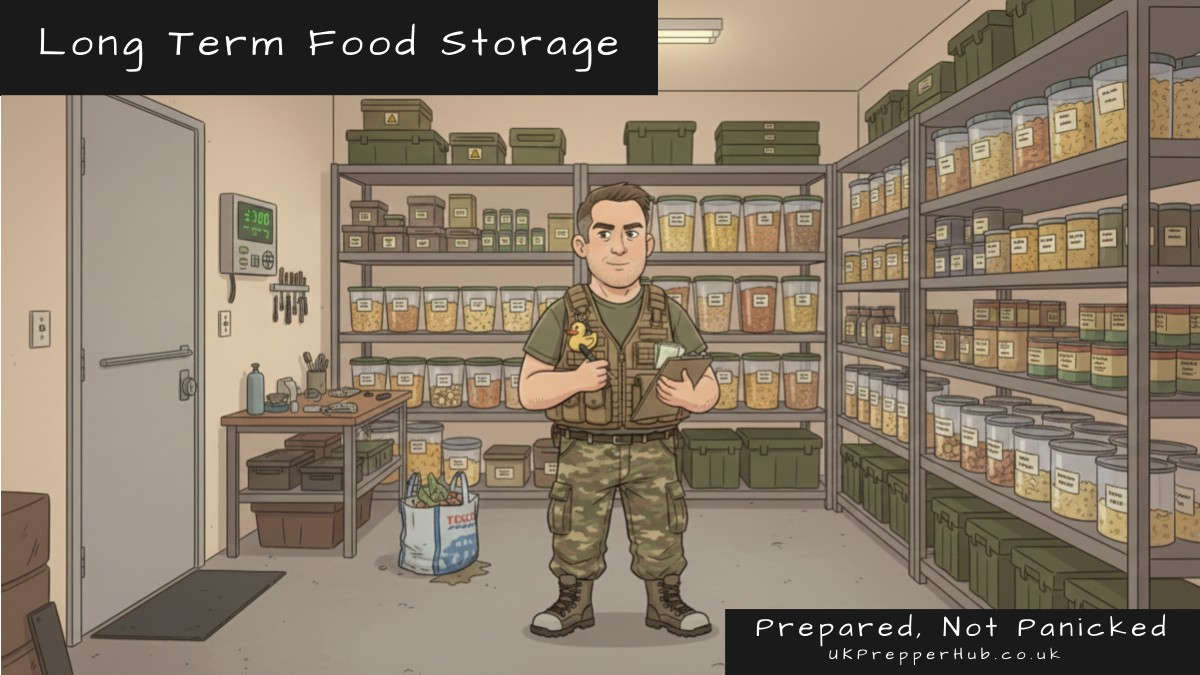
Introduction: The 3-Day Pantry is the Start, Not the Finish
The 3-Day Emergency Pantry is the right place to begin. It is low-cost, uses food you already eat, requires no specialist equipment, and gets most households from “completely unprepared” to “covered for a long weekend” in a single supermarket shop. Long-Term Food Storage is the next step.
But three days is a floor, not a ceiling.
Real UK disruptions — the kind that have actually happened in living memory — can last considerably longer. The 2018 Beast from the East kept parts of rural Scotland cut off for the better part of a week. The 2020 and 2021 supply chain disruptions left supermarket shelves intermittently bare for months. The Somerset Levels flood of 2014 displaced residents for weeks. In all of these situations, a household with three days of food was in a fundamentally different position to one with three weeks.
This guide covers how to extend your food storage from 3 days to 1–4 weeks — practically, affordably, and without turning your home into a warehouse.
Complete Guide
3-Day Emergency Pantry
The low-barrier start: A shopping list of shelf-stable meals that require zero refrigeration.
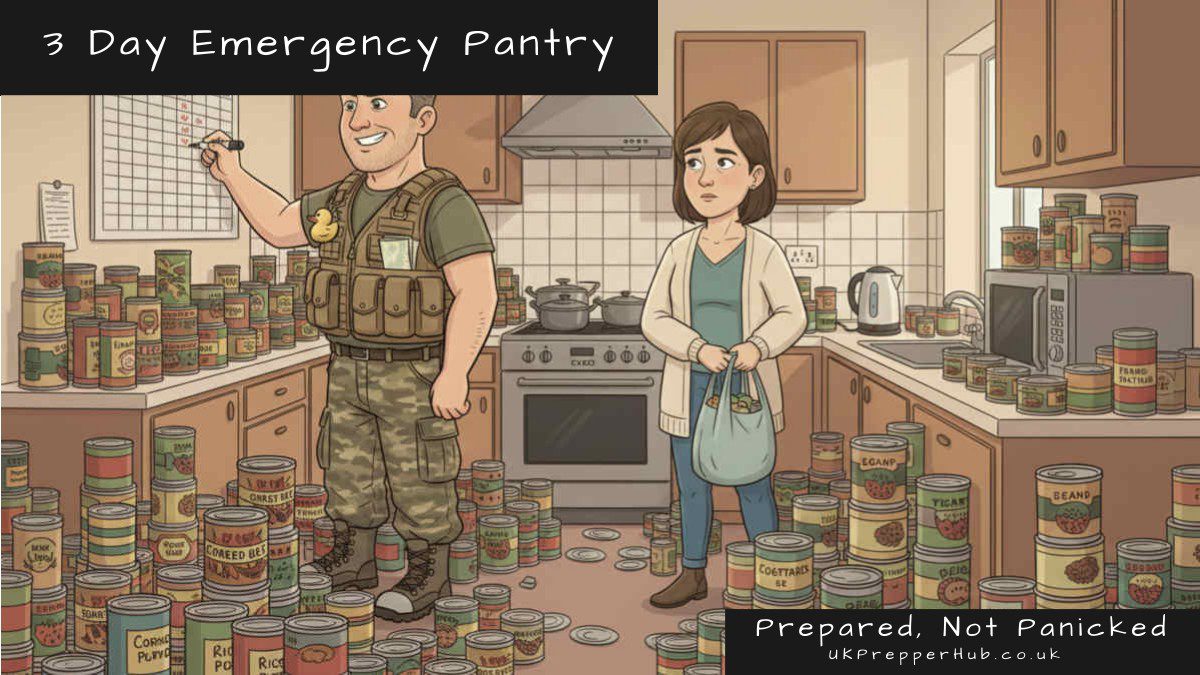
Why Long-Term Food Storage is Different
The 3-day pantry works on a simple principle: buy extra of what you already eat, rotate it regularly, and use normal supermarket shopping to maintain it. That approach works well up to about a week.
Beyond that, a few things change:
Rotation becomes more complex. A tin of tomatoes with an 18-month shelf life is easy to rotate. When you start buying food with 5, 10, or 30-year shelf lives, the rotation logic changes. You are no longer relying on weekly shopping to cycle stock — you need a deliberate system.
Storage space becomes a genuine constraint. Three days of food for two people fits in a kitchen cupboard. Three weeks takes considerably more space and starts to raise questions about damp, temperature, and organisation.
Cooking assumptions change. Your 3-day pantry probably assumes a working hob or at minimum the ability to boil water. A longer-term supply needs to account for the possibility that normal cooking is unavailable for an extended period — and plan accordingly.
Complete Guide
Cooking Without Power
A well-stocked long-term pantry is only useful if you can actually prepare the food when the power goes down. This guide covers practical cooking options for UK households — from camping stoves to solid fuel — so your stored food stays accessible when you need it most.
Read the Full Guide: Cooking Without Power →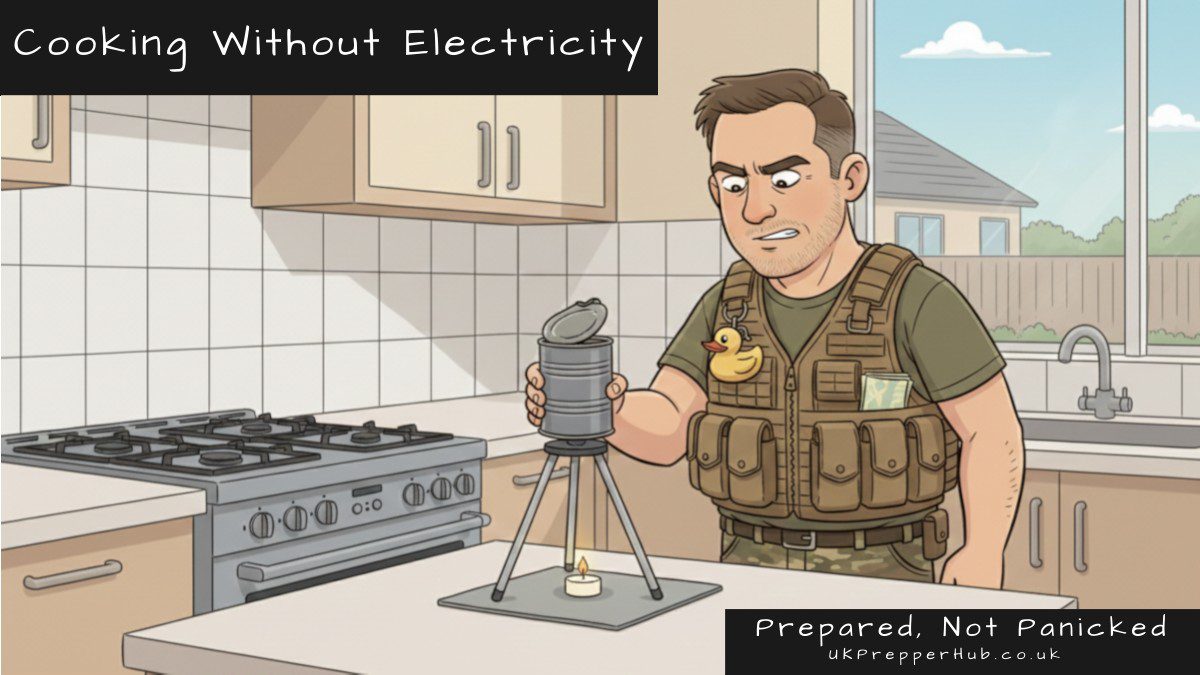
Calorie density matters more. For short disruptions, eating a bit less than normal is manageable. Over two or three weeks, inadequate calorie intake starts to have real effects on energy, mood, and decision-making. Long-term storage needs to actually sustain people, not just keep them from starving.
The Best Energy Bars for Your UK Emergency Kit
What are the best brands, and which should you choose? A look at the main 5 brands available in the UK. Five genuinely different options for different dietary needs and use cases
Our Full Review: The Best Energy Bars →
The Two-Track Approach
The most practical long-term food storage system for UK households combines two complementary tracks:
Track 1 — Extended Supermarket Pantry: A larger version of your 3-day pantry, built from normal supermarket purchases, with a deliberate FIFO (First In, First Out) rotation system. Realistic target: 1–2 weeks. Cost: negligible if built gradually. Requires cooking capability.
Track 2 — 24-Hour Ration Packs: Pre-packaged all-in-one daily rations with very long shelf lives (up to 30 years), complete nutrition, and minimal preparation requirements. Realistic target: 3–7 days on top of Track 1. Cost: £20–30 per person per day. Requires minimal water and no cooking equipment for most items.
Together, these give you a layered system: the extended pantry handles most scenarios, and the ration packs serve as both a genuine emergency reserve and a rotation-free long-term store.
Track 1: Building the Extended Supermarket Pantry
What to Add Beyond the Basics
Your 3-day pantry already covers the essentials: tinned protein, tinned vegetables, pasta, rice, long-life milk, and so on. Extending to 1–2 weeks means more of the same, plus a few additions that improve both nutrition and morale over a longer period.
Calorie-dense staples: Cooking oil, peanut butter, nuts, dried fruit, oats, and plain chocolate all pack a significant amount of energy into a small space and have good shelf lives. These are easy to overlook when planning for short disruptions but become important over two weeks.
Comfort foods: This sounds trivial. It is not. Extended disruption is psychologically difficult, and the ability to make a proper cup of tea, have a biscuit, or eat something that tastes like a real meal has a measurable effect on morale — particularly for children, elderly family members, or anyone managing anxiety or depression. Include coffee, tea, squash, biscuits, and at least a few items that people in your household genuinely enjoy eating.
Variety: The main complaint from households who have lived through extended disruptions is not hunger — it is boredom. Eating the same four meals on rotation for a fortnight is deeply demoralising. Aim for at least 10–14 different meal options across your extended pantry, not just a larger quantity of five things.
Condiments and flavourings: Salt, pepper, stock cubes, soy sauce, chilli flakes, and dried herbs weigh almost nothing and transform the palatability of basic tinned and dried food. They are almost always overlooked in emergency food planning.
The FIFO Rotation System
FIFO — First In, First Out — is the principle that the oldest stock gets used first. It sounds obvious; it is surprisingly easy to get wrong.

🐔 Chicken Licken
Did You Know?
Tinned food often remains safe and perfectly edible years past its best-before date — the date is a quality guide, not a cliff edge
The simplest physical implementation: when you buy new stock, put it at the back of the shelf or box and pull from the front. Write the purchase date on lids and packets with a permanent marker if the best-before date is hard to read. Do a stock check every 3–6 months and use anything approaching its date in normal cooking.
The goal is a living pantry, not a static one. You should be eating from your long-term store regularly and replacing what you use. If you open your emergency food supply in an actual emergency and find items that expired two years ago, the system has failed.
Storage Conditions
Long-term food storage requires three things: cool, dry, and dark.
Cool: Ideal storage temperature is below 20°C. Loft spaces get too hot in summer and too cold in winter. Under-stairs cupboards, spare bedroom wardrobes, and garage shelving (if frost-free) all work well. Avoid anywhere near a boiler or radiator.
Dry: Damp is the enemy of long-term food storage, particularly for dried goods and cardboard packaging. If your storage area is prone to dampness, invest in airtight containers — sealed plastic boxes with positive locking lids offer significantly better protection than standard storage boxes. Our Preventing Storage Damp guide covers this in detail, including how to test your storage area’s humidity before you invest in stock.
Dark: UV light degrades food quality over time. Avoid clear containers in direct light for anything stored longer than a few months.
Complete Guide
Preventing Indoor Mould & Damp
Mould needs moisture to grow — remove the moisture and you remove the problem. This guide covers ventilation, heating patterns, dehumidifiers, humidity monitoring, and keeping stored supplies dry.
Read the Full Guide: Preventing Indoor Mould & Damp →
How Much Space Does It Actually Take?
A useful rough guide: one week of food for one adult takes approximately 10–15 litres of storage space (about the size of a medium Really Useful Box). Two weeks for a family of four therefore takes roughly 80–120 litres — four or five medium storage boxes stacked in a wardrobe or under a bed.
This is less space than most people imagine. The constraint is usually organisation and damp control, not physical volume.
Track 2: 24-Hour Ration Packs
This is where long-term food storage gets interesting — and where UK preparedness diverges sharply from the American freeze-dried-bucket approach that dominates online prepping content.
What a 24-Hour Ration Pack Actually Is
A 24-hour ration pack (also called a rat pack or operational ration pack) is a single box or bag containing everything one person needs to eat and drink for a full day. Originally developed for military use, civilian versions are now widely available and represent the most practical long-term emergency food option for most UK households.
A typical pack contains:
- Breakfast (porridge, cereal, or full English pouch)
- Main meal (stew, curry, pasta, or similar — ambient, no refrigeration needed)
- Pudding
- Snacks (biscuits, chocolate, boiled sweets, nuts)
- Hot drinks (tea, coffee, hot chocolate sachets)
- Cold drinks (squash or isotonic powder)
- Sundries (tissues, matches, water purification tablet, chewing gum, sometimes a small tin opener)
Nutritional content is typically around 4,000 kcal — calibrated for an active adult in demanding conditions. For a sedentary adult sheltering at home, one pack comfortably feeds two people for a day, or one person very generously. For a family of four, two packs per day is a realistic baseline.

🦆 Keith
Don’t Be Keith
Keith spent a fortune on American freeze-dried prepper buckets his family refused to eat — then found British surplus ration packs did the same job for a fraction of the price
Why Ration Packs Beat Freeze-Dried
The freeze-dried bucket — a staple of American prepping channels — looks impressive. Large volume, long shelf life, dramatic packaging. In the UK, it has several significant drawbacks:
Water dependency. Every freeze-dried meal requires a substantial amount of water to rehydrate. In a scenario where water supply is disrupted — which is precisely when you are likely to be using your emergency food — this is a serious problem. Ration packs require water only for hot drinks; the main meals are ambient and ready to eat.
Palatability. Freeze-dried food has improved considerably, but it remains a significant step down from normal food in texture and flavour. Eating it for three days is fine. Eating it for two weeks, under stress, in a disrupted household, is genuinely miserable. UK ration packs — particularly civilian brands — are real food in real portions, cooked and packaged in retort pouches. The difference in morale impact is not trivial.
Cost per calorie. Quality freeze-dried systems cost significantly more per day than equivalent ration packs. For most UK households, the value proposition does not stack up.
Unfamiliarity. You are unlikely to have eaten freeze-dried food before. In a stressful emergency situation, unfamiliar food is an additional burden. Ration pack main meals — chilli, curry, stew, pasta — are recognisable comfort foods.
The “Try Before You Stock” Principle
This is the single most important piece of advice in this guide: do not bulk buy ration packs without trying them first.
Emergency food that you will not eat is not emergency food. It is expensive clutter.
Buy one pack. Eat it — ideally during a low-key test scenario such as a camping trip, a weekend power cut drill, or simply a day at home. Identify which items you genuinely liked, which you tolerated, and which you would struggle to eat under stress. Then stock the menus that work for your household.
The range of available menus is wide enough that most households will find two or three they genuinely prefer. Stocking those — rather than buying a random mixed selection — means your emergency food store is something you will actually use.
UK Brands Worth Knowing
British Army Style surplus packs (various sellers, ~£20 per pack) are genuine ex-military rations with authentic contents and typically a pack date from 2022–2023. Stock and specific menus vary by seller and availability. These offer the best value when in stock but cannot be relied upon for consistent supply.
Ration-X (~£29.49 per pack, multiple menus including vegan) is a civilian manufacturer producing army-style ambient packs to a consistent standard. Available on Amazon with reliable stock, strong reviews (4.4–4.7 stars), and a vegan menu option — useful for households with dietary requirements.
Wayfayrer is a longer-established UK brand making boil-in-bag retort pouch meals, best known as the official food of the Duke of Edinburgh Award scheme. Individual pouches rather than full 24hr packs — useful for supplementing a pantry rather than replacing it entirely. 3-year shelf life, good flavour range, widely available.
British Army 24-Hour Ration Packs
The actual rations British soldiers eat in the field — 24 hours of complete nutrition built for when normal food supply isn’t an option.
Our Full Review: British Army 24-Hour Ration Packs →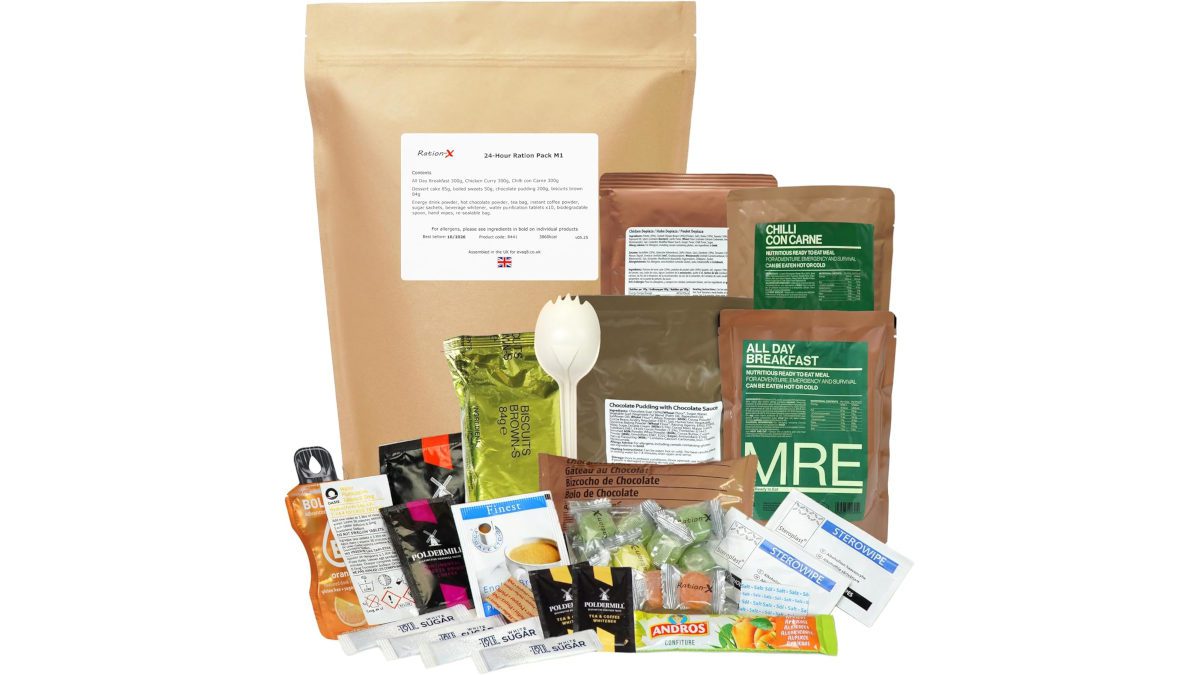
Calorie Reality Check
4,000 kcal per pack sounds like a lot. For context:
- Sedentary adult (desk job, minimal activity): ~2,000 kcal/day
- Active adult (physical work, walking): ~2,500–3,000 kcal/day
- Child aged 5–10: ~1,400–1,700 kcal/day
- Child aged 11–16: ~1,800–2,200 kcal/day
In a household emergency scenario — staying warm, managing stress, potentially dealing with physical tasks — calorie needs tend to be slightly higher than a normal sedentary day. Plan on one pack per adult per day as a generous single-person ration, or one pack shared between two adults eating comfortably.
Water Requirements
The main meals in ambient ration packs require no water — they are fully cooked and sealed in retort pouches, eaten directly from the pouch (cold if necessary) or warmed in hot water. The hot drink sachets require boiling water. The cold drink powders require cold water.
In a scenario with no water supply at all, you can eat the main meals, snacks, and biscuits without any water. The hot drinks are a morale item, not a survival necessity. This is a genuine advantage over any freeze-dried system.
Storage and Shelf Life
Surplus military packs typically carry a 30-year shelf life from pack date. Civilian ration packs vary — Ration-X ambient packs have a shelf life of several years; check individual listings. Wayfayrer pouches are typically 3 years.
Store in a cool, dry location away from direct light. The sealed foil pouches are significantly more robust than cardboard-packaged supermarket food — they are designed to survive field conditions. A stack of ration packs in a wardrobe, spare bedroom, or under a bed is a low-maintenance long-term store.
Dietary Requirements, Children, and Vulnerable Household Members
Long-term food storage planning for a household of healthy adults is relatively straightforward. Add complexity — children, dietary restrictions, medication requirements, or elderly members — and the planning needs to be more deliberate.
Children
Children are not simply small adults when it comes to food planning. Beyond the calorie adjustments already noted, a few specific considerations apply:
Familiarity matters more. Children under stress are significantly less likely to eat unfamiliar food, even if hungry. Your long-term stock should include items your children will reliably eat, not just nutritionally optimal emergency rations. If your child will eat tinned spaghetti hoops and crackers but not tinned mackerel and lentils, stock accordingly — and supplement with a children’s multivitamin as a nutritional backstop.
Comfort and routine. Having a small stock of treats, familiar snacks, and drinks that children enjoy has a real calming effect during disrupted routines. It is not a luxury in a genuine emergency — it is a practical tool for managing a child’s stress response.
Infant and toddler requirements. Households with infants or toddlers need specific stocks: formula (if applicable), baby food pouches, and any specific dietary items. These have shorter shelf lives than adult staples and need more frequent rotation. Do not rely on being able to purchase these during a supply disruption — they are often the first items to disappear from shelves.
Dietary Restrictions
Vegan, vegetarian, coeliac, nut allergy, and other dietary requirements need to be mapped explicitly onto your food storage plan. A stock that cannot be eaten by half the household is not a functional emergency supply.
The good news: most shelf-stable staples are naturally vegan-friendly (tinned pulses, pasta, rice, oats), and ration pack manufacturers including Ration-X now produce vegan menus. Gluten-free alternatives for most staples are available in mainstream supermarkets — the planning is the same, the specific items just differ.
Do the audit: go through your proposed stock list and check every item against your household’s dietary requirements before buying in quantity.
Medication and Food Interactions
If anyone in your household takes medication that interacts with food — warfarin and vitamin K, MAOIs and tyramine-containing foods, certain antibiotics and dairy — factor this into your food choices. This is an edge case for most households but a critical one for those it affects. Our Managing Essential Medication guide covers the broader topic of medication planning during emergencies.
Complete Guide
Managing Essential Medication
This guide covers more detail on being prepared with essential medication for all emergency situations.
Putting It Together: A Realistic Stocking Plan
Week 1–2: Extend the Pantry
Add to your existing 3-day pantry gradually — one or two extra items per weekly shop — until you have 10–14 days of supermarket staples. Focus on calorie density, variety, and comfort. Implement FIFO rotation from day one. Total additional cost spread over 4–6 weeks: £40–80 for a family of four.
Weeks 3–4: Add the Ration Pack Reserve
Buy one ration pack per household member to try. Identify your preferred menus. Then stock 3–7 days’ worth per person (one pack per person per day, or one pack per two people per day for comfortable civilian rations). Store separately from your supermarket pantry — these are your deep reserve, not your first resort. Total cost for 7-day reserve for two adults: approximately £40–60.
Ongoing: Maintain and Rotate
- Check supermarket pantry every 3 months; use anything approaching date
- Check ration pack dates annually; surplus packs with a 2022 pack date have years of shelf life remaining
- Replace as used; add when budget allows
- Do not let the store become a static, forgotten resource — it should feel like a normal part of household management
Three Checklists
✅ Immediate Actions (This Week)
- [ ] Audit your existing 3-day pantry — identify gaps and items approaching date
- [ ] Buy one 24-hour ration pack and eat it (this is the most important action in this guide)
- [ ] Identify your storage location — check for damp, temperature extremes, and light exposure
- [ ] Write your current stock level somewhere visible (a sticky note inside the cupboard door works)
✅ Short-Term Actions (Next Month)
- [ ] Extend supermarket pantry to 7–10 days through gradual top-up shopping
- [ ] Implement FIFO — oldest stock at the front, newest at the back, dates marked
- [ ] Identify 2–3 ration pack menus your household will actually eat
- [ ] Stock 3 days of ration packs per person as a rotation-free deep reserve
- [ ] Address any damp or temperature issues in your storage area
✅ Longer-Term Actions (3–6 Months)
- [ ] Reach a 14-day supermarket pantry target
- [ ] Build ration pack reserve to 7 days per person
- [ ] Review dietary requirements — ensure stock covers any allergies, intolerances, or preferences (vegan Ration-X menus available)
- [ ] Consider storage containers if using a damp-prone space — see Preventing Storage Damp
- [ ] Share your stocking system with all adult household members — it should not live only in one person’s head
Frequently Asked Questions
How long does tinned food actually last past its best-before date?
Best-before dates on tinned food are conservative quality markers, not safety deadlines. In cool, dry storage, most tinned goods remain safe and nutritionally adequate well beyond the printed date — often by years. Discard anything with a bulging lid, visible corrosion, or an off smell when opened; otherwise, you are almost certainly fine.
How much does it cost to build a two-week food supply?
Building a two-week extended pantry gradually costs roughly £40–80 for a family of four, spread over four to six weeks of normal shopping. Adding a seven-day ration pack reserve on top runs to approximately £60–100 for two adults. The total is less than most households spend on takeaways in a single month.
Do I need special storage containers for long-term food storage?
Not necessarily. A cool, dry, dark location is the primary requirement. If your storage area is prone to dampness, sealed plastic boxes with positive locking lids offer solid protection for relatively little cost. Vacuum sealing can extend shelf life further but is entirely optional for most supermarket-bought goods.
Are 24-hour ration packs worth the money?
For what they deliver — complete daily nutrition, ambient storage, shelf lives of five to thirty years, and no cooking requirement — yes, for most households. The key rule is to try before you stock. Buy one pack, eat it, and identify the menus your household will actually eat under stress. A ration pack nobody will touch is expensive clutter.
Should I store water as part of my long-term food supply plan?
Yes, and separately from your food calculations. Most ambient ration pack main meals require no water, but hot drinks, basic hygiene, and cooking from your supermarket pantry all need a supply. The standard recommendation is at least two litres per person per day as a minimum. See our Emergency Water Storage guide for containers, quantities, and rotation.
Build Your Resilience
Further Reading: Related Guides
- The 3-Day Emergency Pantry
- Cooking Without Power
- Emergency Water Storage
- Managing Essential Medication
- Blackout Box
- Power Cut Survival Guide
All our guides can be found listed on our resilience hub.
Gear We’ve Tested & Reviewed
All our reviews can be found on our reviews and resources page.
This guide is part of the UK Prepper Hub Resilience Hub — practical, UK-specific preparedness for ordinary households.