
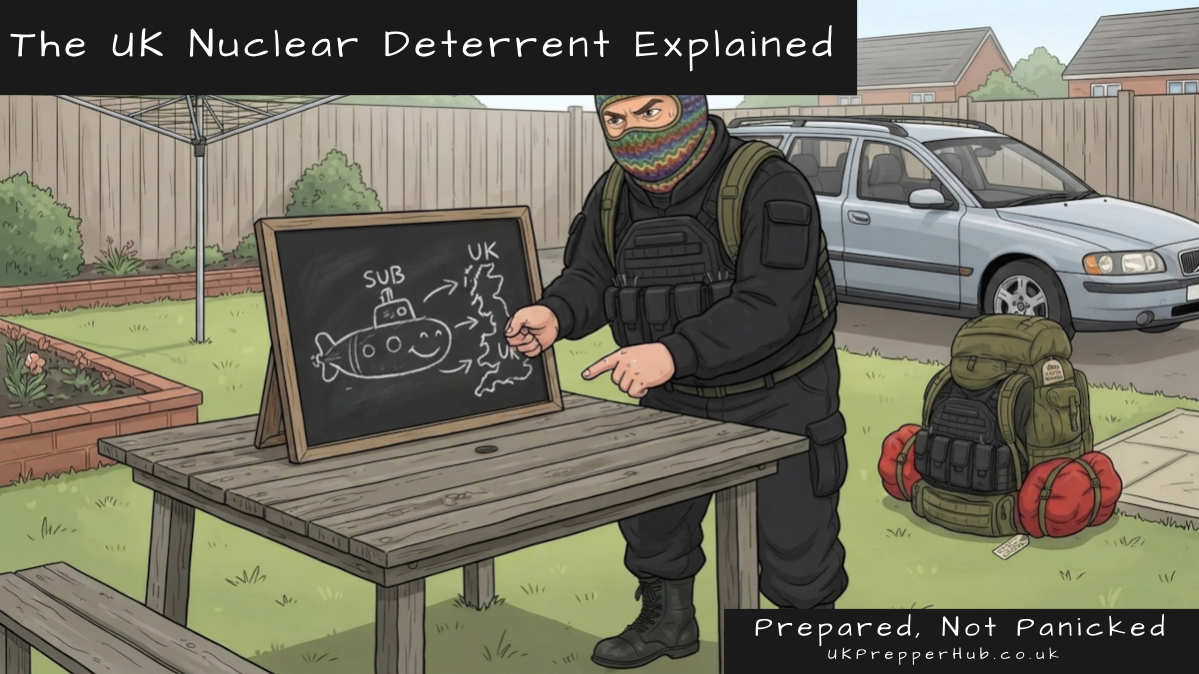
Every week, people search Google asking some version of the same question: would Russia actually nuke the UK? It’s not an idle worry — years of tension over Ukraine, Russian rhetoric about nuclear “de-escalation,” and near-constant coverage of missile tests have left a lot of households genuinely unsure how seriously to take the threat. The honest answer starts with understanding the UK nuclear deterrent — what it actually is, how it works, and why it’s the single biggest reason this scenario stays firmly in the “extremely unlikely” category rather than a realistic near-term risk.
This isn’t a piece about panic. It’s a plain, factual explainer — what the UK nuclear deterrent actually consists of, what a tactical nuclear weapon is (and isn’t), and what a level-headed household should actually take from all of this.
What Is the UK Nuclear Deterrent?
The UK nuclear deterrent is built around four Vanguard-class submarines, each armed with Trident II D-5 missiles. This is the entirety of Britain’s nuclear capability — there’s no separate air-dropped or land-based nuclear force. Everything runs through the submarine fleet.
The UK nuclear deterrent operates on what’s called Continuous At-Sea Deterrence (CASD). At any given moment, one submarine is on patrol somewhere in the ocean, hidden and essentially untrackable, while the others are in port, undergoing maintenance, or training. Britain has maintained at least one submarine at sea, every single day, without a single gap, since 1969. That unbroken record is the actual point — a deterrent only works if an adversary can never be certain it’s momentarily absent.
The submarines are based at HMNB Clyde — Faslane, on Scotland’s west coast — with the missiles themselves stored and maintained nearby at the Royal Naval Armaments Depot, Coulport. As of the most recent public figures, the UK holds around 225 nuclear warheads in total, with roughly 120 deployed across the active submarine fleet at any time.
One detail that surprises people: the UK nuclear deterrent is independently operated. The missile system itself was developed jointly with the US for cost reasons, but the decision to use it rests entirely with the British Prime Minister. There is no American veto, no shared button. It is, by design, Britain’s own.

🦆 Keith
Don’t Be Keith
Keith is convinced knowing Faslane’s exact grid reference is essential prepping knowledge, despite living four hundred miles away in a flood zone he’s done nothing about. He has his priorities wrong.
What Is a Tactical Nuclear Weapon?
This is the term that comes up most in the current news cycle, and it’s also the most misunderstood. A tactical nuclear weapon isn’t a smaller version of the bombs used on Hiroshima and Nagasaki in the way people sometimes assume — but it is a genuinely different category of weapon from what most people picture when they hear “nuclear war.”
Strategic nuclear weapons — the kind that make up the UK nuclear deterrent — are designed to deter or, in an absolute worst case, strike major cities, military infrastructure, and industrial centres. Their yields run into the hundreds of kilotons.
Tactical nuclear weapons are smaller, shorter-range, and designed for use against a specific military target on a battlefield — a troop concentration, an airbase, a column of armour. Yields typically range from a fraction of a kiloton up to around 50 kilotons, and they’re delivered by systems like fighter-bomber aircraft or short-range missiles rather than submarine-launched ICBMs. Russia has significantly expanded its tactical arsenal in recent years, including moving weapons of this class into Belarus in 2023–2024, and Russian military doctrine has floated the idea of limited tactical use as an “escalate to de-escalate” strategy — using a smaller strike to force an opponent to back down rather than triggering full-scale nuclear war.
The critical point for a UK household: every documented instance of this rhetoric, every troop movement, every arsenal expansion reported in this context, has been discussed specifically in relation to the war in Ukraine — a battlefield weapon, aimed at battlefield use, in a specific ongoing conflict. It is a different category of risk entirely from a strategic strike against Britain.
So Would Russia Actually Nuke the UK?
On the honest, current evidence: no analyst, defence official, or serious commentator treats a direct Russian nuclear strike on the UK as a realistic near-term scenario. The reasoning isn’t optimism — it’s the same cold logic that’s held since the Cold War.
Britain is a nuclear-armed NATO member. Any nuclear attack on the UK would not just be an attack on one country — it would be understood, immediately and unambiguously, as an attack requiring a response from an alliance that includes the world’s largest nuclear arsenals. That’s the entire function of the UK nuclear deterrent: not to make a strike on Britain winnable for Russia, but to make it unthinkable. Mutually assured destruction is a grim phrase, but it has kept every nuclear-armed state from directly striking another for eight decades, through crises considerably tenser than the present one.
None of this means the underlying tension isn’t real, or that it’s not worth understanding. It means the specific scenario — a Russian nuclear weapon detonating on British soil — sits in the same category as other genuinely catastrophic but vanishingly unlikely events: real enough to understand, not realistic enough to reorganise a household around.

🐔 Chicken Licken
Did You Know?
I’ve been saying it for years — a nuclear strike is not what’s actually going to get a UK household. Power cuts, floods, and burst pipes will happen to you. Nuclear war almost certainly won’t. The UK Nuclear Deterrent is enough for you not to worry.
What Does This Actually Mean for Prepping?
The UK nuclear deterrent already does the heavy lifting on the single worst-case scenario. Understanding a risk and preparing for it proportionately are two different skills, and this is a good test case for the difference. A household that spends its preparedness budget and headspace on nuclear scenarios, while leaving the loft insulation gapped and no torch by the stairs, has its priorities backwards. The things that will actually happen to a UK household — power cuts, burst pipes, flooding, a genuinely bad storm — deserve the attention. A remote, catastrophic scenario that every layer of national and international deterrence exists specifically to prevent does not need to dominate anyone’s planning.
That said, understanding what to actually do in the extremely unlikely event of a nuclear or radiological incident — the one scenario the UK nuclear deterrent can’t fully rule out — is still worthwhile, the same way it’s worth knowing basic first aid even though you hope never to need it. Our Special Report Nuclear Incident UK: What the Official Guidance Actually Says covers exactly that.
The UK nuclear deterrent is doing exactly what it’s designed to do, and has done for over half a century without a single gap. That’s not a reason to stop paying attention to Russia altogether — the more immediate, more likely category of concern is the activity already happening closer to home: naval incursions near UK waters, damaged undersea cables, and infrastructure-adjacent incidents. Our Special Report Is Russia a Threat to the UK? covers that wider picture. But on the specific question this piece set out to answer — would Russia nuke the UK — the honest, current answer is no, and the reason is the deterrent explained above.
Frequently Asked Questions
Would Russia nuke the UK?
On current evidence, no credible analyst treats this as a realistic near-term scenario. The UK’s own deterrent, combined with NATO membership, makes a direct nuclear strike on Britain an act that would guarantee an overwhelming allied nuclear response — the entire point of deterrence.
Does the UK have nuclear weapons?
Yes. The UK maintains an independent nuclear deterrent built around four Vanguard-class submarines armed with Trident II D-5 missiles, with around 225 warheads in the total stockpile as of the most recent public figures.
How likely is a nuclear war?
Extremely unlikely on any time frame defence analysts currently discuss. The specific risk that gets discussed in relation to the Ukraine war is tactical (battlefield) nuclear use within that conflict — a genuinely different scenario from a strategic strike against the UK or another NATO state.
What is a tactical nuclear weapon?
A smaller, shorter-range nuclear weapon designed for use against a specific battlefield target, with yields typically from a fraction of a kiloton up to around 50 kilotons — far smaller than the strategic weapons carried by Trident submarines, and delivered by aircraft or short-range missiles rather than submarine-launched ICBMs.
Where is the UK’s nuclear deterrent based?
At HMNB Clyde (Faslane) on Scotland’s west coast, with the warheads themselves stored and maintained at the nearby Royal Naval Armaments Depot, Coulport.
Does the US control the UK’s nuclear weapons?
No. While the missile system was developed jointly with the US for cost reasons, the decision to use the UK’s deterrent rests solely with the British Prime Minister — there is no American veto.
📡 Find Us Everywhere
Daily briefings, prep guides, and real-time updates across every platform. Pick yours.
Free. No commitment. Stay anonymous on WhatsApp & Telegram.
Stay Informed on UK Preparedness
Join our newsletter for UK-specific preparedness tips, product recommendations, and real-world advice for households.
Subscribe to Our Newsletter