
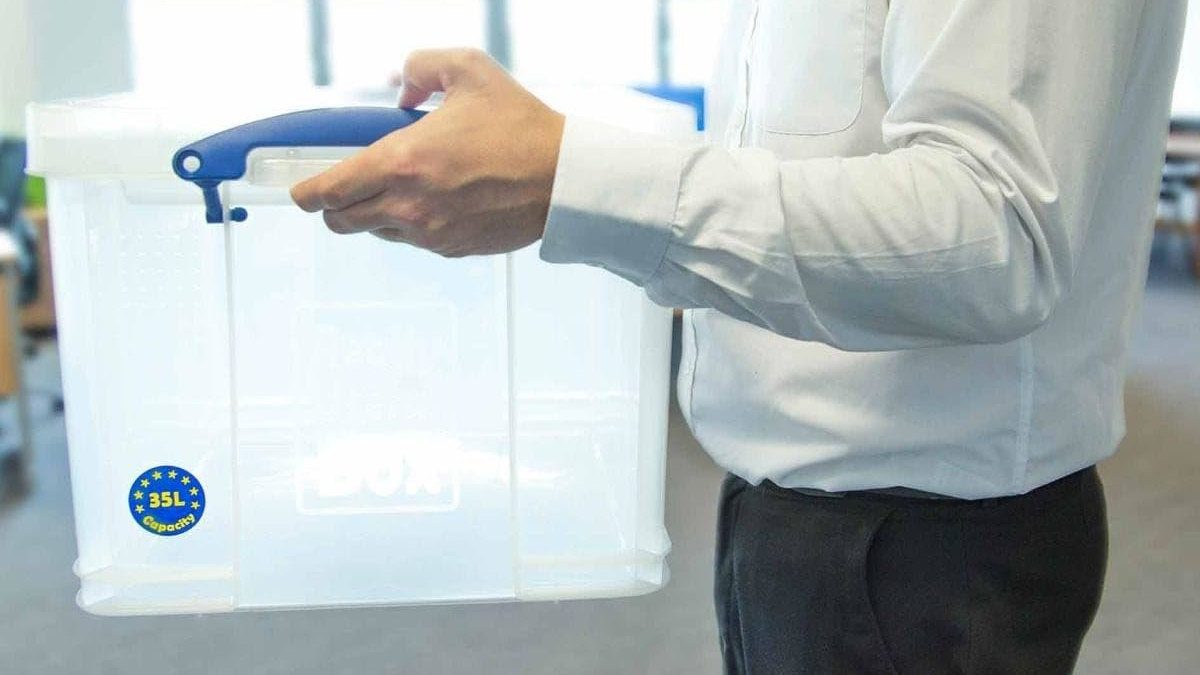
Three months into building an emergency pantry, a Leicester household checked their under-stairs storage cupboard. The £2 plastic boxes they’d bought from B&M had done their job—sort of. The lids hadn’t fallen off. The boxes hadn’t cracked. But when they opened them, every tin inside showed rust spots where condensation had formed on the inside of the box lids, dripped down, and pooled against the metal.
The boxes hadn’t been waterproof. They’d been dust-proof at best. The lids clicked onto the short edges but bulged outward at the long edges when filled, creating gaps where humid air flowed freely in and out. The “seal” was an illusion. Those £2 boxes had seemed like a bargain until they allowed £80 worth of tinned food to rust.
This is the problem with cheap storage boxes sold at budget retailers. They look adequate. They stack reasonably well. They’re cheap enough to buy a dozen without thinking twice. But they don’t actually seal, which means they don’t protect your supplies from the relentless British damp that destroys emergency stores as covered in our Preventing Storage Damp guide.
Really Useful Boxes cost more—sometimes three times as much as budget alternatives. But they’re actually waterproof, they seal properly, and they’re engineered well enough to justify the extra cost when you’re protecting hundreds of pounds worth of emergency supplies.
Really Useful Boxes Manufacturer Shop
View all sizes available direct from the UK Manufacturer
What Makes Really Useful Boxes Different
Really Useful Boxes are a British company (established 1999, manufacturing in the UK) that solved a problem most storage box manufacturers ignore: creating an actual seal. Their design uses positive-locking handles that clamp the lid down onto a gasket, creating an airtight and waterproof closure.
The difference is immediately obvious when you handle them. Cheap boxes have lids that ‘sort-of’ click onto two edges, leaving the other two edges floating with visible gaps. I’ve got through so many of these cheap, thin boxes I’d had enough and tried something different instead. Really Useful Box lids have ‘handles’ that lock down onto the base, pulling the lid tight and sealing the entire perimeter. When a box is locked, the lid cannot bulge outward even when the box is packed full—the handles and the thicker construction prevent it mechanically.
This matters enormously for emergency storage in UK conditions. Humid air can’t seep in overnight when your storage cupboard temperature drops and condensation forms. Dust and pest access is genuinely blocked, not just obstructed. If you’re storing supplies in a damp under-stairs cupboard, garage, or shed, this sealing difference is the difference between supplies that last years and supplies ruined in months.
The clear polypropylene construction means you can see contents without opening boxes, reducing how often you expose supplies to moisture. The plastic is thick enough not to crack under normal use—significantly thicker than budget alternatives—and the reinforced edges prevent the common failure mode where cheap boxes split at corners when dropped.
They’re also properly stackable. The lid design includes recesses that locate onto the base of the box above, preventing stacks from sliding. Cheap boxes just sit on top of each other and slide around. Really Useful Boxes actually interlock when stacked, which matters when you’ve got a cupboard full and you’re reaching for the bottom box without unpacking everything above it.
UK Customer Experience: What People Actually Report
Based on thousands of verified UK customer reviews across Amazon and other retailers, Really Useful Boxes consistently deliver on their core promise: they seal properly and they last.
One customer specifically praised the locking handles: “The handles act as locks when not in use so it’s secure and unlikely to collapse on the contents like some other storage boxes.” This mechanical security is critical when stacking—you don’t want the top box’s weight forcing the lid open on the box below it.
The UK manufacturing is repeatedly mentioned as a selling point. Multiple reviewers note “Love Really Useful Boxes as they are strong and well made. Even better they are made in the UK.” For British customers concerned about quality control and supporting domestic manufacturing, this matters.
Stackability gets consistent praise: “They stack nicely and lock together well enough to stay stacked in the car boot so long as you avoid speed humps.” This real-world test—surviving car journeys—indicates the interlocking system actually works under movement and vibration.
The clarity of the plastic is valued: “The clear design is also a huge bonus as it allows you to see what’s inside without having to open it up, saving both time and effort.” For emergency preparedness where you need to quickly identify stored supplies during a crisis, this transparency has practical value beyond just convenience.
Durability appears excellent: “Robust and will last years” is a common theme, with customers reporting boxes purchased 5-10 years ago still in perfect condition. One reviewer noted “the build quality is impressive. The plastic is durable and robust, making the box perfect for storing heavier items without any worry of it cracking or bending.” – I would personaly agree with this, and this is the main reason why I buy them – they last forever. I’ve never “broken” a”Really Useful Box”
The range of sizes available is frequently mentioned as an advantage over single-size cheap alternatives. Customers appreciate being able to choose the right size for specific storage needs rather than trying to make one generic size work for everything.
Real-World Testing: My UK Storage Experience
I use Really Useful Boxes throughout my 1909 cottage for emergency supply storage, and the contrast with previous cheap alternatives is stark.
My main supply storage is in an unheated bedroom against an external tree sheltered east-facing wall—basically the worst possible UK storage conditions short of an actual basement. I’ve been running a digital hygrometer in there for over a year, and winter readings consistently show 70-75% relative humidity before I run my dehumidifier.
Previous storage attempts with budget boxes resulted in:
- Rust on tin seams within 4-6 months
- Cardboard packaging on pasta going soft and allowing pest entry
- Batteries showing corrosion on terminals
- Visible condensation forming on the inside of box lids
After switching to Really Useful Boxes:
- No rust on tins after 18 months storage
- Pasta packaging stays rigid (no moisture penetration)
- Battery terminals remain clean
- No condensation inside boxes even during temperature cycling
The critical difference is the seal. I’ve tested this deliberately: placed silica gel packets inside a Really Useful Box, sealed it, and left it in the damp spare bedroom for three months. The silica gel packets remained blue (dry) throughout. Identical packets in a cheap B&M box turned pink (saturated) within two weeks because humid air was entering freely.
Size-wise, I use:
- 35L boxes for bulk tinned goods (holds approximately 30-40 standard tins)
- 9L boxes for batteries (sorted by type with silica gel packets)
- 4L boxes for first aid supplies and medications
- 64L boxes for bulkier items (toilet paper, dried goods in larger packaging)
The 35L size is the sweet spot for most emergency storage—large enough to hold meaningful quantities but not so large that they’re too heavy to move when full. A 35L box filled with tins weighs roughly 15-20kg, which is manageable for most adults but starts approaching the practical limit. And most importantly, Really Useful Boxes can cope with this weight. Try filling a cheap B&M storage box and lifting it without it deforming or breaking.
The stackability works exactly as claimed. I have three 35L boxes stacked vertically in the bedroom, and they haven’t shifted despite regular access. The interlocking design means I can pull out the middle box without the top box sliding off—something that definitely wasn’t possible with my old cheap boxes.
Size Selection Guide for Emergency Preparedness
Really Useful Boxes range from 0.07L (tiny component storage) up to 145L (massive archive boxes). For emergency supply storage, these sizes are most relevant:
4L boxes (approximately £4-5 each):
- Ideal for: First aid kits, medications, batteries (sorted by type), important documents in plastic wallets
- Holds: A full home first aid kit, or 50-60 AA batteries, or critical documents for a household
- Dimensions: Roughly A4 paper size, low profile (good for shallow cupboards)
9L boxes (approximately £6-8 each):
- Ideal for: Torches and lighting equipment, water purification supplies, emergency hygiene kits
- Holds: 4-6 torches plus spare batteries, or complete water purification kit (filters, Aquatabs, testing strips)
- Dimensions: Larger than A4, more depth for bulkier items
35L boxes (approximately £8-10 each):
- Ideal for: Tinned food storage, dried goods decanted from packaging, emergency cooking equipment
- Holds: 30-40 standard tins, or 10kg rice/pasta (decanted), or camping stove plus fuel
- Dimensions: Large enough for meaningful storage, small enough to move when full
- This is the most versatile size for general emergency storage
64L boxes (approximately £18-20 each):
- Ideal for: Bulk toilet paper, larger dried goods, seasonal rotation stock
- Holds: 24 toilet rolls, or 20kg dried goods, or bulk pasta/rice in original packaging
- Dimensions: Large—requires good access to move when full
- Warning: Gets very heavy when filled with dense items like tins
84L boxes (approximately £28-32 each):
- Ideal for: Clothing/bedding for grab bags, bulky but lightweight emergency supplies
- Holds: Complete 72-hour clothing for a family, or all emergency bedding/blankets
- Dimensions: Very large—not suitable for heavy items
- Note: Consider this for textile storage where weight isn’t an issue
For a typical UK household building a three-month emergency pantry, I’d recommend:
- 4× 35L boxes (tinned goods, dried goods, cooking equipment, miscellaneous)
- 2× 9L boxes (batteries, first aid, lighting)
- 1× 4L box (medications and critical documents)
Total cost: approximately £60-65, protecting £300-500 worth of supplies.
What Really Useful Boxes Don’t Do (Honest Limitations)
Despite their quality, there are scenarios where Really Useful Boxes aren’t the right choice.
They’re not fireproof. Polypropylene melts at around 160°C. If you’re storing critical documents that must survive a house fire, you need a dedicated fireproof document box as covered in our SentrySafe 1160 Fireproof Safe review, not a plastic storage box.
They’re not vermin-proof against determined rodents. The plastic is thick but a rat with time and motivation can chew through it. If you have an active rodent problem (common in rural properties and older terraced houses), you need metal storage containers like military surplus ammo cans, not plastic boxes.
They don’t replace active damp control. Sealing supplies in Really Useful Boxes protects them from external humidity, but if you lock moisture inside the box (by filling it when contents are damp, or in a very humid room), that moisture stays trapped. You still need to control the humidity of what you’re putting inside—use silica gel packets, ensure items are completely dry before storage, and monitor conditions with a hygrometer.
Large sizes get genuinely heavy when filled with dense items. A 64L box filled with tinned goods weighs 40-50kg—beyond what most people can safely lift. Use smaller boxes for heavy items, larger boxes only for lightweight bulky supplies like sleeping bags, blankets, LED lanterns, etc.
They’re more expensive than alternatives. A 35L Really Useful Box costs £8-10. A similar-sized budget box from B&M costs £3-4. The quality difference justifies the cost, but if budget is extremely tight, you might need to start with fewer Really Useful Boxes for your most critical supplies (medications, batteries, documents) and accept cheap boxes for less vulnerable items (tinned goods you’ll rotate within 6 months anyway).
The handles protrude. When not locked down, the handles stick out from the sides. This can snag on things when you’re pulling boxes out of tight cupboards. It’s a minor inconvenience but worth noting if your storage space is barely wider than the boxes themselves.
Storage Strategy: Where to Use Really Useful Boxes
Not all storage locations require the same level of protection. Use Really Useful Boxes strategically where their sealing capability matters most.
High-priority locations (Really Useful Boxes essential):
- Under-stairs cupboards against external walls (cold, damp, condensation-prone)
- Unheated spare bedrooms (temperature cycling causes condensation)
- Garages and sheds (extreme temperature and humidity swings)
- Basements (rising damp, poor ventilation)
- Ground floor storage against external walls (damp penetration from outside)
Medium-priority locations (Really Useful Boxes recommended):
- Airing cupboards (residual heat helps, but still need protection from steam/humidity)
- Bedroom wardrobes on external walls (better than under-stairs but still at risk)
- Loft spaces (extreme temperature cycling, though usually low humidity)
Low-priority locations (cheaper boxes probably acceptable):
- Internal cupboards in heated rooms (ambient warmth, good ventilation, no damp issues)
- Climate-controlled spaces (if you’re fortunate enough to have proper storage)
- Rooms with active dehumidification (where humidity is consistently below 60% throughout the whole room)
For most UK households, you’ll be using Really Useful Boxes in the high-priority locations where cheap alternatives fail.
Maintenance and Longevity
Really Useful Boxes require minimal maintenance but some basic care extends their lifespan.
Cleaning: Wash with warm soapy water when they get dusty or dirty. The plastic is dishwasher-safe (top rack only) though hand-washing is easier for larger sizes. Dry completely before restocking—putting damp boxes back into storage defeats the purpose of using sealed containers.
Gasket inspection: The lid gasket is the sealing element. Check it annually for degradation. If it’s compressed, cracked, or missing chunks, the seal will fail. Replacement gaskets are available from the manufacturer, though boxes typically last 10+ years before gasket replacement becomes necessary.
Handle check: The locking handles occasionally work loose after years of use. If a handle feels floppy or doesn’t lock positively, check that the hinge pin hasn’t partially pulled out. This is rare but fixable—you can often push the pin back into place or contact the manufacturer for replacement handles.
UV protection: Polypropylene degrades in direct sunlight. Don’t store Really Useful Boxes in locations with constant sun exposure (south-facing windowsills, conservatories). In normal cupboard storage, UV degradation isn’t a concern.
Lifespan expectation: Based on customer reports and my own experience, Really Useful Boxes last 10-15+ years with normal use. The plastic doesn’t become brittle, the handles don’t snap off, and the gaskets remain effective. This longevity is part of the value proposition—buying once and using for a decade beats replacing cheap boxes every 2-3 years.
Comparison With Specific Alternatives
Understanding where Really Useful Boxes sit in the market helps with purchasing decisions.
vs B&M/Poundland budget boxes (£2-4):
- Really Useful: Proper gasket seal, positive locking handles, thick plastic
- Budget: Friction-fit lids (not sealed), thin plastic cracks easily, no interlocking when stacked
- Verdict: Budget boxes for very short-term storage or non-critical items only
vs supermarket “clip lid” boxes (£4-6):
- Really Useful: Positive locking system, gasket runs entire perimeter
- Supermarket: ‘Clicks’ on short edges only, long edges bulge when full, minimal sealing
- Verdict: Supermarket boxes seem adequate until you fill them—then the seal fails
vs Wham/Klass boxes (£5-8):
- Really Useful: UK-made, proven 20+ year track record, wide size range
- Competitors: Similar quality, cheaper by £1-2 per box, smaller size range
- Verdict: Close match on quality, Really Useful wins on size options and proven longevity
vs military surplus ammo cans (£8-15):
- Really Useful: Clear plastic (see contents), lighter weight, stackable
- Ammo cans: Metal (pest-proof), rubber gasket seal, very durable
- Verdict: Ammo cans better for pest-prone areas, Really Useful better for general storage
vs Sistema/Decor food storage containers (£6-12):
- Really Useful: Designed for general storage, wider size range, better stackability
- Food containers: Better for actual food (BPA-free ratings), smaller sizes only
- Verdict: Food containers if storing opened food items, Really Useful for everything else
The market position is clear: Really Useful Boxes are the premium option for sealed storage without going to specialty solutions like ammo cans. They cost more than budget alternatives but deliver a genuinely superior product.
Buying Strategy: Building a Storage System Economically
You don’t need to buy 20 boxes at once. Build your Really Useful Box collection strategically.
Start with high-value items: Buy one or two 9L boxes for batteries and medications first. These are your highest-value-per-weight items where moisture damage causes the most expensive losses.
Add tinned food storage: Buy 2-3× 35L boxes for your main food pantry. This protects the bulk of your emergency supplies.
Expand based on actual needs: After three months of use, you’ll know what additional sizes you need. Maybe you need more 35L for rotation stock, or a 64L for bulk toilet paper, or 4L boxes for organising smaller items.
Watch for multi-packs: Amazon and other retailers occasionally offer 4-packs or 5-packs at modest discounts (£1-2 per box). Stock up on your most-used size when these deals appear.
Consider size compatibility: If you plan to stack boxes, buying all one size (e.g., all 35L) creates neater, more stable stacks than mixing sizes. Mixed sizes work but require more careful arrangement.
Avoid buying the wrong sizes: The most common mistake is buying too large. A 64L box seems efficient until you fill it with tins and realise it weighs 45kg and you can’t move it safely. Start smaller than you think you need—you can always buy larger later.
Budget approach: If £60 for a full set feels steep, buy 2× 35L boxes (£16-20 total) and use them for your most vulnerable supplies. Continue using cheap boxes for everything else, but at least your medications, batteries, and important documents are properly protected.
Where to Buy and What to Watch For
Really Useful Boxes are sold through multiple retailers, but buying directly from the manufacturer’s Amazon storefront ensures you’re getting genuine products with full UK warranty.
Really Useful Boxes Manufacturer Outlet Shop
View all sizes available direct from the UK Manufacturer – The only way to be sure you’re buying genuine products that work as claimed.
What genuine boxes include:
- “Really Useful Box” branding moulded into the plastic (It’s a registered Trademark)
- UK safety/recycling marks on the base (UK made – Meets UK standards)
- Instruction leaflet mentioning UK manufacturing
- Box and lid match exactly (genuine lids fit perfectly, counterfeits often slightly misaligned)
Retailers to trust:
- Amazon UK (sold by Really Useful Products – direct from manufacturer)
- Official Really Useful Products website
- Major UK retailers: Staples, Viking Direct, Ryman – although size availability will be limited
Retailers to be cautious with:
- eBay sellers offering suspiciously cheap prices (possible counterfeits)
- Facebook Marketplace listings (often used boxes, check condition carefully)
- Unknown Amazon third-party sellers (check seller ratings)
Buying used: Really Useful Boxes last so long that used boxes are often in excellent condition. If buying second-hand, check the gasket isn’t damaged, handles still lock firmly, and there are no cracks in the plastic. Used boxes can represent good value at 40-60% of retail price.
Size verification: Box sizes are marked on the product listing and moulded into the box itself. Double-check you’re ordering the size you intend—the listings can be confusing when multiple sizes are offered under one product page.
The Bottom Line: When the Extra Cost is Worth It
Really Useful Boxes cost 2-3 times what budget alternatives cost. That price difference matters when you’re buying a dozen boxes. So when is the extra cost actually justified?
If your storage location is:
- Cold (unheated cupboard, garage, shed)
- Damp (under-stairs, basement, against external walls)
- Subject to temperature swings (loft, garage)
Then Really Useful Boxes are worth every penny of the extra cost. The proper seal prevents moisture ingress that ruins supplies, which means the boxes pay for themselves by preventing waste. They will also last much more than 2-3 times the lifespan of the cheaper ones – if not forever.
If your storage location is:
- Heated and dry (internal cupboard in a warm room)
- Well-ventilated (good airflow, low humidity)
- Monitored regularly (you check weekly and would catch problems early)
Then cheaper boxes might be adequate for less critical supplies. The sealed nature of Really Useful Boxes still adds value (better pest protection, clearer view of contents, superior stackability) but the moisture-sealing capability isn’t essential.
For emergency preparedness specifically, I’d argue Really Useful Boxes are always worth it. You’re building supplies to last months or years until you need them. The storage containers are a one-time cost protecting an ongoing investment. Spending an extra £30-40 on proper boxes for a £300 supply store is sensible insurance.
I learned this the expensive way: losing £80 of rusted tinned food in cheap boxes taught me that the “saving” on storage boxes was a false economy. The £25 I saved buying budget boxes instead of Really Useful Boxes cost me £80 in ruined supplies, plus the time to buy replacements and the frustration of discovering the problem three months later when I actually needed those supplies.
Really Useful Boxes do what budget alternatives don’t: they actually seal. In British damp conditions, that sealing capability is the difference between emergency supplies that work and emergency supplies that failed before you needed them.
Really Useful Box Company
Check out the available sizes,and read real Amazon customer reviews.
Quick Reference: Size Selection by Supply Type
Batteries and electronics:
- Use: 9L boxes
- Why: Adequate for sorted battery storage with silica gel, easy access for checking
- Quantity: 1-2 boxes for typical household stock
Tinned food:
- Use: 35L boxes
- Why: Holds 30-40 tins, manageable weight when full, good for rotation systems
- Quantity: 2-4 boxes for three-month pantry
Dried goods (rice, pasta, flour):
- Use: 35L boxes
- Why: Holds 10kg decanted goods, seals completely against humidity and pests
- Quantity: 1-2 boxes depending on stockpile size
First aid and medications:
- Use: 4L or 9L boxes
- Why: Smaller size prevents over-packing, easy to grab in emergencies
- Quantity: 1 box typically sufficient
Water purification equipment:
- Use: 9L boxes
- Why: Holds filters, Aquatabs, testing strips, storage bottles
- Quantity: 1 box sufficient for household supplies
Emergency lighting (torches, candles, matches):
- Use: 9L boxes
- Why: Adequate for 4-6 torches plus spare batteries, candles, waterproof matches
- Quantity: 1-2 boxes depending on redundancy level
Important documents:
- Use: 4L boxes (documents in plastic wallets inside)
- Why: A4 paper fits perfectly, small enough to grab quickly
- Quantity: 1 box sufficient for critical household paperwork
- Note: This supplements but doesn’t replace a fireproof document box
Toilet paper and hygiene supplies:
- Use: 64L or 84L boxes
- Why: Bulky but lightweight, larger boxes make sense
- Quantity: 1-2 boxes for three-month supply
Grab bag clothing and textiles:
- Use: 64L or 84L boxes
- Why: Lightweight bulky items, largest sizes most efficient
- Quantity: 1 box per person typically sufficient
This review reflects my personal experience using Really Useful Boxes for emergency supply storage in challenging UK damp conditions. Your storage environment may differ. For comprehensive damp prevention strategies, see our Preventing Storage Damp guide and our ThermoPro TP50 humidity monitor review.
What the Rest of the Team Think

Keith

Black Panther

Camping Clown

Weekend Warrior

Pickle
Translation: “There is a teal box with my name on it. I am not allowed to open it. Weekend Warrior says it is for emergencies. I have decided it probably contains something excellent and I am saving it.”

Chicken Licken

Calm Clarissa

Surviv’l Gurl

Aroura
Build Your Resilience
Further Reading: Related Guides
All our guides can be found listed on our resilience hub.
📡 Find Us Everywhere
Daily briefings, prep guides, and real-time updates across every platform. Pick yours.
Free. No commitment. Stay anonymous on WhatsApp & Telegram.
Stay Informed on UK Preparedness
Join our newsletter for UK-specific preparedness tips, product recommendations, and real-world advice for households.
Subscribe to Our Newsletter