
Imagine your phone network is down. The mobile masts are out, the internet is gone, and the usual ways of reaching anyone beyond shouting distance have stopped working. Now imagine being able to send a text message to a neighbour two miles away, or a family member ten miles across town, with no towers, no internet connection, and no infrastructure of any kind — just a small device that fits in your pocket, running on a battery that lasts for months.
That is what LoRa radio makes possible. It is not science fiction and it is not complicated. It is a radio technology that has been quietly maturing for over a decade, and it is now accessible to any household prepared to spend £30 and an afternoon getting familiar with it.
This guide explains what LoRa is, how it works, what it can and cannot do, and why it sits at the heart of serious off-grid communication planning for UK preppers.
What Is LoRa Radio?
LoRa stands for Long Range. It is a radio modulation technique — a specific way of encoding information onto a radio signal — developed by a company called Semtech and now built into a wide range of devices by manufacturers around the world.
The underlying technique is called Chirp Spread Spectrum (CSS). To understand why this matters without getting too technical: a standard radio signal packs its information into a tight, specific frequency. A LoRa signal spreads that information across a range of frequencies in a sweeping, chirping pattern — up and down, continuously. This makes it extraordinarily resistant to interference and noise. A LoRa signal can be detected and decoded even when it is far too weak to be heard as anything recognisable above the background radio noise. This is the core reason LoRa achieves ranges that would be impossible with conventional radio at the same power level.
The trade-off is data rate. LoRa moves information slowly — far too slowly for voice, nowhere near fast enough for video. What it does carry, reliably and over impressive distances, is small packets of data: a text message, a GPS coordinate, a sensor reading. For emergency communication between people, text is enough. Knowing where someone is and whether they are safe does not require a phone call.
What LoRa Can and Cannot Do
Setting expectations clearly before you buy anything will save confusion later.
LoRa radio CAN:
- Send and receive short text messages with no infrastructure
- Share GPS location between devices
- Form a mesh network where each device automatically relays messages for others, extending range further than any single node could achieve alone
- Operate entirely independently of phone networks, internet, and mains power
- Run for days, weeks, or months on a small battery or solar power
- Carry sensor data (temperature, humidity, alerts) from remote locations
LoRa radio CANNOT:
- Transmit voice — it does not have the data throughput for audio
- Replace a walkie talkie for real-time spoken communication
- Stream data at any useful speed — video, large files, and fast-moving data are out
- Work as a phone replacement in normal day-to-day use
In an emergency context, these limitations matter less than they might seem. The critical information in a crisis — “we are safe”, “the road to town is blocked”, “we need medical supplies”, “meet us at the community hall at 6pm” — fits comfortably in a text message. Voice is convenient. Text when the grid is down is still genuinely useful.
How Far Does It Reach?
Range varies considerably with terrain, antenna height, and the environment around the device. Some realistic UK expectations:
Urban and suburban areas: 1–3 miles is typical between handheld devices at ground level, where buildings, trees, and other obstacles absorb and scatter the signal. This is still usable for neighbourhood-level communication.
Open countryside: 5–10 miles between devices is achievable with a clear line of sight. On higher ground or with an elevated antenna, this can extend further still.
With a mesh network: This is where LoRa becomes genuinely impressive. If multiple people in a community each have a LoRa device, messages hop automatically from node to node. A message that cannot reach its destination directly travels via whoever is in between. A community of 10 households spread across a rural area, each with a LoRa node, can form a communication network covering far more ground than any single device could span.
With a fixed elevated node: A LoRa device positioned on a hilltop, a tall building, or even a domestic roof with an external antenna acts as a community relay. In flat or hilly UK countryside, a single well-positioned repeater node can extend coverage dramatically across an entire village or small town.
LoRa vs LoRaWAN — Clearing Up the Confusion
These two terms look similar and are often confused, but they describe quite different things. Understanding the distinction matters because it affects which hardware and software you choose.
LoRa radio is the radio technology itself — the modulation technique, the way the signal is encoded and transmitted. It is the physical layer: radio waves carrying data.
LoRaWAN is a network protocol built on top of LoRa. It is designed for managed IoT (Internet of Things) networks — the kind of system where sensors in a city send data back to a central server through a network of gateways. LoRaWAN requires infrastructure: gateways, a network server, and management. It is used commercially by organisations running sensor networks across cities or industrial sites. It requires LoRa radio hardware but adds a managed network layer on top.
For off-grid emergency communication between people, you do not want LoRaWAN. You want LoRa directly, without the managed network infrastructure — because the whole point is operating when that infrastructure does not exist. The software options covered below (Meshtastic and Reticulum) both use raw LoRa radio, not LoRaWAN. This is the right choice for preparedness use.
The UK Frequency — and a Common Mistake
In the UK and across Europe, LoRa devices operate in the 868MHz ISM band (Industrial, Scientific and Medical). This is a licence-free frequency range — you can use it without any radio licence, in the same way PMR446 walkie talkies operate licence-free.
The common and important mistake: the United States uses a different ISM band for LoRa radio — 915MHz. Many LoRa devices sold on Amazon and AliExpress ship by default in the US 915MHz variant, because the US is a large market. A 915MHz device used in the UK is operating outside its licensed frequency and is not legal to transmit on. Always confirm you are buying the 868MHz EU/UK version before ordering. The product description will specify the frequency band — look for “868MHz” or “EU868” explicitly. If it only says “915MHz” or “US915”, it is the wrong version.
Why LoRa Matters for Off-Grid Preppers
Every other communication method in this cluster has a dependency somewhere. PMR446 walkie talkies are excellent but limited to a few miles in good conditions. CB radio needs a 12V power supply and an antenna installation. The Baofeng UV-5R requires a Foundation licence to transmit legally. Mobile phones require masts, internet connectivity, and a working network.
LoRa in a mesh configuration has almost no dependencies. The devices are small and cheap. They run on batteries that last for days or weeks on a single charge, or indefinitely from a small solar panel. They require no phone network, no internet connection, no tower infrastructure, no licence to operate on 868MHz. They form their own network automatically the moment two or more devices are within range of each other. The network grows as more devices join it.
For a UK household in a grid-down scenario — or a community trying to maintain communications during a prolonged outage — this combination of low cost, low power, zero infrastructure, and automatic mesh networking is genuinely difficult to match.
The Hardware: What You Actually Buy
LoRa is a chip technology built into devices by various manufacturers. For preparedness use, you are looking at small boards or assembled handheld units that contain a LoRa radio chip alongside a microcontroller, battery connector, and often a GPS module and display.
The most widely used hardware for Meshtastic (see below) in the UK includes:
LILYGO T-Beam — the most popular starting point. A small circuit board with a LoRa chip, built-in GPS, WiFi, Bluetooth, and an 18650 battery holder. Runs Meshtastic firmware well. Available from AliExpress and some Amazon sellers for approximately £25–35. Confirm 868MHz version when ordering.
LILYGO T-Echo — a more finished, compact device with an e-ink display and integrated battery. More suitable as a portable unit than the T-Beam’s bare board form. Slightly more expensive at £35–50 but more user-friendly out of the box.
Heltec WiFi LoRa 32 — compact board with a small OLED display. Affordable at around £15–20. Works with Meshtastic. Less ideal for portable use due to battery connector variations.
RAK WisBlock — a modular system used more often in fixed installations and community repeater nodes. More flexible but requires more assembly and configuration.
For most people starting out, two LILYGO T-Beam units at 868MHz gives you a working two-node LoRa network for under £70 total. Add more devices to add more nodes and extend range.
Loading the LoRa Radio Software: Your Two Main Options
Once you have the hardware, it does not do anything useful out of the box. You need to flash firmware onto it — load the software that tells the device what to do and how to behave as part of a network. There are two main options for preparedness use, and they suit different needs.
Option 1: Meshtastic
Meshtastic is the most widely used LoRa mesh networking firmware in the world. It is free, open source, and specifically designed to make LoRa mesh networking accessible to non-technical users. You flash the Meshtastic firmware to your device, install the free Meshtastic app on your smartphone (iOS and Android both supported), connect the two via Bluetooth, and you are on the network. The app handles everything: sending messages, viewing who is connected, seeing GPS positions on a map, configuring channels.
Meshtastic — Pros:
- Very easy to set up — firmware can be flashed via a web browser, no programming knowledge needed
- Excellent smartphone app (iOS and Android) with a clean, intuitive interface
- Automatic mesh networking — messages hop between nodes with no configuration required
- GPS position sharing built in — see where every node in your network is located
- Large and active community — good documentation, active forums, frequent updates
- Works with a wide range of affordable hardware
- Encrypted channels — messages are not readable by anyone not on your channel
- No internet or phone network required once set up
Meshtastic — Cons:
- Text messaging only — no voice, no file transfer
- Message length is limited (around 230 characters per packet)
- The mesh network is limited to Meshtastic devices — it does not interoperate with other systems
- GPS active use increases battery drain
- Network capacity drops as node count grows large — designed for community-scale networks, not citywide infrastructure
Verdict for most preppers: start here. Meshtastic is accessible, well-supported, and does everything a household or community needs for off-grid text communication. The Meshtastic guide in this cluster covers setup in detail.
Option 2: Reticulum
Reticulum is a different approach entirely. Where Meshtastic is a dedicated mesh networking application, Reticulum is a full network stack — a framework for building resilient, encrypted, infrastructure-independent communication networks across whatever transport layers are available, including LoRa, WiFi, serial connections, and even the internet when it exists. Think of it less as an app and more as an alternative internet protocol designed from the ground up for situations where the real internet is unavailable or untrusted.
Built on top of Reticulum are applications including Nomad Network (a command-line messaging and community board system) and Sideband (a smartphone interface). Reticulum can bridge across different transport layers — a message can travel via LoRa between two nodes, hop onto a WiFi link, continue via serial connection, and arrive at its destination regardless of what mix of physical links lies in between.
Reticulum — Pros:
- Far more capable than Meshtastic — handles longer messages, file transfer, and complex routing
- Bridges multiple transport types (LoRa, WiFi, serial, TCP/IP) in a single network
- Designed for long-term, large-scale resilient networks rather than simple mesh
- Strong privacy focus — encrypted end-to-end by design, no central authority
- Can run across hardware the existing internet cannot reach
- Open source and actively developed
Reticulum — Cons:
- Significantly more complex to set up — requires comfort with command-line tools and network configuration
- Typically needs a small computer (such as a Raspberry Pi) to act as a node, not just a phone
- Much smaller community than Meshtastic — fewer tutorials, less beginner support
- Overkill for household or small community use where Meshtastic is sufficient
- The smartphone apps are less polished than Meshtastic’s
Verdict: Reticulum is for when you have outgrown Meshtastic — or when you are building a more ambitious community network that needs to bridge different types of link, handle more complex data, or integrate with other systems. It is not where most preppers should start. We will cover it in a separate guide in this cluster.

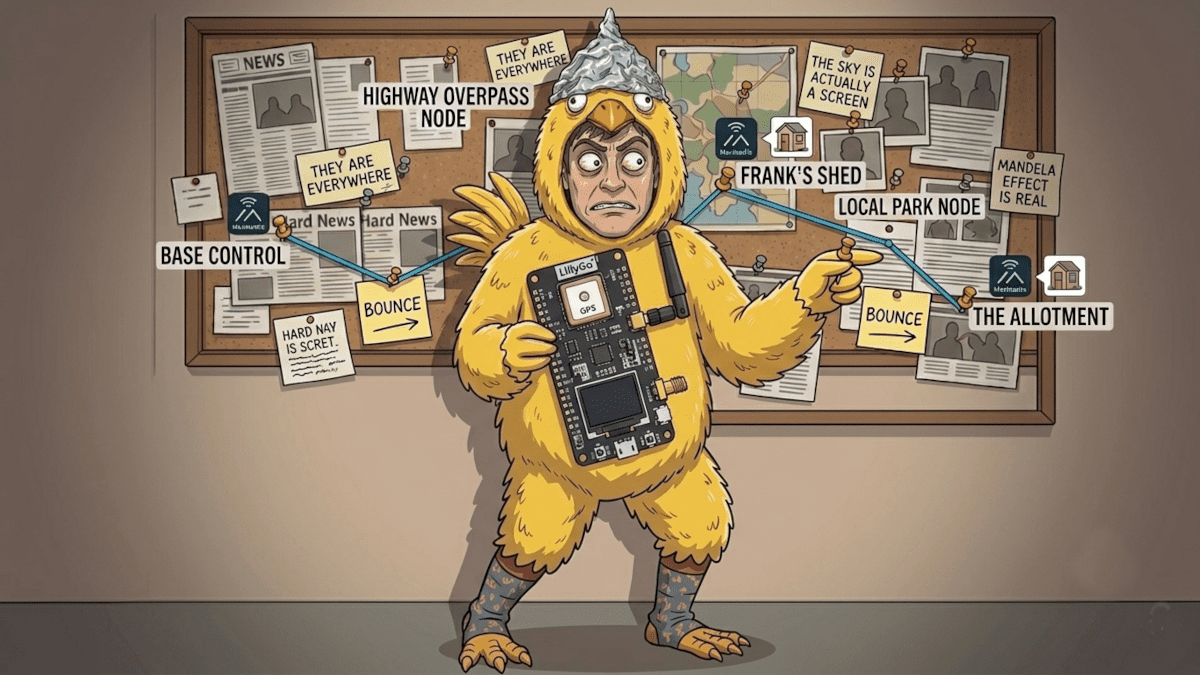
🐔 Chicken Licken
Did You Know?
Messages sent by LoRa radio networks don’t touch the internet, don’t pass through any server, and don’t identify you to any network — your smartphone tells more people where you are in a day than a LoRa node ever will. I’ve been saying it for years: the most private way to communicate is the one nobody’s tracking.
Frequently Asked Questions
Do I need a licence to use LoRa radio in the UK?
No. LoRa devices operating on the 868MHz ISM band in the UK are licence-exempt under Ofcom regulations. You can buy, own, and transmit on 868MHz LoRa hardware without any licence or registration. The only requirement is that devices operate within the permitted power and duty cycle limits for the ISM band, which commercially available devices are designed to do automatically.
What is the difference between LoRa and LoRaWAN?
LoRa is the radio modulation technology — how the signal is transmitted. LoRaWAN is a network protocol built on top of LoRa, designed for managed commercial IoT networks with central servers and gateways. For off-grid emergency communication, you use raw LoRa (via Meshtastic or Reticulum) rather than LoRaWAN, because LoRaWAN requires infrastructure that may not be available.
Can LoRa radio replace my walkie talkies?
Not for voice — LoRa cannot transmit audio. It complements walkie talkies rather than replacing them. PMR446 walkie talkies give you instant real-time voice communication over short distances. LoRa gives you text messaging over much longer distances with no infrastructure. Both have a role in a well-prepared communications plan.
How do I know if I am buying the right LoRa frequency for the UK?
Look for 868MHz or EU868 in the product specification. The US version uses 915MHz (US915) which is not authorised for use in the UK. Many devices on Amazon and AliExpress ship in the US variant by default. Always confirm the frequency band explicitly before ordering.
How many devices do I need?
Two is the minimum to have a working network between two locations. Each additional device both extends the network’s coverage and adds another node that can relay messages — increasing resilience and range. For a household starting out, two devices covers the basic use case. For a community network, the more nodes the better.
How long do LoRa devices run on battery?
It depends on configuration. A device with GPS active, screen on, and transmitting regularly will drain its battery in a day or two. The same device with GPS off, screen sleeping, and transmitting only when a message arrives can run for many days to several weeks on the same battery. For a fixed relay node, a small solar panel keeps the device running indefinitely without any battery management.
Does Meshtastic work without a smartphone?
Devices with a screen and keyboard (such as the T-Echo) can send and receive short messages without a phone. For most setups, a smartphone running the Meshtastic app is the primary interface — but the LoRa devices themselves relay messages automatically even without any phone connected, which means a node left running at home continues to extend the network’s reach while you are away.