

There’s a real government plan for what happens if the UK’s power grid fails completely — not for an evening, but for up to a week. It’s called Programme Yarrow, and unlike most of what circulates online about “secret government documents,” this one genuinely exists, was war-gamed in a live exercise, and its priorities are a matter of public record. No dramatic reveal needed here. Just what it actually says — including one detail in the government’s own risk modelling that runs against what most people assume about who’s safest when the lights go out.
We’ve read Programme Yarrow and the National Risk Register’s own section on a national grid failure, so you don’t have to go digging through government PDFs to find out what’s actually planned. Here’s what’s real, what it means for your own household, and the one finding that might change where you think you’re safest.
What Programme Yarrow Actually Is
Programme Yarrow is the UK government’s contingency plan for a nationwide power blackout lasting up to a week. It was developed in 2021 and stress-tested in a live exercise in late 2022, at the height of concern over gas and fuel shortages linked to the war in Ukraine. It isn’t a leak, a rumour, or a YouTube theory — it’s been reported on by multiple outlets and its broad shape is publicly known.
The plan assumes exactly the scenario this site exists for: something goes wrong with the national grid, and the country has to cope without mains power for days, not hours.
Who The Plan Actually Prioritises
Here’s the bit that matters most if you’re trying to work out where you sit in the government’s own thinking. Programme Yarrow’s stated priority is getting food, water and shelter to elderly and young people and their carers first. It’s an age and vulnerability-based framework — not a postcode-based one.
Hospitals and major airports are treated as protected infrastructure and are expected to keep running. Everyday communications largely aren’t — the plan expects most digital and online services to go down, with only BBC Radio 2 and Radio 4 (the old analogue FM signal, not an app or a stream) expected to keep broadcasting throughout. If your emergency information plan currently relies on your phone, that’s worth sitting with for a second.

🦆 Keith
Don’t Be Keith
Keith has spent three years and a small fortune planning for permanent, civilisation-ending collapse — never once checked that the government’s own worst-case scenario is a week, not forever.
What The National Risk Register Says About A National Grid Failure
The National Risk Register is the government’s own published assessment of the risks facing the UK, and it has a specific section on exactly this: failure of the National Electricity Transmission System. A few things worth knowing straight from the document.
Great Britain has never actually experienced a full nationwide power loss. The likelihood of one is scored at 1–5% over any five-year period — low, but not zero, and the impact if it did happen is scored as catastrophic. The worst-case scenario the government plans against assumes winter conditions, when demand on the grid is at its highest.
What Would Actually Cause A National Grid Failure?
This is the question most people assume the government won’t answer plainly, and it’s worth stating clearly: the National Risk Register does. Its own wording is: “Reasons for failure could include an extreme weather event, a cyber attack and cascading technical failures.” Three causes, named directly, no euphemism.
Extreme weather is the one with real, recent precedent. Storm Arwen in November 2021 and Storm Eunice in February 2022 both caused genuine regional electricity failures, leaving thousands of homes without power — not nationwide, but a real demonstration of how a single severe weather event can take down parts of the network. The government’s own post-incident review of those storms led the industry to make changes to improve the physical resilience of the electricity sector, specifically because of what Arwen and Eunice exposed.
A cyber attack sits alongside extreme weather as a named cause, not a hypothetical bolted on for effect — it’s in the same sentence, treated with the same weight. Cascading technical failures — one fault triggering another, snowballing across the network — is the third, and it’s the mechanism behind most of the largest blackouts seen internationally, including the 2019 South American power failure the National Risk Register itself references as a comparison point.
It’s worth being clear about what this means for probability, too: the document separately assesses a regional electricity failure (smaller in scale, more common) as “cause agnostic” but most likely to result from extreme weather — which lines up with the real Arwen and Eunice precedent above. A full national failure is the rarer, catastrophic-impact scenario; a regional one is the more realistic, more survivable version of the same underlying risk. Programme Yarrow exists precisely because a nationwide version of that risk, however unlikely, has to have a plan behind it.
How Long Would A Nationwide Blackout Last
According to the National Risk Register’s own recovery estimates, “small pockets” of the country would reconnect within hours, a “skeletal network” would be restored within days, and full restoration across the country could take up to seven days.
There’s an important caveat buried in that same estimate, though: full restoration in up to seven days assumes a relatively straightforward recovery. The document is explicit that the actual timeline “depends on the cause of failure and damage” — and that restoration of critical services specifically could take several months if the damage is severe. A cascading technical fault that’s fixed at source recovers very differently to a storm that’s physically destroyed substations and pylons across several regions. Seven days is the headline figure, not a guarantee.
And here’s the detail that runs against the grain of most prepper content on this exact scenario: the document states that rural areas are likely to get power back faster than urban areas, because the urban distribution network is more complex to bring back online safely. Northern regions may also reconnect faster, depending on where generation capacity sits. If your plan assumes “the countryside is doomed too, just later,” the government’s own document says the opposite.

🐔 Chicken Licken
Did You Know?
Rural areas are expected to get their power back faster than cities in a national grid failure, not slower — the opposite of what most people assume.
What Actually Stops Working When The Grid Goes Down
A national blackout plan on paper is one thing. What it actually feels like in your house is another, and some of it isn’t obvious until you think it through.
If you live above roughly the fifth or sixth floor of a block of flats, your water pressure depends on an electric booster pump, not just the mains supply. When the power goes, so does your water pressure — no flushing, no filling a kettle, nothing, and it happens within minutes of the cut, not hours.
Hospitals aren’t simply “fine because they’re hospitals.” UK hospital backup power is governed by a real technical standard (HTM 06-01), which tiers different parts of a hospital by clinical risk and backs them with different levels of generator and UPS protection — critical care isn’t treated the same as a corridor. It’s a genuinely more sensible system than a single flat “hours of fuel” number, but it also means a hospital under sustained strain is managing a lot of moving parts at once, not simply running on autopilot.
FosPower Emergency Radio
Most emergency radios have one or two power options. The FosPower has four, and that redundancy is the single most important feature for preparedness use.

Water companies have their own legal obligations here too — Defra’s Security and Emergency Measures Direction (SEMD) 2022 requires water and sewerage companies to maintain distribution and protect supply during emergencies. It’s not a vague aspiration: it’s a binding direction made under the Water Industry Act 1991, and it covers physical threats, cyber threats and contamination risk, not just power loss specifically. It’s a real regulatory backstop, even if it doesn’t come with a guaranteed number of hours attached — the obligation is on the company to have a resilience plan, not on the government to promise your tap will keep running.
That distinction matters in practice. A legal duty to plan for an emergency is not the same as a guarantee nothing will go wrong at your specific address, especially somewhere near the end of a long distribution chain. It’s the same logic that applies to Programme Yarrow itself — the plan being real doesn’t mean it removes the need for your own household to have some stored water and a way to purify more if the mains supply is disrupted for any length of time.
The Real-World Precedent
None of this is theoretical when it comes to how quickly things can unravel once people sense a shortage coming. In September 2021, media coverage of a leaked government briefing about HGV driver shortages triggered panic-buying at petrol stations across the country — in some regions, 50–90% of forecourts ran dry within days. That wasn’t a grid failure. It was rumour plus normal human behaviour, and it still emptied the pumps in under a week.
It’s the clearest real-world evidence we’ve got for how fast a supply shock turns into an actual, visible problem on the ground — and it’s worth remembering when you’re deciding how early is “too early” to sort your own plan out.
The practical lesson isn’t “panic-buy earlier than everyone else.” It’s the opposite: the 2021 crisis was entirely avoidable at a household level for anyone who already kept their tank reasonably topped up rather than running it down to the warning light every time. The same logic applies directly to a grid failure — a half-full tank, a stocked blackout box, and a few days of food and water sorted before anything happens costs you nothing extra and means you’re never the person queuing at 6am because a headline scared you into it. None of this requires spending big or going full off-grid. It requires not being the last person to act once everyone else already has.
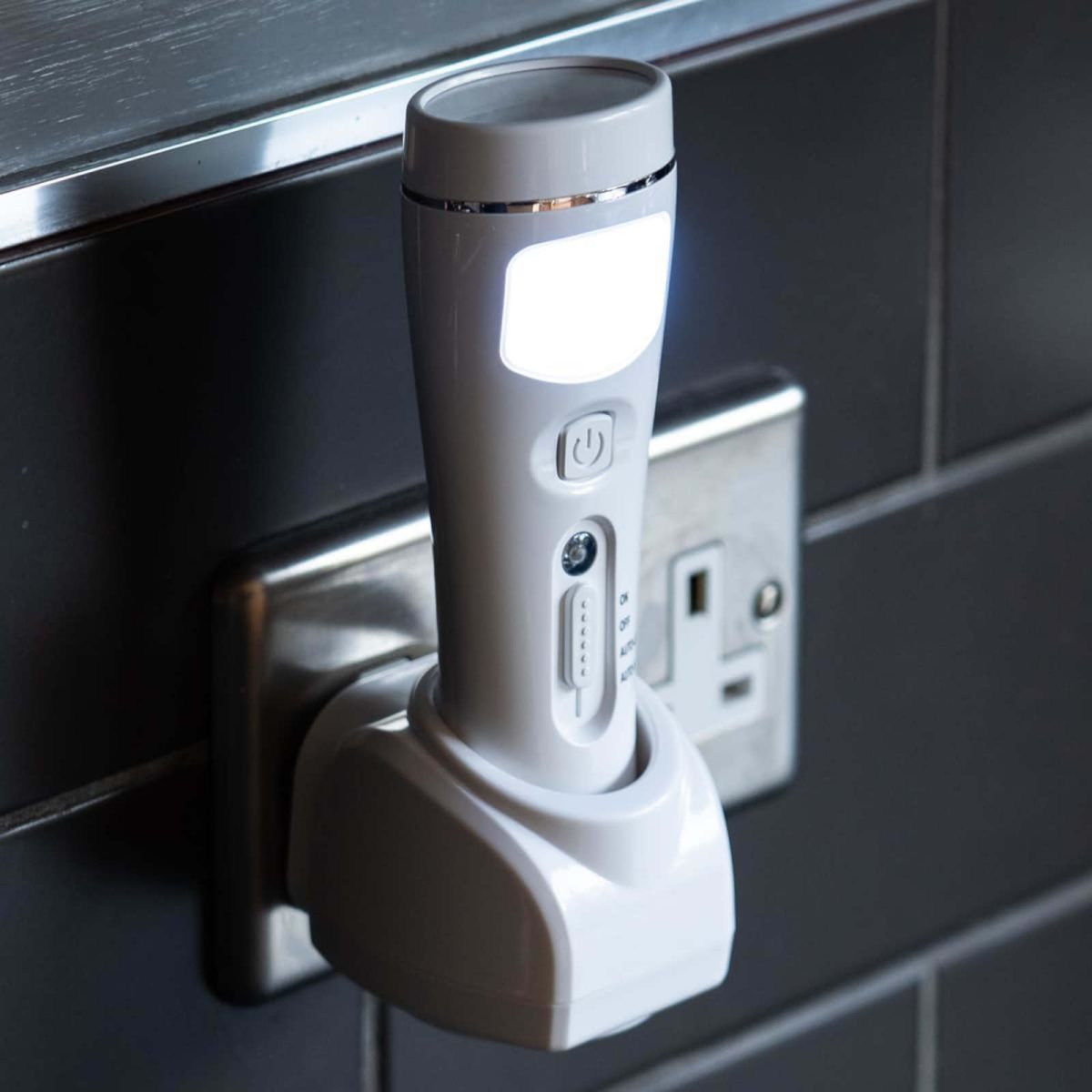
XtraLite NiteSafe
The NiteSafe is a dual-function device that works as both a plug-in nightlight and an emergency torch. It sits in a standard UK plug socket, charges continuously, and the moment mains power fails, it automatically illuminates.
What This Means For Your Own Plan
None of this is a reason to panic, and it’s not a reason to assume the government has a magic fix either. It’s a reason to actually read what’s been planned, rather than guess. The real documents say: prioritisation is about age and vulnerability, not where you live; full recovery is realistically measured in days, not months; rural areas are expected to bounce back faster than cities; and most of your everyday information sources won’t be there when you need them.
That last point is the one worth acting on today, not during the blackout itself.
Complete Guide
How to Prepare for a Power Cut
The 12 things to sort before the lights go out: lighting, heating, food, water and keeping phones charged, plus what to do in the first few minutes.
📋 Calm Clarissa
For your own plan, my printable power cut checklist covers light, power, warmth, food, water and safety for a long blackout, plus what to do when the power goes and when it comes back. Free to download, obviously.
Download the Free Checklist →Frequently Asked Questions
Is Programme Yarrow a real government plan?
Yes. It’s a genuine UK government contingency plan for a nationwide power blackout lasting up to a week, developed in 2021 and stress-tested in a live exercise in late 2022.
How long could a nationwide blackout in the UK actually last?
The National Risk Register’s own assessment says small areas could reconnect within hours, a skeletal network within days, and full restoration across the country could take up to seven days in a reasonable worst-case scenario.
Would rural areas or cities get power back first in a blackout?
According to the National Risk Register, rural areas are likely to reconnect faster than urban areas, because city distribution networks are more complex to safely bring back online. This runs against the common assumption that cities recover first.
Who does the government prioritise in a national blackout?
Programme Yarrow’s stated priority is getting food, water and shelter to elderly and young people and their carers first — an age and vulnerability-based framework, not a location-based one. Hospitals and major airports are treated as protected infrastructure.
What radio or communications would still work in a national blackout?
Programme Yarrow expects most digital and online services to be unavailable, with only BBC Radio 2 and Radio 4 on analogue FM expected to keep broadcasting throughout.
Build Your Resilience
Further Reading: Related Guides
All our guides can be found listed on our resilience hub.
Gear We've Tested & Reviewed
All our reviews can be found on our reviews and resources page.
📡 Find Us Everywhere
Daily briefings, prep guides, and real-time updates across every platform. Pick yours.
Free. No commitment. Stay anonymous on WhatsApp & Telegram.
Stay Informed on UK Preparedness
Join our newsletter for UK-specific preparedness tips, product recommendations, and real-world advice for households.
Subscribe to Our Newsletter