
This post contains affiliate links. Learn more
Carrying full watering cans back and forth from the water butt is the single most tedious part of using stored rainwater in the garden — heavy, slow, and exactly the kind of chore that quietly puts people off bothering with rainwater at all. The Gardena rain barrel pump solves that outright: drop it in the butt, connect a hose, and you get proper pressure on demand instead of another trip with a can.
It’s worth using stored rainwater over tap water regardless of the convenience, too. Most UK mains water is treated with chlorine and runs hard or alkaline, particularly across the south and east of the country, which gradually raises soil pH and doesn’t suit the acid-loving plants — rhododendrons, camellias, blueberries, azaleas — that struggle under repeated tap watering. Rainwater arrives untreated, naturally soft, and close to neutral or slightly acidic, which is exactly why most experienced gardeners reach for the butt over the tap whenever they can. The Gardena rain barrel pump just makes doing that properly a lot less effort.
As a side effect of drawing only from stored water rather than the mains, it also keeps working exactly as normal whenever a hosepipe ban is in force nearby — it was never using mains water to begin with, so the restriction simply never applies to it.
Gardena Rain Barrel Pump
Turns stored rainwater into real hose pressure — no more hauling watering cans, and it keeps working through a hosepipe ban since it never touches the mains.
Current Price at time of writing: £79.99
Rated: 4.7/5 ⭐ from 64 reviews · Amazon’s Choice (Gardena Rain Barrel Pump 4000/1)
What the Gardena Rain Barrel Pump Actually Is
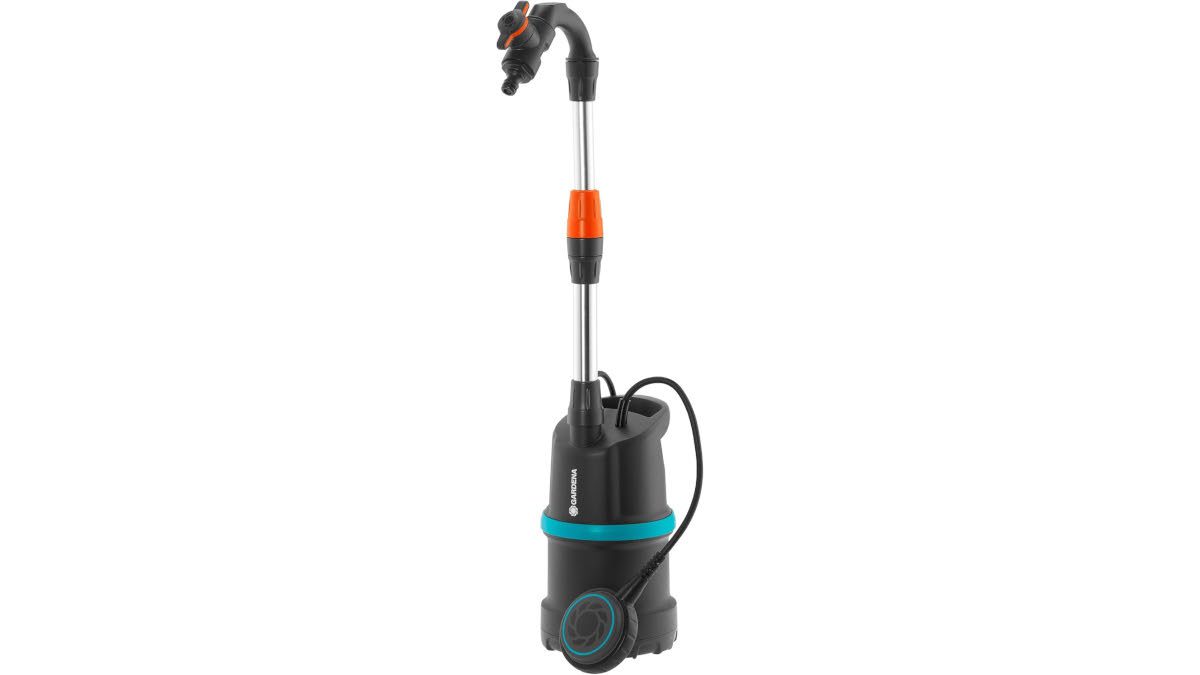
It’s a submersible electric pump built to sit inside a water butt or rain tank and push stored water out through a garden hose under real pressure — 4,000 litres an hour at 1.3 bar, enough to run a spray gun, shower head, or sprinkler properly rather than the weak dribble gravity alone gives you from most butts. A UK-plug mains cable powers it, so it needs a nearby socket rather than a battery.
The base has an integrated pre-filter that keeps leaves and debris out of the pump itself, and it’s removable for cleaning when it inevitably clogs. The standout detail is the patented telescopic tube: it guides the hose over the lip of the butt without kinking, doubles as a regulating and shut-off valve, and works as a carry handle when you need to lift the whole thing out. It’s also rated for drainage work, not just irrigation, if you ever need to empty a butt down rather than out through a hose. Gardena’s wider accessory range extends it further — a drip irrigation timer is the obvious add-on for anyone wanting to automate watering entirely — though that’s a separate purchase and a subject for another day, not something this review covers in depth.
Why Rainwater Beats the Tap
Every gardener worth their salt already knows this, but it’s worth spelling out. UK tap water is treated to be safe to drink, not to be ideal for plants — chlorine (and often chloramine) is added specifically to kill the same microbes that healthy soil actually relies on, and much of the country, especially the south and east, sits on chalk or limestone geology that makes mains water hard and alkaline. Water that alkaline gradually pushes soil pH upward with every watering, which is exactly what stresses ericaceous, acid-loving plants over a season or two.
Rainwater sidesteps all of it. It falls untreated, carries none of the added chemicals, and sits naturally closer to neutral or slightly acidic — the range most garden plants actually prefer. It also arrives free of the dissolved minerals and salts that build up in soil over years of tap watering, and if a household has a water softener plumbed into outdoor taps, mains water can carry softener salt too, which plants tolerate even less well. None of this is new information to anyone who’s gardened seriously for a few years — it’s just far easier to act on once a pump is doing the carrying instead of a watering can.
Free Water, But Not Quite Free to Move
Rainwater itself costs nothing — no metered water bill for anything that goes through the Gardena rain barrel pump, which matters if the household is on a water meter and pays per litre used. What it doesn’t remove is the cost of running the pump itself: it draws mains electricity while it’s working, so there’s a small running cost attached to every use. It’s nowhere near what the same volume would cost through a metered hosepipe, but it isn’t literally free either — just considerably cheaper than watering the same amount straight from the tap.
Gardena Rain Barrel Pump
Turns stored rainwater into real hose pressure — no more hauling watering cans, and it keeps working through a hosepipe ban since it never touches the mains.
Current Price at time of writing: £79.99
Rated: 4.7/5 ⭐ from 64 reviews · Amazon’s Choice (Gardena Rain Barrel Pump 4000/1)
The Other Job It Does: Moving Water to Where It’s Actually Needed
Most water butts end up positioned wherever the downpipe happens to be, which is rarely anywhere near the vegetable patch or whichever corner of the garden actually needs the most watering. The Gardena rain barrel pump solves that too. Run a hose from the butt that fills automatically off the roof across to a second, largely empty butt positioned exactly where the watering happens, and transfer the water over in one go. The house-side butt drops back down ready to refill on the next downpour, and the water ends up stored where it’s actually going to be used, rather than sitting forty feet away from the plants that need it. It’s a genuinely different job to watering directly, and one most people never realise a rain barrel pump can do until they need it.
Who the Gardena Rain Barrel Pump Isn’t For
It needs a nearby mains socket and an outdoor-rated extension if the butt isn’t already close to power, so it’s not the fully portable, anywhere-will-do solution a battery pump would be. It also needs enough water depth in the butt to submerge properly and prime — once a butt’s down to the last few inches, the pump won’t have enough to work with, so it’s a tool for using stored water well, not for scraping the very last of it out. And if all that’s needed is topping up a couple of pots on a balcony, a watering can will always be simpler than setting up a pump for the job.
[INSERT AFFILIATE CARD: Gardena Rain Barrel Pump 4000/1]
Gardena Rain Barrel Pump
Turns stored rainwater into real hose pressure — no more hauling watering cans, and it keeps working through a hosepipe ban since it never touches the mains.
Current Price at time of writing: £79.99
Rated: 4.7/5 ⭐ from 64 reviews · Amazon’s Choice (Gardena Rain Barrel Pump 4000/1)
What the Rest of the Team Think

🦆 Keith the Prepper
Had a proper watering can relay going between the house butt and the veg patch butt every evening — my wife on cans two and four, me on one, three and five. Turns out you can just run a hose between them with the Gardena rain barrel pump. Five stars, mildly embarrassed, wife’s reclaimed her evenings.
⭐⭐⭐⭐⭐

🪖 Black Panther
Redeploys reserves from the primary cache to the forward position without exposing personnel to open ground between them. Correct logistics doctrine. Base camp’s vegetable patch has never been better supplied.
⭐⭐⭐⭐⭐

🤡 Camping Clown
Yeah but have you seen the twelve-stage rainwater filtration rig I built for the allotment? This just moves water from A to B. Bought three of the Gardena rain barrel pumps anyway, one’s still in the box, one’s in the shed, no idea where the third one went.
⭐⭐⭐

🐾 Weekend Warrior
Two water caches now instead of one, exactly like the channel recommends for redundancy. Doesn’t touch the mains supply at all, which the channel also says is coming for all of us eventually. WW3 is coming, bro. So is the next dry spell.
⭐⭐⭐⭐

🐕 Pickle
“Snorgle!”
(Translation: There’s a second water bowl by the veg patch butt now that never runs dry, so I don’t have to walk all the way back to the house one on patrol.)
⭐⭐⭐⭐⭐

🐔 Chicken Licken
They don’t want you to know what’s actually in mains water, but rainwater falls straight from the sky before anyone’s had a chance to add anything to it. The Gardena rain barrel pump moves it without a single foot of council pipework involved. Checked it for trackers regardless. Clean, for now.
⭐⭐⭐⭐

📋 Calm Clarissa
There is now a transfer schedule between the two butts, reviewed monthly. Janet checks the filter basket on the first of the month, I check it on the fifteenth. It wouldn’t laminate well while wet, so the schedule stays on the shed wall in a plastic wallet instead.
✅✅✅✅✅

💄 Survivl Gurl
“Sustainable garden era” is literally trending right now and my veg patch has never looked this hydrated on camera 🌱💧 Wish it came in a colour that matched the butt though, currently just a green one sat next to a green one and it’s not giving intentional. Still cute. #chateausurvie
⭐⭐⭐⭐

🌿 Aroura
I’ve known rain feeds the garden better than the tap ever could since long before anyone needed a pump to prove it. Still prefer to carry it by hand when I can, it’s part of the exchange between me and the plants, but the Gardena rain barrel pump is a good backup for the far beds when my back isn’t up to it. Three stars — would be five if it ran on solar instead of the mains. Namaste 🙏
⭐⭐⭐
Frequently Asked Questions
Why is rainwater better for my garden than tap water?
UK mains water is treated with chlorine (and often chloramine) and, across much of the south and east of the country, runs hard and alkaline due to chalk and limestone geology. Watering with it repeatedly gradually raises soil pH, which stresses acid-loving plants like rhododendrons, camellias, and blueberries. Rainwater arrives untreated, naturally soft, and closer to neutral or slightly acidic — the range most garden plants actually prefer.
Can I use the Gardena rain barrel pump during a hosepipe ban?
Yes. It draws water from a butt or tank you’ve already collected, never from the mains, so hosepipe ban restrictions simply don’t apply to it, ban or no ban.
Does using the pump actually save money?
It saves on metered water use, since the water itself is free rainwater rather than mains supply. It doesn’t save on electricity — the pump draws mains power while it’s running, so there’s a small running cost each time, just far less than watering the same volume through a metered tap.
Can it move water between two separate water butts?
Yes — run a hose from a downpipe-fed butt near the house to a second butt positioned closer to where the water’s actually needed, such as a vegetable patch, and transfer water across on demand. The house-side butt then has room to refill on the next rainfall.
How much water does the butt need for the pump to work properly?
Enough to keep the pump fully submerged so it can prime and draw water without running dry. Once a butt’s down to the last few inches, it’s not enough for the pump to work with reliably.
Can I expand the Gardena rain barrel pump with other accessories?
Yes — Gardena’s wider range includes things like a drip irrigation timer that can automate watering from the same pump. Those are separate purchases and outside the scope of this review, which covers the pump itself.
Pros and Cons
Pros
- Ends the tedious job of hand-carrying watering cans and buckets from the butt
- Rainwater is genuinely better for most garden plants than UK mains water — softer, chlorine-free, closer to neutral pH
- No metered water bill for anything that goes through it, unlike watering from the tap
- Can transfer water between two butts, moving it from where it collects to where it’s actually needed
- Amazon’s Choice with a strong review base from a genuinely trusted garden brand
- Draws from stored water only, so it keeps working exactly as normal during any hosepipe ban
Cons
- Needs a nearby mains socket and outdoor-rated cable — not portable the way a battery pump would be
- Still costs a small amount in electricity every time it runs
- Needs enough water depth in the butt to submerge and prime properly — won’t help once a butt’s nearly empty
- Wider accessories like the drip irrigation timer are sold separately if you want to automate further
Build Your Resilience
Further Reading: Related Guides
📡 Find Us Everywhere
Daily briefings, prep guides, and real-time updates across every platform. Pick yours.
Free. No commitment. Stay anonymous on WhatsApp & Telegram.
Stay Informed on UK Preparedness
Join our newsletter for UK-specific preparedness tips, product recommendations, and real-world advice for households.
Subscribe to Our Newsletter