
This post contains affiliate links. Learn more
Most households hit the same ceiling at some point during a power cut. The power bank is keeping the phones alive, but the CPAP machine is sitting useless on the bedside table. The router has gone dark. The mini-fridge is warming up. A power bank cannot fix any of that. A portable power station can — and the Anker SOLIX C300 is where that journey sensibly starts.
At 288Wh and 300W output, the C300 is not trying to run your fridge for a week. It is the first step up from a power bank: a compact, LiFePO4-powered unit that handles medical equipment, device charging, small appliances, and lighting — and does it from something that weighs about the same as a bag of sugar and costs less than a mid-range laptop.
Anker SOLIX C300 Portable Power Station
The entry-level portable power station with LiFePO4 chemistry — 288Wh and 300W pure sine wave in something you can actually carry.
Current Price at time of writing: £179.00
Rated: 4.6/5 ⭐ from 1,645 reviews
Build and Design
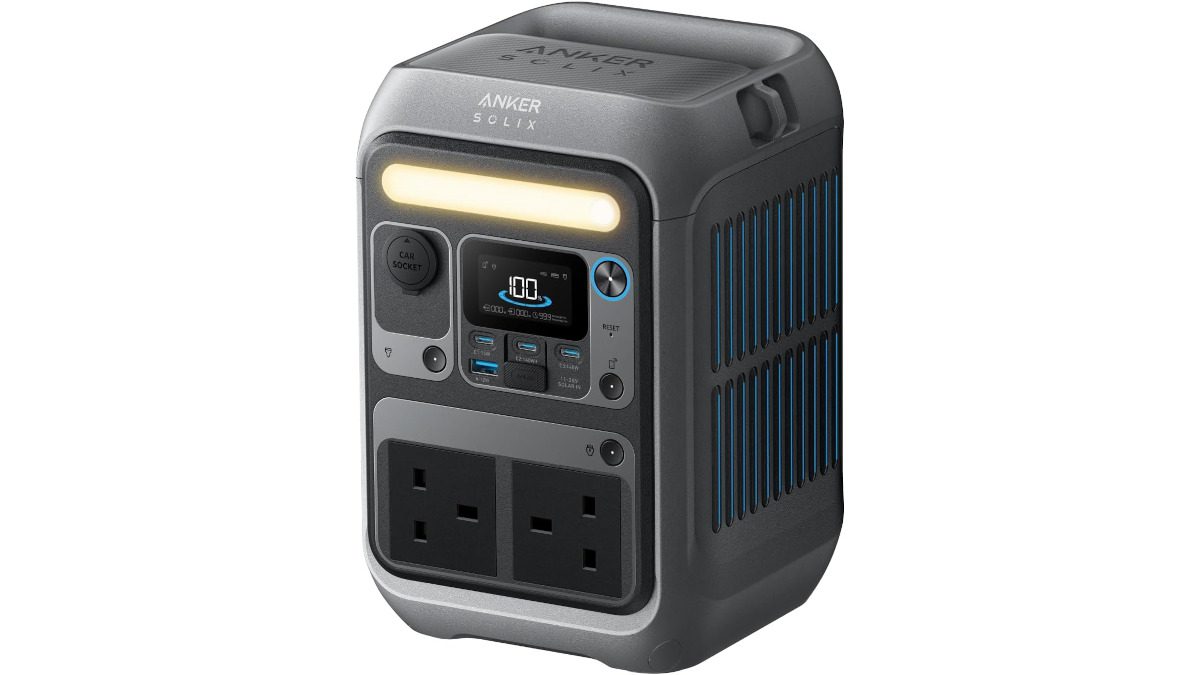
The C300 is noticeably smaller than the category photos suggest. At roughly the size of a large lunchbox — about 21 × 21 × 18cm — it sits unobtrusively on a shelf or in a cupboard without demanding storage reorganisation. The carry handle is solid and the unit feels well-assembled throughout. Nothing rattles. The display is clear: capacity percentage, input/output wattage, and estimated run time or charge time depending on what is plugged in.
The port selection covers everything most households actually use: two AC outlets (300W combined), two USB-A, two USB-C (one at 45W PD), and a DC barrel output. Enough to run a CPAP, charge two phones, and power a lamp simultaneously — which is a reasonable description of a real power cut setup.
The Anker SOLIX C300 in a UK Power Cut
The 300W output handles a CPAP machine (30–60W) comfortably, with capacity to spare for charging. It runs a router (10–20W) for 12+ hours. LED lighting draws almost nothing. A small 12V camping fridge (40–60W) runs for 4–6 hours on a full charge.
What it will not do: run a standard kettle (2,000W+), a microwave (700–1,000W), or a fan heater (1,000–2,000W). The 300W ceiling is a real one. Anyone expecting to maintain normal domestic life through a power cut will hit it. Anyone expecting to keep medical equipment running, devices charged, and a lamp on will not.
Charging from mains takes roughly 1.5 hours — fast enough that topping up between outages is painless. It charges while simultaneously powering devices (pass-through), so running it permanently plugged in as a live backup is a viable option. Solar input is supported up to 100W via the DC input — useful in summer for slow maintenance charging, less so in a UK January.
LiFePO4 — Why It Matters at This Price
The C300 uses LiFePO4 (lithium iron phosphate) battery chemistry, which at this price point is still a selling point rather than a given. LiFePO4 is significantly more thermally stable than the NMC lithium-ion used in cheaper units — less prone to the thermal runaway that can turn a battery into a problem. It is also rated for 3,000+ charge cycles, compared to 500–1,000 for NMC.
For a unit you will charge monthly during storm season and occasionally the rest of the year, that cycle life means a genuinely long-lived purchase. A no-name 300Wh unit at £89 might look like a better deal. By cycle count, it is the more expensive option.
Honest Limitations
The 300W ceiling rules out anything with a heating element or large motor. Anyone who wants to run a small fridge properly overnight needs to step up to the 1kWh tier — the C300 can run a small camping fridge, not a domestic fridge-freezer.
The solar input (100W max) is modest. Anker sells compatible panels, but for meaningful solar charging you will want to look at a higher-input unit in the mid-range tier.
There is no expandability — the C300 is what it is. As a starting point, that is fine. As a long-term whole-household backup plan, it is the first step rather than the last.
Anker SOLIX C300 Portable Power Station
The entry-level portable power station with LiFePO4 chemistry — 288Wh and 300W pure sine wave in something you can actually carry.
Current Price at time of writing: £179.00
Rated: 4.6/5 ⭐ from 1,645 reviews
What the Rest of the Team Think

🦆 KEITH THE PREPPER
I’ve got it charged and sitting next to the blackout box. Has been for three months. When the grid goes — and it will — I’ll be the one everyone rings for a phone charge. Not that I’ll answer. Operational security. But the point stands.
⭐⭐⭐⭐⭐

🪖 BLACK PANTHER
Compact. LiFePO4 certified. Pure sine wave output — suitable for field medical equipment. In my previous role we used hardware that cost fifteen times this price to achieve the same result. Civilians don’t need what I had access to. This does the job. Carry on.
⭐⭐⭐⭐

🤡 CAMPING CLOWN
I bought the EcoFlow Delta Pro first. 3,600Wh. Weighs 17kg. Cost over a thousand pounds. I am not entirely sure what I was thinking — I live in a flat. This is considerably more sensible. I’m keeping both, obviously.
⭐⭐⭐⭐

🐾 WEEKEND WARRIOR
Grid went down at 18:47 last Tuesday. Unit powered the router, charged two phones, and ran the lamp. Pickle sat on it for the warmth it gives off when charging. I’m logging that as a secondary tactical function. Bro.
⭐⭐⭐⭐⭐

🐕 PICKLE
Snorgle!
⭐⭐⭐⭐⭐ (warm, sitdownable, good in a crisis)

🐔 CHICKEN LICKEN
LiFePO4. Three thousand cycles, minimum. I’ve been saying this for years — the cheap NMC option looks better until you’re buying your third one in a decade while mine is still running fine. Get the chemistry right the first time.
⭐⭐⭐⭐⭐

📋 CALM CLARISSA
Added to the emergency kit inventory. Charged monthly on the first of the month, same as the smoke alarms. The app lets me check the charge level without opening the cupboard, which I appreciate. It is on the list. The list is laminated.
✅✅✅✅✅

💄 SURVIVL GURL
Okay I was NOT expecting to love this but the matte finish is genuinely clean?? It charged my ring light, both phones, and my laptop during the last power cut and I got content the whole time. Prep that doesn’t ruin the aesthetic. We love to see it. 🔋
⭐⭐⭐⭐⭐

🌿 AROURA
The earth’s energy stored in a box and returned to us when we need it most. I use it to power the essential oils diffuser when the grid is unsettled — frankincense for grounding, lavender for calm. The LiFePO4 chemistry feels gentler somehow. Namaste 🙏
⭐⭐⭐⭐
Pros and Cons
Pros
- LiFePO4 battery — 3,000+ cycles, thermally stable, long-term value
- Pure sine wave output — safe for CPAP machines, medical equipment, anything with a motor
- Compact and genuinely portable at roughly 3.5kg
- Fast mains charge (~1.5 hours to full)
- Pass-through charging — can run as a live backup plugged in permanently
- Clear display showing capacity, wattage in/out, and estimated run time
- Anker’s 2-year warranty and established UK support
Cons
- 300W ceiling rules out kettles, microwaves, and fan heaters
- 288Wh is not enough for overnight fridge operation — step up to the 1kWh tier for that
- Solar input capped at 100W — adequate for maintenance top-ups, slow for full recharges
- No expandability — what you buy is what you have
Frequently Asked Questions
What can the Anker SOLIX C300 run during a power cut?
The C300 runs CPAP machines (30–60W), routers (10–20W), LED lamps, phones, tablets, and laptops comfortably. It will not run a kettle (2,000W+), microwave, or fan heater — the 300W output ceiling rules those out. Think of it as keeping medical equipment and communication going, not replacing your mains supply.
How long does the Anker SOLIX C300 take to charge?
From a standard mains socket, the C300 charges in approximately 1.5 hours. Solar charging (up to 100W input) is much slower — roughly 3–4 hours on a bright summer day with a suitable panel.
Is the Anker SOLIX C300 safe to use indoors?
Yes. Unlike petrol generators, portable power stations produce no fumes or carbon monoxide and are completely safe indoors. The C300’s LiFePO4 battery chemistry is also significantly more thermally stable than standard lithium-ion, making it a safer option for home use.
Can the Anker SOLIX C300 run a CPAP machine?
Yes. Most CPAP machines draw 30–60W, and the C300 outputs pure sine wave AC — the type required by sensitive medical equipment. A full charge should power a CPAP machine for 5–9 hours, depending on settings and whether the heated humidifier is enabled.
What is LiFePO4 and why does it matter?
LiFePO4 (lithium iron phosphate) is a type of lithium battery chemistry that is more thermally stable than standard NMC lithium-ion — significantly less prone to fire risk under stress or damage. It also lasts much longer: 3,000+ charge cycles versus 500–1,000 for cheaper units. For a power station you are relying on in emergencies, both factors matter.
Can I leave the Anker SOLIX C300 plugged in permanently?
The C300 supports pass-through charging — it can charge from the mains while simultaneously powering connected devices. This makes it viable as a permanently-on live backup. Anker recommends not storing it at 100% for extended periods; aim for 80% if leaving it plugged in long-term.
Is 288Wh enough for a power cut?
It depends on what you need to run. For phone charging, router, and lighting through a 24-hour outage, yes — comfortably. For running a mini-fridge overnight or powering anything with a high wattage draw, you will want to step up to the 1kWh tier.
Build Your Resilience
📡 Find Us Everywhere
Daily briefings, prep guides, and real-time updates across every platform. Pick yours.
Free. No commitment. Stay anonymous on WhatsApp & Telegram.
Stay Informed on UK Preparedness
Join our newsletter for UK-specific preparedness tips, product recommendations, and real-world advice for households.
Subscribe to Our Newsletter