
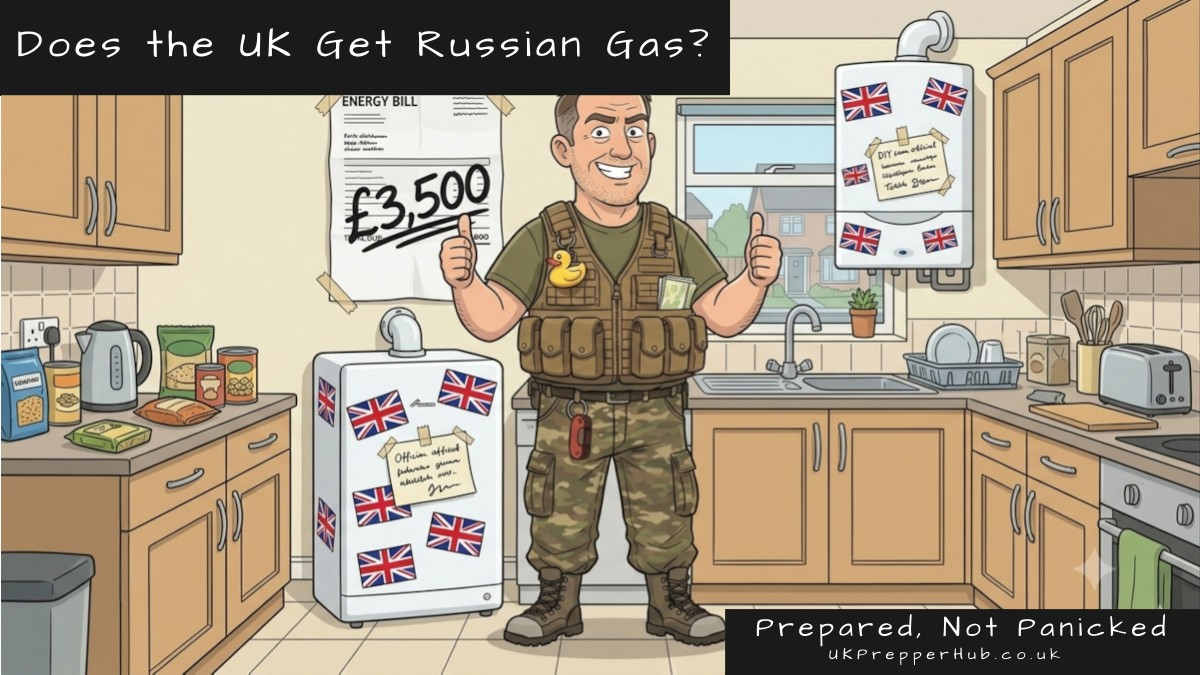
Does the UK get gas from Russia? The official answer is no — Britain stopped buying Russian gas at the start of 2023. The government issued a press release. There were ministers looking pleased with themselves. And technically, they were right.
But technically correct and actually safe are different things. Russia’s gas infrastructure still has a direct line to your energy bill — just not the one most people imagine. Understanding that connection, and what happens if it gets disrupted, is what this piece is for.
Does the UK Get Gas From Russia?
To be clear: the UK banned imports of Russian gas at the start of 2023. Before Russia’s invasion of Ukraine, Russia supplied roughly 4% of UK gas imports — a relatively small share compared to Germany, which was running at over 50% Russian dependency at the time. We were never as exposed as continental Europe, and we stopped buying before the pressure to do so became unavoidable.
The UK’s gas today comes primarily from three sources: the North Sea (domestic production, though it’s been declining for years), Norway via undersea pipeline, and LNG tankers arriving at terminals in South Wales and on the Isle of Grain in Kent. Russia doesn’t feature in that supply chain. Not directly.
And yet, UK household energy bills rose 13% in July 2026, to an average of £1,862 a year. Part of the reason given was the Iran war — a conflict that Britain is not a party to, involving oil fields that supply countries we don’t directly buy oil from. If you’re starting to sense a pattern here, you’re on the right track.
Gas Doesn’t Have a Price Tag — It Has a Market
Natural gas isn’t priced like a product you buy from a specific supplier at a fixed rate. It’s traded on a global wholesale market, and that market responds to supply and demand across every producing and consuming country simultaneously. When a major supply source is disrupted anywhere — when an Arctic facility goes offline, when a pipeline is damaged, when a shipping route becomes unsafe — the price goes up everywhere.
Your energy bill isn’t set by what your particular molecules of gas cost at their source. It’s set by Ofgem’s price cap, which tracks the wholesale market. When wholesale prices spike — for any reason, in any country — Ofgem adjusts the cap at the next quarterly review, and your direct debit goes up.
This is why the July cap rose when the Iran war intensified. Britain doesn’t buy Iranian oil. It still felt the price impact. The same mechanism is what connects a gas facility on Russia’s Arctic coast to a bill landing on a doormat in Wolverhampton.
What Yamal LNG Is — and Why It Matters
The Yamal LNG facility is a vast liquefaction plant on Russia’s Arctic coast, built on the Yamal Peninsula in Siberia. Russia’s largest gas fields are buried here — enormous reserves, but thousands of kilometres from European customers and far beyond the practical reach of a new pipeline. So instead, the gas is chilled to -162°C, compressed into liquid form, loaded onto specialist ice-class tankers, and shipped to European ports — where it’s warmed back into gas, pumped into the grid, and eventually burned in someone’s boiler in Rotterdam, Marseille, or Madrid. That process is what LNG means: Liquefied Natural Gas.
Yamal LNG is operated by Novatek, Russia’s largest independent gas producer, and it’s one of the largest LNG export facilities in the world, producing roughly 16.5 million tonnes of LNG per year. When it runs, it represents a significant chunk of the European LNG market.
The detail that makes this particularly relevant right now: it has been running at record levels. EU imports of Yamal LNG hit an all-time high in the first four months of 2026, up 17.2% year-on-year. The European Union paid an estimated €2.88 billion for Russian LNG in Q1 2026 alone — while simultaneously announcing plans to phase out Russian energy. The tankers kept coming. The money kept flowing. Europe’s stated policy and its actual purchasing behaviour are not currently the same thing.
How Yamal Connects to Your Energy Bill
Here’s the chain, laid out plainly.
Yamal LNG ships gas to European terminals. European buyers purchase that gas at the prevailing spot price — a price traded at the Title Transfer Facility (TTF) in the Netherlands, which is the standard benchmark for European gas. When Yamal LNG is flowing freely, it helps keep the TTF price from rising as fast as it otherwise would, because the market has more supply to draw on. When Yamal LNG is disrupted — partially or fully — European buyers compete harder for alternative supplies from Norway, Qatar, and the United States. The TTF price rises.
The UK buys Norwegian gas and LNG from multiple non-Russian sources. But those suppliers set their prices with reference to the TTF. When the TTF rises, the price of Norwegian gas sold to the UK rises with it. So does the landed cost of every LNG cargo arriving at Milford Haven.
Does the UK get gas from Russia via Yamal? No — not a single tanker of it lands on British shores. But we are exposed to it through price. Every British household paying an energy bill is, in effect, participating in the same global market as every European buyer of Russian gas — and paying a price partly set by whether that Russian gas keeps flowing.
The Disruption Risk
Ukraine’s long-range drone campaign has spent three years systematically targeting Russian energy infrastructure — oil refineries, fuel depots, pipeline compressor stations. It has been methodical, patient, and increasingly effective at reaching deep into Russian territory.
In recent weeks, military analysts have begun publicly discussing the Yamal Cross — the infrastructure hub that connects Yamal’s gas fields to their processing and liquefaction facilities — as a potential target. A strike on Yamal LNG wouldn’t need to destroy the facility to have a market impact. A partial shutdown, a damaged export terminal, or significant disruption to the ice-class tanker routes would be sufficient to remove a meaningful volume of LNG from the European market. The TTF would respond immediately. UK wholesale prices would follow within hours.
We’ve already seen what a gas price shock looks like in 2026. In March, when Middle East tensions escalated sharply, UK wholesale gas prices doubled in a matter of days — from around 77p per therm to a peak of 151p. That spike fed directly into the July cap rise. A Yamal disruption of comparable scale would produce a similar effect, landing on top of bills that are already at their highest point since early 2024.
None of this is certain. The Yamal facility hasn’t been struck. The risk is real and worth understanding, but it is a risk scenario rather than an announced event. The point of knowing about it is precisely that: knowing about it before it becomes a headline.

🐔 Chicken Licken
Did You Know?
The UK having barely two weeks of gas storage has nothing to do with Russia — Britain’s been running on empty since it closed the Rough facility. I’ve been saying it for years. Nobody listened. They never do.
Why the UK Feels Gas Price Spikes Faster Than Most
There is a reason UK energy bills respond to global gas market shocks more sharply than those in Germany or France — and it comes down to storage.
Most large European economies hold significant strategic gas reserves. Germany, which learned an expensive lesson from its dependence on Russian pipeline gas, has invested heavily in underground gas storage and now holds enough to cover roughly 90 days of average demand. France has comparable capacity. These reserves act as a buffer: when supply is disrupted and wholesale prices spike, countries with large storage can draw on reserves rather than buying at peak market prices immediately. Their bills still rise, but the shock is absorbed more gradually.
The UK’s position is considerably more exposed. Britain has historically held minimal gas storage relative to demand — enough for roughly 14 days of typical winter consumption at full draw-down. The reasons are partly geological (the North Sea provided readily accessible domestic gas for decades, reducing the case for storage), partly commercial (storage was seen as unnecessary overhead when domestic production was abundant), and partly a specific policy decision: the Rough storage facility — once the UK’s largest gas store, capable of supplying the country for months — was closed by Centrica in 2017 on commercial grounds.
Rough has since been partially reopened, but at significantly reduced capacity. The UK’s total gas storage remains among the lowest in Western Europe as a proportion of annual consumption.
What this means in practice: when a gas price shock hits, UK buyers have far less buffer than their European counterparts. Prices adjust faster and harder. The 2021-22 gas crisis illustrated this clearly — Russia reduced pipeline flows to Europe ahead of the Ukraine invasion, Germany could draw on reserves to cushion the immediate impact, and the UK felt the wholesale price movement almost at once. That spike fed directly into household bills through the Ofgem cap and contributed to the energy crisis of 2022.
A Yamal LNG disruption would work through the same mechanism. European countries with large storage would have weeks to find alternative supplies at competitive prices. With a 14-day buffer, the UK would be competing in the spot market almost immediately.
What Is the Government’s Strategy?
The honest answer is that the UK government does not hold strategic gas reserves in the way it holds emergency oil stocks. There is no national gas equivalent of the US Strategic Petroleum Reserve. The government’s approach to gas security is largely market-based — it relies on commercial suppliers to secure diverse supply contracts, on interconnectors with Europe and LNG import terminals to access global supply, and on Ofgem’s price cap mechanism to regulate what households ultimately pay.
What the government can do when prices spike is react. Cost of living payments, energy bill support schemes, targeted relief for vulnerable households — all have been deployed in recent years and would be deployed again. These are not nothing. But they are reactive by design: they arrive after the price has already risen, often months after the wholesale shock that caused it, and they are means-tested in ways that leave a significant portion of stretched households outside the eligibility threshold.
What the government cannot do is prevent a global wholesale gas price spike from happening. It cannot compel Ofgem to hold the cap below cost. It cannot redirect global LNG tanker traffic toward the UK during a supply crunch. It has no lever that insulates British households from the market mechanics described in this piece.
This is not a criticism — it reflects the reality of how interconnected global energy markets work, and no government in a market economy has found a clean answer to it. But it is worth being clear about: the household that has thought through its heating options, fixed its energy tariff before the next shock, and reduced its gas dependency where practically possible is in a materially better position than the one waiting for a ministerial statement.
Government support exists. It helps. It is not a plan.

🦆 Keith
Don’t Be Keith
Keith has a 47-point government emergency response plan laminated and filed under K. He is waiting for the ministerial statement. His wife suggested fixing the draughts and switching to a fixed tariff in October. He told her it wasn’t that simple.
What UK Households Can Do
There’s no practical way to fully insulate yourself from a global gas price spike. Your home doesn’t come with an off switch for the wholesale market. But there are sensible steps that reduce exposure and give you more options if prices jump sharply.
Check whether a fixed-rate tariff makes sense for you. Fixed deals are available from some suppliers at rates close to or below the current cap. If you fix now, a Yamal disruption doesn’t show up in your direct debit next quarter — your rate is locked regardless of what the wholesale market does. The trade-off is that if prices fall sharply, you won’t benefit either. With the July cap already up 13% and the geopolitical picture cloudy, many households are deciding that certainty is worth more than the chance of a downside that may not materialise. Check comparison sites and your current supplier for what’s available.
Reduce gas consumption where it’s cheap and easy to do so. A properly programmed boiler timer — running only when the house actually needs heat, not all day by default — cuts consumption directly without any outlay. Draught-proofing around doors, letter boxes, and skirting boards costs very little and makes a measurable difference. These aren’t dramatic measures, but they reduce the volume of gas you’re buying at whatever price the market sets.
Build a small financial buffer for a higher bill. If a Yamal disruption pushed the October price cap up another 10–15% — broadly comparable to what a March-level gas price spike would produce — a typical household would see annual bills rise by roughly £185–£280 more than the current cap. That works out at around £15–£23 extra per month. Not unmanageable for most, but a surprise if it arrives without warning. Knowing it’s a plausible scenario means it doesn’t have to be.
Know what support is available before you need it. Warm Homes Discount, Cold Weather Payment eligibility, and hardship funds run by major suppliers all exist for households that can’t absorb a price spike. Find out now what you qualify for. The application windows and eligibility criteria are considerably easier to navigate before a crisis than during one, when phone lines are busy and deadlines have already passed.
Consider your heating backup options. If gas prices spike significantly, households with some alternative heat source — even a decent portable oil-filled radiator powered from a power station, or a well-insulated room they can concentrate on keeping warm — have more flexibility than those with no fallback at all. This isn’t about replacing your central heating. It’s about having one warm room that doesn’t depend entirely on gas if you decide to cut consumption sharply.
Does the UK get gas from Russia? No. But Russia’s gas still has a hand on your thermostat — through the market that connects every buyer and every seller of energy on the planet. That’s not a reason to panic. It is a reason to understand it, and to have thought through your options before the next price shock arrives with a fortnight’s notice.
Build Your Resilience
Further Reading: Related Guides
📡 Find Us Everywhere
Daily briefings, prep guides, and real-time updates across every platform. Pick yours.
Free. No commitment. Stay anonymous on WhatsApp & Telegram.
Stay Informed on UK Preparedness
Join our newsletter for UK-specific preparedness tips, product recommendations, and real-world advice for households.
Subscribe to Our Newsletter