
The government just announced a £97 million investment to strengthen the country’s wildfire response. Not as a precaution — as a direct reaction. Last spring, North Yorkshire’s Fylingdales Moor suffered some of the worst wildfire damage in recent UK history, burning for weeks and leaving behind miles of scorched moorland. The government is spending a further £3.2 million on peatland recovery there alone. Specialist wildfire teams are now being positioned across England — in Lancashire, Greater Manchester, Northumberland, London, and South Wales — ready to deploy anywhere in the country.
Meanwhile, the ground is drying out. Wildfire season isn’t theoretical. It is happening right now.
This is what UK households actually need to know: the risks, the warning signs, what to do before a wildfire threatens your area, what to do if you’re caught outdoors when one starts, and how to protect your household from smoke even if the fire is miles away.
Why the UK Has a Wildfire Problem
Most people picture wildfire as an Australian or Californian problem. The UK doesn’t have that kind of drought, those temperatures, or those vast forests. Except it increasingly does — and we have something else those places don’t: tens of millions of acres of upland moorland, heathland, and dry grassland that is under-grazed, overgrown, and has been accumulating dry fuel for decades.
The 2018 Saddleworth Moor fire in Greater Manchester burned for weeks and produced a smoke plume visible from space. That same summer, Winter Hill in Lancashire burned simultaneously. The Brecon Beacons and Malvern Hills have seen recurring significant fires on their dry grassland in recent years. And in 2025, North Yorkshire’s Fylingdales Moor suffered damage described by the government as among the worst in recent UK history.
The cause behind most of these? Us.
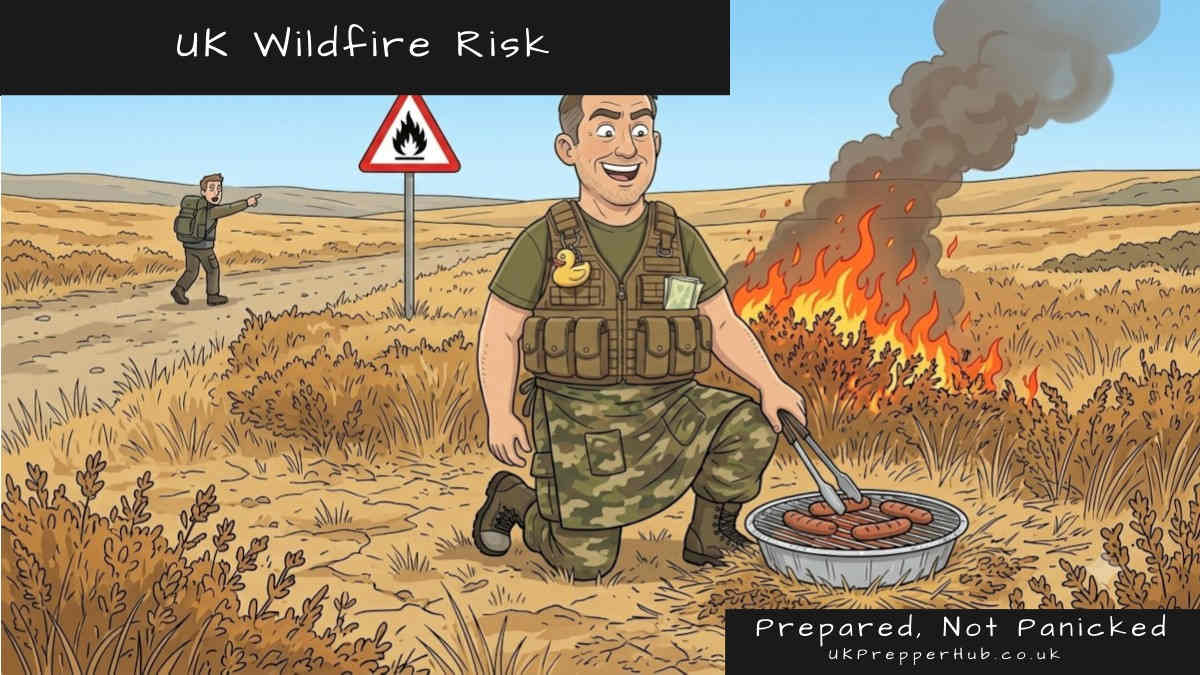
Fire services consistently report that human activity is the primary cause of UK wildfires. Unattended disposable BBQs on dry grassland. Cigarettes thrown from car windows. Campfires left to smoulder overnight. Arson. The link between hotter, drier summers and wildfire spread is real — but the ignition source is almost always human.
The vegetation compounds it. Decades of fire suppression policy have allowed heather, bilberry, and coarse grass to build up across upland areas. When a fire starts in these conditions, it doesn’t smoulder — it races.
The frequency is increasing. Fire and rescue specialist capabilities were deployed over 1,000 times in 2025 alone across diverse incidents, with wildfires identified as one of the fastest-growing demands on services. The government’s £97 million investment isn’t ring-fenced planning money — it’s a direct response to services being overwhelmed by a problem that is escalating year on year.
None of this is inevitable. If the majority of UK wildfires are started by human activity, the majority are also preventable. Disposable BBQs — banned on many moorland areas but still routinely used — are one of the single biggest single-ignition risks in summer. If you’re heading to open countryside in dry conditions: no disposable BBQ, no open campfire, no cigarettes discarded into vegetation. Many moorland areas now display fire risk warnings during dry spells — these are not advisory suggestions. Check what’s permitted in the area before you go.
Which Parts of the UK Are Most at Risk
Any area with moorland, heathland, or dry grassland carries wildfire risk during a prolonged dry spell. The highest-risk zones are:
- The North Yorkshire Moors — extensive heather moorland, recent history of significant fires including Fylingdales 2025
- The Pennines — running through Lancashire, Greater Manchester, and South Yorkshire
- The Brecon Beacons / Bannau Brycheiniog — high-altitude moorland and dry grassland
- The Malvern Hills — dry chalk and limestone grassland prone to summer fires
- Dartmoor — upland moorland and bog
- The Scottish uplands — Cairngorms and surrounding heather moorland
- The New Forest — dry heathland and pine forest mix
- Surrey Hills and Ashdown Forest — dry heathland with a recent history of summer incidents
Wildfire isn’t exclusively a remote rural problem. Urban fringe areas — where housing backs onto common land, parks, or heathland — can be directly threatened, particularly in suburban London, the South East, and around major northern cities. Wimbledon Common, Hampstead Heath, and similar open spaces have all experienced significant grassland fires during prolonged dry periods. You don’t need to be walking the Pennines to find yourself downwind of a spreading fire.
How to Get Warnings — The Honest Answer
There is no UK national real-time wildfire alert system for the public. No hotline. No government website updating live with fire locations. That’s a genuine gap in UK emergency infrastructure, and it’s worth knowing so you’re not searching for something that doesn’t exist when conditions deteriorate.
Here’s what does exist — and what actually works:
UK Emergency Alerts — the government’s cell-broadcast system that pushes an alert to every compatible phone in a geographic area simultaneously, making them beep. It has been used for severe flooding warnings and could be deployed for wildfire threats if they pose an immediate risk to life in your area. Make sure it’s enabled on your phone. On iPhone: Settings → Notifications → scroll to Government Alerts. On Android: Settings → Notifications → Emergency Alerts (location varies by manufacturer). Don’t rely on it being on by default — check.
Your local fire and rescue service’s social media — this is your most reliable real-time source during an active incident. Lancashire Fire and Rescue, North Yorkshire Fire and Rescue, and the other services that cover high-risk areas post live updates on Facebook and X during fires. Find your regional fire service and follow or bookmark their pages now, not when the horizon changes colour.
The Met Office weather warnings — the Met Office issues Extreme Heat and drought warnings that signal the conditions for wildfire risk before any fire starts. Check the app during prolonged dry spells. If there’s an Extreme Heat warning in your area and you live near moorland or heathland, treat it as elevated wildfire risk.
BBC News alerts — during major incidents, push notifications from the BBC News app are typically fast and reach people quickly.
Your local council’s emergency planning page — some councils in higher-risk areas operate community alert systems. Check your council’s website to see whether any such service exists in your area.
Protecting Your Property
If you live near moorland, heathland, or dry grassland, there are practical steps to reduce wildfire risk to your property before fire season peaks.
Create a clear zone immediately around your home. Remove dry vegetation, dead leaves, and combustible material from the ground immediately against your exterior walls. Dry material pressed against a wall is one of the primary ways fire jumps from field to house.
Move combustibles away from the building. Garden furniture, log stores, compost bins, and gas cylinders stored against external walls are ignition risks. Relocate them, particularly during extended dry spells.
Don’t block access routes for fire crews. If crews need to reach your property, locked gates or poorly maintained tracks can cost critical minutes. If you’re down a single track road in a high-risk area, think through access in advance.
Clear your gutters and check your roof. Burning embers from wildfires travel significant distances on the wind. Leaf-packed gutters, dry roof valleys, and ventilated eaves can all become ignition points when embers land. Keep gutters clear heading into summer.
Protect your important documents. If evacuation becomes necessary, you want your key documents — passports, insurance policies, birth certificates — ready to go. A fireproof document box stored somewhere accessible means you’re not rummaging through drawers when you have minutes to leave.
Complete Guide
Protecting Your Important Documents
ost fireproof boxes don’t take A4. Most fireproof wallets don’t work. This guide covers what to actually buy, how to add digital backups, and how to waterproof your documents for 20p.
Read the Full Guide: Protecting Your Important Documents →
If You’re Caught Outdoors When a Fire Starts
You’re walking the dog across the moors. You’re on a hillside path. You’re watching the view from a high point on Dartmoor. Then you smell smoke, and the horizon shifts. Here’s what matters in the first sixty seconds.
Work out the wind direction. Wildfire follows the wind. If the smoke is blowing toward you, the fire is upwind and moving in your direction. If you’re unsure, wet a finger and hold it up, or watch which way sparks and smoke are drifting.
Move at 90 degrees to the wind direction — not directly away from the fire. Running directly ahead of a wildfire in wind conditions puts you in the fire’s travel corridor. Moving perpendicular — across the path of the fire rather than in front of it — gets you out of its line.
Never try to outrun a fire uphill. Wildfire travels significantly faster uphill than on flat ground — hot air rises and preheats the fuel above. If you’re on a slope with fire below you, move off it horizontally, not by climbing further up.
Get to a road, car park, or any area clear of vegetation. Tarmac, gravel, car parks, and rocky ground don’t burn. A road gives you a safe surface, better visibility, and a clear route for emergency vehicles to reach you.
Call 999 immediately. Give your precise location. If you’re unsure where you are, open your phone’s maps app — you’ll see a coordinate or grid reference you can read out. Don’t assume someone else has already called.
Alert anyone nearby. Shout. Wave. Call or text people you know are in the area.
If smoke is thickening, stay low. Smoke rises, so the air nearest the ground carries the most oxygen and the lowest particulate concentration. Cover your nose and mouth with any cloth — wet it if you have water.
Keep your dog on the lead. A panicking dog bolting toward smoke or fire is a second emergency on top of the first. Hold the lead, stay calm, move together.
Vehicles are a last resort. A car is not a refuge from wildfire. If you can drive away safely, do so immediately with windows up and vents closed. If you’re already trapped and cannot move: pull off the road, close all vents and windows, lie on the floor below window level, and cover yourself with anything available. Switch the engine off.
Evacuation: When to Go and How
If fire and rescue services tell you to evacuate, go immediately. Not after you’ve packed properly. Not after you’ve checked whether the neighbours have left. Go.
The single most dangerous decision in a wildfire evacuation is waiting to see how bad it gets first. Wildfire spreads faster than most people expect — particularly in wind and on dry ground. The time between “this might be serious” and “the route out is cut off” can be a matter of minutes.
Your grab bag should already be together before you need it. Documents, medication, phone charger, cash, a change of clothes. If it’s not together already, put it together today — not when the sky turns orange.
Leave early. Leave your property accessible for fire crews. Do not go back.
If you have elderly or mobility-impaired neighbours who may not have seen an alert, knock as you leave — but don’t delay your own departure waiting for them. Call 999 and let the fire service know their location and situation.
Complete Guide
Home Evacuation Plan
Most households freeze during an evacuation — not from fear, but from making fifteen decisions simultaneously under pressure for the first time. This guide walks you through the five decisions to make now, calmly, before you ever need them.
Read the Full Guide: Home Evacuation Plan →
Complete Guide
72-Hour UK Grab Bag
The ‘get out quick bag’ for rapid home evacuation in the event of fire, flood, or other incidents. Every essential for 3 days away from home in one bag.
Wildfire Smoke — Even If the Fire Isn’t Near You
Wildfire smoke travels. A significant moorland fire in North Yorkshire can push a smoke plume into Lancashire, County Durham, and the wider Yorkshire region within hours. You may be nowhere near the flames — but you will feel the air quality effects.
Wildfire smoke contains PM2.5 particles — fine particulate matter small enough to penetrate deep into the lungs. At high concentrations, it affects everyone. At lower concentrations, it significantly worsens outcomes for people with asthma, COPD, heart conditions, and existing respiratory illness. It also hits the very young, the elderly, and pregnant women harder.
If there’s a significant wildfire upwind of you:
- Close windows and doors
- Avoid outdoor exercise until air quality improves
- If you have an air purifier, run it on its highest setting
- Check the DEFRA Daily Air Quality Index — search “UK AIR” to find the current index. During significant wildfire events, DEFRA updates the local air quality classification and it will show as Very High in affected areas
- If you need to go outdoors, a well-fitted FFP2 or FFP3 mask substantially reduces your exposure to PM2.5 particles
- Keep pets indoors where possible — dogs and cats are susceptible to smoke inhalation, and outdoor cats with respiratory conditions can be seriously affected during prolonged poor air quality
ADESTE – FFP2 Masks – UKCA Certified
BSI-certified FFP2 protection at 28p a mask — 50 individually sealed, long-term storage ready, and exactly what disappeared from shelves in March 2020.
Our Full Review: ADESTE – FFP2 Masks →

🐔 Chicken Licken
Did You Know?
Most UK wildfires are human-caused — people blame nature and climate, but we’re setting our own countryside on fire
Frequently Asked Questions
Does the UK have wildfires?
Yes — the UK has a genuine and growing wildfire risk, particularly on upland moorland, heathland, and dry grassland. Spring and summer are the highest-risk periods. In 2025, North Yorkshire’s Fylingdales Moor suffered some of the worst wildfire damage in recent UK history.
What areas of the UK are most at risk from wildfire?
The highest-risk areas include the North Yorkshire Moors, the Pennines, Brecon Beacons, Dartmoor, the Malvern Hills, the New Forest, the Surrey Hills and Ashdown Forest, and the Scottish uplands. Urban fringe areas with adjacent heathland or common land are also at risk during prolonged dry spells.
Is there a UK wildfire warning system?
The UK has no single national real-time public wildfire alert service. The most reliable real-time source during an active fire is your local fire and rescue service’s social media pages. The UK Emergency Alerts system (the one that makes your phone beep) can also be used for immediate threats to life — make sure it’s enabled on your phone.
What should I do if I’m caught outdoors near a wildfire?
Identify the wind direction — fire moves with the wind. Move at 90 degrees to it, not directly ahead of the fire. Get to a road, car park, or any area without vegetation. Call 999 and give your precise location. Stay low if smoke is thick, and cover your nose and mouth. Keep pets on the lead.
Can wildfire smoke affect me if the fire is miles away?
Yes. Wildfire smoke can travel tens of miles and contains fine PM2.5 particles that are harmful when inhaled. Close windows, avoid outdoor exercise, and check the DEFRA Daily Air Quality Index (search “UK AIR”). A well-fitted FFP2 mask substantially reduces exposure if you need to go outdoors.
📲 Stay Informed — Free Daily UK Household Briefing
Every day we publish a free briefing covering fuel prices, energy costs, food supply, infrastructure, and anything else that affects UK households. No fluff. No politics. Just the practical stuff.
Your number stays private. WhatsApp and Telegram channels are broadcast-only. You receive updates — nobody, including us, can see your number, and other subscribers cannot contact you.
Free. No commitment. Unsubscribe any time. Stay anonymous.
Build Your Resilience
Further Reading: Related Guides
- Home Evacuation Plan
- 72-Hour UK Grab Bag
- Get Home Bag
- Protecting Your Important Documents
- Heatwave Survival UK
- Emergency Radio Guide
- Animals in Extreme Weather
All our guides can be found listed on our resilience hub.
Gear We’ve Tested & Reviewed
All our reviews can be found on our reviews and resources page.
📡 Find Us Everywhere
Daily briefings, prep guides, and real-time updates across every platform. Pick yours.
Free. No commitment. Stay anonymous on WhatsApp & Telegram.
Stay Informed on UK Preparedness
Join our newsletter for UK-specific preparedness tips, product recommendations, and real-world advice for households.
Subscribe to Our Newsletter