
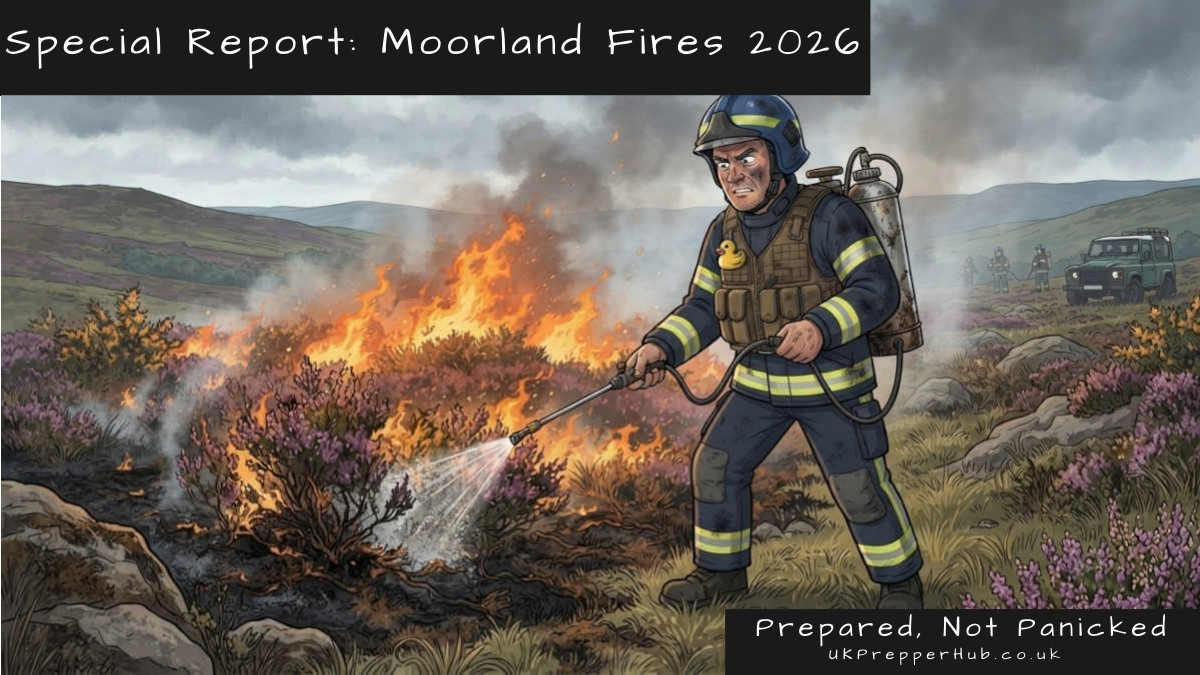
Moorland fires have torn through parts of Britain almost continuously since May, and by the middle of July, more than 18,600 hectares of countryside had already burned across at least 65 separate fires larger than 30 hectares. That’s before counting the smaller blazes — the ones contained in an afternoon that never made the national news. Fire and rescue services in England and Wales alone had responded to 342 wildfires by 6 July, and the season isn’t close to over.
This isn’t just a story about scorched hillsides. Behind the numbers is a fire service leaning heavily on retained firefighters and volunteer crews, a national mutual aid system being formally invoked, and reservoirs running low enough that fire services themselves have flagged concerns about the water needed to fight the fires in the first place. Here’s the full picture — and what it actually means if the emergency isn’t on a hillside near you, but in your own home.
The Moorland Fires So Far — A Year Like No Other
March’s moorland fires were small by comparison — a few hundred square metres at Marsden Moor, around 1.5 hectares at Stiperstones, a couple of modest blazes near the Scout Moor Wind Farm. By the end of the month, deliberately-lit heathland fires near Sandford in Dorset had burned around 2,100 square metres.
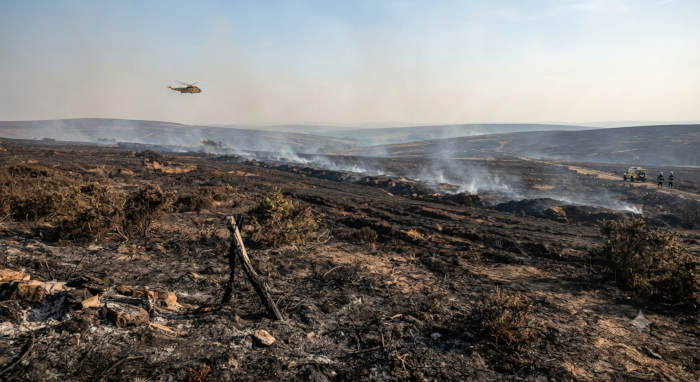
April is when things escalated. Marsden Moor’s moorland fires flared again, this time spreading to around 300 hectares, with four further fires breaking out the following day. Heathland burned at Whitmoor Common, Hankley Common and Blackheath Common in Surrey. A large grass fire broke out near Kincorth in Aberdeen. Bodmin Moor in Cornwall and the Tarbet/Loch Fionn area of Argyll both saw moorland fires take hold. In Northern Ireland, the Mourne Mountains were hit hardest — around 1,000 hectares near Newcastle, County Down, followed by a further 1,500 hectares near Hilltown, with 45 firefighters deployed to one blaze alone. Brookeborough saw 175 hectares burn with 85 firefighters on scene, and Loughermore forest needed 49.
By May, a grass fire had broken out at Holyrood Park near Arthur’s Seat in Edinburgh — the first of two incidents there this year.
June brought a reed bed fire at Pegwell Bay in Kent, and the start of an extended burn at Tintwistle Moor near Glossop that would smoulder on and off for almost a month, eventually covering roughly 260 hectares of moorland and woodland.
Then July arrived, and the moorland fires didn’t let up. Heathland burned at Blackwater in Hampshire. Devon, Sussex and Greater Manchester all saw fires break out within days of each other, including the first blaze at Dove Stone Reservoir. North Wales declared a major incident over fires at Conwy Mountain and the Sychnant Pass, with evacuations. A fire broke out near Durham University’s sports ground. Then, on 15 and 16 July, the Cairngorms wildfire broke out near Ryvoan Bothy and grew to 3.5 kilometres wide, forcing the evacuation of 600 residents in Nethy Bridge and closing roads for days. A festival site near Wareham in Dorset was affected. Arthur’s Seat burned again. Dove Stone and the neighbouring Swineshaw moor stayed active. A car fire near Woore in Shropshire spread into a field.
By 23 and 24 July, two of the largest single incidents of the year broke out in Wales: an estimated 951 hectares burned at Rhinogydd in Gwynedd, and 220 hectares at Blaenavon in Torfaen, with smoke reaching as far as Cardiff and Newport.
By 16 July alone — before Rhinogydd and Blaenavon are even added to the total — more than 18,600 hectares had burned across at least 65 fires larger than 30 hectares. That’s the scale of moorland fires the UK has seen in a single summer.
A Fire Service Already Stretched Thin
The sheer number of moorland fires this year has done more than burn countryside — it’s tested how much the fire service can actually absorb at once.
North Wales Fire and Rescue Service made a formal request through UK National Resilience for mutual aid — additional staff and fire engines — because of the number and scale of fires it was dealing with. That’s not a routine ask. Mutual aid arrangements like this exist specifically for moments when local resources are no longer enough on their own.
Elsewhere, Staffordshire and West Midlands fire services activated Operation Willowbeck, a mechanism reserved for “periods of exceptionally high demand” when call volumes exceed what a service can normally handle.
And when the Cairngorms wildfire needed helicopter support, it wasn’t readily available — reporting at the time linked the delay to helicopter resources already committed to fires in England and Wales. The same pattern showed up at Rhinogydd: fire officer Paul Kay said helicopter support wasn’t expected to become available until the following week, “due to competing wildfire incidents across the UK.” At the time of reporting, five fire appliances, two narrow access vehicles, one wildfire unit and around 40 firefighters were already on scene there — with more likely needed, since the fire, covering roughly 2,000 acres of difficult terrain, was expected to keep burning for days.
Much of this frontline effort isn’t coming from full-time crews sat waiting at a station. Local MP Liz Saville Roberts made the point directly about the firefighters tackling Rhinogydd: “Many on the frontline are retained firefighters. They balance emergency service duties alongside other jobs and family commitments.” Roughly a third of Scotland’s operational firefighters work on a similar retained, on-call basis — and in rural parts of Wales, Scotland and Northern Ireland, where most of this year’s largest moorland fires have actually happened, retained crews are often the majority, not the exception. These are people with day jobs and families who carry a pager and drop everything when it goes off, not a standing army of moorland fire specialists sitting idle between call-outs.
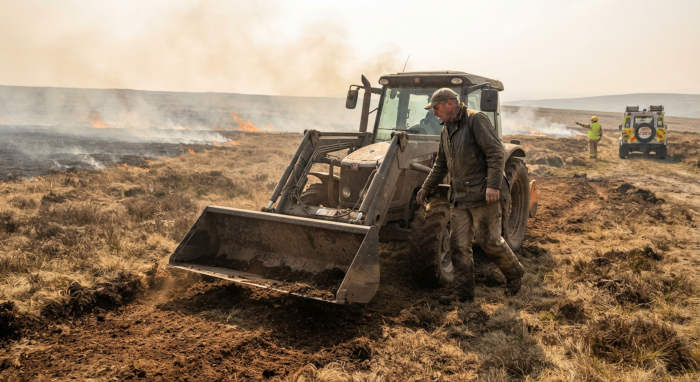
Farmers have played their part too. Land managers and farmers are recognised as key early responders in a wildfire — using their own tractors, ploughs and cultivating machinery to cut fire breaks, drawing on farm water supplies and slurry tankers to help dampen ground, and offering local knowledge of tracks and access points that outside crews simply don’t have. It’s done under the direction of fire officers on scene, not off their own initiative, but it’s a real and recognised part of how these moorland fires actually get brought under control — one more example of a response that’s leaning on more than just the standing fire service to cope with the scale of this year’s fires.
Fire and rescue services in England and Wales had already responded to 342 wildfires by 6 July, with 19 active wildfire incidents recorded on the National Resilience system at one point. The scale of it prompted the National Fire Chiefs Council to issue a public warning headlined “It only takes one spark” — not the kind of statement fire chiefs make lightly.
Even the Water Is Running Out
Here’s where it gets genuinely difficult. The same drought driving this year’s moorland fires is also limiting the water available to fight them.
Official Environment Agency reporting for the week ending 14 July put reservoir storage across England at 78.8% — 5% below the long-term average for the time of year — and noted that over half of England’s reservoirs are now classed as below normal or lower for the time of year. One reservoir, Blagdon in Somerset, was classed as exceptionally low; six more, including Wimbleball, Grafham and Hanningfield, were classed as notably low.
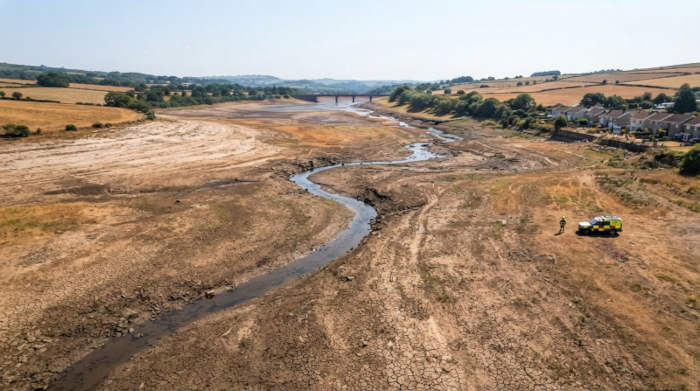
That matters for firefighting directly, not just for taps and gardens. South Wales Fire and Rescue said there could “potentially be an issue” using their helicopter because reservoir levels were too low — helicopter water-bombing draws directly from open water, and if the water isn’t there, neither is that option. In west and mid Wales, fire crews have gone further still, trialling UV-treated wastewater as a firefighting substitute after “challenging” low water supplies during previous droughts. Crews have also flagged concerns that the usual hydrant network becomes less reliable in these conditions, adding another layer of difficulty to an already stretched response.
Not every water source is in the same state, to be fair. The Canal & River Trust’s own position on its canal network is broadly normal for the time of year, and actually slightly better than this point in 2025 — a reminder that this isn’t a uniform national picture, and some regions and water bodies are coping better than others. But for the specific reservoirs feeding the areas worst affected by this year’s moorland fires, the official classification is “notably low” or worse, and that’s the water fire crews would ordinarily rely on most.
This isn’t a separate story to the drought and hosepipe bans covered in yesterday’s daily briefing — it’s the same drought, seen from the firefighting side rather than the garden hosepipe side.
What It Means If It’s Your House, Not Just the Hillside
It’s easy to read all this as a story about faraway hills and moorland fires that don’t affect you directly. Scale it back to an ordinary week in an ordinary town, though, and the picture changes.
Fire and rescue services in England attended 628,764 incidents in the year ending June 2025 — up 5.7% on the year before. Of those, 142,494 were fires. On average, England sees around 34,136 house fires a year: roughly 93 a day, or one every 15 minutes, somewhere in the country. Fire-related deaths rose too, up 8% to 271 in 2024/25 — and that’s before this year’s exceptional wildfire season is even factored in. None of that routine caseload stops because there’s also a moorland fire burning in Wales or Scotland. It’s the baseline the fire service was already working to, before this year’s wildfire season piled 342-plus additional incidents and multiple national mutual aid escalations on top.
None of this means help won’t come if your house catches fire. It means you can’t necessarily assume it’ll arrive as fast as it would on an ordinary day — and for a house fire, minutes matter more than almost anything else.
Two Things Worth Doing Now
Know when you’d leave, and have a bag ready
Moorland fires this year have forced real evacuations — 600 residents in Nethy Bridge for the Cairngorms fire, more at Conwy Mountain — sometimes with only hours’ notice, and often driven as much by smoke and access-route closures as by the fire front itself. If you live near moorland, heathland or forest, or somewhere that’s ever been evacuated during a past wildfire season, this isn’t a hypothetical. You want to already know what you’d take and where you’d go, not work it out for the first time while smoke is visible from your window.
Complete Guide
Home Evacuation Plan
Most households freeze during an evacuation — not from fear, but from making fifteen decisions simultaneously under pressure for the first time. This guide walks you through the five decisions to make now, calmly, before you ever need them.
Read the Full Guide: Home Evacuation Plan →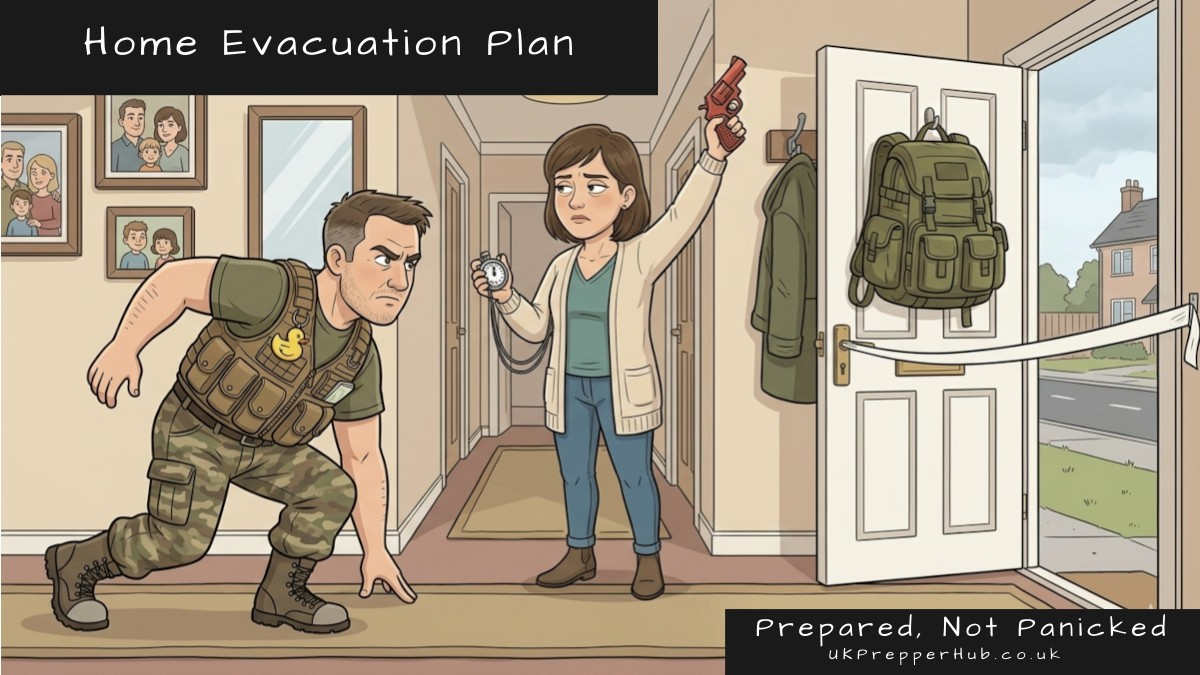
Complete Guide
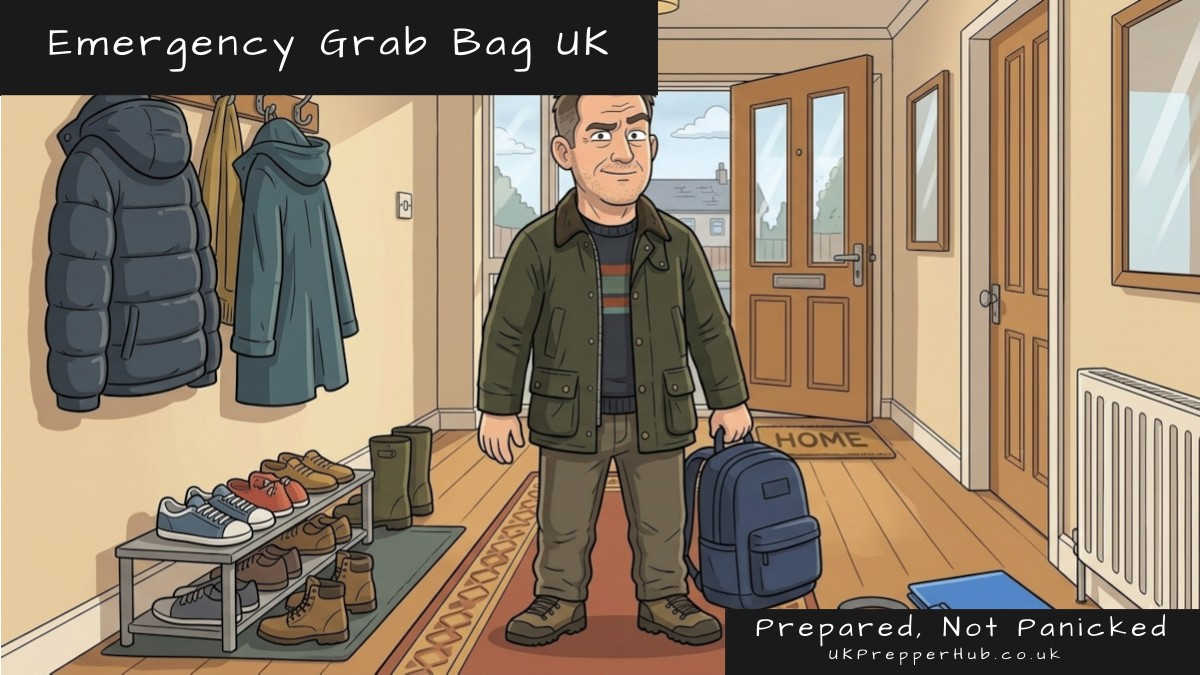
72-Hour UK Grab Bag
The ‘get out quick bag’ for rapid home evacuation in the event of fire, flood, or other incidents. Every essential for 3 days away from home in one bag.
Buy yourself time before help arrives
None of this replaces the fire service, and it’s not meant to. But the gap between a fire starting and a crew arriving is exactly where a working smoke alarm and a proper first-response kit earn their keep — an alarm that actually wakes you, an extinguisher and fire blanket within reach, not buried behind the ironing board.
FireAngel Combination Smoke and Carbon Monoxide Alarm
One sealed unit covering smoke and CO detection — with a 10-year battery that keeps it running during a power cut, when emergency stoves and heaters are out and a mains-wired alarm would already have gone dark.
Our Full Review: FireAngel Combination Smoke and Carbon Monoxide Alarm →
FireShield Home Fire Safety Pack
A 600g aerosol extinguisher and a 1m fire blanket on one wall mount — the two tools that cover almost every domestic fire scenario, for under £25.
Our Full Review: FireShield Home Fire Safety Pack →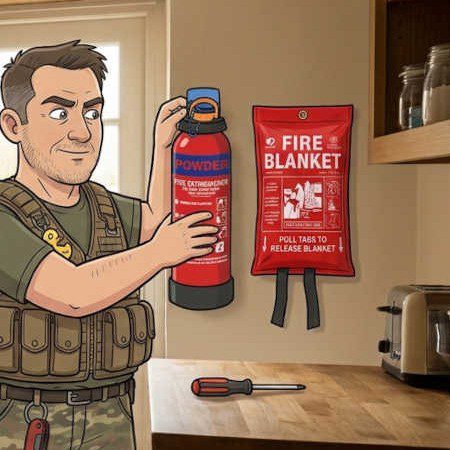

🦆 Keith
Don’t Be Keith
Keith has an elaborate fire safety setup he’s genuinely proud of, still hasn’t checked whether the smoke alarm batteries actually work.
For the wider picture on wildfire risk specifically — what causes them, how to spot the warning signs, and what to do if one’s near you — see our Wildfire Risk guide: What Every Household Needs to Know.
This year’s moorland fires aren’t finished yet, and the conditions behind them — heat, drought, a stretched fire service — aren’t going anywhere soon. More fires are likely before the season properly breaks, and each one will draw on the same stretched pool of appliances, retained crews and low reservoirs already covered above. The countryside will recover, as it always has after a bad wildfire year. Whether your own household is actually ready for its turn is still entirely up to you.
📡 Find Us Everywhere
Daily briefings, prep guides, and real-time updates across every platform. Pick yours.
Free. No commitment. Stay anonymous on WhatsApp & Telegram.
Stay Informed on UK Preparedness
Join our newsletter for UK-specific preparedness tips, product recommendations, and real-world advice for households.
Subscribe to Our Newsletter