
This post contains affiliate links. Learn more
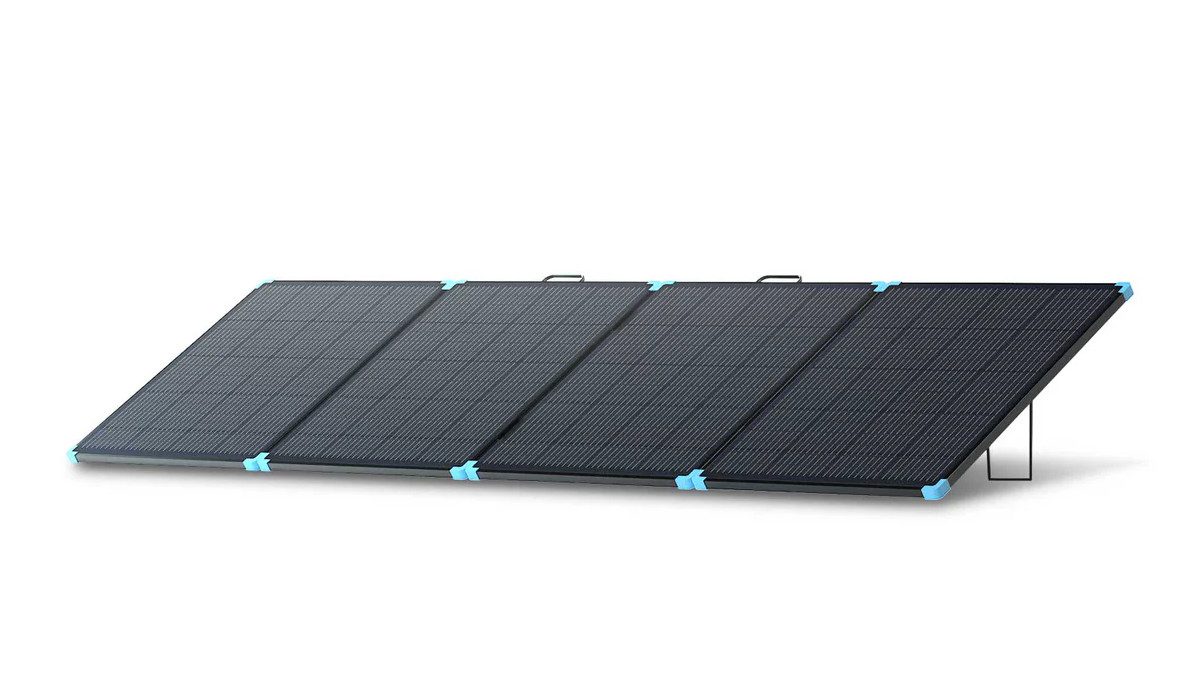
The Jackery Explorer 1000 v2 has a genuinely generous 400W max solar input — most panels on the market undersell that ceiling badly. The Renogy 400W Lightweight Portable Solar Suitcase is one of the few single panels that actually lands on it, which means no series-versus-parallel wiring decision, no pairing two smaller panels together — just one panel, one cable, the full 400W the unit can accept.
It’s not a small panel. At 13.7kg and folding down to a genuine suitcase-sized case, this is a two-hands job to move. But for a single-panel setup that hits a 400W ceiling exactly, that’s the trade-off.
Renogy 400W Lightweight Portable Solar Suitcase
One Renogy panel that lands exactly on the Jackery Explorer 1000 v2’s 400W solar ceiling — no pairing, no wiring decisions.
Current Price at time of writing: £399.99 (was £449.99)
Rated: 4.6/5 ⭐
Renogy 400W Lightweight Portable Solar Suitcase Specs
- Max power: 400W
- Open-circuit voltage: 47.2V
- Short-circuit current: 11.0A
- Maximum system voltage: 600VDC
- Unfolded dimensions: 2838 x 855 x 20mm
- Weight: 13.7kg
- IP67-rated, fibreglass-reinforced construction
- Warranty: 3 years on materials and workmanship
One Panel, One Connection, No Wiring Decisions
The Explorer 1000 v2’s solar input is split across two DC ports that combine to accept the full 400W when both are used — which normally means running two panels and getting the wiring configuration right. This suitcase sidesteps that entirely. It’s a single unit that plugs in and delivers the full ceiling on its own, which matters if the appeal of solar charging is simplicity rather than another wiring problem to solve.
The 47.2V open-circuit voltage sits comfortably within the Explorer 1000 v2’s 16–60V input window, so there’s no voltage-matching guesswork before you connect it.
Built to Stay Outside, Sized to Be a Two-Person Carry
IP67-rated with fibreglass reinforcement and corner protection, this is built for actual outdoor deployment rather than fair-weather use only. The trade-off for that single-panel simplicity is size and weight — 13.7kg and a case that opens out to nearly 2.8 metres. Setting it up on your own is fine; carrying it any real distance is easier with two people.
Setting It Up
Unclip the case and unfold the panel out flat — Renogy rate this as a one-minute job once you’ve done it the first time. Renogy’s own spec sheet lists it as either flush-mounted or simply placed on a table, so there’s no separate stand to fiddle with; you’re choosing a flat, sun-facing surface and laying it down rather than propping it at an angle.
From there it’s a single MC4 cable into the Explorer 1000 v2’s solar input port. The Jackery’s display shows a charging icon and incoming wattage within a few seconds of connecting — if that reading doesn’t appear, check the connection before assuming a fault. Because this is one panel rather than two wired together, there’s no parallel-versus-series decision to second-guess once it’s plugged in.
Renogy 400W Lightweight Portable Solar Suitcase
One Renogy panel that lands exactly on the Jackery Explorer 1000 v2’s 400W solar ceiling — no pairing, no wiring decisions.
Current Price at time of writing: £399.99 (was £449.99)
Rated: 4.6/5 ⭐
What the Rest of the Team Think

🦆 Keith the Prepper
Only put one leg of the kickstand down. Gust of wind had it face-down in the flowerbed inside a minute. Told my wife it was “wind-related,” which is technically true.
⭐⭐⭐⭐

🪖 Black Panther
One panel, one connection point — fewer failure points than a two-panel parallel rig. That’s the correct call under pressure. Complexity is where mistakes get made. Carry on.
⭐⭐⭐⭐⭐

🤡 Camping Clown
I now own three separate ways to charge one Jackery. This one, a rigid pair, and the 100W one for reasons I’ve genuinely forgotten. This is the one that’s actually correctly sized. The other two are just sat there.
⭐⭐⭐⭐

🐾 Weekend Warrior
Full send at the bug-out location. Pickle supervises deployment from a safe distance — she’s not a fan of the fibreglass corners near her tail. Two-person carry is real though, don’t let anyone tell you otherwise.
⭐⭐⭐⭐

🐕 Pickle
Snorgle. Snorgle snorgle. Snorgle snorgle snorgle.
Snorgle! (too big, staying inside)

🐔 Chicken Licken
Did you know most people buying solar for a 400W-rated power station actually undersize the panel? I’ve been saying it for years. This is one of the few that actually hits the number on the box. Nobody checks until I tell them.
⭐⭐⭐⭐⭐

📋 Calm Clarissa
I’ve prepared a checklist for this. One item on it: connect it. That’s genuinely the whole checklist. No pairing decision, no second panel to source. Efficient by design.
✅✅✅✅✅

💄 Survivl Gurl
Unfolded this across the whole garden for the shoot and my neighbour actually came over to ask what it was. Content gold. Needed help lifting it back into the case though, not gonna lie.
⭐⭐⭐⭐

🌿 Aroura
One panel opening fully to the sky, taking exactly what it needs and nothing wasted — there’s a simplicity in that worth sitting with. Heavy to move, yes, but the earth doesn’t ask us to travel light, only honestly. Namaste 🙏
⭐⭐⭐⭐⭐
Pros and Cons
Pros
- Single panel hits the Jackery Explorer 1000 v2’s 400W ceiling exactly — no series/parallel wiring decision
- IP67-rated, fibreglass-reinforced — built for genuine outdoor deployment, not fair-weather use only
- 3-year warranty, longer than Renogy’s smaller portable panels
- 47.2V open-circuit voltage sits comfortably inside the Explorer 1000 v2’s 16–60V input window
Cons
- 13.7kg and nearly 2.8 metres unfolded — a two-person carry for any real distance
- Considerably more expensive than pairing two smaller panels, though simpler to set up
- Overkill for anything smaller than a 400W-class power station
Frequently Asked Questions
Does the Renogy 400W Solar Suitcase work with the Jackery Explorer 1000 v2?
Yes — its 47.2V open-circuit voltage sits within the Explorer 1000 v2’s 16–60V solar input range, and it delivers the full 400W the unit can accept from a single panel.
Can I carry this on my own?
You can move it short distances alone, but at 13.7kg and nearly 2.8m unfolded, it’s genuinely easier with two people for any real distance.
Is it weatherproof for permanent outdoor use?
Yes — it’s IP67-rated with fibreglass reinforcement, built for actual outdoor deployment rather than fair-weather use only.
Why not just buy two smaller panels instead?
Two smaller panels wired in parallel can reach a similar total wattage, but this single-panel option removes the wiring decision entirely — one connection, no configuration to get wrong.
What’s the Renogy 400W Lightweight Portable Solar Suitcase come with a warranty?
Yes it does, it has a 3 year warranty on materials and workmanship.
Build Your Resilience
Further Reading: Related Guides
- Portable Power Station With Solar Panel: The Renogy Buying Guide for Every Brand
- Portable Power Stations for Power Cuts: What Size Does a UK Home Actually Need?
All our guides can be found listed on our resilience hub.
📡 Find Us Everywhere
Daily briefings, prep guides, and real-time updates across every platform. Pick yours.
Free. No commitment. Stay anonymous on WhatsApp & Telegram.
Stay Informed on UK Preparedness
Join our newsletter for UK-specific preparedness tips, product recommendations, and real-world advice for households.
Subscribe to Our Newsletter