
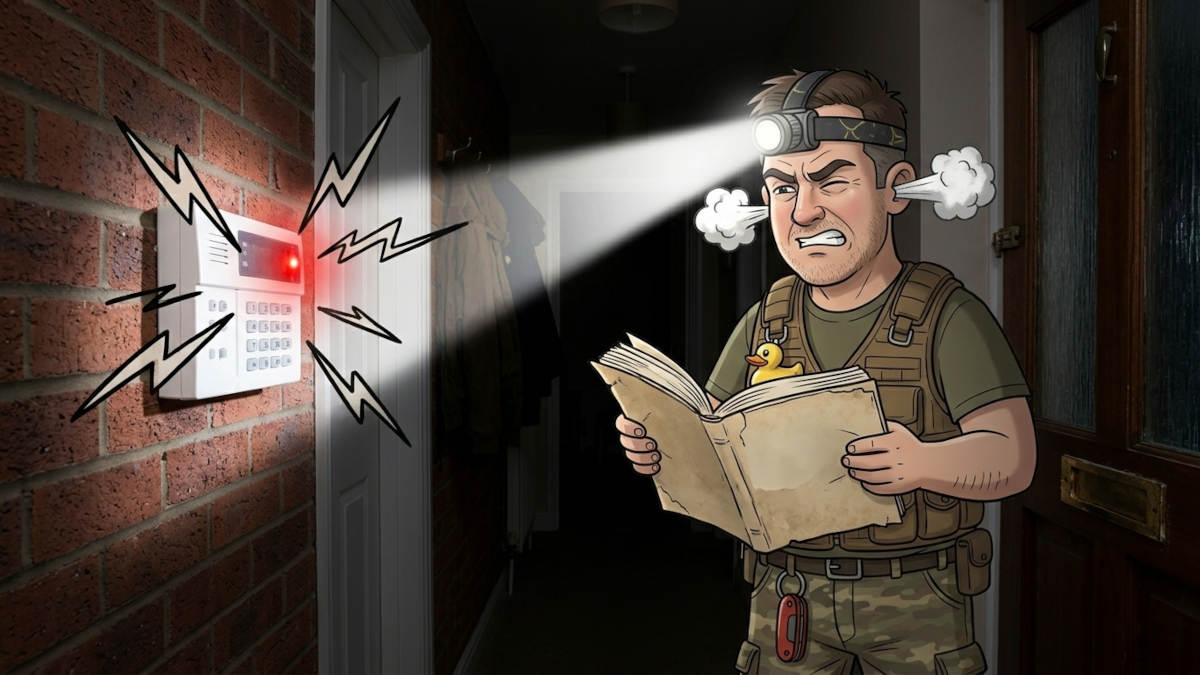
A burglar alarm power cut is one of those things nobody thinks about until 2am, when the lights have gone, the street’s pitch black, and a small box in the hallway has started beeping like it’s trying to tell you something. It is. Usually it’s “my battery’s low”, occasionally it’s “my battery’s dead and I’ve decided you’re being burgled”.
This guide covers what your alarm actually does when the power goes, how to stop the beeping, what happens to video doorbells, cameras and smart locks when the Wi-Fi goes with it, and the home security that carries on working with no electricity at all. None of it involves turning your semi into a fortress. Most UK power cuts bring neighbours checking on each other and a lot of tea made on camping stoves, not gangs roaming the streets. But a few things genuinely do change when the power’s off, and it’s worth knowing which.
Burglar Alarm Power Cut: What Actually Happens
A wired burglar alarm doesn’t switch off when the mains goes. The control panel has a rechargeable standby battery inside, and it carries on running from that. The National Security Inspectorate (NSI) says the standby battery is there to keep a system going for at least 12 hours in a power cut. In a long cut, the system will eventually go quiet when the battery runs down.
The external bell box on the front of the house usually has its own battery too, so the siren can still sound with the mains off. That’s deliberate: cutting the power is the oldest trick there is, and the alarm is designed not to fall for it.
The catch is the battery’s age. Standby batteries wear out after a few years, and nobody notices because they spend their whole life sitting on charge doing nothing. When the power goes, an old battery can’t hold the system up, and some panels then treat the sudden loss of power as someone tampering with the system. That’s when a burglar alarm power cut turns into a full alarm going off in the dark, with you, the neighbours and the dog all awake.
Monitored alarms and digital landlines
If your alarm is monitored, or you have a telecare alarm for an older relative, check how it sends its signal. Many now go over broadband or a digital landline, and both stop when your router loses power. Old copper phone lines kept working in a power cut. Digital ones don’t, unless there’s a battery backup.
Ofcom says that if you rely on your landline and don’t have a working mobile or a reliable mobile signal, your provider must offer you a free way to call 999 in a power cut, such as a battery backup unit. It only has to last at least an hour. If anyone in your home depends on a telecare alarm, ask your provider and the alarm company what happens in a power cut, rather than finding out during a burglar alarm power cut of your own.
House Alarm Beeping After Power Cut? How to Stop It
A house alarm beeping after power cut is almost always the panel reporting a fault: mains lost, or battery low. It’s annoying, it’s loud, and at some point everyone ends up searching how to stop house alarm after power cut at an hour when nobody’s answering the phone. It’s the most common burglar alarm power cut problem by a distance. Here’s the order to try things in.
- Enter your user code on the keypad. On most systems this silences the fault beep and acknowledges it. If you don’t know your code, find out now, in daylight, with the power on.
- Wait for the mains to come back. Once the power returns, the mains fault usually clears by itself, though some panels need the code entering again, or a reset, before they settle.
- Give the battery time to recharge. A battery that’s been run down can take a day or two to charge back up, so a low-battery warning straight after a cut isn’t necessarily a dead battery.
- If the low-battery fault won’t clear after a couple of days, the battery needs replacing. That’s a cheap job for your installer, usually done at the annual service.
- Don’t open the panel unless you know what you’re doing. There’s mains voltage inside, and pulling wires out can set off the full alarm or damage it. If the siren won’t stop, ring your installer or alarm company.
Keep the installer’s number, your user code and the alarm’s manual somewhere you can find with a torch. A note on the inside of the cupboard door where the panel lives is perfect. The alarm company’s number on a sticker on the bell box is no use to you when you’re inside and it’s dark.
Video Doorbells, Cameras and Smart Locks When the Wi-Fi Goes
This is where most modern home security quietly falls over. Video doorbells and Wi-Fi cameras need two things: power for the device, and an internet connection to send you alerts and save the video. A power cut usually takes away both.
- Mains-wired doorbells and cameras switch off when the power goes.
- Battery doorbells and cameras keep running, but with the router off they can’t send alerts to your phone or upload video. Unless the device records to its own memory card, there’s nothing saved.
- Your phone may lie to you. The app can carry on showing a device as connected for a while after it’s actually gone offline.
- After the power comes back, some cameras don’t reconnect to the Wi-Fi by themselves, particularly if they come back on before the router has finished starting up. Check them all once things are back to normal, rather than finding out the next time you need the footage.
- Smart locks run on their own batteries, so a power cut doesn’t stop them locking and unlocking at the door by keypad, fingerprint or key. What stops is the app and remote features. Change the lock’s batteries when it warns you, and keep the physical key or backup method sorted.
None of this is a reason not to have the gadgets. It’s a reason not to rely on them. Treat smart security as a bonus on top of locks that work in the dark, not as your security.

🦆 Keith
Don’t Be Keith
Keith has a video doorbell, four Wi-Fi cameras, a smart alarm and an app that sends him an alert every time a leaf blows past. In the last power cut, all of it went offline at once, and he spent the evening watching a spinning wheel on his phone while the side gate, which he has never once bolted, banged open and shut in the wind. The bolt costs less than one month of the doorbell subscription.
Keeping the Router Running in a Power Cut
If you want the cameras, a monitored alarm or a digital landline to keep going, the thing to keep powered is the router. A typical home router only uses around 10 watts, so it doesn’t take much.
- A portable power station with a normal three-pin socket will run a router, and the doorbell’s charger, for many hours. It’s the simplest option, because you just plug the router into it.
- A power bank can run some routers, but most need 12 volts, which a normal USB power bank doesn’t supply without a special adapter cable. Check what your router needs before relying on one.
- A small UPS (uninterruptible power supply) sits between the router and the wall and switches over by itself, so the router never notices the cut.
One limit: if the power cut is widespread, the broadband cabinet in the street and the nearest mobile masts may be running on their own batteries too, and those run out. A powered router won’t help if there’s no service coming down the line.
Anker SOLIX C300X
Two proper plug sockets, 288Wh of long-life LiFePO4 and 80% recharged in 50 minutes: the essentials kept running through a power cut.
Our Full Review: Anker SOLIX C300X →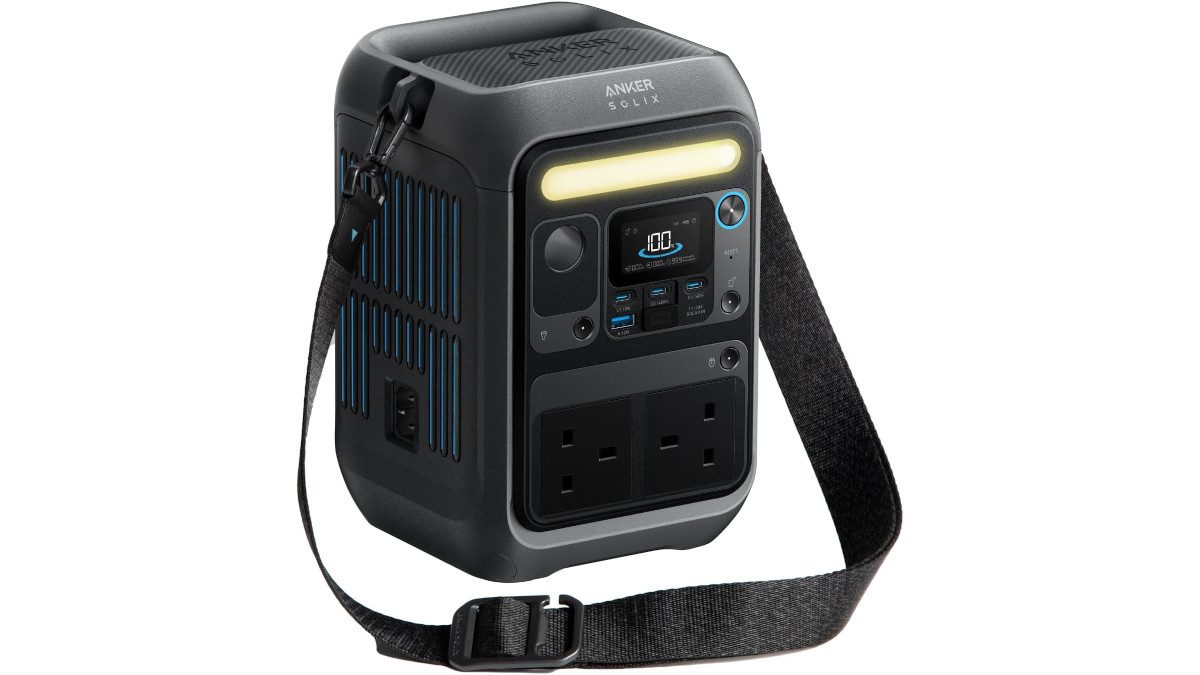
Home Security Tips That Work Without Power
Most home security advice assumes the power is on. These home security tips are the ones that don’t care either way, because they’re mechanical, and they’re the same things police forces tell people every autumn when the clocks go back.
Doors
- Wooden doors: a five-lever mortice deadlock to British Standard BS3621 is the standard most home insurers expect. A night latch on its own can be slipped. And use the deadlock: plenty of homes have one fitted that never gets turned.
- uPVC and composite doors: lift the handle and turn the key every time, so the multi-point lock actually engages. A door that’s just pulled shut isn’t locked.
- Hinge bolts stop a door being forced at the hinge side.
- A door chain or limiter and a spy hole let you see who’s there and talk to them without opening the door.
- Keep keys away from the door and the letterbox. Thieves fish keys through letterboxes with a hook. Keyless car keys can be relayed from inside the house, which a signal-blocking pouch or tin stops.
Windows, sheds and gates
- Lock ground-floor windows and any you could reach from a flat roof or a wall. Keep the window keys where you can find them in the dark, not on the sill, because windows are also your way out in a fire.
- Sash jammers stop sliding sash windows and patio doors being forced.
- A lockable side gate, so nobody can walk round the back unseen.
- A closed-shackle padlock on a proper hasp for the shed, not a cheap one that snaps with bolt croppers.
- Bikes, tools, ladders, fuel and generators locked away and out of sight. A ladder left in the garden is an invitation to an upstairs window.
Light without the mains
When the street lights go out, so does a lot of the natural surveillance a street gets for free. Solar or battery motion-sensor lights over the front door, the back door and the side gate keep working when everything else goes dark. Indoors, a plug-in emergency light that comes on by itself when the power fails means you’re not fumbling for the door, or the alarm keypad, in the dark.
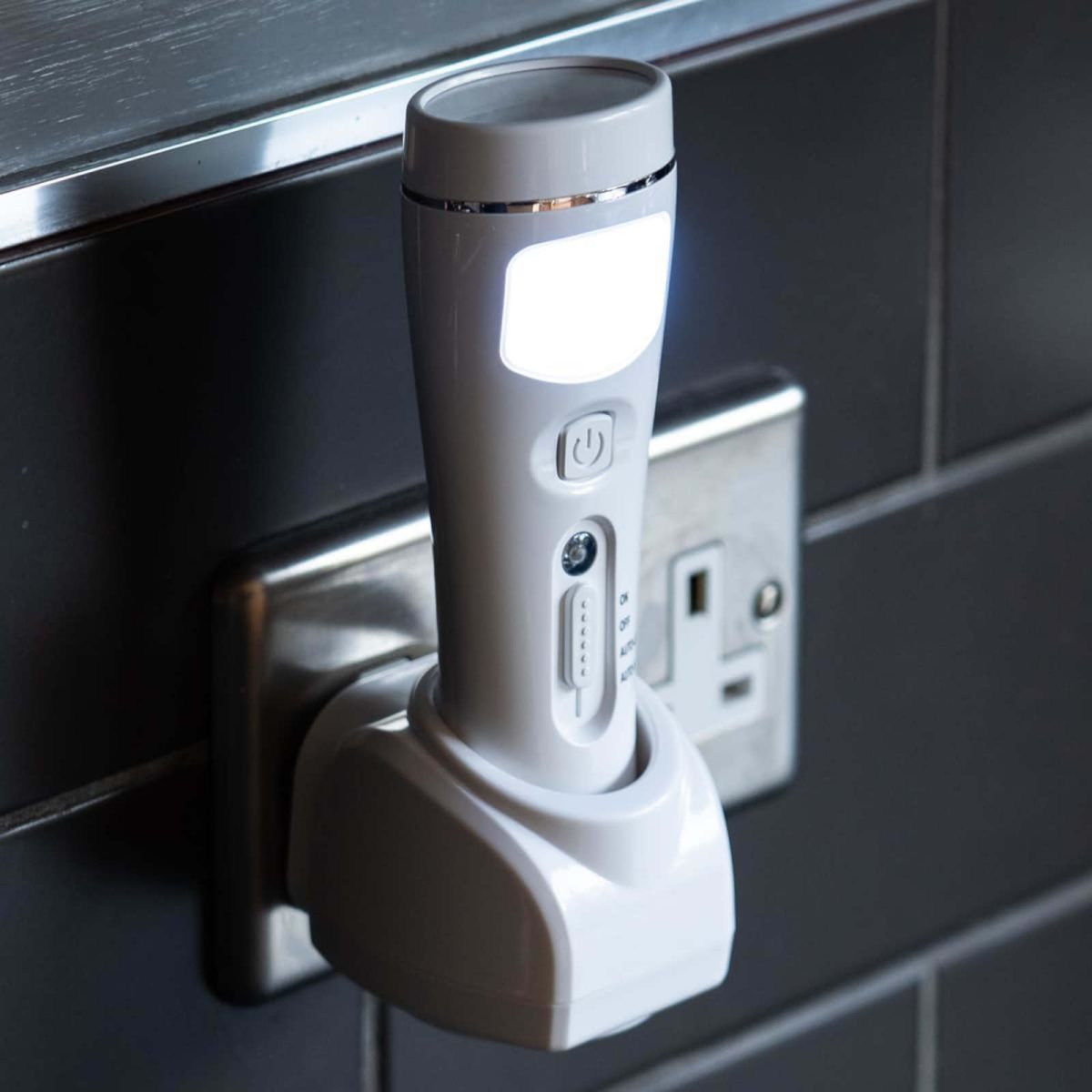
XtraLite NiteSafe
The NiteSafe is a dual-function device that works as both a plug-in nightlight and an emergency torch. It sits in a standard UK plug socket, charges continuously, and the moment mains power fails, it automatically illuminates.
Lock up, even when you’re in
Power cuts make people careless with doors. The back door gets left unlocked while everyone’s in and out to the shed for the camping stove, the side gate gets propped open, the front door gets left on the latch for a neighbour. Lock it behind you, every time. Most burglaries aren’t clever. They’re someone trying handles.

🪖 Black Panther
In My Previous Role…
In my previous role, perimeter security meant fences, floodlights, patrols and a duty roster. You don’t need any of it for a semi in Swindon. A deadlock you actually lock, a bolt on the side gate, a solar light over the back door and a neighbour who notices things will see off nearly every opportunist going. Carry on.
Don’t Advertise an Empty or Well-Stocked House
Being prepared is nothing to hide, and the best neighbours are the ones with a bit put by. It’s just not worth handing an opportunist a shopping list.
- Don’t post that you’ve been evacuated or that you’re away until you’re back. “We’ve been moved to the leisure centre” tells everyone the house is empty.
- Check the background of storm and flood photos before you post them: a broken fence, a smashed window, your house number.
- Keep the generator, fuel and new kit out of sight from the street, and break down the boxes from big purchases.
Complete Guide
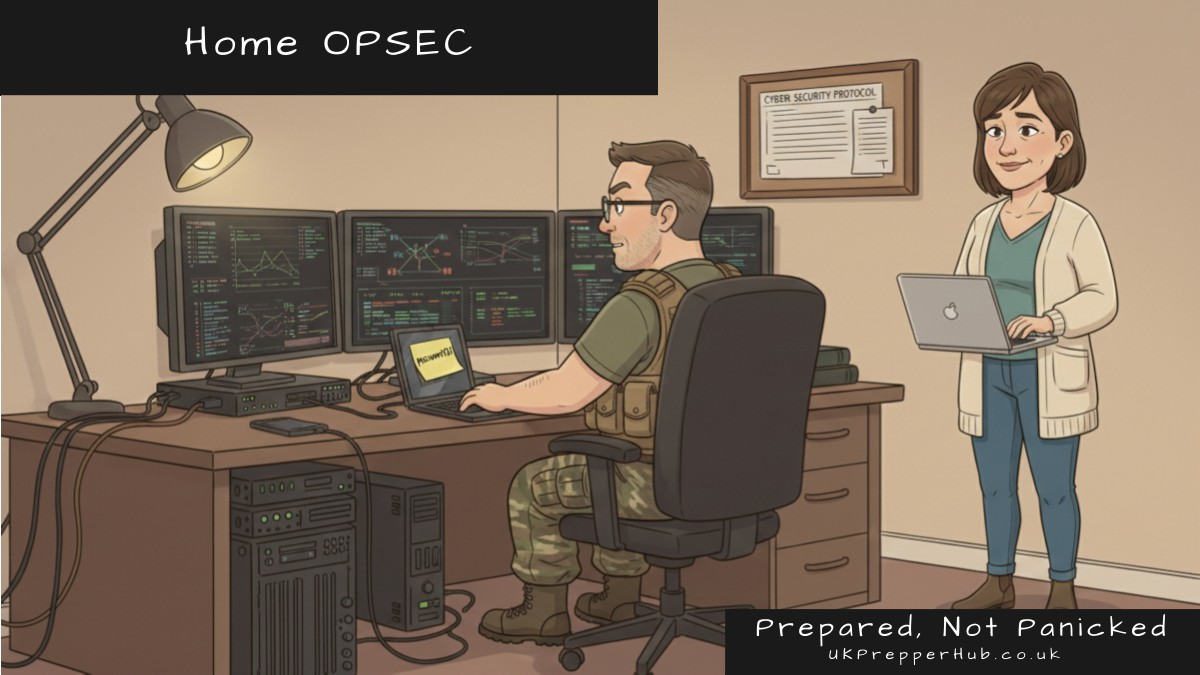
Household OPSEC Guide
OPSEC is a military term that’s filtered down to civilian life. OPSEC is short for “OPerational SECurity”. At its core, it means protecting information that could be used to harm you.
If You Have to Leave Home
If a flood, fire or a long power cut means leaving the house for a while, a few minutes on the way out makes a real difference.
- Lock every door and window, including the side gate and the shed. Take the keys with you.
- Take your valuables and documents, or lock them away. Passports, insurance details and anything irreplaceable should go with you in the grab bag.
- Tell a trusted neighbour you’ve gone and how to reach you, so someone’s keeping an eye on the house.
- Cancel deliveries, and ask someone to pick up the post and move the bins if you’ll be away more than a day or two.
- Check your insurance: many policies change or reduce cover if a home is left empty for more than a set number of days.
Complete Guide
Home Evacuation Plan
Most households freeze during an evacuation — not from fear, but from making fifteen decisions simultaneously under pressure for the first time. This guide walks you through the five decisions to make now, calmly, before you ever need them.
Read the Full Guide: Home Evacuation Plan →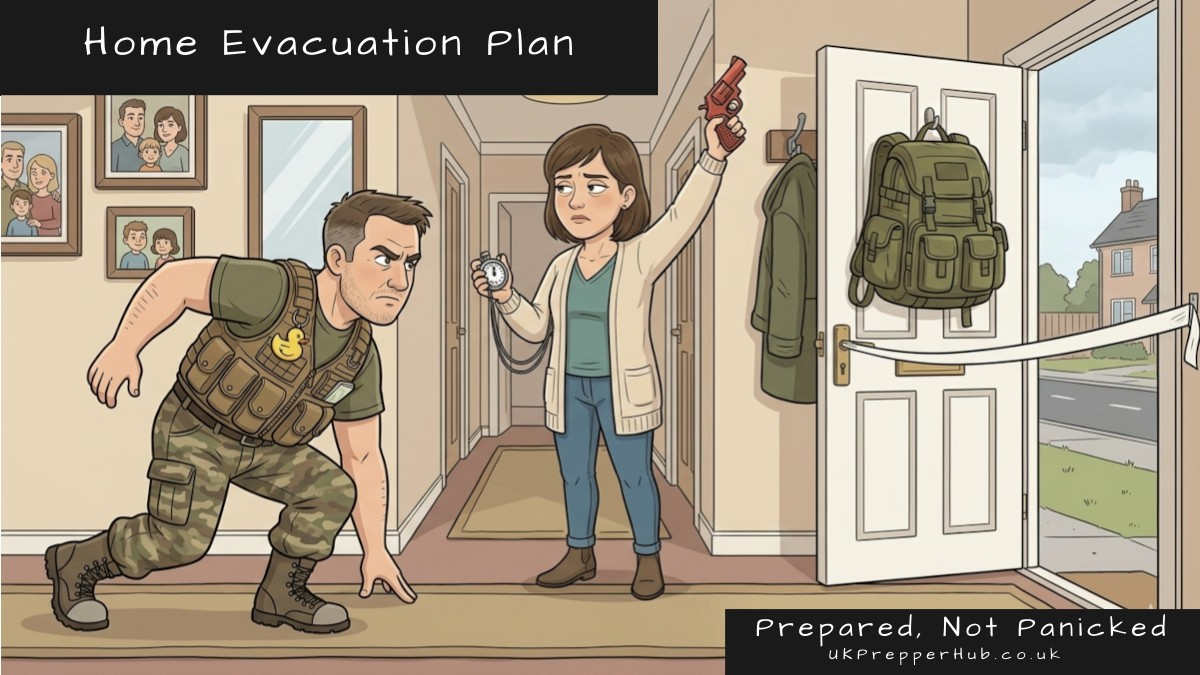
SentrySafe Fireproof Safe Box with Key Lock
UL-tested at 843°C, takes A4 flat, and ETL verified for USB backups — the fireproof document safe that actually fits your birth certificate.
Our Full Review: SentrySafe Fireproof Safe Box with Key Lock →
Doorstep Scams After a Storm or Power Cut
Emergencies bring out the scammers, because people are stressed and want the problem fixed now. The usual ones:
- Bogus utility workers in hi-vis offering to “check your fuse box” or reconnect your supply for a fee. Network operators don’t charge to restore your power, and nobody genuine asks for cash on the doorstep. For a power cut, ring 105 (in Northern Ireland, NIE Networks on 03457 643 643).
- Fake council staff offering emergency grants if you hand over bank details. Councils don’t take bank details at the door.
- Cowboy traders offering to fix storm damage to the roof today, cash only, half up front.
- Fake insurance assessors offering a quick cash settlement for a “processing fee”.
The rule is verify, don’t trust. Keep the door on the chain, ask for ID, and ask them to wait outside while you ring their company on a number you already have, from a bill, your policy or the company’s website, never the number on their card. A genuine worker will understand. A scammer will leave. Gas engineers carry a Gas Safe ID card you can check on the Gas Safe Register.
If you’ve got older relatives, tell them to ring you before opening the door to anyone claiming to be from the council, the water company or anywhere else. Better still, agree a family password that anyone you’ve genuinely sent round would know.
If Someone Breaks In While You’re Home
Your priority is getting everyone safe, not protecting your things.
- Don’t go looking for them.
- Get everyone into one room you can lock or barricade, ideally with a window you could get out of, and take your phone.
- Ring 999. Say there’s an intruder, where you are in the house and how many of you there are. Stay on the line.
- Make noise if you think it’ll make them leave: lights on, shouting that the police are coming.
- Let them go. Don’t chase them or try to get anything back.
What the law allows
UK law is very different from what you’ll see in American films and prepping videos. In England and Wales you can use reasonable force to protect yourself, your family or your home if you honestly believe it’s necessary, and if someone has broken into your home, the law gives householders extra leeway in the heat of the moment. Force that’s grossly disproportionate is never reasonable, though, and once the threat’s over, so is your right to use force. Scotland and Northern Ireland have their own law, built on the same idea of reasonable force. The Crown Prosecution Service guidance for householders sets out the detail.
What you can’t do: keep pepper spray, CS spray or a stun gun (all prohibited weapons in the UK), keep a weapon by the bed with the intention of using it, or set traps. The safest plan, legally and physically, is never to need any of it.
Check Your Insurance Before You Need It
- Locks: many policies expect a certain standard of lock, often BS3621 deadlocks, and may not pay out if a door wasn’t locked.
- Alarms: if your premium depends on having an alarm, the policy may expect it to be maintained, which is another reason to get the battery checked at the annual service.
- Empty homes: check what your policy says about leaving the house empty, before an evacuation forces the question.
Frequently Asked Questions
Does a burglar alarm work in a power cut?
Yes, for a while. In a burglar alarm power cut, a standby battery in the control panel takes over, and the NSI says it’s there to keep the system going for at least 12 hours. An old or worn-out battery won’t last that long, and some panels go into full alarm if the battery can’t hold them up, so get the battery checked at the annual service.
Why is my house alarm beeping after a power cut?
The panel is reporting a fault, usually that the mains was lost or the standby battery is low. Enter your user code to silence it. The mains fault normally clears once the power is back, and a run-down battery can take a day or two to recharge. If the low-battery warning won’t clear after that, ask your installer to replace the battery.
Do video doorbells and Wi-Fi cameras work in a power cut?
Mostly not. Mains-wired doorbells and cameras switch off. Battery ones keep running, but with the router off they can’t send alerts or upload video, so unless they record to their own memory card nothing is saved. Keeping the router running on a power station or a small UPS helps, as long as the broadband in the street is still working.
Do smart locks work in a power cut?
Yes, at the door. Smart locks run on their own batteries, so you can still lock and unlock them by keypad, fingerprint or key. The app and remote features stop when the Wi-Fi goes. Change the lock’s batteries when it warns you, and keep the backup key or backup method sorted.
Can I keep pepper spray for home protection in the UK?
No. Pepper spray, CS spray and stun guns are all prohibited weapons in the UK, and owning one is an offence. In England and Wales you can use reasonable force to protect yourself and your home if you honestly believe it’s necessary, but the best protection is good locks, lights and getting everyone safe while you ring 999.
Build Your Resilience
The whole plan, in one book
Prepared, Not Panicked (2026 edition) pulls our guides together into one plan for UK households. PDF, £4.99.
See inside the book →Further Reading: Related Guides
- How to Prepare for a Power Cut
- Household OPSEC Guide
- Home Evacuation Plan
- Protecting Your Important Documents
- Emergency Lighting Guide
- Portable Power Stations for Power Cuts
All our guides can be found listed on our resilience hub.
Gear We've Tested & Reviewed
- Xtralite NiteSafe Review
- Anker SOLIX C300X Review
- SentrySafe 1160 Fireproof Safe Box Review
- Lepro Torch Review
All our reviews can be found on our reviews and resources page.


