

This post may contain affiliate links Learn more
The EcoFlow DELTA 3 is the power station that took over from the DELTA 2: the same 1kWh size, a battery chemistry built to last for years, and enough output to run most of the things in a UK kitchen when the grid goes down. It charges from flat to full in under an hour on a normal wall socket, and it can sit plugged in behind the router or the fridge, switching itself over in 10 milliseconds the moment the power cuts out.
That last bit is what makes the EcoFlow DELTA 3 worth a look for a household rather than a campsite. Most power cuts in the UK arrive at teatime in a winter storm, last a few hours, and catch everyone with the freezer full and the phones at 12%. This EcoFlow DELTA 3 review covers what it will actually run, how quickly it refills, what changed from the DELTA 2, and where it fits among the other DELTA 3 models.
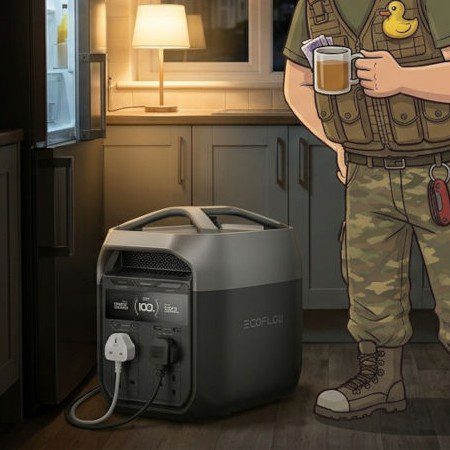
EcoFlow DELTA 3 Portable Power Station
Four UK sockets, a 10ms switchover and a full charge in under an hour: the 1kWh EcoFlow DELTA 3 keeps the fridge, router and lights going through a power cut.
Current Price at time of writing: £649.00
Rated: 4.3/5 ⭐ from 99 reviews
What the EcoFlow DELTA 3 Runs in a Power Cut
The EcoFlow DELTA 3 puts out 1,800W continuously, with 3,600W of surge for the moment something with a motor or compressor kicks in, such as a fridge-freezer starting up. On the front are four UK three-pin sockets, plus USB-A and USB-C ports, so the fridge, the router and a couple of lamps can run from the mains sockets while phones, tablets and a laptop charge from USB.
For appliances that want more than 1,800W, EcoFlow’s X-Boost lets it run heating-type kit rated up to 2,400W by running it at reduced power. In practice that means a travel kettle or a small hob will work, slowly. A full-size 3kW UK kettle is a stretch, so a camping stove is still the better way to boil water in a long cut.
The capacity is 1,024Wh. A rough way to work out run time is to divide that by the watts the appliance uses, then knock a bit off for conversion losses:
- Broadband router (around 10W): well over three days.
- Laptop (around 60W): most of a working day and evening.
- LED lamp (under 10W): days.
- Fridge or fridge-freezer: the compressor cycles on and off, so it varies a lot by model and how often the door opens. Check the energy label’s yearly kWh figure and divide by 365 for a daily guide.
- Phones: dozens of charges.
It won’t run electric heating, an electric shower or an oven for any useful length of time, and nothing this size will. For a typical UK power cut of a few hours, though, it keeps the food cold, the house connected and the lights on.
Charging: From Flat to Full in Under an Hour
This is the headline feature, and it matters more than it sounds. With 1,500W of AC input, it reaches a safe charge level in about 30 minutes, 80% in 40 minutes and 100% in 56 minutes from a normal UK socket. If a storm warning goes out at lunchtime, a flat unit can be full long before the wind gets up.
- Mains: 0 to 100% in 56 minutes.
- Solar: up to 500W of solar input, which EcoFlow says recharges it in about 2 hours in good sun. UK winter sun is a lot weaker than that, so treat solar as a top-up in a long outage rather than the main supply.
- Car: EcoFlow’s 800W alternator charger fills it in about 1.3 hours while you drive.
- Generator: it also charges from EcoFlow’s Smart Generator, and you can combine charging sources.
The 10ms UPS: Why It Matters at Home
As a portable power station for home backup, this is where the EcoFlow DELTA 3 earns its keep. Leave it plugged into the wall with your router, a computer or the fridge plugged into it, and it behaves like an uninterruptible power supply. When the mains goes, it switches to battery in 10 milliseconds, quickly enough that a router or a desktop PC doesn’t notice. You don’t come home to a defrosted freezer, and the Wi-Fi, the video doorbell and any digital landline keep going through the cut.
The app adds a storm warning mode and a Time-of-Use mode that charges on cheaper off-peak electricity, plus remote monitoring of what’s plugged in and how much charge is left. It’s quiet too: EcoFlow rates it at 30dB under 600W, which is library-quiet, so it can live in the hallway or a bedroom without anyone noticing.
Battery, Build and Expanding to 5kWh
Like every current EcoFlow power station, the DELTA 3 uses LiFePO4 (lithium iron phosphate) cells, the type now used in most good home power stations because they cope with years of charging and discharging far better than older lithium-ion packs. That matters for a box that will spend most of its life sitting on charge, waiting for the next storm.
If 1kWh turns out not to be enough, it can take EcoFlow’s extra battery packs to expand to as much as 5kWh, so you can start with one unit and add capacity later rather than buying the biggest model up front.
EcoFlow DELTA 2 vs DELTA 3: What Changed
The DELTA 2 has been superseded, and the EcoFlow DELTA 3 is its direct replacement at the same 1kWh size. The improvements are the ones that matter in a power cut:
- A proper UPS switchover of 10 milliseconds, so the router and computers stay on through the cut.
- A faster full charge, from flat to 100% in under an hour.
- Much more surge power, 3,600W, for fridges and tools that need a big kick to start.
- Quieter running and a smarter app with storm warnings and off-peak charging.
The capacity, the LiFePO4 battery and the ability to add extra packs stay. If you were looking at a DELTA 2, this is the one to buy now.
EcoFlow DELTA 3, Plus, Classic or Max?
EcoFlow sells several DELTA 3 models, which makes choosing harder than it should be:
- EcoFlow DELTA 3 (this one): 1kWh, the all-rounder, and the one most households need.
- EcoFlow DELTA 3 Plus: the same 1kWh capacity with faster solar charging and more features, for a higher price.
- EcoFlow DELTA 3 Classic: also 1kWh with the same output, for less money, but only two UK sockets on the front instead of four. Also sold bundled with a small solar panel.
- EcoFlow DELTA 3 Max: double the capacity at 2kWh, for longer outages or running a fridge and a freezer together for longer.
For keeping a normal home going through a typical UK power cut, the EcoFlow DELTA 3 is the sensible middle of the range.
Who the EcoFlow DELTA 3 Is For
- Households that want the fridge, freezer, router and lights covered through a winter storm cut.
- Anyone relying on power-dependent medical equipment who wants an instant switchover.
- Home workers who can’t afford to lose the broadband or an unsaved file.
- Rural homes on the end of long overhead lines, where cuts come more often and last longer.
- Campers and caravanners who want one unit for the van and the house.
EcoFlow DELTA 3 Portable Power Station
Four UK sockets, a 10ms switchover and a full charge in under an hour: the 1kWh EcoFlow DELTA 3 keeps the fridge, router and lights going through a power cut.
Current Price at time of writing: £649.00
Rated: 4.3/5 ⭐ from 99 reviews
What the Rest of the Team Think

🦆 Keith the Prepper
I’ve got one in the Land Rover Discovery, one in the garage and one under the stairs. My wife asked what happens if they all go flat at once. I said I’d charge them off each other. She went quiet in a way I didn’t like.
⭐⭐⭐⭐⭐

🪖 Black Panther
In my previous role, backup power meant a diesel generator the size of a shed and a corporal to refuel it at 0300. This switches over in 10 milliseconds and doesn’t need refuelling. Acceptable. Carry on.
⭐⭐⭐⭐⭐

🤡 Camping Clown
I’ve got a whole-house battery system with three expansion packs and an app that tells me how my house is feeling. In the last power cut it was mid-update. My neighbour’s DELTA 3 ran his fridge and his telly while I read the terms and conditions by torchlight.
⭐⭐⭐⭐⭐

🐾 Weekend Warrior
Bro, I bought this for the bug-out location. Then the power went on a Tuesday at teatime and it ran the fridge with Pickle’s raw food in it, the router and my ring light. All fourteen subscribers got their upload on time.
⭐⭐⭐⭐

📋 Calm Clarissa
It’s on my power cut checklist: plugged in behind the router, fridge on the other socket, charge checked on the first of the month. Janet calls it the fridge’s bodyguard. Janet is correct.
✅✅✅✅✅
Pros and Cons
Pros
- The EcoFlow DELTA 3 charges from flat to full in under an hour on a normal socket.
- 10ms UPS switchover keeps the router, PC and fridge running through a cut.
- Four UK three-pin sockets plus USB ports, with 1,800W output and 3,600W surge for most household kit.
- LiFePO4 battery built for years of standby life.
- Expandable to 5kWh with extra battery packs.
- Quiet enough to live indoors, with storm warnings and off-peak charging in the app.
Cons
- Won’t run a full-size UK kettle at full power: X-Boost runs it slowly.
- 1kWh won’t cover electric heating or a whole house for long.
- UK winter solar is weak, so solar charging is a top-up, not a main supply.
- A serious purchase, not an impulse buy.
Frequently Asked Questions
Is the EcoFlow DELTA 3 worth it over the DELTA 2?
Yes. The DELTA 2 has been superseded, and the EcoFlow DELTA 3 keeps the same 1kWh capacity while adding a 10ms UPS switchover, a full charge in under an hour, much higher surge power and quieter running. If you were looking at a DELTA 2, buy the DELTA 3 instead.
How long will the EcoFlow DELTA 3 run a fridge in a power cut?
It depends on the fridge, because the compressor switches on and off. Check the energy label’s yearly kWh figure, divide by 365 for a daily figure, and compare it with the 1,024Wh capacity, allowing a bit for conversion losses. Most modern fridges will comfortably get through a typical few-hour UK power cut.
Can the EcoFlow DELTA 3 run a kettle?
A small or travel kettle, yes. It puts out 1,800W, and its X-Boost mode runs heating appliances rated up to 2,400W at reduced power. A full-size 3kW UK kettle will be slow, so a camping stove is the better way to boil water in a long power cut.
Does the EcoFlow DELTA 3 work as a UPS?
Yes. Leave it plugged into the wall with your devices plugged into it, and it switches to battery in 10 milliseconds when the power cuts out, fast enough to keep a router or a desktop computer running without a blip.
Can I charge the EcoFlow DELTA 3 with solar panels?
Yes, it takes up to 500W of solar input. EcoFlow says that recharges it in about 2 hours in good sun, but UK winter sunshine is much weaker, so plan on solar as a top-up during a long outage rather than the main way to charge it.
Build Your Resilience

The whole plan, in one book
Prepared, Not Panicked (2026 edition) pulls our guides together into one plan for UK households. PDF, £4.99.
See inside the book →Further Reading: Related Guides
- Portable Power Stations for Power Cuts
- Portable Power Station With Solar Panel
- How to Prepare for a Power Cut
- Emergency Planning for Disabled People
- Burglar Alarm Power Cut
All our guides can be found listed on our resilience hub.


📡 Find Us Everywhere
Daily briefings, prep guides, and real-time updates across every platform. Pick yours.
Free. No commitment. Stay anonymous on WhatsApp & Telegram.
Stay Informed on UK Preparedness
Join our newsletter for UK-specific preparedness tips, product recommendations, and real-world advice for households.
Subscribe to Our Newsletter