
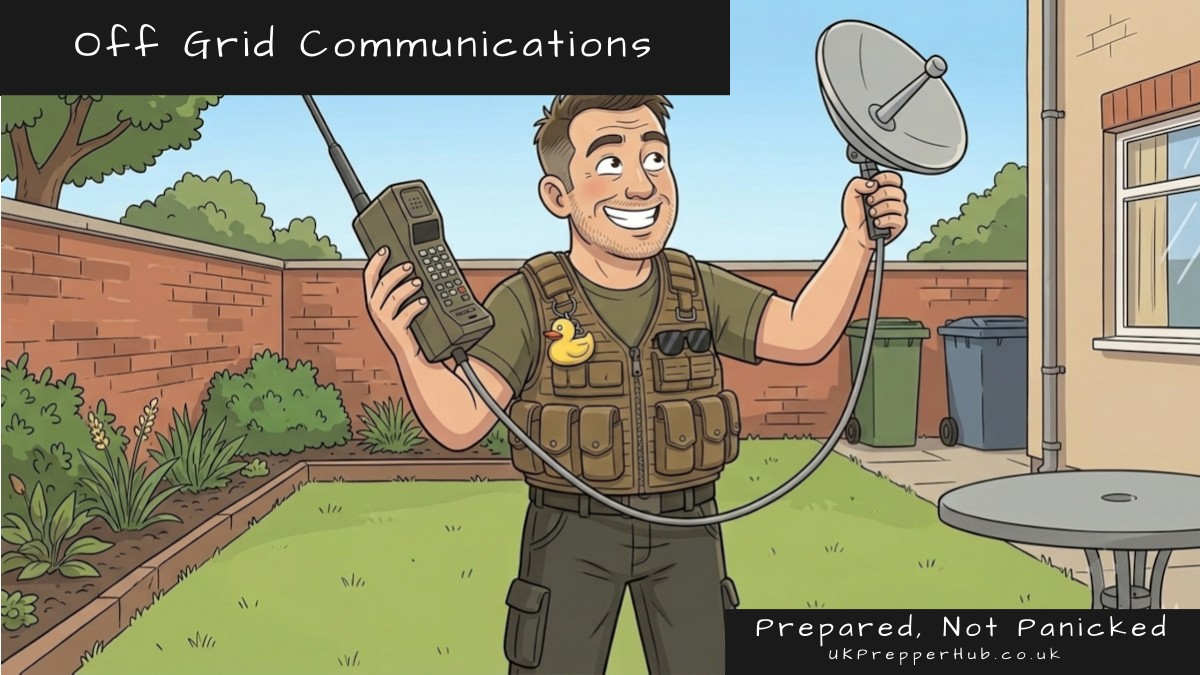
Your mobile is the first thing to go. Not the last — the first. When a serious emergency hits, mobile networks buckle under load within minutes. And when the masts finally run dry on backup battery power — typically within four to eight hours of a grid outage — that’s it. No signal, no internet, no way to reach anyone. The cordless phone on your kitchen counter is equally dead the moment the power goes. Off grid communications is about having a plan before any of that happens.
This guide covers every practical option available to a UK household — from a £15 wind-up radio to satellite messengers — what each one does, what it costs, and what’s actually legal to use here.

🐔 Chicken Licken
Did You Know?
Mobile masts run on backup batteries lasting just 4–8 hours — most people assume their phone works as long as it has charge, but the network dies long before your phone battery does
Why Your Comms Fail Before the Power Does
Most people assume the phone network is one of the last things to go in an emergency. It isn’t. Mobile masts run on mains power with a battery backup — four to eight hours in a prolonged outage, sometimes considerably less. Add in network congestion — every person in the affected area reaching for their phone at exactly the same moment — and calls and data often fail within minutes of a major event regardless of mast battery state.
Broadband and VOIP phones go the moment your router loses power. Cordless landline handsets are the same — the base station needs mains to function. The only landline that still works in a power cut is a corded handset plugged directly into the telephone socket, and BT’s ongoing PSTN switch-off means the majority of UK homes no longer have one of those either.
The result: a UK household in a serious grid outage has no reliable way to communicate unless they’ve planned for it. Here’s how to plan for it.
Your Off-Grid Communications Options
These options are arranged in tiers — cost and complexity increase as capability increases. Start with what covers your most likely scenario. Don’t start with what looks most impressive.
Tier 1 — Receive Only: The Emergency Radio
The simplest and most important piece of kit. A battery or wind-up radio lets you receive emergency broadcasts, weather updates, and live news from the BBC and local stations — even with no grid power, no mobile signal, and no internet. You can’t send anything, but in most UK emergencies, listening is 90% of what you actually need to do.
You don’t need DAB — DAB is a battery hog, and in an emergency that battery matters. A simple FM/MW analogue radio is all you need. Radio 4 (the most important station in any UK emergency) is on FM and LW and receivable on any basic set with power. Look for hand-crank or solar charging as a bonus, and keep a stock of the right batteries. This is the non-negotiable foundation of any off-grid comms plan.
Complete Guide
Emergency Radio Guide
When the power fails, your phone signal goes with it. This guide covers which radio frequencies actually matter in a UK emergency, what to look for before you buy, and how to make sure it works when you need it.
Read the Full Guide: Emergency Radio Guide →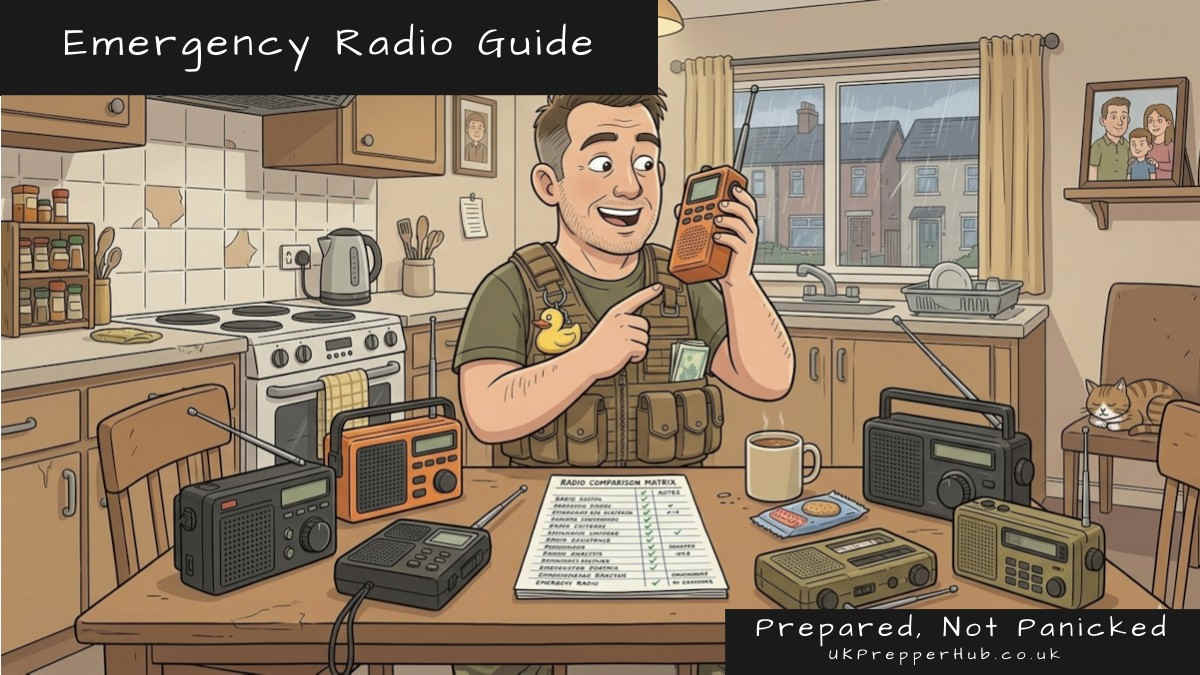
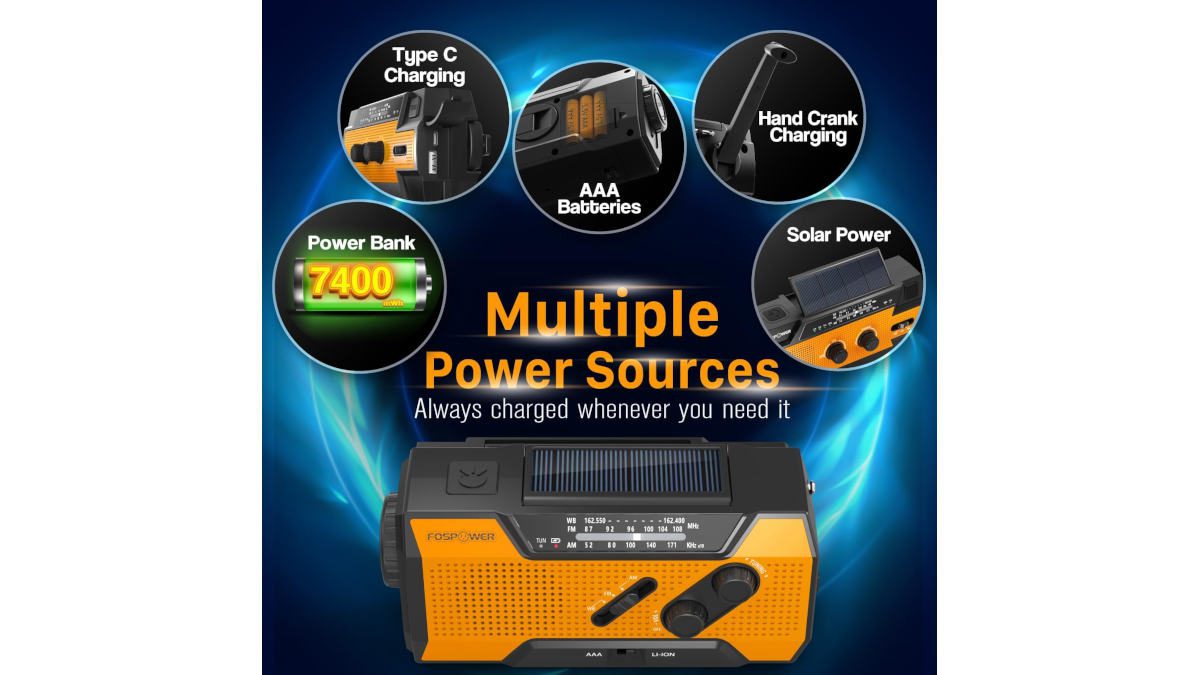
FosPower Emergency Radio
Most emergency radios have one or two power options. The FosPower has four, and that redundancy is the single most important feature for preparedness use.
Tier 2 — Licence-Free Two-Way: PMR446 Walkie Talkies
PMR446 is the UK’s licence-free two-way radio standard — no paperwork, no registration, buy a pair and use them. These handheld radios operate on 16 channels at a maximum of 500mW, which gives a realistic range of 1–3km in typical UK conditions (towns, suburbs, hills, trees). Ignore the “8km” or “10km” figures on the box — those are line-of-sight in an open field with nothing in the way.
PMR446 is ideal for family-scale comms: staying in touch between two cars in convoy, across a street, or across a neighbourhood during an extended emergency. Everyone you want to talk to needs a compatible radio, but a decent pair costs £30–50 with no subscription and no ongoing cost.
Complete Guide
PMR446 Walkie Talkies
PMR446 walkie talkies need no licence, no subscription, and no infrastructure — they work when mobile networks don’t. This guide covers realistic range, how to use them in a UK emergency, what to look for when buying, and why the “privacy codes” on the box aren’t what you think.
Read the Full Guide: PMR446 Walkie Talkies →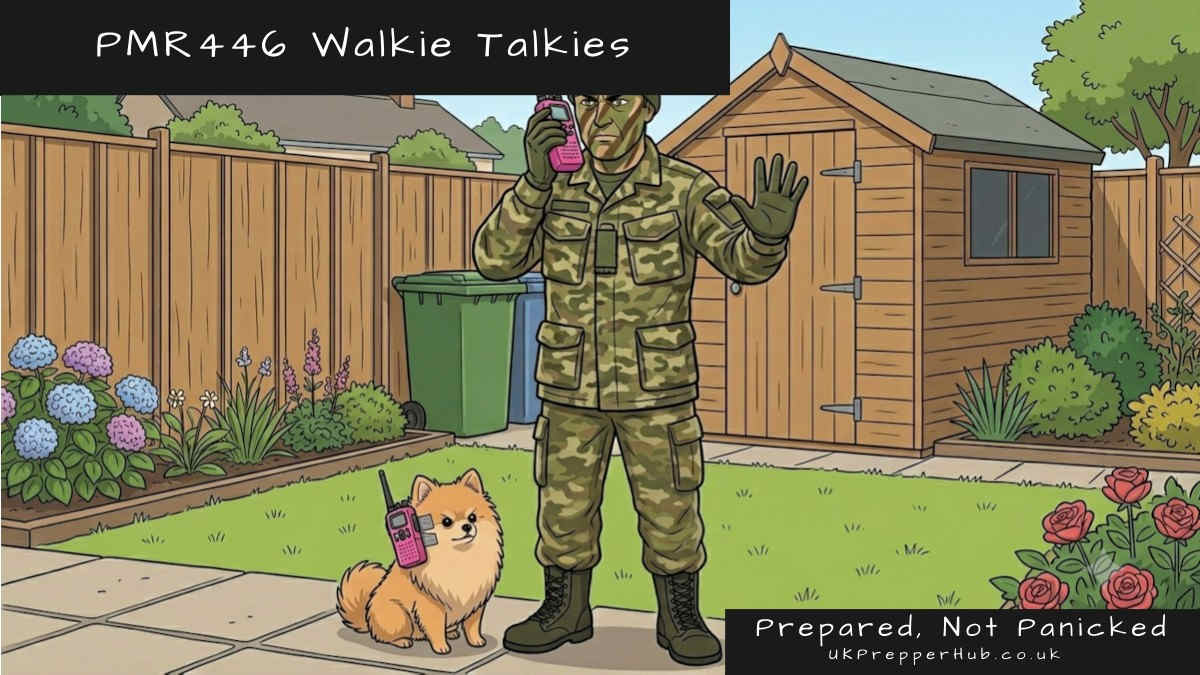
Tier 3 — CB Radio
Citizens’ Band radio has been licence-free in the UK since 2006. It runs on 40 channels and offers more range than PMR446 under the right conditions — typically 5–15km in flat open terrain, considerably less in built-up areas. Channel 19 is the unofficial UK road and emergency channel, monitored by truckers and enthusiasts.
CB requires more power than a handheld walkie talkie — usually a 12V car socket or mains adaptor — and is less portable. But it covers ground that pocket PMR446 radios can’t, and a CB set in the car paired with one at home gives a reliable house-to-vehicle link when the mobile network is down.
Complete Guide
CB Radio: The Licence-Free Step Up
CB radio is the licence-free step up from PMR446 walkie talkies — more power, greater range, and access to Channel 19 where lorry drivers broadcast real-time road intelligence before any official source catches up. No licence, no registration, and it runs from a leisure battery when the grid goes down.
Read the Full Guide: CB Radio: The Licence-Free Step Up →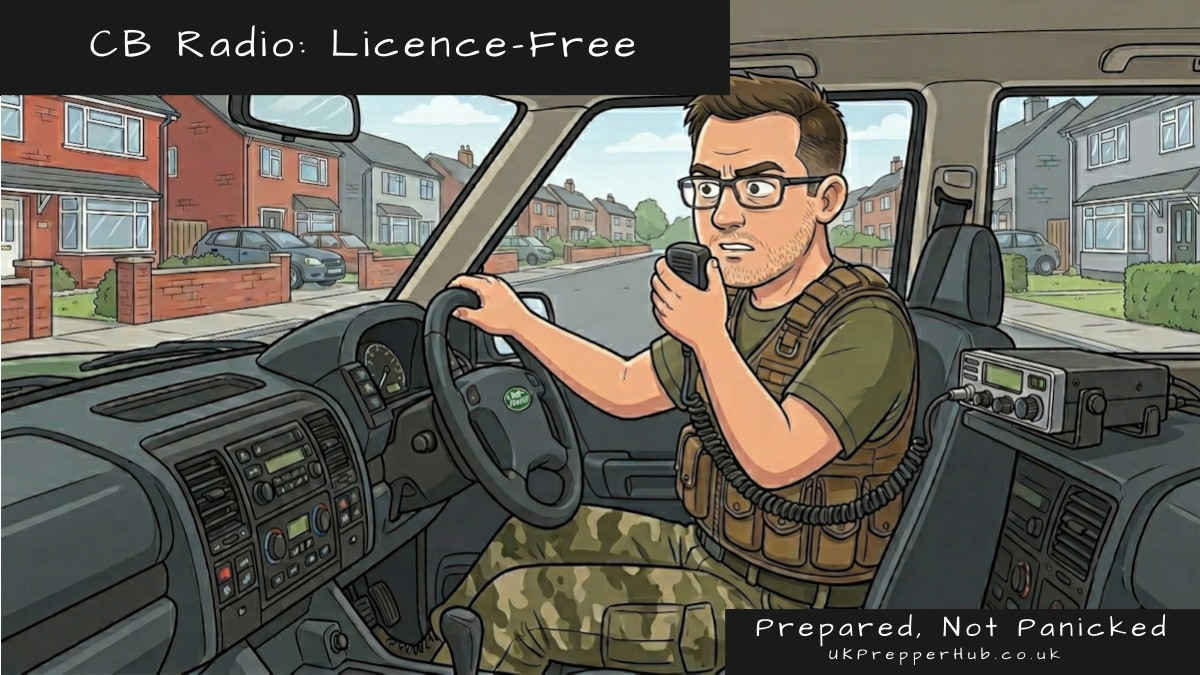
Tier 4 — The Grey Area: Baofeng and Other Multiband Handhelds
The Baofeng UV-5R is the most widely owned handheld radio in the prepper community. In the UK, you can legally receive on a Baofeng across most frequencies without any licence. Transmitting is where it gets more complicated — and where people regularly get it wrong.
Transmitting on amateur radio bands requires a UK amateur radio licence (Foundation level is the entry point, achievable in a weekend through the RSGB). Transmitting on PMR446 channels with a Baofeng is actually illegal regardless of whether you hold any licence, because the device doesn’t meet the technical specification for those channels — wrong power output, wrong antenna. Know what you’re doing before you key up.
Complete Guide
Baofeng UV-5R in the UK
The Baofeng UV-5R is the most talked-about radio in UK prepper circles and the most legally misunderstood — £25, dual-band VHF/UHF, and capable of far more than most people realise. This guide covers what you can and cannot do with it in the UK, how to get the Foundation licence that makes it fully legal to transmit, and whether it belongs in your kit.
Read the Full Guide: Baofeng UV-5R in the UK →
Tier 5 — LoRa Mesh: Meshtastic and Off-Grid Text
Meshtastic devices use LoRa radio technology to create a decentralised mesh network — text messages hop from device to device with no masts, no internet, and no subscription required. In the UK, these devices operate on 868MHz, which sits within the licence-free ISM band. No registration required.
Realistic range is 3–10km per hop in UK conditions, and messages relay through other Meshtastic devices within range, extending coverage further across a community. The catch is that it’s a community tool — everyone you want to communicate with needs their own device. If your household has one and nobody else in the street does, you have a very capable radio that can’t reach anyone. For setup detail, netneo.co.uk covers Meshtastic for beginners thoroughly.
[INSERT GUIDE CARD: Meshtastic UK — card not yet built, prompt Darren to create one]
Tier 6 — Satellite: When Everything Else Has Failed
Satellite communicators — Garmin inReach, SPOT, and similar devices — work anywhere with a clear view of the sky. Two-way text messaging, SOS capability, GPS tracking. No masts, no infrastructure, no network congestion, no dependency on anything terrestrial. They genuinely work when everything else has stopped.
They also require a monthly subscription (typically £15–50 depending on plan and device), and the scenarios where they’re genuinely necessary — remote rural locations, offshore coastal exposure, total infrastructure collapse — are rare for the majority of UK households. For most people in most situations, the problems satellite solves are handled more than adequately by Tier 2.
🪖 Black Panther
In My Previous Role…
A full satellite comms setup — device plus monthly subscription — for use in a Midlands suburb is overkill, when a £30 pair of PMR446 radios covers every scenario you’ll realistically face as a UK household
Complete Guide
Satellite Comms for UK Preppers
One or two sentences on what this guide covers and why it’s worth reading from this context. Keep it specific to the topic being discussed on this page.
Read the Full Guide: Satellite Comms for UK Preppers →
What’s Legal and What Isn’t
Most of what this guide covers is legal with no licence required. But it’s worth knowing exactly where the lines are before you start transmitting.
- Receive-only (any radio) — fully legal, no licence needed
- PMR446 walkie talkies (compliant devices) — licence-free, legal
- CB radio — licence-free since 2006, legal
- Baofeng or similar (receive only) — legal, no licence needed
- Baofeng (transmitting on PMR446 channels) — illegal regardless of licence; non-compliant device
- Baofeng (transmitting on amateur radio bands) — legal only with a UK amateur radio licence (Foundation level minimum)
- Meshtastic 868MHz LoRa devices — licence-free, legal
- Satellite communicators (inReach, SPOT etc.) — fully legal, subscription required but no radio licence
The Foundation amateur radio licence is more accessible than most people expect — the exam can be sat in a weekend through an RSGB-affiliated club. It opens up a significant range of frequencies beyond the licence-free options and is worth considering if you want serious capability.
Building Your Off-Grid Comms Plan
Start with Tier 1. Every household should have a battery or wind-up radio — not stored away somewhere for emergencies, but somewhere accessible. If you have nothing else, you can receive critical information when every other source has gone dark.
Add PMR446 if your household spans more than one building, vehicle, or person likely to be separated during an emergency. At £30–50 a pair with no ongoing cost, there’s very little reason not to.
Add Tier 5 (Meshtastic) only if you can bring neighbours on board — it earns its place as a street or village-level project, not as a solo purchase. Add Tier 6 only if your location or lifestyle genuinely warrants it: remote rural, offshore coastal, or regular solo work in areas with no infrastructure.

🦆 Keith
Don’t Be Keith
Keith spent £400 on a satellite phone and a £25/month subscription for home emergencies after reading a prepper forum — before anyone pointed out that a pair of PMR446 walkie talkies would have covered every scenario he’d actually face in a Midlands suburb, for £30, with no monthly fee
Frequently Asked Questions
Can I use a Baofeng radio legally in the UK?
You can legally receive on a Baofeng without any licence. To transmit legally on amateur radio frequencies, you need a UK amateur radio licence — the Foundation level is the entry point and can be obtained in a weekend through an RSGB-affiliated club. Transmitting on PMR446 channels with a Baofeng is illegal regardless of licence, because the device’s power output and antenna don’t meet the technical specification for PMR446.
How far do PMR446 walkie talkies actually reach?
Ignore the range figures on the box. “8km” or “10km” means line-of-sight in completely open conditions. In a UK suburb — buildings, trees, hills — expect 1–3km in practice. In open countryside you’ll do better. For household and neighbourhood use, that range is more than adequate.
Do I need a licence for Meshtastic in the UK?
No. Meshtastic devices in the UK operate on 868MHz, which is in the ISM (Industrial, Scientific and Medical) licence-free band. No registration or licence is required for low-power use. Make sure your device is configured to the EU 868MHz channel plan rather than the US 915MHz plan — the US frequencies are not legal to operate in the UK.
Will my mobile phone work during a power cut?
Probably, initially — mobile masts run on backup batteries that typically last four to eight hours. After that, the mast shuts down. Network congestion in major emergencies also means calls and data often fail within minutes regardless, as everyone in the affected area tries to use the network simultaneously. Don’t rely on it.
What’s the single most important off-grid comms purchase?
A battery or wind-up emergency radio. It requires no other devices, no network, no infrastructure, and no co-operation from anyone else. It gives you access to official emergency broadcasts, weather updates, and news at exactly the moment everything else has gone quiet. Every other tier in this guide builds on that foundation.