
This post contains affiliate links. Learn more
The EcoFlow Delta 2 does something neither the Anker SOLIX C300 nor the Jackery Explorer 1000 v2 can: it runs a standard UK kettle. Via EcoFlow’s X-Boost power management technology, appliances rated up to 2400W work on a unit with an 1800W output — and that single feature changes what “home backup power” actually means for a UK household. You can boil water, make tea, and get on with it.
It also expands. The base unit ships with 1024Wh of capacity — already enough for a long overnight power cut. But clip on a Delta 2 Extra Battery and you’re at 2kWh. Add the larger Delta Max Extra Battery and you’re at 3kWh. This is not an accessory-as-afterthought design; it is the core product architecture, built to scale with your needs rather than requiring you to replace the whole unit.
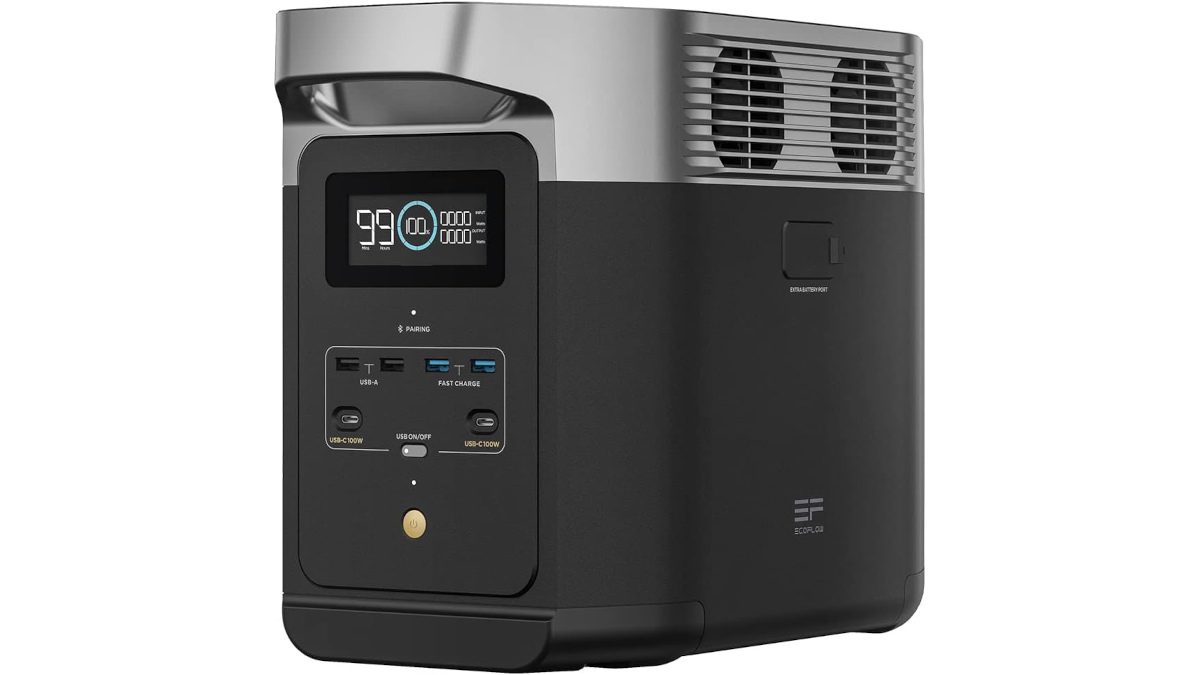
EcoFlow DELTA 2 Portable Power Station
1024Wh LFP power station that runs standard UK kettles, expands to 3kWh with extra battery packs, and switches to battery power in under 30 milliseconds .
Current Price at time of writing: £399
Rated: 4.6/5 ⭐ from 386 reviews
What the EcoFlow Delta 2 Is — and Where It Sits
The Delta 2 is EcoFlow’s core 1kWh portable power station. It delivers 1800W of AC output from a 1024Wh LFP (lithium iron phosphate) battery, with four UK three-pin AC outlets, two 100W USB-C ports, and an EPS (Emergency Power Supply) mode that switches over in under 30 milliseconds when the grid drops. Think of it as the fully-loaded option in the cluster: more output than the Anker C300 (which tops out at 300W), more AC outlets and output than the Jackery 1000 v2 (1500W, two outlets), and the expandability that neither of those units offers.
At time of writing, the Delta 2 has been superseded by the EcoFlow Delta 3 Classic. The Delta 2 is no longer listed on EcoFlow’s UK website — but it remains available on Amazon, and at the current price represents considerably better value than it did at launch. The hardware is unchanged and EcoFlow’s 3,000-cycle LFP chemistry means the battery will outlast most reasons to replace it.
X-Boost: The Feature That Actually Changes What You Can Run
Most portable power stations have a hard output ceiling. If an appliance draws more watts than the unit can supply, it simply won’t power on. That is the constraint every UK household hits when they plug in a kettle: standard UK kettles are rated at 2,000–3,000W, and units rated at 1,500W or below cannot power them.
EcoFlow’s X-Boost works differently. Rather than refusing the appliance, it intelligently manages power delivery to allow appliances rated up to 2,400W to run from the Delta 2’s 1,800W output. In practice, the appliance receives up to 1,800W — so a 2,000W kettle will draw 1,800W and take a little longer to boil than it would from the mains. It boils. That is the point. For most UK households, the ability to run a kettle without buying a travel kettle specifically for the power cut is the deciding argument between an 1,800W unit and a 1,500W one.
X-Boost also covers other common household appliances: hair dryers, smaller electric ovens, induction hobs — anything up to 2,400W rated that would otherwise exceed the output limit. In a power cut scenario, this is the difference between a unit that handles your full kitchen versus one you have to work around.
Capacity and Runtime: 1024Wh in a UK Power Cut
The base Delta 2 carries 1024Wh — enough to cover most UK domestic power cuts comfortably on a single charge. A fridge-freezer averaging 100W runs for around 10 hours. A CPAP machine at 50W runs for over 20 hours. TV, router, and phone charging together come to roughly 200W — approximately 5 hours. Running the fridge plus the essentials (TV, router, phones, a couple of LED lights) keeps you at roughly 250W average draw, which gives you around four hours — typically enough for any overnight outage in the UK.
The four UK three-pin AC outlets matter more than they might appear. Running fridge, slow cooker, CPAP machine, and a lamp simultaneously requires four output points. Units with two outlets require adaptors or extension leads to run the same setup — fine in principle, but an unnecessary complication during an actual power cut.
The Expandability Design: Building to 3kWh
This is the feature that sets the Delta 2 apart from the rest of the competition, and it is worth understanding how it actually works rather than treating it as a marketing bullet point.
The Delta 2 has a dedicated battery expansion port on the rear panel. A compatible extra battery pack — either the Delta 2 Extra Battery (approximately 1kWh additional) or the larger Delta Max Extra Battery (approximately 2kWh additional) — connects via a cable directly to this port. Once connected, the EcoFlow app recognises the additional capacity and manages charging and discharging across both units as a single system.
With the Delta 2 Extra Battery: 1024Wh + 1000Wh = approximately 2kWh total. At the same 250W household draw, that is eight hours of runtime rather than four — enough to cover a 24-hour outage without needing to charge the unit. With the Delta Max Extra Battery: approximately 3kWh total, which extends to twelve-plus hours at the same draw rate.
Critically, this is a modular investment rather than a replacement purchase. If you buy the Delta 2 base unit today and your needs grow — a household addition, medical equipment, working from home through longer outages — you add a battery pack. You do not buy a new power station. The architecture acknowledges that preparedness requirements change over time.
One honest caveat for 2026: EcoFlow UK has discontinued the Delta 2 and moved to the Delta 3 platform. The Delta 2 Extra Battery and Delta Max Extra Battery remain available on Amazon at time of writing, but sourcing expansion packs long-term from EcoFlow UK directly is not guaranteed. If expandability is the primary reason you are buying this unit, verify that expansion batteries are in stock before purchasing the base unit.
EPS Mode: Seamless Switchover
The Delta 2’s EPS (Emergency Power Supply) mode switches from mains to battery in under 30 milliseconds. That is fast enough that most equipment does not register the transition — routers stay connected, computers don’t crash, CPAP machines don’t lose their session data. Set it up permanently: Delta 2 plugged into the wall, your key equipment plugged into the Delta 2. A power cut becomes effectively invisible for everything connected to it.
The switchover time is slightly slower than the Jackery 1000 v2’s quoted ≤20ms, but both are fast enough for virtually all domestic equipment. The practical difference is negligible.
Charging Speed
Via a standard UK wall socket using EcoFlow’s X-Stream technology, the Delta 2 charges from flat to full in approximately 80 minutes — faster than any comparable unit in this cluster. The Jackery 1000 v2 takes two hours in standard mode (one hour in emergency mode with thermal caveats). The Delta 2’s 80-minute standard charge time is genuinely useful: top it up in the afternoon and it is ready for an evening power cut.
Solar charging is supported at up to 500W input, using EcoFlow’s 220W solar panels (two panels in parallel) or compatible third-party panels with the right connector. UK solar output in winter limits realistic recharge times — plan for several hours rather than the spec-sheet figures, which assume optimal sun conditions.
EcoFlow DELTA 2 Portable Power Station
1024Wh LFP power station that runs standard UK kettles, expands to 3kWh with extra battery packs, and switches to battery power in under 30 milliseconds .
Current Price at time of writing: £399
Rated: 4.6/5 ⭐ from 386 reviews
What the Rest of the Team Think

🦆 Keith the Prepper
I’ve got mine, the two extra battery packs, and I’ve wired all three in series through a junction box I made from a biscuit tin and some copper pipe. Currently the biscuit tin is on fire so I can’t tell you the output. The X-Boost is an excellent feature and I have already tried to improve it. My wife has unplugged the biscuit tin.
⭐⭐⭐⭐⭐

🪖 Black Panther
Four AC outlets is the correct number of AC outlets. I can run my full tactical operations room and still have two outlets spare for contingency equipment. The 1800W ceiling covers every piece of kit I own except the item I cannot discuss. The X-Boost handled my kettle without complaint. Operationally sound.
⭐⭐⭐⭐⭐

🤡 Camping Clown
I have the Delta 2, the Delta Max, the Delta Pro, and the Delta Pro Ultra. Plus two Extra Batteries and a Smart Generator. They’re all in the spare room. The expandability is a really compelling feature and the reason I needed a second spare room. I haven’t used any of them for an actual camping trip. I remain open to the idea.
⭐⭐⭐⭐⭐

🐾 Weekend Warrior
The four AC outlets means I can run Pickle’s heat pad, the TV, the router, and the bedside lamp all at once without any adaptors. That is a meaningful quality-of-life improvement over units with two outlets. Pickle has not commented directly on the EcoFlow branding but she does sleep next to it which I consider a positive endorsement.
⭐⭐⭐⭐⭐

🐕 Pickle
“Snorgle!”
(Translation: “My heat pad runs. The fan in this one is quieter than the other big box. I sleep beside it now. I have claimed it.”) ⭐⭐⭐⭐⭐

🐔 Chicken Licken
EcoFlow is a Chinese company. I’m not saying anything. I’m just saying. The unit itself is excellent and I have disabled Wi-Fi, Bluetooth, and the app entirely, which means I can’t use the remote monitoring features, which is probably fine. I control the charge cycle manually with a timer plug. It still works. Four stars because of the Wi-Fi. The unit itself is five stars.
⭐⭐⭐⭐

📋 Calm Clarissa
Four AC outlets means I can power all four priority appliances simultaneously without adaptors, which I have documented in Section 3A of the power cut protocol. Janet has the appliance priority list laminated and attached to the unit. I have also laminated the X-Boost appliance compatibility chart and put it in the emergency binder behind the load-shedding risk assessment.
✅✅✅✅✅

💄 Survivl Gurl
Okay so having four outlets means I can run the ring light, charge the phone, run the GoPro dock AND charge the spare batteries simultaneously without an extension lead and honestly that is the dream setup for off-grid content. Also the X-Boost let me run my full-size hair dryer which I did not expect. Game changer. Absolute game changer. #EcoFlow #PreparedLife 💕
⭐⭐⭐⭐⭐

🌿 Aroura
The expandable design speaks to me deeply — the idea that you begin with what you need and grow the system as your intentions evolve feels very aligned with how the universe operates. I have begun the cleansing rituals for the Extra Battery separately from the base unit, as each piece of the ecosystem deserves its own intention. The combined energy field is notably stronger. Namaste 🙏
⭐⭐⭐⭐⭐
Pros and Cons
Pros
- X-Boost runs appliances up to 2400W — including standard UK kettles, hair dryers, and other high-draw appliances that defeat 1500W units
- Four UK three-pin AC outlets — no adaptors or extension leads needed to run multiple appliances simultaneously
- Expandable to 2kWh or 3kWh via clip-on extra battery packs — scale capacity without replacing the base unit
- EPS mode (≤30ms switchover) for permanent mains-to-battery UPS use
- Charges from flat in approximately 80 minutes via wall socket — fastest in this cluster
- 1024Wh LFP battery: 3,000 cycles, holds charge well in storage
- App control via Wi-Fi and Bluetooth — remote monitoring, charging schedules, cycle control
- 500W solar input for extended off-grid recharging
Cons
- EcoFlow UK has discontinued the Delta 2 — the Delta 3 is the current replacement. Long-term expansion battery availability from EcoFlow UK is not guaranteed; verify stock before buying if expandability is the priority
- At ~12kg it is the heaviest unit in this cluster — manageable but noticeable if you need to move it frequently
- App and Wi-Fi connectivity are arguably a potential attack surface and data concern; all core functions work without the app, but some features (Emergency Charge Mode, detailed monitoring) require it
- Fan runs more audibly under high loads than the Jackery 1000 v2 — still reasonable, but not as whisper-quiet as Jackery’s sub-22dB claim
- 3,000 cycles vs 4,000 cycles on the Jackery 1000 v2 — both will outlast any reasonable ownership window, but the Jackery edges ahead on paper
Frequently Asked Questions
Will the EcoFlow Delta 2 run a standard UK kettle?
Yes. Via EcoFlow’s X-Boost technology, the Delta 2 can power appliances rated up to 2,400W even though its AC output is rated at 1,800W. X-Boost manages the power delivery so that a 2,000W kettle runs at 1,800W — it boils slightly more slowly than from the mains but it works. This is a key advantage over portable power stations with a hard 1,500W ceiling.
What does the EcoFlow Delta 2’s X-Boost feature actually do?
X-Boost is EcoFlow’s power management technology that allows high-draw appliances (rated up to 2,400W) to run from the Delta 2’s 1,800W output. Rather than refusing to power an appliance that exceeds its rated output, the Delta 2 caps the power draw at 1,800W and delivers it efficiently. The appliance runs at reduced power but functions normally — a 2,000W hair dryer will dry your hair; a 2,000W kettle will boil water.
How does the EcoFlow Delta 2 expandability work?
The Delta 2 has a dedicated battery expansion port on the rear. A compatible extra battery — the Delta 2 Extra Battery (adds approximately 1kWh) or the larger Delta Max Extra Battery (adds approximately 2kWh) — connects via a cable to this port. Once connected, the EcoFlow app manages both units as a single system with a combined capacity of up to 3kWh. You do not need to buy a new power station as your needs grow — you add a battery pack.
Is the EcoFlow Delta 2 still available to buy in the UK?
Yes, at time of writing the Delta 2 is available on Amazon UK. EcoFlow UK has discontinued the Delta 2 on their own website in favour of the Delta 3, but existing stock remains available. If you plan to use the expandability feature, verify that Delta 2 Extra Batteries are in stock before purchasing the base unit, as long-term availability directly from EcoFlow UK is not guaranteed.
How long does the EcoFlow Delta 2 take to charge?
Approximately 80 minutes from flat to full using a standard UK wall socket via EcoFlow’s X-Stream fast charging technology. This makes it the fastest-charging unit in this cluster. Solar recharging supports up to 500W input, though realistic UK conditions — particularly outside summer — will extend recharge times beyond headline figures.
How does the EcoFlow Delta 2 compare to the Jackery Explorer 1000 v2?
Both are 1kWh-class LFP power stations at similar price points. The Delta 2 has more AC outlets (4 vs 2), higher AC output (1800W vs 1500W), X-Boost (runs a standard UK kettle — the Jackery cannot), faster charging (~80 min vs 2 hours), and expandability to 3kWh. The Jackery edges ahead on battery cycle count (4,000 vs 3,000) and noise level (under 22dB vs the Delta 2 which is louder under load). Both are excellent; the choice depends on whether you need to run a kettle and whether expandability matters to you.
Build Your Resilience
Further Reading: Related Guides
📡 Find Us Everywhere
Daily briefings, prep guides, and real-time updates across every platform. Pick yours.
Free. No commitment. Stay anonymous on WhatsApp & Telegram.
Stay Informed on UK Preparedness
Join our newsletter for UK-specific preparedness tips, product recommendations, and real-world advice for households.
Subscribe to Our Newsletter