
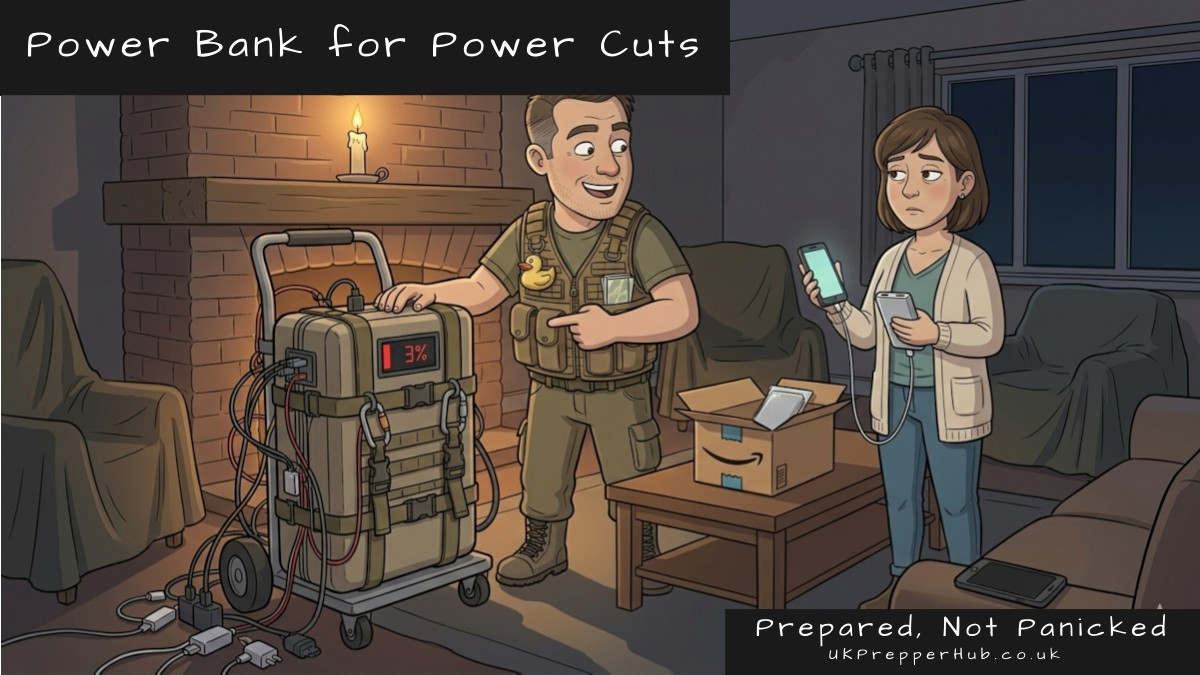
When your home experiences a power cut, your phone becomes your most important piece of kit. It’s how you get information, stay in contact with the rest of the household, and call for help if you need it. Adding a simple power bank for power cuts to your back up kit is not a complicated process — but most households either don’t own one, have one sitting in a drawer with 4% battery, or bought something that isn’t really fit for purpose. This guide covers what to look for, how much capacity you actually need, and — just as importantly — how to make sure it works when you need it.
If you’re also building out a grab bag or a get home kit, there’s a second set of considerations: size and weight matter as much as capacity when you might be carrying it for several hours. We cover both scenarios below.
Complete Guide
How to Prepare for a Power Cut
The 12 things to sort before the lights go out: lighting, heating, food, water and keeping phones charged, plus what to do in the first few minutes.
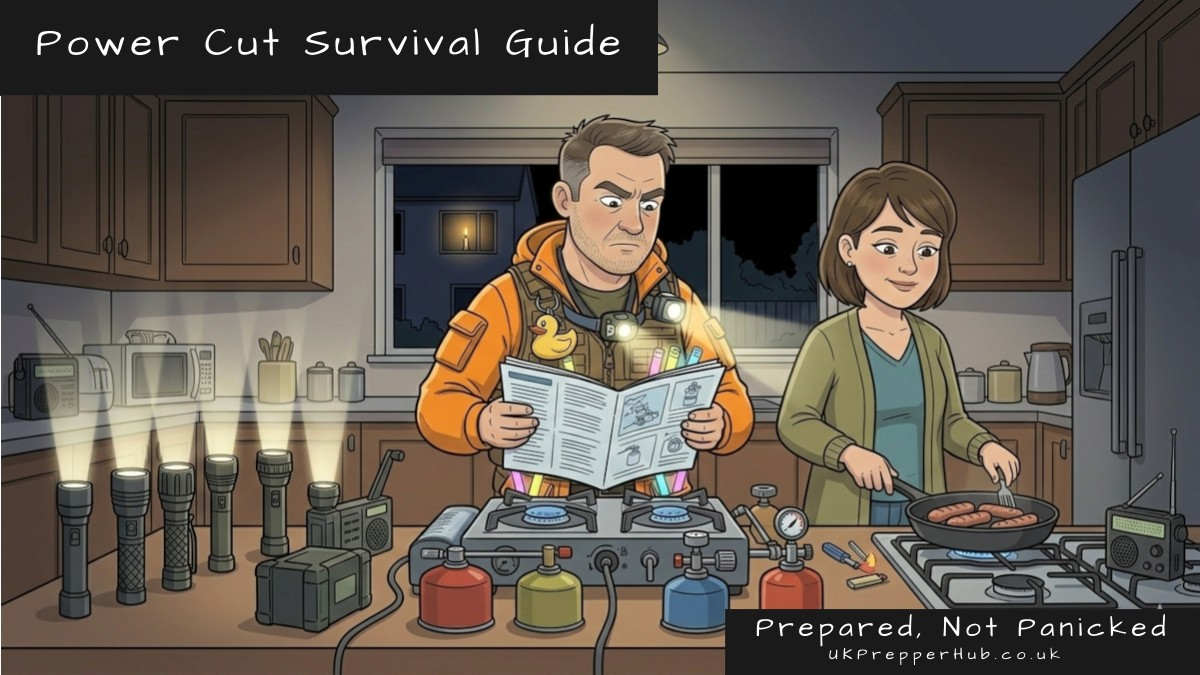
Two jobs it needs to do: home power cut vs. grab bag
Before you start looking at specs, be clear about what job your power bank needs to do — because the right answer for sitting at home during an outage and the right answer for a grab bag are not quite the same.
At home during a power cut: you’re stationary. The power bank lives on a shelf, in a drawer, or in your blackout box. Capacity is the main priority — you want enough charge to keep phones topped up for 24–48 hours without rationing. Size and weight are irrelevant.
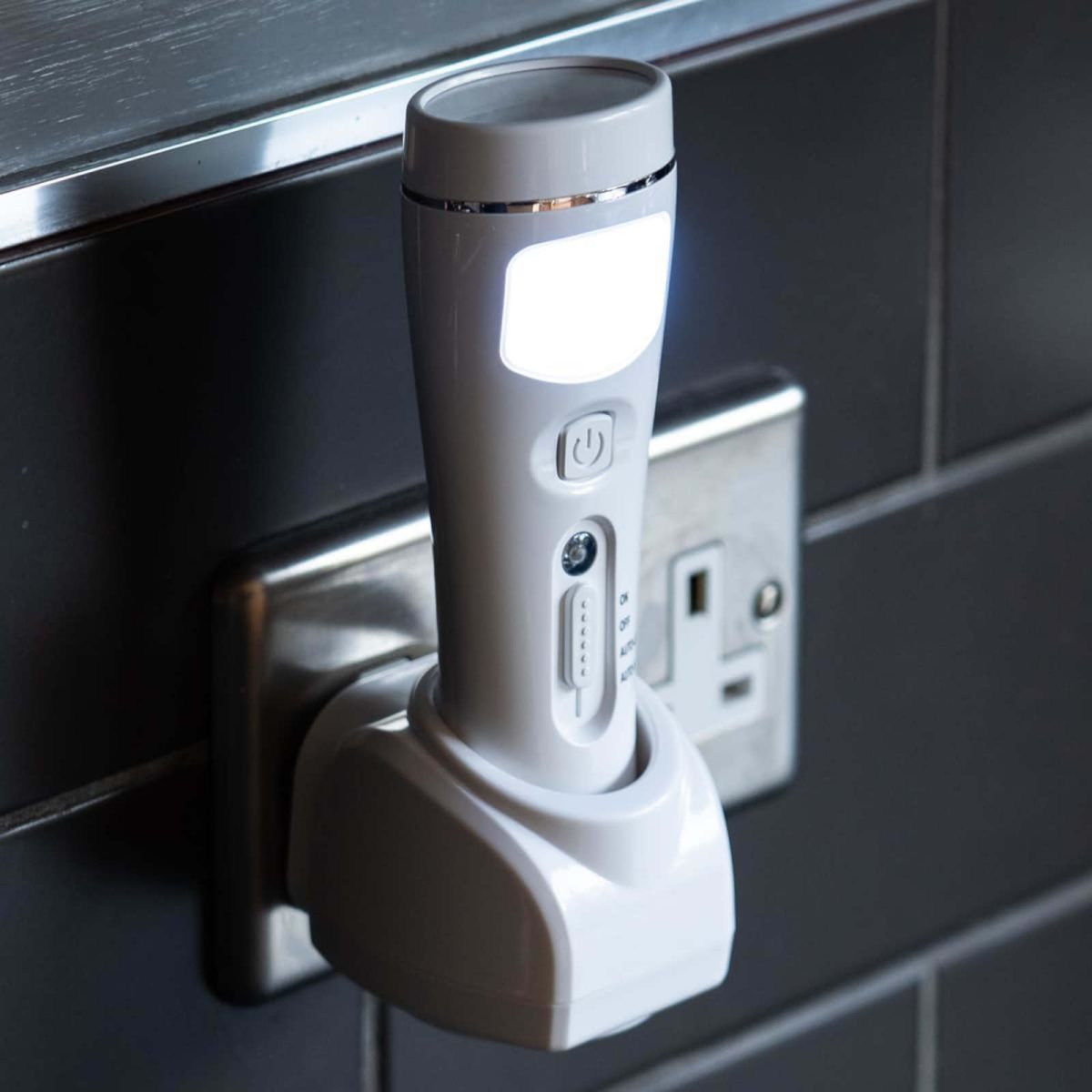
XtraLite NiteSafe
The NiteSafe is a dual-function device that works as both a plug-in nightlight and an emergency torch. It sits in a standard UK plug socket, charges continuously, and the moment mains power fails, it automatically illuminates.
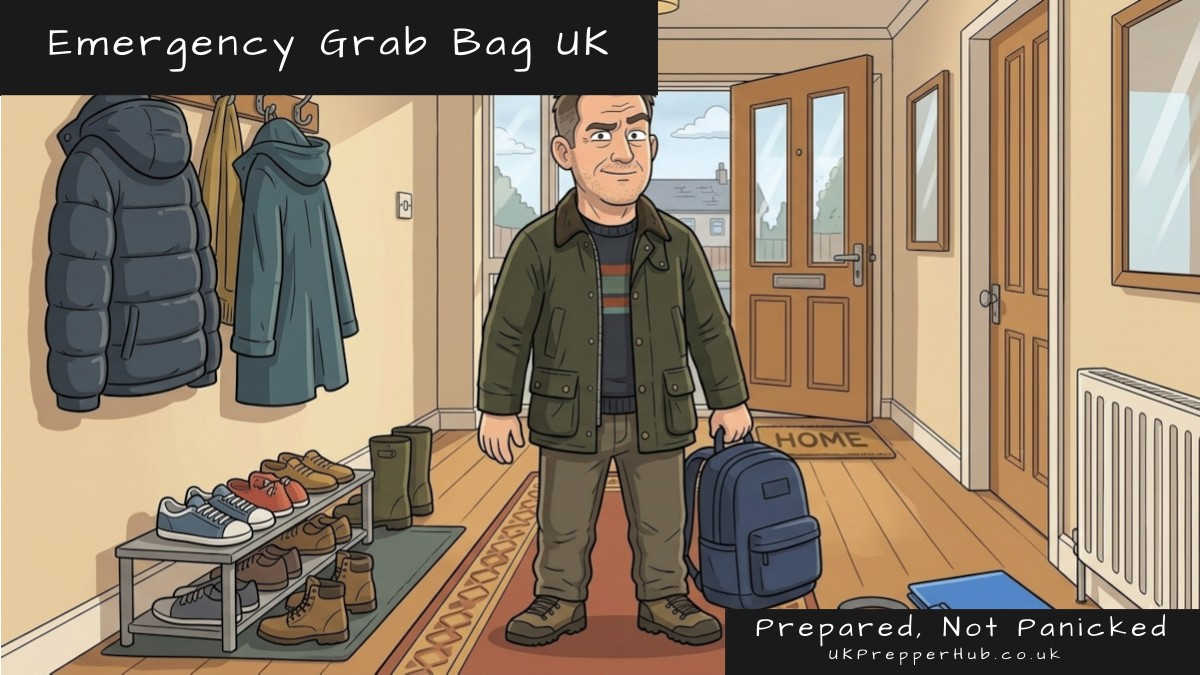
In a grab bag or get home kit: you’re carrying it. Weight suddenly matters. A 20,000mAh unit that sits happily on a shelf starts to feel significant when you’ve been walking for three hours in the rain. For a bag that might genuinely need to go on your back, a smaller, lighter unit is often the more sensible call — even if the capacity is lower.
Some households keep two: a larger one for home use and a smaller one packed in the bag. If budget allows, that’s the cleanest solution.
Complete Guide
72-Hour UK Grab Bag
The ‘get out quick bag’ for rapid home evacuation in the event of fire, flood, or other incidents. Every essential for 3 days away from home in one bag.
How much capacity do you actually need?
Power bank capacity is measured in milliampere-hours (mAh). A modern smartphone battery is typically 4,000–5,000mAh, but that’s not how much you draw from the power bank — conversion losses mean you lose roughly 20% in transfer. A 20,000mAh bank will deliver approximately 15,000–16,000mAh to your devices in practice.
In real terms:
- 10,000mAh power bank: roughly 2 full phone charges
- 20,000mAh power bank: roughly 4 full phone charges
- 26,800mAh power bank: roughly 5–6 full phone charges
For a household of two people relying on smartphones through a 24–48 hour outage, 20,000mAh is the minimum worth buying. If you have more people, a tablet, or a portable emergency radio to keep charged, step up from there.
One thing to set expectations on: most consumer power banks will not charge a laptop. Laptops require 60–100W, which standard power banks can’t deliver. If laptop power during an outage is a genuine requirement, that’s a different product category entirely — a portable power station, not a power bank.
Complete Guide
Rechargeable vs Alkaline Batteries
Rechargeable batteries seem like the sensible choice — until you can’t charge them. This guide makes the case for alkaline AA and AAA as the backbone of any emergency kit.
Read the Full Guide: Rechargeable vs Alkaline Batteries →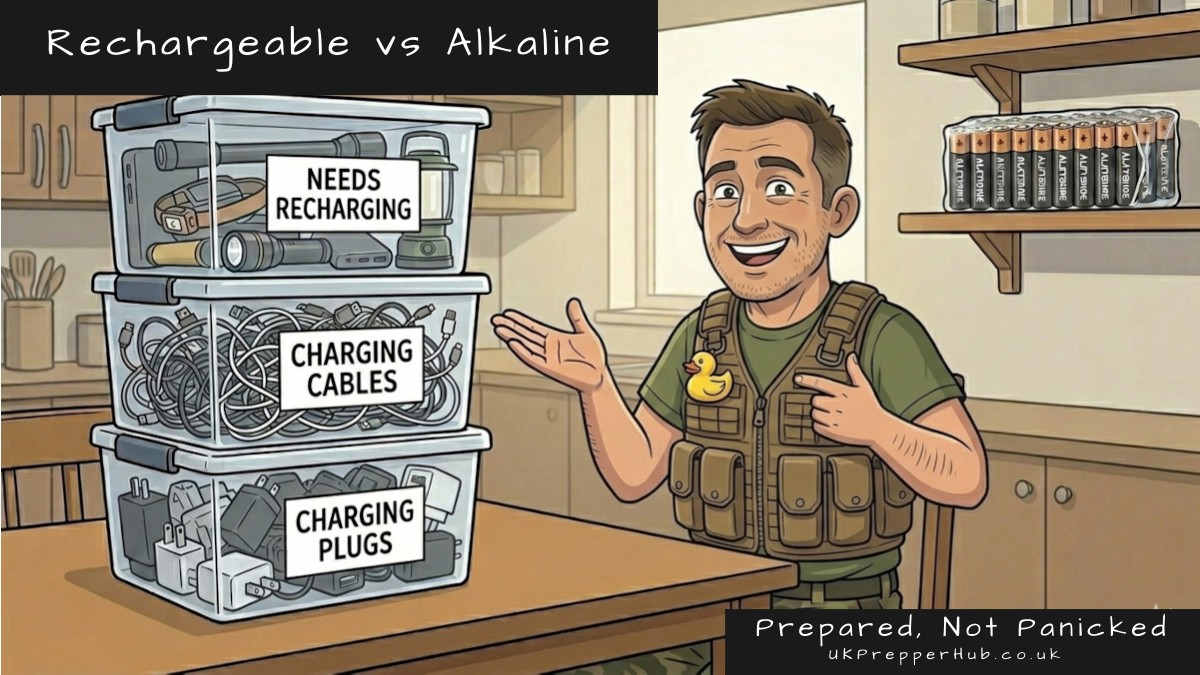

🤡 Camping Clown
He Has The £4,000 Version
I own a 50,000mAh power bank. It is approximately the size and weight of a house brick. I cannot explain why I bought it. The 20,000mAh one would have done everything I actually needed.
Size and weight — what actually fits in a grab bag?
If your power bank is going into a grab bag or a get home kit, check the physical dimensions before you buy. The capacity spec is on the front of the box; the dimensions are usually in small print on the back, and they matter.
- 10,000mAh models typically weigh around 200–250g — slim enough to slide into a jacket pocket
- 20,000mAh models run around 400–500g — heavier, but most sensibly designed units are still manageable in a bag
- Anything above 26,800mAh starts to resemble a small paperback book in both size and weight, and is better left at home
Flat, rectangular form factors pack better than chunky cylindrical ones. When you’re loading a bag quickly under pressure, you want things that sit flat and don’t create awkward voids. A slim 20,000mAh unit packs well; a fat cylinder of the same capacity doesn’t.
What to look for when choosing a power bank for power cuts
There is no shortage of power banks on the market, and some of them inflate their capacity figures considerably. Stick to brands with genuine third-party reviews and verifiable specs. Beyond that, here’s what to check before you buy:
USB-C input and output. Non-negotiable now. USB-C charges the bank faster from the mains, and USB-C output means the same cable that charges your phone charges your power bank too. If a unit only has Micro-USB input in 2026, put it back on the shelf.
Fast charging support. Look for at least 18W input, ideally 20W or higher. The faster it can draw from your mains charger, the less time you spend waiting to top it up before a storm or during a short window of restored power. Fast output (18W+) also matters — a slow trickle charge to your phone is frustrating when you need it quickly.
Multiple output ports. Two USB-A ports plus one USB-C output is a sensible minimum. During a power cut you want to charge a phone and something else — a head torch, a portable radio — at the same time without having to choose.
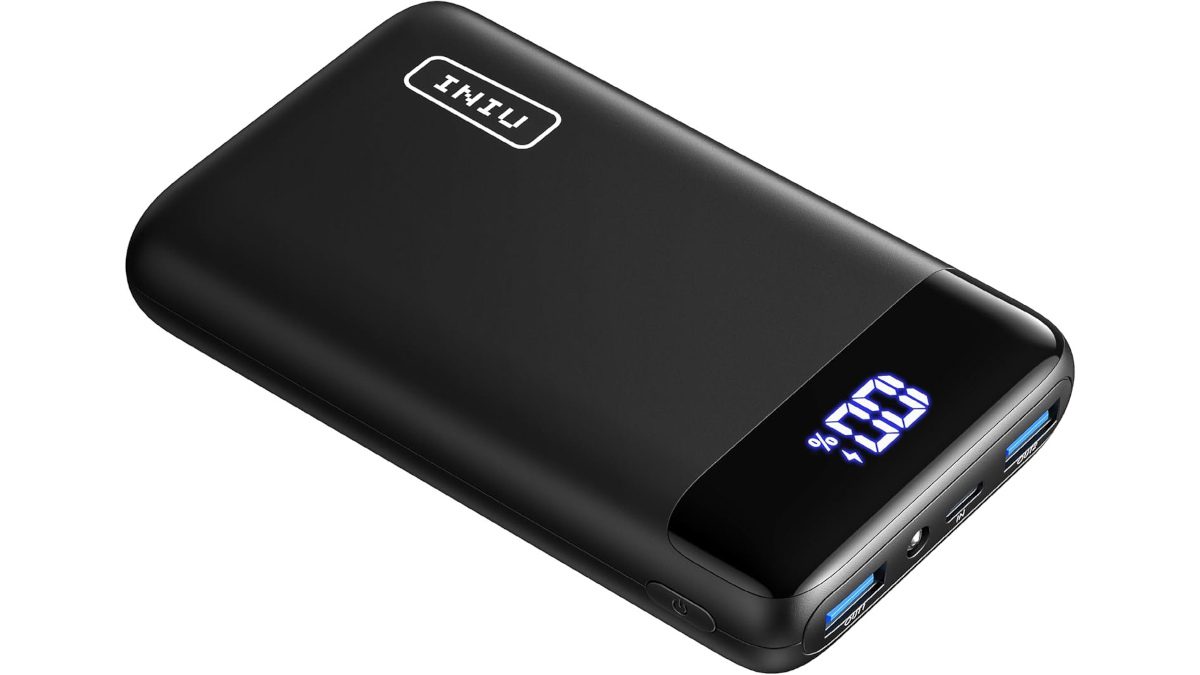
An LED charge indicator you can read without plugging anything in. This matters more than it sounds. If you can’t check the battery level without connecting a cable, you won’t check it regularly — and you’ll discover it’s flat when it’s already too late. A four-segment LED indicator is the minimum; a percentage display is better.
Reputable brand or verified reviews. A 30,000mAh power bank for £12 is not 30,000mAh. Lithium-ion cells cost money to manufacture. If the price looks too good, the stated capacity almost certainly isn’t real.
INIU 20,000mAh Power Bank
We tested it so you don’t have to — here’s the one thing most power banks get wrong, and why this one doesn’t.
Keep a cable with the power bank — and consider a magnetic multi-tip one
The most common reason people can’t use a power bank in a hurry is not a flat battery — it’s not being able to find the cable. Store a cable permanently with your power bank: coiled, cable-tied or in a small bag, always in the same place. Not in the drawer with the chargers, not on the desk with your phone — with the power bank, ready to go.
A USB-C to USB-C cable covers most modern devices. If your household has a mix of port types — newer USB-C phones alongside older Micro-USB devices or Apple Lightning kit — a magnetic multi-tip cable is worth considering. These use a small magnetic adapter that stays in the device port, and the cable itself clicks on magnetically. One cable works with every device regardless of port type. They’re cheap, they simplify your emergency kit, and they solve the “four devices, four different cables” problem in one go.
Kuulaa Magnetic Charging Cable
Pack of two cables (2m + 1m) – 6 magnetic tips (2 USB micro, 2x USB-C, 2x Lightening). Two cables, three connector types, every device in the house — snap on, charge anything, snap off.
Our Full Review: Kuulaa Magnetic Charging Cable →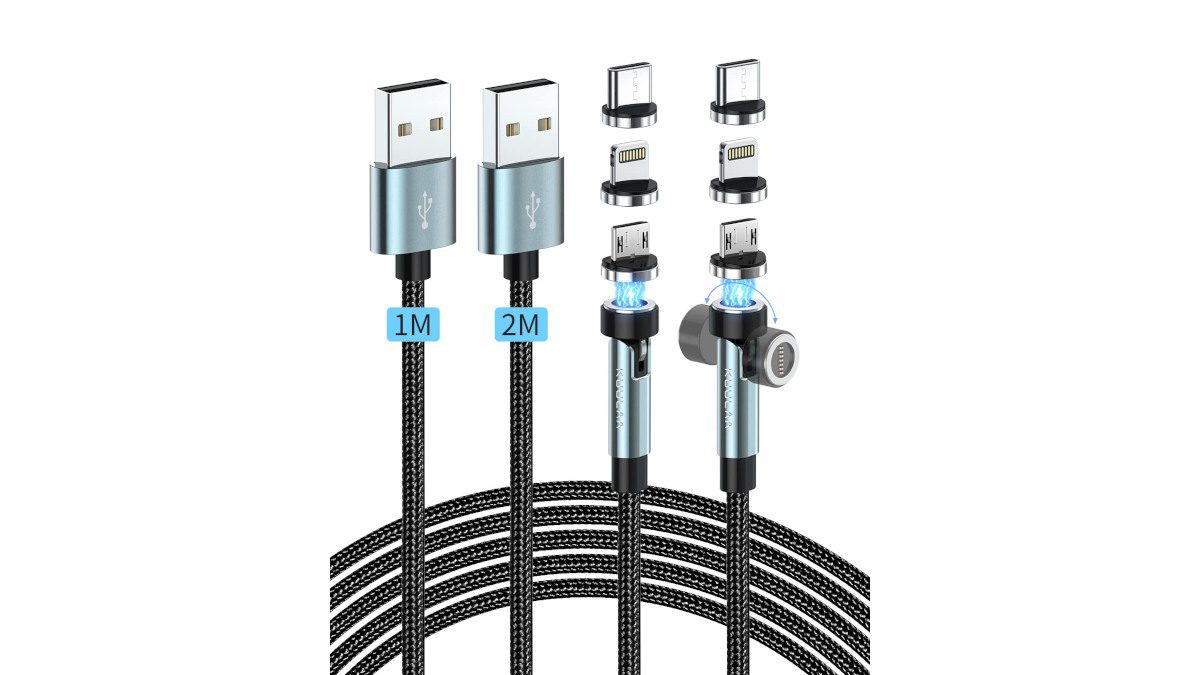
The one habit that makes a power bank useless
Not charging it.
Lithium-ion batteries self-discharge. A fully charged power bank left in a drawer for six months will have lost a meaningful chunk of its stored energy just from sitting there — no fault, no damage, just chemistry. After twelve months, you might have 60–70% left. After eighteen months, significantly less. After two years, it may have discharged below the protection threshold entirely and refuse to charge at all.
The fix is simple: check and top it up once a month. Set a calendar reminder if that helps. Keep it at around 80% rather than 100% for long-term storage — lithium-ion cells last longer when not held at full charge. Some better-quality power banks include an automatic discharge-to-50% mode for this exact reason, which is a useful feature to look for.
The best place to keep your power bank is in or next to your blackout box — somewhere you’ll encounter it regularly and be reminded to check it. Not somewhere you’ll forget it exists for eighteen months.

🦆 Keith
Don’t Be Keith
Keith bought the biggest power bank he could find — 30,000mAh, cost him £48, very pleased with himself. He plugged it in when it arrived, saw the LEDs light up, and put it in the utility room. A power cut hit fourteen months later. The indicator showed 3% battery. He maintains this was the manufacturer’s fault.
📋 Calm Clarissa
Monthly charging is on my printable power cut checklist, along with the power banks, cables and everything else for a power cut. Free to download, obviously.
Download the Free Checklist →Frequently Ask Questions
How many times will a 20,000mAh power bank charge my phone?
Roughly 3–4 full charges on a modern smartphone, accounting for around 20% energy conversion loss in transfer. A phone with a 5,000mAh battery will receive closer to 4,000mAh per cycle from the bank.
Can a power bank charge a laptop during a power cut?
Most standard power banks cannot — laptops require 60–100W, which consumer power banks don’t deliver. If you need laptop power during an outage, look at portable power stations rather than power banks.
Is 10,000mAh enough for a power cut?
It depends on how many people and devices you need to cover, and for how long. For one person with a single phone through a short outage, yes. For two people over 24–48 hours, 10,000mAh will be tight. 20,000mAh is a more comfortable baseline for a household.
How long will a power bank hold its charge in storage?
Lithium-ion cells self-discharge at roughly 2–3% per month under ideal conditions. After six months, a fully charged bank may have 85% remaining; after a year, around 70–75%. Cheaper or older cells discharge faster. Top it up once a month to keep it genuinely ready.
Should I keep my power bank plugged in all the time?
No. Holding lithium-ion cells at 100% charge continuously degrades them faster. Charge to 80–90%, unplug, and store. Top up monthly rather than leaving it permanently on charge.
What’s the best capacity for a grab bag?
For a grab bag you’ll actually carry, 10,000mAh is the sweet spot — roughly 2 full phone charges, but in a much lighter and more pocketable form factor. If you can tolerate the extra weight, a slim 20,000mAh unit gives you more headroom without being unreasonably heavy.
Build Your Resilience
Further Reading: Related Guides
- How to Prepare for a Power Cut
- 72-Hour Grab Bag
- Get Home Bag
- Emergency Lighting Guide
- Make a Blackout Box
- Rechargeable vs Alkaline Batteries
All our guides can be found listed on our resilience hub.
Gear We’ve Tested & Reviewed
All our reviews can be found on our reviews and resources page.