
This post contains affiliate links. Learn more
A paraffin heater or a paraffin lamp is only as good as the fuel in it, and the wrong bottle is an easy mistake to make. Walk into a garage or a DIY shop and you’ll find paraffin, kerosene, heating oil and lamp oil, often on the same shelf. The one you want for anything burning inside your home is C1 paraffin.
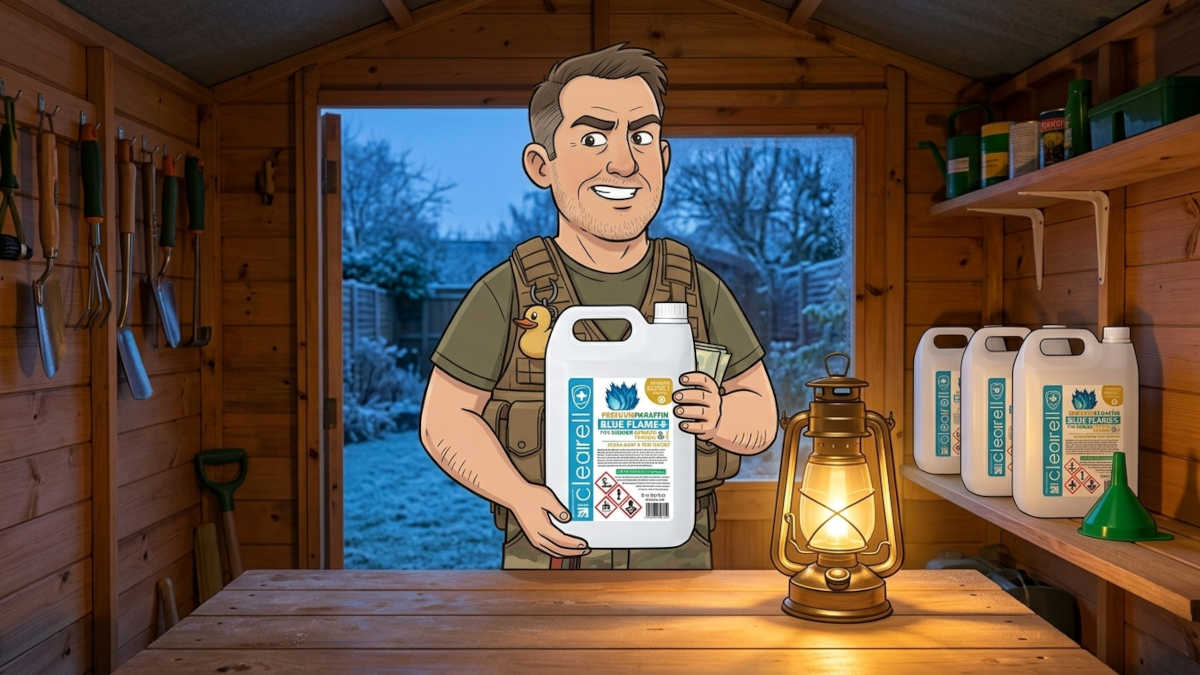
This C1 paraffin review explains what the grade means, how it differs from the C2 kerosene sold for oil boilers, and why we’ve picked Clearell Blue Flame: a 20 litre pack of C1 paraffin in four easy-pour 5 litre cans, made for indoor heaters and lanterns.

C1 Paraffin for Heaters and Lamps
The right paraffin for indoor heaters and lamps: Class 1 C1 paraffin, highly refined for minimal smell and smoke, in four easy-pour 5 litre cans.
Current Price at time of writing: £54.77
Rated: 4.7/5 ⭐ from 91 reviews
What Is C1 Paraffin?
UK heating fuels are made to a British Standard, BS 2869, which splits them into classes. Class C1 is the most refined grade of paraffin, low in sulphur and made to burn cleanly in appliances that have no flue, where the fumes go straight into the room. That’s every portable paraffin heater and every paraffin lamp.
You’ll see C1 paraffin sold as premium paraffin, Class 1 paraffin or indoor paraffin. They all mean the same thing. If the bottle says C1 or Class 1 and BS 2869, it’s the right fuel.
Kerosene – Paraffin: Same Fuel, Different Name
Kerosene paraffin is how a lot of fuel and heaters are listed online, and it causes no end of confusion. Kerosene is the name most of the world uses. Paraffin is what we’ve always called it in the UK. The heater you buy may be sold as a kerosene heater and the lamp as a kerosene lamp, but in Britain both run on paraffin.
The catch is that kerosene is also sold in a second grade, and that’s where people go wrong.
C1 vs C2: The Mistake to Avoid
Class C2 is also called kerosene, and in the UK it’s usually sold as heating oil or 28 second burning oil. It’s the fuel delivered by tanker to homes with an oil-fired boiler. C2 is made for appliances with a flue that carries the fumes outside, so it’s not the right fuel for a heater or lamp burning in the room you’re sitting in.
The two can look identical in a clear container, and some C2 is sold in the same 4 and 5 litre cans as C1 paraffin. Always check the label for C1 or Class 1 before you buy paraffin for heaters or lamps you’ll use indoors. If it says C2, Class 2 or heating oil, leave it on the shelf.
Why We Picked Clearell Blue Flame C1 Paraffin
Clearell Blue Flame is a premium Class 1 indoor paraffin, made to BS 2869 C1. It’s highly refined to burn with minimal odour and smoke, and with less soot and residue, which matters when the heater or lamp is in your living room rather than a greenhouse.
It comes as four 5 litre cans rather than one heavy 20 litre drum, so each one is light enough to lift and pour without spilling, and easy to tuck into a shed or garage. It has a long shelf life and resists evaporation, so you can buy it in autumn and it’ll be ready whenever the power goes. Clearell makes it for heating and lighting, which covers both of the jobs this C1 paraffin is likely to do in a power cut.
Paraffin for Heaters
A portable wick heater is the main reason most households buy paraffin fuel. It needs no electricity or batteries, gives proper heat to one room, and carries on whatever the grid is doing. In the paraffin heater we reviewed, a standard 5 litre can of C1 paraffin gives around 15 hours of heat, so this 20 litre pack is roughly 60 hours of warmth.
Paraffin Heater
No plug, no batteries: a 6 litre paraffin heater that warms a room and boils a kettle, with around 15 hours of heat from a 5 litre bottle.
Our Full Review: Paraffin Heater →
Paraffin Lamp Oil: Using It for Light
C1 paraffin is also the traditional fuel for paraffin lamps: hurricane lanterns, storm lamps and the classic glass-chimney table lamps. Clearell makes Blue Flame for lanterns as well as heaters, so one supply covers both heat and light in a power cut.
Paraffin lamp oil is sometimes sold separately in small, pricey bottles. For a lamp designed for paraffin, C1 paraffin does the same job and usually costs far less per litre. The one exception is a decorative oil lamp made for a specific lamp oil, so always follow the lamp maker’s instructions on fuel.
C1 Paraffin for Heaters and Lamps
The right paraffin for indoor heaters and lamps: Class 1 C1 paraffin, highly refined for minimal smell and smoke, in four easy-pour 5 litre cans.
Current Price at time of writing: £54.77
Rated: 4.7/5 ⭐ from 91 reviews
Using and Storing Paraffin Safely
Fit a carbon monoxide alarm. Any heater or lamp burning paraffin indoors needs a working CO alarm in the same room. Carbon monoxide has no smell or colour, so an alarm is the only warning you’ll get.
FireAngel Combination Smoke and Carbon Monoxide Alarm
One sealed unit covering smoke and CO detection — with a 10-year battery that keeps it running during a power cut, when emergency stoves and heaters are out and a mains-wired alarm would already have gone dark.
Our Full Review: FireAngel Combination Smoke and Carbon Monoxide Alarm →
Keep a window open a crack while anything is burning, to let fresh air in and water vapour out.
Fill up when the appliance is off and cool, outside if you can, using a funnel or a hand pump, and wipe up any spills before lighting.
Store it sealed, in its own cans, in a cool, dry place such as a shed or garage, away from heat and out of reach of children. Never decant paraffin fuel into drinks bottles.
C1 Paraffin for Heaters and Lamps
The right paraffin for indoor heaters and lamps: Class 1 C1 paraffin, highly refined for minimal smell and smoke, in four easy-pour 5 litre cans.
Current Price at time of writing: £54.77
Rated: 4.7/5 ⭐ from 91 reviews
What the Rest of the Team Think

🦆 Keith the Prepper
I bought 200 litres of the other stuff because it was cheaper. Turns out it was C2 and it’s for the boiler, which we haven’t got. My wife says the drums make the garage smell like a petrol station. I’ve now got C1 paraffin for the heater, and 200 litres of character-building in the garage.
⭐⭐⭐⭐⭐

🪖 Black Panther
In my previous role, fuel discipline was everything. Right fuel, right container, right place. C1 paraffin. Four cans. Shed, not the kitchen. Label checked twice. Carry on.
⭐⭐⭐⭐⭐

🤡 Camping Clown
I’ve been buying my lamp oil in little 500ml bottles with a picture of a lighthouse on them. It’s paraffin. I’ve been paying about ten times the price for a lighthouse. I’m not sure why, if I’m honest.
⭐⭐⭐⭐

🐾 Weekend Warrior
Fuel cache is locked down in the shed, bro, four cans, rotation logged. Pickle is not cleared for the fuel store. She tried to inspect a can and got a nose full of paraffin, so she’s now on perimeter duty only.
⭐⭐⭐⭐

🐕 Pickle
Snorgle! Sn… snorgle.
⭐⭐ (Smells bad. Not food. Lamp is nice though.)

🐔 Chicken Licken
Did you know the paraffin sold as heating oil isn’t meant for indoor heaters at all? It’s C2, for boilers with a flue. I’ve been saying this for years. People grab the cheapest can on the shelf, then wonder why the room stinks. Check for C1.
⭐⭐⭐⭐⭐

📋 Calm Clarissa
I’ve prepared a checklist for this. Obviously. C1, BS 2869, Class 1. Four 5 litre cans, dated on arrival, used oldest first. Funnel stored with the cans, not in the kitchen drawer. Janet labelled ours with the delivery date before I’d even asked, which is why we’re still together.
✅✅✅✅✅

💄 Survivl Gurl
Hurricane lamp plus blue flame is such a vibe for a cosy power cut reel. Minimal smell, so the candles still win on scent, but this one actually lights the room. The cans are not giving aesthetic though, babes. Hide them in the shed.
⭐⭐⭐

🌿 Aroura
Our grandparents lit their homes with paraffin lamps and kept a can by the back door. There is wisdom in a flame you can tend yourself. Keep it clean, keep it safe, and let the light be gentle. Namaste 🙏
⭐⭐⭐⭐
Pros and Cons
Pros
- C1 paraffin to BS 2869, the right grade for indoor heaters and lamps
- Highly refined for minimal odour, smoke and soot
- Four 5 litre cans are easier to lift, pour and store than one 20 litre drum
- Long shelf life and resists evaporation, so it can sit ready until winter
- Made for both heating and lighting, so one supply covers both
Cons
- It’s a fuel, so it needs storing safely in a shed or garage
- You’ll need a funnel or hand pump to fill a heater or lamp cleanly
- Any indoor use needs a CO alarm and a little ventilation
- A 20 litre pack is a fair amount to buy if you only have one small lamp
Frequently Asked Questions
What is C1 paraffin?
C1 paraffin is the Class 1 grade of paraffin under the British Standard BS 2869. It’s the most refined, low-sulphur grade, made to burn cleanly in heaters and lamps that have no flue.
Is kerosene the same as paraffin?
Yes. Kerosene is the name used in most other countries, and paraffin is the UK name. The thing to check is the grade: C1 for indoor heaters and lamps, not C2.
Can I use C2 kerosene in a paraffin heater?
No. C2 is heating oil for boilers and appliances with a flue. For a portable heater or lamp burning in the room, use C1 paraffin.
Can I use C1 paraffin in an oil lamp?
Yes, in lamps made for paraffin, such as hurricane lanterns and storm lamps. Clearell Blue Flame is made for lanterns as well as heaters. If a decorative lamp asks for a specific lamp oil, follow the lamp maker’s instructions.
How long does paraffin fuel keep?
C1 paraffin has a long shelf life and resists evaporation. Keep it sealed in its own cans in a cool, dry place and it’ll be ready when you need it.
Where should I store paraffin at home?
In its original sealed cans, in a shed or garage, away from heat and out of reach of children. Never decant it into drinks bottles.
How much paraffin does a heater use?
It depends on the heater. Our paraffin heater runs for around 15 hours on a 5 litre can, so a 20 litre pack gives roughly 60 hours of heat.
Build Your Resilience
Further Reading: Related Guides
- Heating Without Electricity
- Fuel Storage at Home
- Emergency Lighting Guide
- How to Prepare for a Power Cut
All our guides can be found listed on our resilience hub.
📡 Find Us Everywhere
Daily briefings, prep guides, and real-time updates across every platform. Pick yours.
Free. No commitment. Stay anonymous on WhatsApp & Telegram.
Stay Informed on UK Preparedness
Join our newsletter for UK-specific preparedness tips, product recommendations, and real-world advice for households.
Subscribe to Our Newsletter