

Something goes wrong at home. It’s always at the worst possible time — a Sunday evening, a bank holiday, 11pm on a Tuesday. A screw needs tightening, a pipe is weeping, something has come off the wall. The job itself is five minutes. Finding the tools takes an hour, and half of what you need isn’t there.
This guide isn’t about building a tradesman’s toolkit. It’s about having the right basics in one place so that when something goes wrong, you can deal with it. Most household emergencies don’t need a professional — they need a hammer and someone who knows where it is.
The Basics Of An Emergency Home Tool Kit
Every home should have these. No exceptions, no caveats. If you don’t own these already, start here.
- Claw hammer — you hit things with it. You also pull nails out with the other end. Get a decent weight — 16oz is the standard all-rounder.
- Screwdrivers — at minimum, one flat-head and one cross-head (Phillips), in medium size. A set with multiple sizes covers everything.
- Pliers — gripping, bending, pulling. A medium pair of combination pliers handles most jobs.
- Adjustable spanner — for nuts and bolts of any size. One good adjustable is worth a set of fixed spanners for general household use.
- Tape measure — 5 metres covers almost everything. Buy one with a wide, stiff blade that holds its shape when extended.
- Utility knife — Stanley knife or box cutter. More useful than scissors for most household jobs.
- Spirit level — short one, 30–40cm. Shelves, pictures, anything that needs to be straight.
- Pencil — mark before you drill, cut, or fix. A carpenter’s pencil or a standard HB. Permanently useful, weighs nothing, always missing.
The Less Obvious Essentials
These are the items that experienced home-owners reach for constantly and that most households don’t have until they need them urgently.
Duct tape
The closest thing to a universal household fix. Strong, waterproof, tears by hand, bonds to almost anything. It won’t fix everything permanently — but it will hold something together long enough to sort it properly, which is usually all you need at 11pm on a Tuesday. Buy a decent branded roll, not the cheap stuff that loses adhesion after a week.
Self-amalgamating tape
Different from duct tape and worth understanding. Self-amalgamating tape contains no adhesive — it bonds to itself when stretched and wrapped, creating a waterproof, airtight seal. It’s the right tool for leaking pipes, split hoses, cable joints, and anything where you need a proper waterproof repair rather than a sticky patch.
It works on wet surfaces, doesn’t peel off, and lasts years rather than days. If you have duct tape but not self-amalgamating tape, you have the wrong tool for pipe repairs.
Self Amalgamating Tape
A roll of black silicone tape that fuses to itself into solid rubber: stop a leaking pipe tonight, waterproof a cable gland tomorrow.
Our Full Review: Self Amalgamating Tape →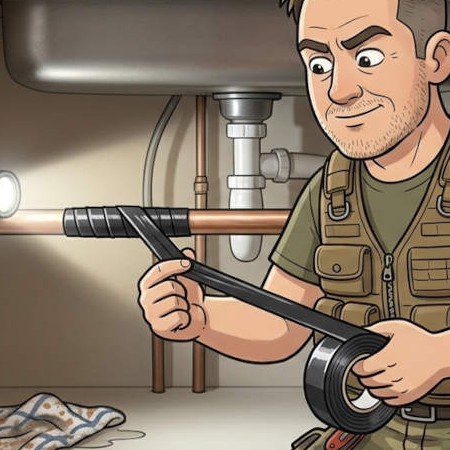
PTFE tape
The white thread tape used on threaded pipe joints and fittings. If you’ve ever had a slow drip from a shower head fitting, a garden tap thread, or any threaded plumbing connection — PTFE tape is the fix. Wrap a few layers around the thread before reassembling and the drip stops. Costs about £1 a roll and lasts for years. Every home should have one roll in the toolkit.
Cable ties
Endlessly useful and absurdly cheap. Securing cables, bundling garden hoses, temporary repairs, keeping things together in transit. Buy a mixed pack with several sizes and you’ll reach for them constantly. The ones you don’t use weigh nothing and take up no space.
WD-40 or penetrating oil
For stuck screws, seized bolts, stiff hinges, and anything that’s rusted or corroded. WD-40 is the household standard — it also displaces water and protects metal surfaces from rust. A single can lasts years. Apply, wait a few minutes, try again. It works on the vast majority of stuck fixings without any additional force.
Electrical tape
Not the same as duct tape — electrical tape is specifically rated for insulating electrical connections. If you ever need to repair or insulate a cable join, electrical tape is the correct tool. Duct tape is not rated for electrical use and should never be used as a substitute.
All-in-One Kits — A Starting Point, Not an End Point
If your home currently has no toolkit at all, an all-in-one starter kit is a reasonable way to cover the basics in one purchase. For households that have nothing, something is always better than nothing.
But there’s a problem with most of them: the case.
The majority of budget all-in-one kits come in a moulded plastic case with fixed, shaped slots for each tool. It holds exactly what came in it. You can’t add the PTFE tape. There’s no room for the self-amalgamating tape, the duct tape, the cable ties, the WD-40, or the pencil. The day you buy something extra — or want to upgrade one tool — the case becomes a problem.
Buy an all-in-one kit if you need to get started today. But treat the tools as keepers and the case as temporary.
The Cantilever Toolbox — Build It Your Way
A cantilever toolbox — the classic hinged design that opens out into multiple trays — solves every problem the moulded plastic case creates. It holds whatever you put in it. When you buy a new tool, it goes in the box. When you add PTFE tape and a spare set of fuses, they go in the box. The box grows with you.
This is the better long-term approach: start with the basics, house them properly, add to the kit one item at a time. Better quality tools bought individually last far longer than the cheapest option in a budget all-in-one set — and when something wears out, you replace just that item.
A decent steel cantilever toolbox costs £20–40 and will outlast several generations of cheap plastic cases. It’s the one purchase that organises everything else.
Hi-Spec 24-Piece Tool Kit Review
Equip yourself with the essential tool kit set designed for first homes, new apartments, and dorm rooms; tackle everyday tasks and complete simple repairs, emergency fixes, basic maintenance, and weekend chores with ease.
Our Full Review: Hi-Spec 24-Piece Tool Kit Review →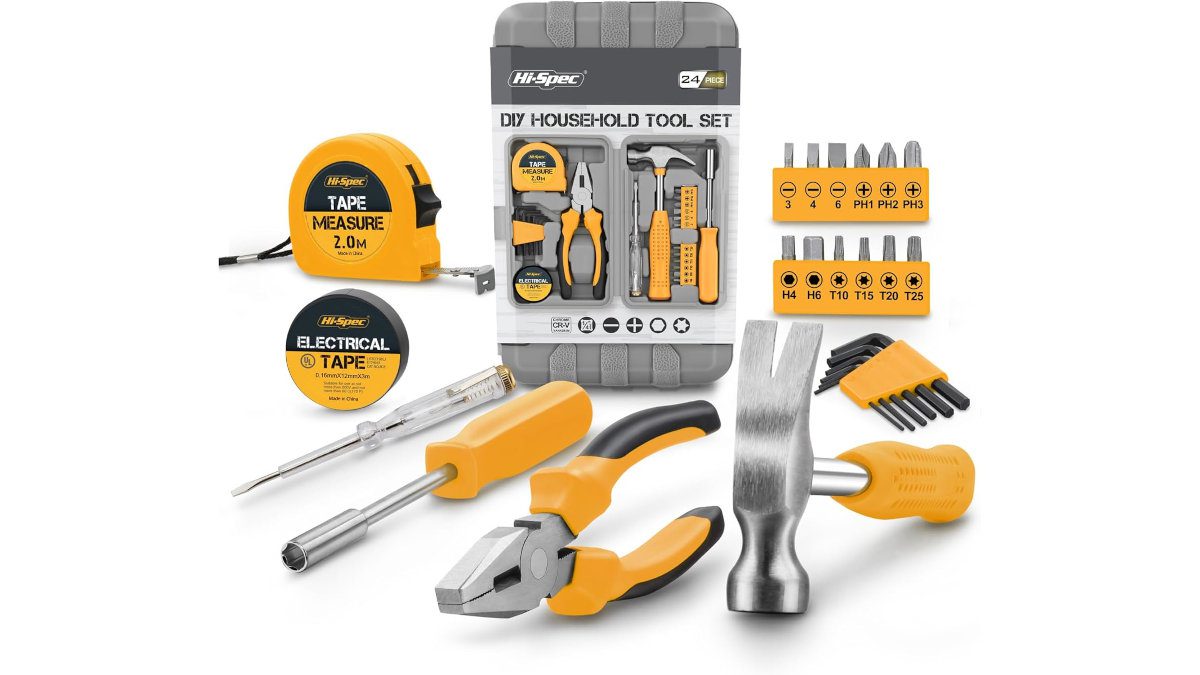
What else belongs in the box
Once you have the basics covered, these are worth adding over time:
- Spare fuses (3A and 13A) — for plug fuses, which still blow occasionally
- Wall fixings and picture hooks — a mixed pack covers most hanging jobs
- Rawlplugs in several sizes — for drilling into masonry
- A small flat pry bar — for opening paint tins, lifting floorboards, separating stuck things
- Superglue — for small repairs that don’t need tape
- A permanent marker — for labelling anything that needs labelling
One Box, One Place, Everyone Knows Where It Is
The most important thing about a home toolkit isn’t what’s in it — it’s knowing where it is. A hammer in the garage, a screwdriver in the kitchen drawer, PTFE tape somewhere in the bathroom cupboard, and duct tape that nobody can find is not a toolkit. It’s a scavenger hunt.

🦆 Keith
Don’t Be Keith
Keith has 200 items in a tackle box he can’t find, three sets of screwdrivers handles with no matching screwdriver bits, and no adjustable spanner when the stopcock needs turning.
One box. One location. Ideally somewhere everyone in the household knows and can access without asking. Under the stairs, in a utility room, at the back of a kitchen cupboard. It doesn’t matter where — it matters that everyone knows.
This is also why the cantilever toolbox matters beyond just holding more stuff: it’s a single, obvious, portable object. You pick it up and carry it to wherever the problem is. Nothing gets left behind.
Frequently Asked Questions
How much should I spend on a basic home toolkit?
For decent quality individual tools — hammer, screwdrivers, pliers, spanner, tape measure, utility knife — budget £50–80 buying separately. A cantilever toolbox adds another £20–40. Spread over several purchases it’s very manageable, and quality tools bought once last decades.
Is an all-in-one kit worth buying?
As a starting point if you genuinely have nothing, yes. Look for one where the individual tools are a reasonable weight and feel solid — avoid anything with hollow-feeling handles or very light tools. Treat the case as temporary and plan to transfer to a proper toolbox.
What’s the difference between self-amalgamating tape and duct tape?
What’s the difference between self-amalgamating tape and duct tape?
Duct tape uses adhesive and sticks to surfaces. Self-amalgamating tape uses no adhesive — it bonds to itself when wrapped, creating a waterproof seal. For pipe repairs and anything that needs to be genuinely waterproof, self-amalgamating tape is the correct tool. Duct tape is better for general repairs where waterproofing isn’t critical.
What is PTFE tape used for?
Threaded plumbing joints and fittings — shower heads, tap connections, garden hose fittings, any threaded pipe connection that drips. Wrap several layers around the thread before reassembling. It’s not for general repairs — it’s specifically for threaded connections.
Do I need a power drill?
For a basic emergency toolkit, no. A hand screwdriver handles most household fixings. A drill becomes useful when you’re regularly putting up shelves or hanging things — but it’s a step beyond the minimum kit covered here, and a reasonable quality drill is worth buying properly rather than including in a starter kit.
What tools are most often missing from UK homes?
Self-amalgamating tape, PTFE tape, and a spirit level come up most often. Most homes have a hammer and a screwdriver somewhere. Very few have PTFE tape until the day they need it.
Build Your Resilience
Further Reading: Related Guides
All our guides can be found listed on our resilience hub.
Gear We’ve Tested & Reviewed
All our reviews can be found on our reviews and resources page.