
This post contains affiliate links. Learn more
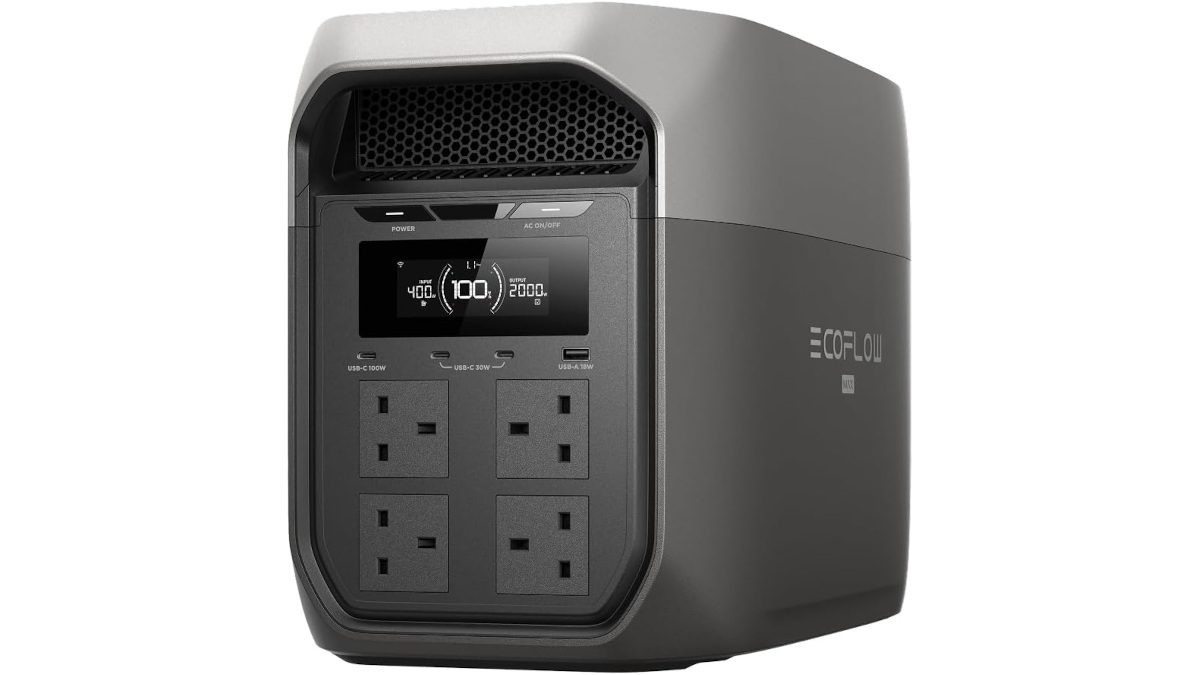
Most power stations sold for home backup will handle your essentials — phone charging, a lamp, keeping the router alive. The EcoFlow Delta 3 Max is not trying to solve that problem. It’s trying to solve the next one: what happens when the outage runs past six hours, or when you need the fridge, freezer, and something with a heating element all running at once.
At 2,048Wh — double the capacity of the standard 1kWh class — the Delta 3 Max is positioned as the step up for households where “it’ll probably be fine” isn’t good enough. The 51-minute charge to 80% means you can refill it before the evening gets difficult. At £999, with a £200 voucher currently available on Amazon, it’s a serious purchase. Here’s an honest look at whether it earns the price.
EcoFlow Delta 3 Max
The 2kWh EcoFlow Delta 3 Max charges to 80% in 51 minutes, runs every UK appliance via its 3,200W X-Boost, and switches to battery in under 10ms — the step up for households where 1kWh was never quite enough.
Current Price at time of writing: £999
Rated: 4.2/5 ⭐ from 15 reviews
The EcoFlow Delta 3 Max — What You’re Getting
The Delta 3 Max holds 2,048Wh in a LiFePO₄ battery pack — lithium iron phosphate chemistry, which runs cooler, lasts longer, and is more stable under heavy discharge than the lithium-ion cells in cheaper units. EcoFlow states it’s built for 10 years of daily use, which is the closest thing to a meaningful lifespan claim in a market full of vague promises.
Standard AC output is 2,400W, already enough for the majority of UK household appliances. X-Boost — EcoFlow’s smart power management layer — extends the effective ceiling to 3,200W, intelligently throttling high-draw appliances so they run within the unit’s capacity rather than tripping the overload protection. Nine outlets handle everything simultaneously: AC sockets, USB-A, USB-C, and a 12V car port across the output panel.
Weight is 20.3kg. That’s substantially heavier than 1kWh stations — roughly 8kg more than the EcoFlow Delta 2 — and it’s worth being realistic about from the start: this unit will likely pick a spot and stay there. The carry handles are still there, but solo shifting between floors isn’t comfortable. Decide where it’s living before it arrives.
Charging — Where the Delta 3 Max Actually Surprises
The headline spec is 0–80% in 51 minutes via EcoFlow’s X-Stream fast charging. For a 2kWh unit, this is genuinely unusual. Most stations in this capacity class take two to three hours to reach full charge — useful if you have time to plan, far less useful if you’re filling it up during a scheduled maintenance window or a break in a storm.
The practical implication: if you keep a petrol generator for emergencies, you can run it for under an hour, charge the Delta 3 Max to a usable level, then turn it off. The difference between “generator running for an hour” and “generator running for three hours” is significant in noise, fuel cost, and the patience of everyone in the house.
The unit accepts solar panel input as well, allowing daytime top-up when grid power isn’t available — the useful option during extended disruptions where running a generator isn’t practical or desirable. The EcoFlow app gives real-time monitoring of charge state, input rate, and draw, and handles charge and discharge scheduling without any technical knowledge required.
The 3,200W X-Boost — What It Actually Does
The most common complaint about home backup power stations is that they don’t run the kettle. Technically they do — but if the standard inverter rating falls below the 2,500–3,000W a UK kettle can pull, the unit shuts itself down to protect its internals.
X-Boost sidesteps this by intelligently managing power delivery to the appliance. It doesn’t generate extra capacity — what it does is throttle the appliance’s draw to stay within the station’s limits, so the kettle takes marginally longer to boil but stays running. At a 3,200W ceiling, the Delta 3 Max’s X-Boost covers kettles, hair dryers, most microwaves, and smaller electric hobs. If you’ve previously owned a power station that tripped on a kettle, this is the spec that changes the day-to-day experience.
UPS Mode — The Feature Most People Overlook Until They Need It
The Delta 3 Max switches to battery power in under 10 milliseconds when mains fails. To put that in terms that matter: a computer requires a switchover time below roughly 20ms to avoid crashing or losing data. Standard UPS devices typically manage 20–30ms. The Delta 3 Max’s sub-10ms means computers, NAS servers, routers, and most medical equipment — including CPAP machines — will not register the transition from mains to battery.
This matters most in scenarios where the power cut is brief or intermittent — the kind where the lights flicker, the router reboots, and you lose whatever was open on screen. With the Delta 3 Max in UPS mode, those interruptions become invisible to anything plugged into it. For households with medical equipment, home office setups, or freezers with temperature-sensitive contents, this is a meaningful differentiator from standard battery alternatives.
How Long Will It Actually Last?
Runtime depends entirely on what you’re running, but the 2,048Wh capacity gives the Delta 3 Max roughly double the runtime of a 1kWh station at equivalent loads.
A modern frost-free fridge draws around 40–60W on average. At that load alone, the Delta 3 Max will run for 30 hours or more — long enough to cover most UK power outages with capacity to spare. Add a freezer (similar draw) and you’re looking at 15–20 hours of combined runtime. Add a TV, phone charging, and a router, and you’re still comfortably in the 10–15 hour range.
High-draw appliances — kettle, microwave, hair dryer — deplete capacity faster while actively running, but via X-Boost they will run, and brief repeated use from a 2kWh bank costs a fraction of total capacity each time. The key difference between 1kWh and 2kWh isn’t running time alone — it’s the headroom to stop monitoring the percentage constantly.
The 5-Year Warranty — and Why It’s Worth Noting
EcoFlow includes a 5-year extended warranty with the Delta 3 Max as standard. Most competitors in this space offer 2–3 years. For a product you’re buying specifically because you need it to work when everything else has failed, warranty coverage isn’t a detail — it’s part of what justifies the outlay. Activate it immediately via the EcoFlow app or website once the unit arrives; registration takes a few minutes and the documentation matters if you ever need to use it.
The Honest Bit
The Delta 3 Max has 15 Amazon UK reviews at the time of writing. That’s a thin sample. The 4.2-star rating is solid but there isn’t the long-term user data available that you’d have for a product with hundreds of reviews. LiFePO₄ chemistry has a strong track record across the wider market, and EcoFlow’s Delta range has accumulated significant feedback — but the specific Delta 3 Max is new enough that the anecdotal evidence is limited.
Twenty kilograms is genuinely heavy. Not impossible, not dangerous — but not something you’ll casually pick up and carry between floors. If you’re imagining moving it around the house depending on the situation, recalibrate that plan now.
At £999 before the voucher, this is a considered purchase. The £200 Amazon voucher brings the effective price to £799, which makes the value case considerably stronger — but vouchers expire and availability changes, so confirm what you’re actually paying before ordering.
EcoFlow Delta 3 Max
The 2kWh EcoFlow Delta 3 Max charges to 80% in 51 minutes, runs every UK appliance via its 3,200W X-Boost, and switches to battery in under 10ms — the step up for households where 1kWh was never quite enough.
Current Price at time of writing: £999
Rated: 4.2/5 ⭐ from 15 reviews
What the Rest of the Team Think

🦆 Keith the Prepper
I’m not someone who throws money at gadgets. But I did sit down with a spreadsheet and worked out how long this would run the fridge, freezer, and boiler controller simultaneously. The maths made a lot more sense than I expected. The 51-minute charge means I can run the petrol generator for under an hour and have useful capacity again — not continuous hours of noise and fuel. It’s quieter than I thought it would be, too. That matters when it’s living in the utility room.
★★★★★

🪖 Black Panther
Most people buying “backup power” are buying peace of mind. The sub-10ms UPS transfer is what separates a power station from a proper backup system — your CPAP, NAS, and medical equipment won’t even register the switchover. The 5-year warranty is longer than most competitors will commit to on a product like this. Those two specs together make the Delta 3 Max the one I’d actually deploy in a serious household preparedness scenario.
★★★★★

🤡 Camping Clown
I’ve already got a 300W station in the garage and a 1kWh unit in the utility room. This one appeared on the doorstep last Tuesday. My reasoning was airtight — the 3,200W X-Boost is genuinely different from what I had before. My wife pointed out that I now own more backup power than the National Grid. She is not wrong. But the kettle works, so.
★★★★★

🐾 Weekend Warrior
Took it on the longer camping trip — three nights off-grid, compressor fridge, fan, phone and camera charging, and lights. With solar input keeping it topped up through the day we didn’t plug into mains once. Pickle was suspicious of it for about four minutes, then settled down right next to it because it barely makes any noise. That’s the Weekend Warrior seal of approval right there.
★★★★★

🐕 Pickle
Snorgle!
Snorgle! Snorgle! Snorgle! Snorgle! Snorgle! (translation: very quiet, barely noticed it was there, excellent napping companion — five paw rating)

🐔 Chicken Licken
I’ve been saying for years that 20-30ms switchover times are long enough to crash a home server mid-write or corrupt a NAS drive. Nobody listened. The sub-10ms on this finally makes it a genuine UPS for household electronics, not just “battery backup for the lights.” Yes, the sky isn’t falling. But your drive array won’t corrupt itself either, and that’s basically the same thing.
★★★★☆

📋 Calm Clarissa
Janet and I put it through the Full Household Emergency Scenario checklist. Fridge and freezer for a 24-hour outage: ✅. Boiler controller and pump: ✅. CPAP and essential medical devices: ✅. Laptops and phones overnight: ✅. Five-year warranty activated and documentation filed: ✅. We’re satisfied. Do register the warranty the moment it arrives — three minutes now, significant paperwork later if you need it.
✅✅✅✅✅

💄 Survivl Gurl
Okay the 51-minute charge is genuinely the content hook I’ve been waiting for. Set it up, filmed the whole unboxing-to-first-full-charge in one session. The design is actually minimal and clean — it photographs well for the “emergency prep but make it chic” aesthetic. The app is intuitive which means I actually use it. Prep doesn’t have to look like a bunker, and this definitely doesn’t. ★★★★★
★★★★★

🌿 Aroura
The solar integration means this isn’t locked into grid dependence, and that aligns with building genuine energetic and practical independence for the household. I’ve paired ours with two solar panels and the home feels meaningfully more self-sufficient — not performing preparedness, actually living it. The quiet operation matters more than people expect. There’s something grounding about backup power that doesn’t disrupt the ambient peace of the space. Namaste 🙏
★★★★★
Pros and Cons
Pros
- 2,048Wh LiFePO₄ — double the standard 1kWh class; extended outages without constantly watching the percentage
- 51-minute 0–80% charge — exceptional for a 2kWh unit; refill from a petrol generator in under an hour
- 3,200W X-Boost — kettles, microwaves, and hair dryers all run without tripping the station
- <10ms UPS switchover — transparent to computers, CPAP machines, NAS servers, and routers
- Ultra-quiet operation — no noise reason it can’t live in a living room or utility room full-time
- 5-year extended warranty — best in class for this product category
- Expandable ecosystem — extra battery options available for even greater capacity
- Intuitive EcoFlow app — real-time monitoring, scheduling, and smart energy management
Cons
- 20.3kg — heavier than 1kWh alternatives; plan its permanent location before it arrives
- Only 15 Amazon UK reviews at time of writing — limited long-term user data for this specific model
- £999 RRP is a significant outlay; confirm the £200 voucher is still active before ordering
- Advanced features (scheduling, smart priorities) require the EcoFlow app — cloud-dependent control
- Nine outlets is ample for connected essentials, but not a whole-home solution simultaneously
Frequently Asked Questions
Is the EcoFlow Delta 3 Max worth buying over the Delta 2?
The Delta 3 Max gives you double the capacity (2,048Wh vs 1,024Wh), a faster 51-minute charge, and a higher 3,200W X-Boost ceiling. If 1kWh was ever not quite enough — or if runtime under 10 hours felt uncomfortably short — the Delta 3 Max addresses that directly. If 1kWh covers everything you need, the Delta 2 remains excellent value at its current price.
Can the EcoFlow Delta 3 Max run a kettle?
Yes. The 3,200W X-Boost intelligently manages the kettle’s draw to keep it within the station’s output limits. The kettle takes marginally longer to boil, but it runs. Hair dryers and most microwaves are also within range.
How long will the EcoFlow Delta 3 Max run a fridge and freezer together?
A typical UK frost-free fridge draws around 40–60W on average; a freezer similar. Running both simultaneously, expect 15–20 hours of combined runtime from the 2,048Wh capacity.
Does the EcoFlow Delta 3 Max work as a UPS for computers and medical equipment?
Yes. The sub-10ms switchover is fast enough that computers, CPAP machines, NAS servers, and routers won’t register the transition from mains to battery. It’s designed specifically to protect sensitive electronics, not just general household appliances.
What is X-Boost on the EcoFlow Delta 3 Max?
X-Boost is EcoFlow’s smart power management technology. It allows high-draw appliances — kettles, microwaves, hair dryers — to run even if their rated wattage would normally exceed the standard AC output, by throttling power delivery intelligently so the appliance runs within safe limits. The Delta 3 Max’s X-Boost ceiling is 3,200W.
How heavy is the EcoFlow Delta 3 Max?
20.3kg. Manageable but not lightweight — plan where it’s going to live before it arrives. It’s not a product you’ll casually carry between floors.
What warranty does the EcoFlow Delta 3 Max come with?
EcoFlow includes a 5-year extended warranty as standard — longer than most competitors. Activate it via the EcoFlow app or website immediately after the unit arrives; registration takes a few minutes.
Build Your Resilience
📡 Find Us Everywhere
Daily briefings, prep guides, and real-time updates across every platform. Pick yours.
Free. No commitment. Stay anonymous on WhatsApp & Telegram.
Stay Informed on UK Preparedness
Join our newsletter for UK-specific preparedness tips, product recommendations, and real-world advice for households.
Subscribe to Our Newsletter