

Stand in any supermarket queue in Britain today and watch. Almost nobody pays with cash. They tap a card, or wave a phone. The queue moves fast. Nobody thinks twice.
That invisible process — card presented, payment authorised, transaction logged — crosses four separate systems in under a second. Your bank. A payment processor. The merchant’s acquiring bank. The internet infrastructure carrying it all. If any one of them stops, the person in front of you is suddenly unable to buy their shopping.
Britain’s digital dependency has never been greater — and most people have never stopped to think about what happens when that stack fails. Not just one card, at one terminal. The system itself.
We’ve already seen the preview
Cast your mind back to March 2020. A demand shock — not an infrastructure failure, just unusual demand — emptied supermarket shelves within 48 hours. Panic buying. Bare pasta aisles. Limits on toilet rolls. Elderly and vulnerable people unable to get basics. And that was just people buying more than usual. The lights stayed on. The internet worked. Payment systems processed normally.
The infrastructure itself never went down.
What we experienced during Covid was a stress test on the supply side — the shelves and the lorries. What we haven’t tested, and what very few people are prepared for, is a stress test on the systems that make all of it work. The power. The internet. The payment processing. The software that moves stock from warehouse to shelf.
Those systems have never failed simultaneously in peacetime Britain. They have failed elsewhere. They are being actively targeted now.
The threat to Britain’s digital infrastructure isn’t theoretical
This morning (4th July 2026), NOAA issued active geomagnetic storm warnings — a G2 event, hitting today. Moderate by solar weather standards. A reminder, not a catastrophe. But a significant solar storm, a Carrington-scale event, wouldn’t just disrupt satellite communications. It would damage transformers across the national grid. The kind of damage that takes months to repair, not days.
State actors are less random than the sun. Russian military intelligence has been documented conducting reconnaissance around undersea internet cables — the physical fibre optic cables carrying roughly 97% of all international internet traffic. Baltic undersea cables connecting Finland, Estonia and Germany were cut in late 2024. Nord Stream was destroyed in 2022. These weren’t accidents, and nobody seriously claims otherwise.
China, Russia, and state-sponsored groups are actively probing the digital systems that underpin British infrastructure. Not planning to — doing it now. The UK’s National Cyber Security Centre has been unambiguous: our energy grid, water systems, financial infrastructure, and communications networks are all considered targets. We’ve written separately about what a cyberattack on UK infrastructure means for households — the short version is that most people have no plan at all.

🐔 Chicken Licken
Did You Know?
I’ve been saying this for years and everyone called me a conspiracy theorist. The NCSC — that’s the government’s own cybersecurity centre — openly publishes that Russia and China are actively probing our power grid, our payment systems, our communications infrastructure. Right now. Today. They don’t want you to know that the tin foil hat crowd were right. The sky IS falling. Very slowly. Until it isn’t.
The Jenga tower
Britain’s critical infrastructure is a Jenga tower.
Remove a block or two — a power substation goes offline, a single undersea cable is cut — and the tower wobbles but holds. Engineers reroute. Redundant systems activate. The lights stay on and most people never notice. The system is designed with resilience in mind, and that resilience is real.
But there are wrong blocks.
Consider what our “always on” world actually runs on:
Power. Not just homes and businesses, but the data centres and network exchanges that route internet traffic. A modern data centre consumes as much electricity as a small town. No power, no internet.
Internet. Not just for communication, but for the real-time software that runs logistics, supply chains, and payment processing. Supermarket stock management, distribution centre routing, driver navigation, payment authorisation — all of it requires a live internet connection. Not occasionally. Constantly.
Payment processing. Not just contactless payments at the till, but the interbank settlement systems that move money between institutions. The vast majority of UK retail transactions now flow through a handful of payment processors. Visa, Mastercard, a small number of acquiring banks. When payment systems fail, commerce stops — and most British households are no longer carrying enough cash to function for even 24 hours without one.
Supply chain software. The just-in-time systems that tell warehouses when to move stock, which lorries to load, which routes to take. These systems don’t have a manual override. They weren’t designed with one, because nobody expected to need it.
These are not four separate systems. They are one stack, each layer dependent on the layers beneath it. A sufficiently targeted cyberattack — or a geomagnetic event of sufficient magnitude, or coordinated physical interference with multiple cables simultaneously — doesn’t need to destroy each layer individually.
It just needs to pull the wrong block.
Someone, somewhere, could press Enter. And Britain’s monetary system stops. Food and resource infrastructure — all running on electronic systems, many of them internet-connected — suddenly stops. Not slowly. Immediately.
What the timeline actually looks like
This is not a disaster film. There are no explosions. No warning sirens. Just a system that stops.
Hour 1. Card payments begin failing — not everywhere at once, but propagating unevenly. Some people assume it’s their bank. Some assume it’s the specific terminal. “Try a different card.” The problem isn’t the card.
Hour 6. ATMs have stopped dispensing. Not because the vaults are empty, but because the systems authorising withdrawals are offline. The people who spotted the problem in hour one and went for cash have cleaned out whatever was available. Those who waited have nothing.
Hour 12. Supermarkets are cash-only. The majority of shoppers cannot pay. Those with cash are buying everything they can reach. Delivery drivers are navigating on memory or printed maps — routing software is down. Some deliveries arrive. Most don’t.
Hour 24. Petrol stations are closed or cash-only. Without fuel, the lorry network begins to fail. The supermarkets still operating are running on what’s already on the shelf. Restocking requires a functioning supply chain. The supply chain requires internet. The internet requires power. The power requires…
Day 3. This is the number anyone who has studied retail supply chains already knows. Three days from disruption to empty shelves in a normal, functioning UK retail environment — not because people are panicking, but because the margins are that thin. Digital dependency has made those margins thinner still.
What actually protects you
The response to this isn’t a bunker and a year’s worth of freeze-dried food. It’s the same preparation that covers power cuts, severe weather, and most other disruptions. The basics. Done properly.
Cash. Keep some at home. Not a fortune — enough to buy food and fuel for a few days without access to your bank account. Make it a habit. Withdraw a little when you can, keep it somewhere you can find it in the dark. A cashless society is only convenient until the system stops.
Food and water. Three days minimum, seven is better. Not special prepper rations — your normal food, rotated. It takes one supermarket trip and an afternoon of reorganising a cupboard.
Complete Guide
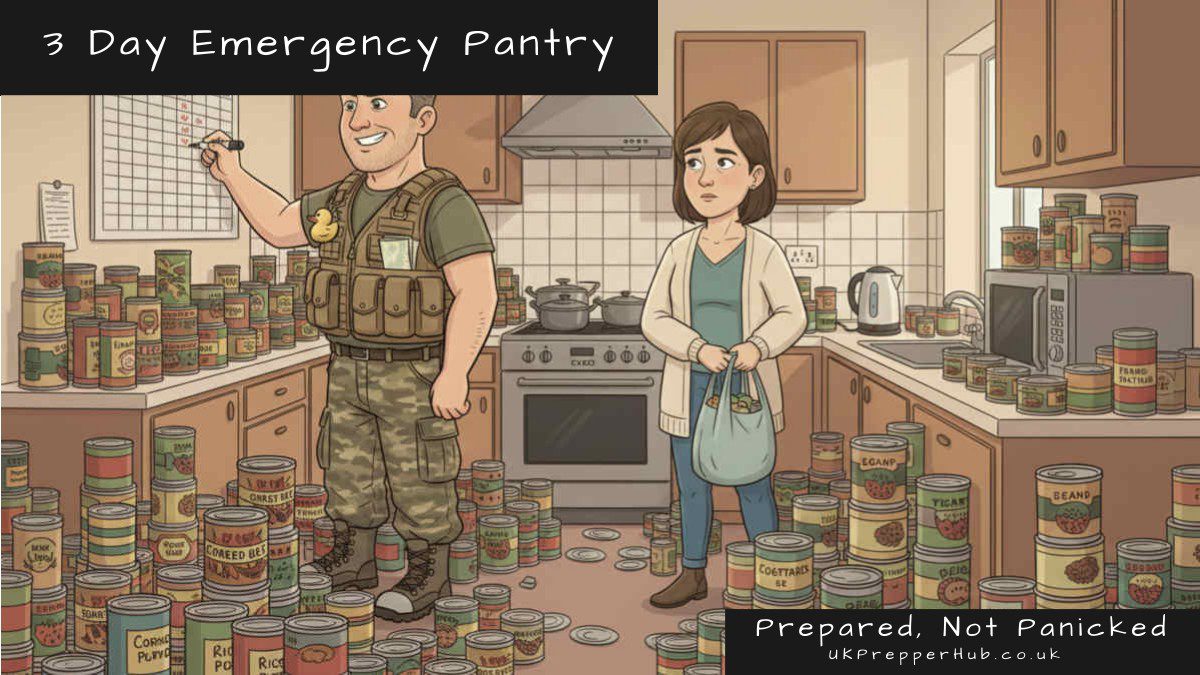
3-Day Emergency Pantry
The low-barrier start: A shopping list of shelf-stable meals that require zero refrigeration.
Offline communications. When the internet goes down, your phone becomes a very expensive paperweight. Know where your family is. Have a plan that doesn’t rely on mobile networks. PMR446 walkie talkies, a designated meeting point, a neighbour who knows to check on you. These things cost almost nothing and are worth everything when it matters.
Complete Guide
Off Grid Communications
When mobile networks go down and the internet disappears, most households are completely cut off — and most people have no backup plan. This guide covers every practical option for staying in contact during a UK emergency, from emergency radio and walkie-talkies to mesh networks and satellite communicators.
Read the Full Guide: Off Grid Communications →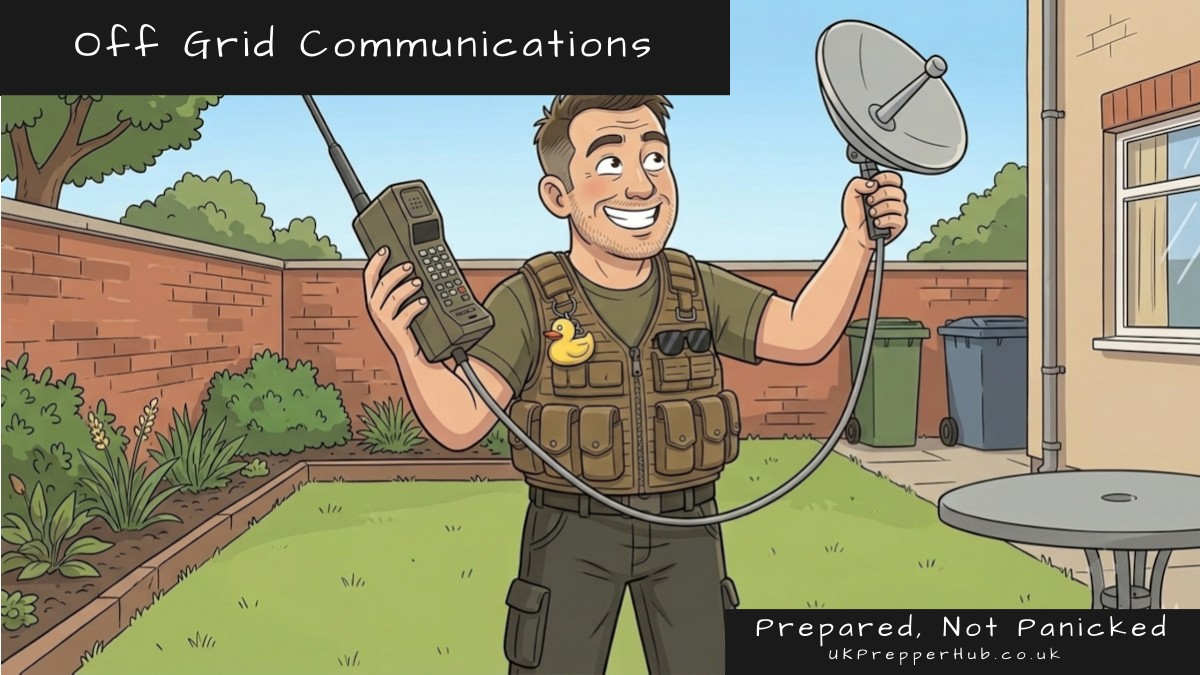
Backup power and a full preparedness plan. If the network is down, your phone is little more than a torch — but a power bank still earns its place: keeping a battery radio topped up, running USB LED lighting, and powering small devices that don’t need a network to work. A portable power station extends that to days and can run a fan, keep medication refrigerated, or charge a laptop for offline use. The Power Cut Survival Guide covers the full picture — from the moment the lights go out to day three and beyond.
Complete Guide
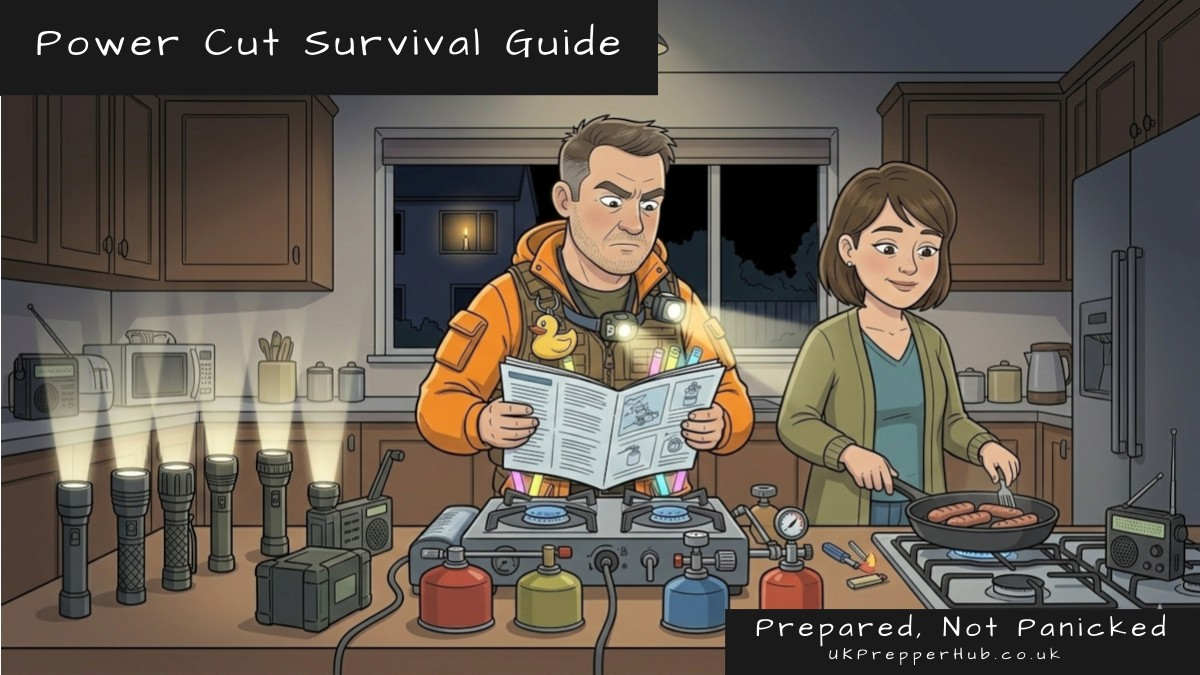
Power Cut Survival Guide
The master 72-hour blueprint. Vital steps for staying warm, connected, and safe when the UK grid fails during extreme weather.
None of this requires paranoia. None of it requires spending a lot of money. It requires taking seriously what governments, intelligence agencies, and infrastructure experts have already acknowledged: the system is more fragile than most people believe, and the people best protected when it fails are the ones who thought about it beforehand.
The Jenga tower is real. Most people are just hoping nobody pulls the wrong block.
Frequently Asked Questions
What is digital dependency and why does it make the UK vulnerable?
Digital dependency is the reliance on interconnected electronic systems — power, internet, payment processing, and supply chain software — to carry out everyday functions. The UK’s critical infrastructure is now so deeply dependent on these layers that a failure in one can cascade through the rest. Unlike previous generations, most households today have no backup plan for even 24 hours without digital systems functioning.
What happens when payment systems fail in the UK?
Commerce effectively stops. Card terminals go offline, ATMs stop dispensing, and online banking becomes inaccessible. Most UK households carry little or no physical cash, meaning they cannot buy food, fuel, or medicine without a functioning payment system. Shops revert to cash-only — and most customers cannot pay.
How quickly would supermarket shelves empty if the grid went down?
UK supermarkets operate on roughly three days of stock — and that assumes a functioning supply chain. A failure that takes down internet and logistics software simultaneously would accelerate that timeline significantly. Within 24 hours, panic buying strips high-demand items. Within 72 hours, restocking becomes impossible without digital systems working.
What should I keep at home in case digital infrastructure fails?
Three to seven days of food and water (your normal food, rotated), enough cash for several days of purchases, a battery or hand-crank radio for emergency broadcasts, and a communication plan that doesn’t rely on mobile networks. A power bank and portable power station extend your options if the grid is also affected.
How much cash should UK households keep at home?
Enough to buy food and fuel for three to five days without card access — for most households that’s somewhere between £100 and £300 depending on family size and local costs. Keep it in mixed denominations, somewhere accessible in the dark, and replenish it when you spend it.
Could a cyberattack actually bring down Britain’s digital infrastructure?
The UK’s National Cyber Security Centre has stated publicly that state-sponsored groups from Russia, China, and other nations are actively probing British infrastructure — energy, water, finance, and communications. The threat is not theoretical. Documented incidents include reconnaissance around undersea internet cables and confirmed intrusions into energy sector networks. A coordinated attack targeting multiple layers simultaneously is the scenario infrastructure experts consider most dangerous.
Build Your Resilience
Further Reading: Related Guides
📡 Find Us Everywhere
Daily briefings, prep guides, and real-time updates across every platform. Pick yours.
Free. No commitment. Stay anonymous on WhatsApp & Telegram.
Stay Informed on UK Preparedness
Join our newsletter for UK-specific preparedness tips, product recommendations, and real-world advice for households.
Subscribe to Our Newsletter