

For years, cyber attacks on the UK’s critical national infrastructure were something officials warned about in speeches. In 2026 they stopped being a warning. Hackers have spoiled millions of pounds’ worth of supermarket food by turning freezers into ovens, shut down a UK power plant for four days, and tampered with cold stores holding blood for French hospitals. On 10 November France named Iran’s Revolutionary Guards as the force behind the first wave.
None of this means the lights are about to go out across Britain. But it does show what modern cyber attacks actually look like: not a Hollywood blackout, but quiet, targeted sabotage of the systems that keep food cold, power flowing and payments working. Here’s what has happened, sector by sector, what it means for an ordinary household, and the handful of things worth doing about it.
The Supermarket Fridge Hacks: How Cyber Attacks Reached the Food Aisle
The first of the cyber attacks on supermarkets came overnight on Sunday 11 October, when hackers took control of the software that manages refrigeration in hundreds of French supermarkets and told the fridges and freezers to heat up and stay hot.
Managers arriving on Monday morning were met by a wave of hot air from the freezer aisle. Intermarché said its units sat at 50°C for six hours and threw away all the affected food, and in some stores there were even small fires, BBC News reported.
Coopérative U, Intermarché, Netto, Carrefour, Monoprix and E.Leclerc were all hit. The BBC put the total at about 400 stores; later reports in The Guardian said as many as 700. The EU’s food commissioner, Christophe Hansen, said “the weaponisation of food has become a reality”.
The attackers went after refrigeration controllers made by Danish engineering firm Danfoss, software that lets retailers manage their cold units remotely. Danfoss said the affected units were older models whose security software couldn’t be updated.
Three weeks later it happened again, across more countries. On Monday 2 November supermarkets in Belgium, Luxembourg, Sweden, Ireland, the Netherlands, Estonia and Finland reported fridges and freezers forced into defrost mode, the BBC reported. Around 40 Delhaize stores were hit, 13 SuperValu shops in Ireland pulled chilled and frozen food from sale, and one Swedish store posted that its freezers had been “set to 50 degrees”. By the next day Germany, Romania and Italy had reported problems too, taking the total to at least 11 countries, according to Al Jazeera.
The UK Food Firms That Were Hit
The second wave reached Britain, though not the supermarkets. Several UK meat suppliers found their fridges tampered with overnight, all running Dixell XWEB controllers, a system owned by Copeland, The Grocer reported. The Association of Independent Meat Suppliers said some of its more than 300 members became “collateral” in the hacks.
Fresh produce wholesaler Langridge Organic said hackers set a number of its units to defrost for more than four hours at 150°C before staff stepped in, and a London fruit and vegetable wholesaler stopped the attack by pulling its cold stores’ internet connection out at the wall, The Guardian reported. No meat was lost.
The National Cyber Security Centre (NCSC) said the national impact was “minimal”. Its chief executive, Dr Richard Horne, called the attacks the “foothills” of a much bigger threat.
Then the Blood Banks
The same night, hackers got into the control systems of three cold stores holding blood products for France’s national blood service, the EFS, which supplies more than 1,900 hospitals. Temperature and defrost settings were pushed to “very high levels”, but alarms let technicians step in before anything was damaged, The Guardian reported. The cold stores were run by contractors, and the plasma inside was moved to other sites.
Who Did It?
On 10 November French Foreign Minister Jean-Noël Barrot accused Iran’s Islamic Revolutionary Guard Corps of the October attack, calling it “unprecedented in both its scale and its level of aggression”, BBC News reported. Paris prosecutors have opened an investigation into the head of an IRGC-linked cyber unit, Shahid Kaveh, and his two deputies, and France summoned Iran’s ambassador. Some Iranian media have dismissed the claim, and France hasn’t said how it reached its conclusion. Two Russian-aligned hacktivist groups had earlier claimed responsibility, and few believed them. Nobody has yet been officially blamed for the November wave.
It probably didn’t start in France either. In August, fridges at a number of US military base stores mysteriously malfunctioned and spoiled food, and that is now being investigated as a deliberate attack. Security firm Sekoia says about 40 Israeli supermarkets running Danfoss controllers were compromised back in 2022, the BBC reported.
Why Would Anyone Hack a Fridge?
Most cyber attacks you hear about are about money: lock a company’s computers, demand a ransom. Nobody asked for a penny here. “The attackers simply broke the fridges, so there’s no financial leverage,” Jon Abbott of ThreatAware told The Observer. That points to sabotage: showing what you can do, and making people wonder whether the shops will have food on the shelves.
Supermarkets make an easy target because they run enormous numbers of refrigeration controllers, building management systems and door panels, said Tom Hegel of security firm SentinelOne. “Once an attacker can operate those controls, legitimate functions such as defrosting become tools for disruption,” he told the BBC. “Changing a setting can destroy physical stock, not just interrupt a computer system.” Nobody had to break the fridge. They just pressed the defrost button, over and over, from somewhere else.
Could Hackers Get Into the Fridge in Your Kitchen?
If you heard a radio phone-in this month wondering whether your own fridge freezer could be next, it’s an understandable worry, but it misses what these attacks actually were. The fridges and freezers that were hacked were not kitchen white goods. They were commercial refrigeration systems: the chillers, display cabinets and cold rooms in supermarkets, meat plants and warehouses, run by industrial controllers that are built to be monitored and adjusted remotely by the retailer or its refrigeration contractor.
That remote access is the whole point of them, and it’s also how the attackers got in. According to France’s cyber security agency, the controllers were reachable on the internet and had predictable passwords, The Observer reported. When security firm Lupovis set up fake fridge controllers online as bait, it logged 256 break-in attempts from 91 different sources in ten days, and most simply tried the maker’s published factory-default username and password. Many of the controllers are years past their end of life, so even where a flaw is known, no fix is coming.
The BBC was clear: “there’s no evidence domestic appliances are being targeted” in these cyber attacks. Most home fridges and freezers aren’t connected to the internet at all, so there’s nothing to log into. If you do own a Wi-Fi smart fridge, the NCSC’s chief technology officer has said connected home devices can be vulnerable “in certain situations”, so keep its app and software updated and don’t leave any default password in place. Since April 2024, UK law has required makers of consumer smart devices to meet minimum security standards, including on passwords and security updates.
And if your own fridge ever did stop working, for whatever reason, you’d deal with it exactly as you would a power cut: keep the doors shut and eat what’s at risk first. The real household risk from these cyber attacks isn’t the fridge in your kitchen. It’s the empty chiller cabinet at the shop.

🐔 Chicken Licken
Did You Know?
Did you know most of the hackers trying to get into those fake fridge controllers didn’t hack anything at all? They typed in the maker’s own default username and password, straight out of the published manual. I’ve been saying for years that the weakest part of any system is the setting nobody could be bothered to change. Nobody listens. Then the freezer’s at 50°C and everyone’s asking how the Russians got in.
What Cyber Attacks on Supermarkets Mean for Your Food
Britain’s supermarkets haven’t been hit by these cyber attacks, and retailers say they are working with the NCSC to make their fridges and freezers as secure as possible. But they run the same kind of networked refrigeration as the French chains. Researchers at UK Cyber Defence found more than 800 refrigeration and building-control interfaces linked to British retailers that could be reached over the public internet, the BBC reported, and a follow-up count of supermarket refrigeration controllers alone found 274 still reachable from anywhere in the world, according to The Grocer.
Reachable doesn’t mean hackable, but it’s not where you’d want them.
We’ve already seen what a cyber attack on a retailer looks like here. After M&S and the Co-op were hit by ransomware in 2025, some shoppers found empty shelves for days. M&S put its cost at around £136 million, and in September the National Audit Office named cyber attacks as one of the major threats to the UK’s food supply chain, The Register reported.
An attack like the French one empties the chilled and frozen aisles first: meat, milk, ready meals, frozen veg. Food that doesn’t need a fridge or freezer carries on regardless. A week of tins, pasta, rice, cereal, long-life milk and jars at home turns a closed chiller cabinet into a shrug. See our Special Report “Nutritionists Are Wrong About Your Emergency Food Supply” first published on 21 September 2026.
Ration-X 24 Hour Ration Pack
A full day’s food in one sealed bag. UK-made, in the same format as the British Army 24 hour ration pack, ready to eat hot or cold with four menus to choose from.
Our Full Review: Ration-X 24 Hour Ration Pack →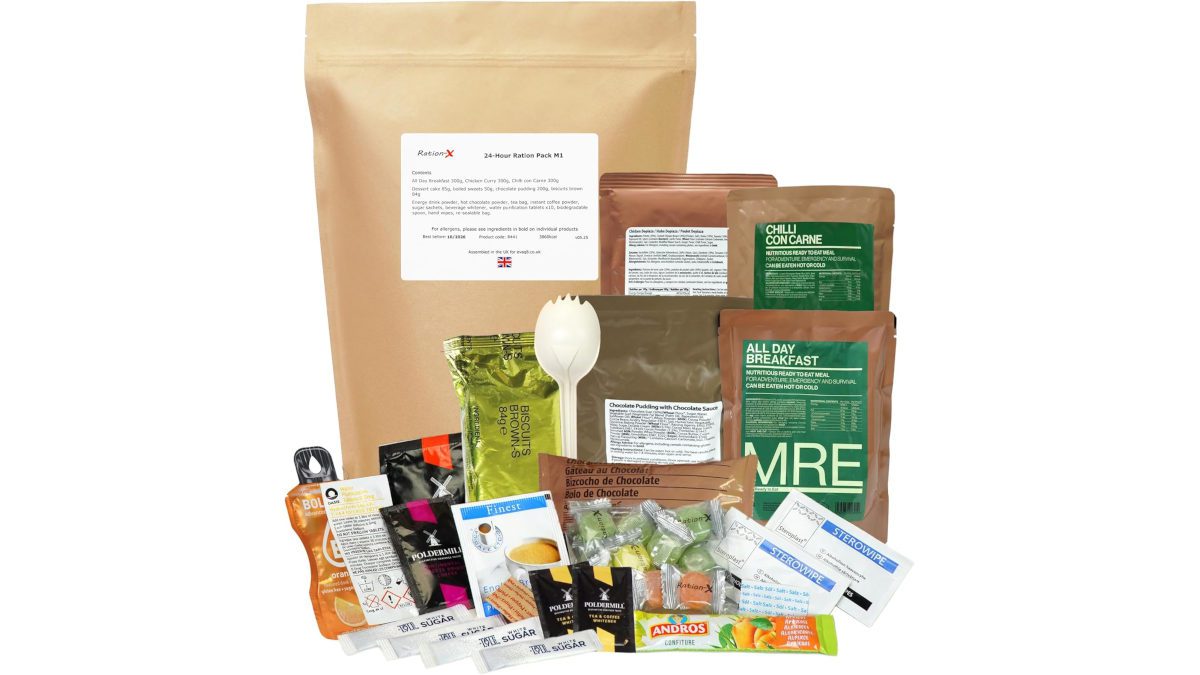
Energy: Iran-Linked Hackers Shut Down a UK Power Plant
Before the fridges, there was a power station. In July, hackers affiliated with the Iranian regime shut down a small-scale UK gas power plant for four days, BBC News reported in August. The government confirmed the incident but, for security reasons, wouldn’t name the site. The Department for Energy Security and Net Zero said it was a small generator, not an essential service like a large power station, and that at no point was the wider energy system at risk.
That’s reassuring as far as it goes. But Britain has hundreds of small, unmanned gas plants that sit idle most of the year and switch on when electricity supplies are tight, and tougher baseline cyber security standards for them won’t be required until the end of 2030, The Guardian reported.
For a household, a power cut caused by hackers is the same as one caused by a tree on the line in a storm. The lights go off, the fridge goes quiet and the boiler stops. The kit that gets you through one gets you through the other, and you don’t need to know why the power went to use it.
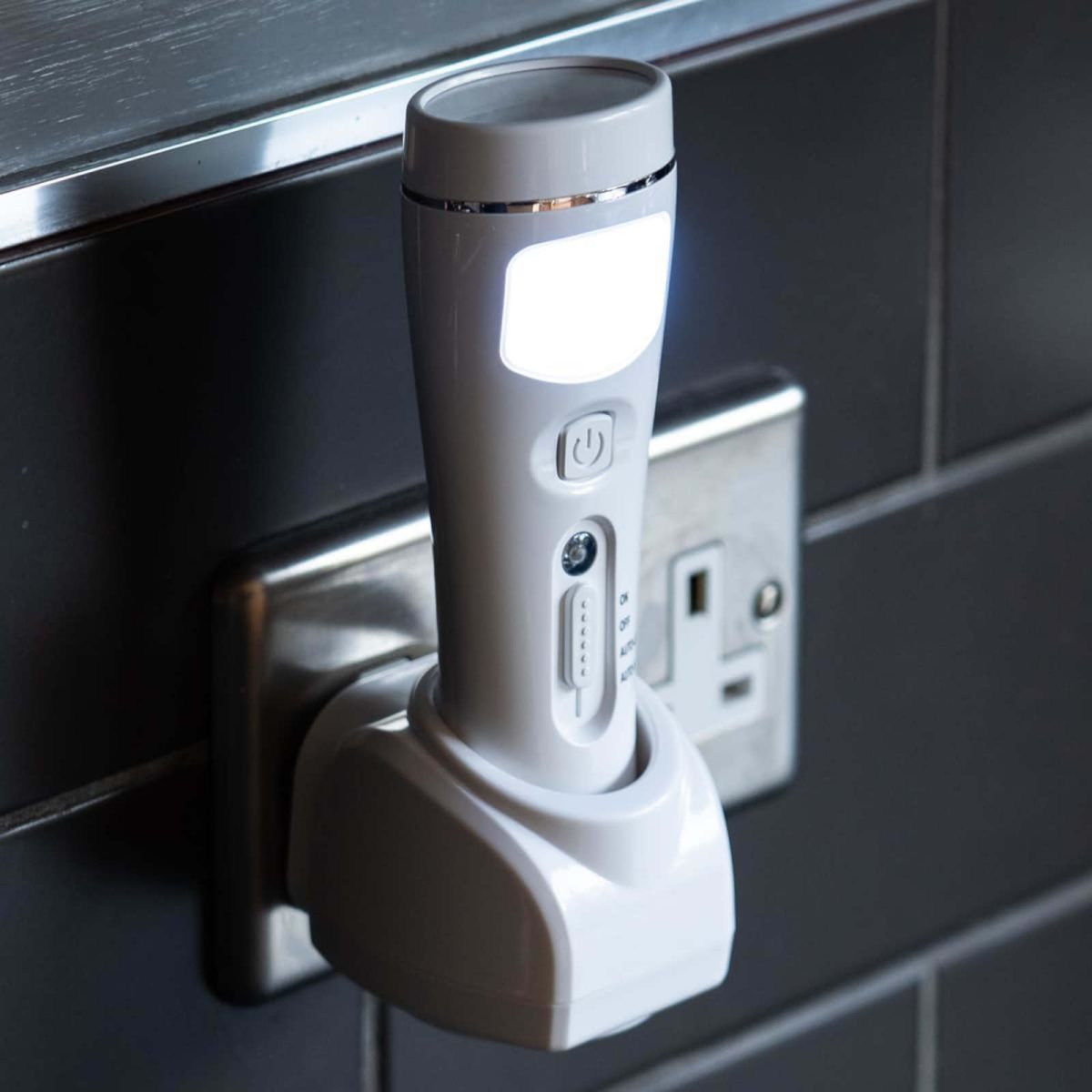
XtraLite NiteSafe
The NiteSafe is a dual-function device that works as both a plug-in nightlight and an emergency torch. It sits in a standard UK plug socket, charges continuously, and the moment mains power fails, it automatically illuminates.
Health: The Cyber Attack on the NHS That Cost a Life
The most serious cyber attack on the NHS so far happened in June 2024, when ransomware gang Qilin hit Synnovis, the company that runs blood testing for several London hospitals. Operations and appointments were cancelled, blood transfusion services were severely disrupted, and hospitals ran critically short of O-type blood. It became the first cyber attack in history to be directly linked to a death, after a patient died partly because blood test results were delayed.
In October 2026 German police detained a 28-year-old Russian man accused of being a core member of Qilin, a gang alleged to have hacked more than 4,000 organisations since 2024, BBC News reported. German detectives are examining links to the Synnovis attack, and British police are looking at whether their own inquiry could lead to an unlawful killing case, potentially a world first for cyber crime.
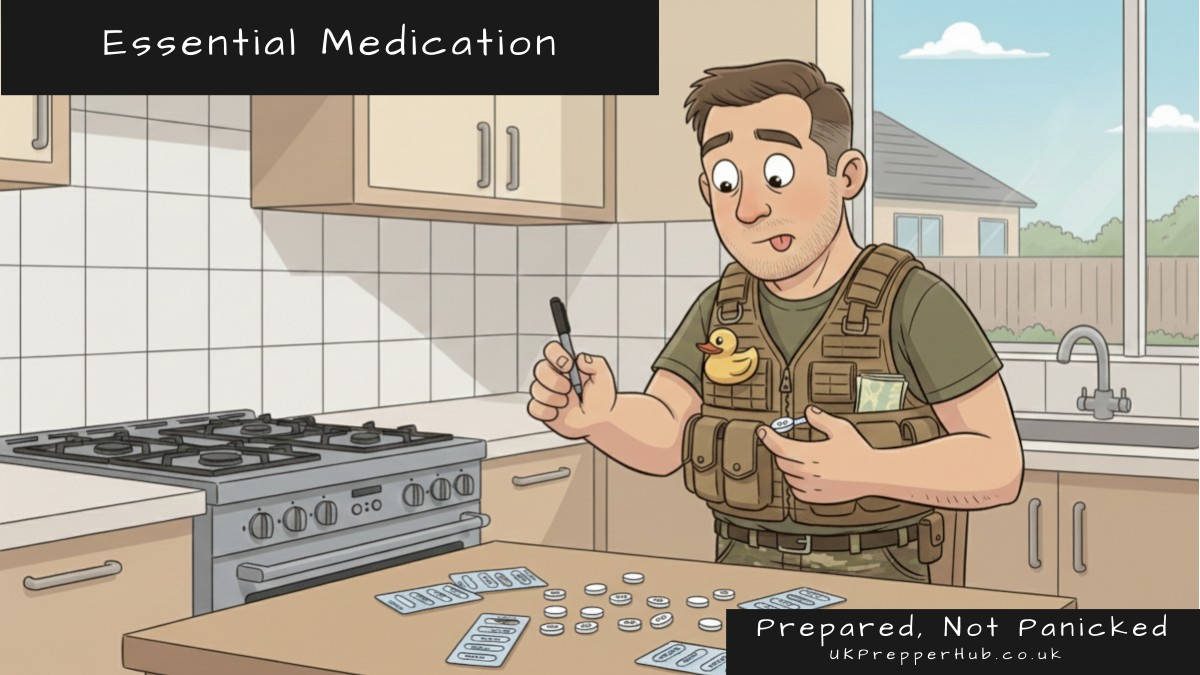
Add the French blood bank attack, and the pattern of this year’s cyber attacks is clear: health systems depend on the same kind of connected equipment as everything else. If NHS systems go down, the advice is still to call 999 in an emergency. What helps at home is having the basics on paper: a list of your medicines and doses, your GP and pharmacy numbers, and a week or so of spare repeat medication rather than running down to the last strip.
Complete Guide
Managing Essential Medication
This guide covers more detail on being prepared with essential medication for all emergency situations.
Money: When the Card Machine Says No
Not every outage is an attack, but some show you what one would feel like. On 20 October a power failure at a datacentre in Google’s London cloud region disrupted Revolut card payments and cash machine withdrawals, glitches hit HSBC, Lloyds, Royal Mail and the NHS app, and court hearings were put on hold until things settled by mid-afternoon, The Guardian reported. One building’s power cut, nationwide disruption.
Deliberate cyber attacks on banks are happening too. In November French bank Crédit Mutuel Arkéa said hackers stole about €100 million through a third-party platform, a rare case of criminals stealing directly from a mainstream bank, teiss reported. Customers’ money wasn’t affected, but some transfers were delayed while the bank paused transactions.
Analysis by Moody’s for an MP put the chance of a Russia-linked cyber attack costing the UK at least £4 billion at about one in ten in any given year, the Mirror reported. And the 2025 cyber attack that stopped Jaguar Land Rover’s production for five weeks, costing up to £2.1 billion, was backed by a foreign state, according to former Armed Forces Minister Al Carns, The European reported.
The household answer is unglamorous: keep some cash at home in small notes, and have a second way to pay that doesn’t depend on the same bank or app as the first. Our earlier piece, When Payment Systems Fail, covers why it matters when the card machine goes down.
Communications: Cables, Fake Alerts and the Landline Switch-Off
Undersea cables carry about 99% of Britain’s international telecoms and data traffic. This spring British, Norwegian and American forces confronted Russian naval vessels near Svalbard rehearsing with a device designed to cut subsea cables while leaving little trace, TechRadar reported.
In October MPs on the Commons Defence Committee warned of “glaring gaps” in Britain’s ability to defend the Arctic and its undersea infrastructure, BBC News reported, and the government proposed up to 14 years in prison for deliberately damaging undersea cables, UK Defence Journal reported. See our Special Report “Is Russia a Threat to the UK?” first published on 26 July 2026.
Warning systems are a target for cyber attacks too. On 1 November Ukraine’s air raid alert app sent hoax warnings of a radiation threat in Kyiv, and the Ukrainian Air Force said the app had “probably been subjected to hostile interference”, LBC reported. Loudspeaker alerts sounded across the Lviv region as a result. The lesson travels: if an alert ever seems out of place, check it against a second trusted source, such as BBC radio, before acting on it. A battery radio means you can still do that if the phone network is down.
Closer to home, the old copper phone network is due to close on 31 January 2027, and landlines will run over broadband instead, WalesOnline reported. A digital landline plugs into your router, so when the power goes, the home phone goes with it. If anyone in your home relies on a landline or a telecare alarm, ask your provider about a battery backup.
Tendak Battery Radio
A proper little AM/FM radio that runs on two AA batteries, with a big speaker and a headphone jack for quiet listening when everyone else is asleep.
Our Full Review: Tendak Battery Radio →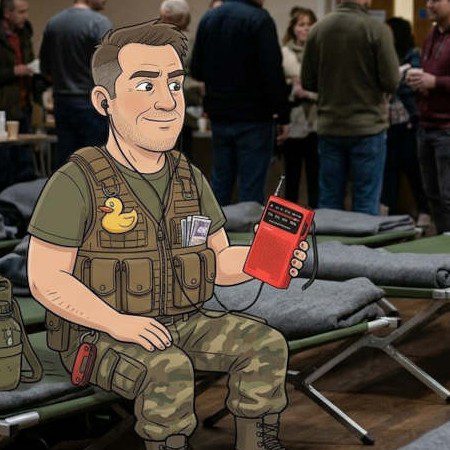
What the Government Is Worried About
The official tone has changed this year. In October the UK’s AI minister, Kanishka Narayan, said it was “likely, if not inevitable” that the country’s cyber defences would at some point be breached, BBC News reported.
On 3 November the NCSC’s annual report warned that the UK’s critical national infrastructure should be braced for a ransomware attack using AI-powered malware by 2028, and Dr Horne warned of “a real prospect of an unprecedented rise in the number of cyber incidents” in the coming months. Leaders who don’t act, he said, will have to explain themselves “when food isn’t on shelves, lights aren’t on, businesses have gone under”, the NCSC said.
In September the government announced closed-door intelligence briefings, chaired by Security Minister Dan Jarvis, for the organisations that run essential services, saying Russia and linked groups had tried to disrupt them, UK Defence Journal reported. In October the policing and fire inspectorate reported that police and fire and rescue services are not fully prepared for the growing cyberattack threat. And next year’s Exercise Albiston Shadow 2027 “will be the largest UK Home Defence exercise in decades”, testing how government responds to hybrid attacks, the Armed Forces Minister has confirmed, UK Defence Journal reported.
None of that is a prediction of disaster. It’s the government doing its homework before the next round of cyber attacks. The useful part for households is what it tells you: officials expect more cyber attacks, and they expect some to get through. See our Special Report “We Are One Button Away” first published on 4 July 2026.

🪖 Black Panther
In My Previous Role…
In my previous role, we’d have air-gapped the lot and posted a sentry on the freezer. I’ve also recently got into Tor, the ultimate privacy internet connection, which I’ll be explaining to anyone at the bar on Friday whether they ask or not. You don’t need any of it. The London wholesaler that beat these hackers did it by pulling a cable out of the wall. Your version is a battery radio, a tin opener and twenty quid in the drawer. Carry on.
How to Prepare for a Cyber Attack at Home
Here’s the good news. You can’t stop cyber attacks on a power plant or a supermarket chain, and you don’t need to. What reaches your front door is always the same handful of effects: no power, no card payments, no chilled food in the shops, no internet, or a GP surgery working off paper. The kit that covers a winter storm covers a cyber attack too, so if you’ve already got the basics, you’re most of the way there.
- Food that doesn’t need a fridge: a week of tins, dried food, long-life milk and things you can eat cold. Build it slowly, a few extra items each shop. See The 3-Day Emergency Pantry.
- Water: water treatment works run on control systems too. Keep a few days of drinking water stored. See Emergency Water Storage.
- Cash: enough in small notes to buy food and fuel for a few days if cards and apps stop working.
- Light and power: torches, spare batteries and a charged power bank. See How to Prepare for a Power Cut.
- A battery or wind-up radio: for official news when the internet and mobile network are down, and to check any alert that seems wrong. See our Emergency Radio Guide.
- Important information on paper: phone numbers, bank and insurance details, your GP and pharmacy, and everyone’s medicines and doses.
- A bit of scepticism: after any big breach, criminals send fake “refund” and “delivery” messages. Don’t click links in a message about an attack; go to the company’s own website or app instead. See the Household OPSEC Guide.

📋 Clarissa
I’ve Made A Checklist
Here’s my Household Emergency Plan: every number and detail you’d need if your phone contacts, the banking app and the GP’s online system all went down on the same morning. It’s free, you can fill it in on screen, and then you print it. On paper. Obviously.
Download: Household Emergency Plan →The cyber attacks of 2026 have been unsettling, and more are coming. But look at what actually happened: food was binned, a small power plant went offline, blood was moved to another fridge. Each one hurt the businesses involved far more than the households around them. A few days of food, water, cash and light at home is what keeps it that way.
Frequently Asked Questions
Why were supermarket fridges hacked?
To cause disruption, not to make money. No ransom was demanded. The attackers took over commercial refrigeration controllers that could be reached over the internet, often with default passwords, and switched the units to defrost or heat up overnight so the food spoiled. France has blamed Iran’s Revolutionary Guards for the October attack.
Can hackers get into my fridge freezer at home?
Not in these attacks. They targeted industrial refrigeration controllers in shops, meat plants and cold stores, not kitchen appliances, and the BBC reported no evidence that domestic appliances were targeted. Most home fridges aren’t connected to the internet at all. If yours is a Wi-Fi smart fridge, keep its software updated and change any default password.
Have UK supermarkets been hit by cyber attacks on their fridges?
Not as of 10 November 2026. UK meat suppliers and a London wholesaler were hit in early November, but no meat was lost, and the NCSC called the national impact “minimal”. UK retailers say they are working with the NCSC to secure their fridges and freezers.
Has a cyber attack ever caused a power cut in the UK?
Iran-linked hackers shut down a small UK gas power plant for four days in July 2026. The government says it was a small generator, not an essential service, and that the wider energy system was never at risk. No UK homes are reported to have lost power because of it.
How do I prepare for a cyber attack at home?
Knowing how to prepare for a cyber attack is mostly knowing how to prepare for a storm or a long power cut: a few days of food that doesn’t need a fridge, stored water, some cash, torches and a power bank, a battery radio, and important numbers and medicine details written on paper.
What is critical national infrastructure?
It’s the systems the country can’t run without, grouped by the government into 13 sectors including energy, water, food, health, finance, transport and communications. The NCSC warns that these sectors should be braced for AI-powered ransomware attacks by 2028.
Build Your Resilience
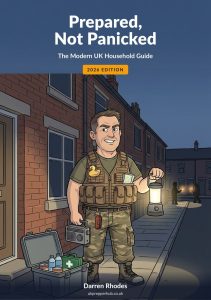
The whole plan, in one book
Prepared, Not Panicked (2026 edition) pulls our guides together into one plan for UK households. PDF, £4.99.
See inside the book →Further Reading: Related Guides
- The 3-Day Emergency Pantry
- Emergency Meal Planning
- How to Prepare for a Power Cut
- Managing Essential Medication
- Emergency Water Storage
- Emergency Radio Guide
- Off Grid Communications
- Household OPSEC Guide
All our guides can be found listed on our resilience hub.
Gear We've Tested & Reviewed
- Ration-X 24 Hour Ration Pack
- Xtralite NiteSafe Emergency Light
- Tendak Battery Radio
- Simpeak Wind Up Torch
All our reviews can be found on our reviews and resources page.


📡 Find Us Everywhere
Daily briefings, prep guides, and real-time updates across every platform. Pick yours.
Free. No commitment. Stay anonymous on WhatsApp & Telegram.
Stay Informed on UK Preparedness
Join our newsletter for UK-specific preparedness tips, product recommendations, and real-world advice for households.
Subscribe to Our Newsletter