
This page contains affiliate links. As an Amazon Associate, UK Prepper Hub earns from qualifying purchases. Learn more
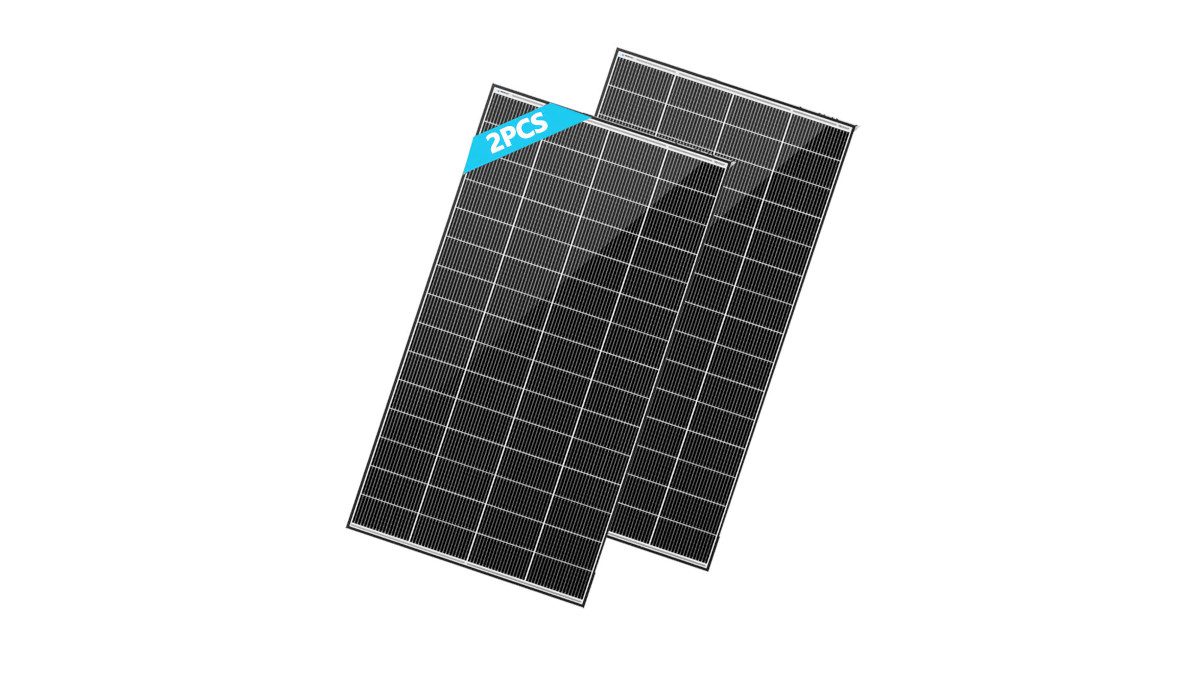
The EcoFlow Delta 3 Max is built to run a fridge through a multi-day outage, and if it’s living somewhere semi-permanent — a shed roof, a static caravan, a summer house — a rigid panel setup makes more sense than something you’re folding up and carrying indoors every night. The Renogy N-Type 320W Monocrystalline Solar Panel 2-Pack is the rigid option: two 320W panels, glass-fronted and aluminium-framed, built to bolt down and stay down.
At 640W nominal between the pair, it’s rated above the Delta 3 Max’s 500W solar input ceiling — which sounds like a mismatch until you understand why that’s actually fine, and often the smarter buy.
Renogy N-Type 320W Monocrystalline Solar Panel
Two rigid 320W Renogy panels, permanently mounted and rated well above the EcoFlow Delta 3 Max’s input cap — because real-world UK sun never hits the spec sheet number.
Renogy N-Type 320W Monocrystalline Solar Panel Specs (per panel)
- Max power: 320W
- Open-circuit voltage: 43.82V
- Optimum operating voltage: 37.85V
- Optimum operating current: 8.46A
- Module efficiency: 22.2%
- Maximum system voltage: 1000VDC
- Dimensions: 1640 x 880 x 35mm
- Warranty: 10 years material and workmanship, 25-year 80% output performance warranty
Why 640W of Panel for a 500W Input Cap Isn’t Wasted Money
The Delta 3 Max’s built-in charge controller simply won’t draw more than 500W, no matter what’s connected — going over the ceiling doesn’t damage anything, it just means the unit caps the input at its own limit. The reason to buy above that ceiling anyway is real-world output. Rated wattage is a laboratory figure; actual UK output — especially outside peak summer — regularly falls well short of the spec-sheet number. Oversizing the panel array is how you keep getting close to that 500W ceiling even when conditions aren’t perfect, rather than watching your “500W-rated” setup deliver a fraction of that on an overcast January afternoon.
This is standard practice in solar installation generally, not a Renogy-specific quirk — panel arrays are routinely sized above the inverter or charge controller’s rated capacity for exactly this reason.
Built to Stay Where You Put It
Glass-fronted, aluminium-framed, and rated to 1000VDC maximum system voltage, these panels are designed for permanent mounting — shed roof, caravan roof, ground-mounted frame — not for being unfolded and packed away daily. That’s the trade-off against the portable suitcase-style panels: no daily setup routine, but also no picking it up and moving it if your circumstances change.
Mounting the Panels
Renogy’s Z-brackets or tilt mounts bolt through each Renogy N-Type 320W Monocrystalline Solar Panel’s aluminium frame and onto whatever you’re fixing to — shed roof, caravan roof rail, or a ground-mounted frame. The bracket holes are the only fixing points that need sealing: use proper roofing sealant or cable gland fittings rather than a bead of silicone over a raw drill hole, and route the cable along an existing fixing line where possible rather than adding fresh penetrations. It’s a five-minute difference in the install and the one that actually keeps water out.
Whether to wire the pair in series or parallel depends on your charge controller’s rated input voltage — check the manual before deciding, since series wiring roughly doubles the voltage while parallel keeps it the same as a single panel. When in doubt, parallel is the safer default: lower voltage, and one panel underperforming (shade, dirt, a partial fault) doesn’t drag the other one down with it.
Renogy N-Type 320W Monocrystalline Solar Panel
Two rigid 320W Renogy panels, permanently mounted and rated well above the EcoFlow Delta 3 Max’s input cap — because real-world UK sun never hits the spec sheet number.
What the Rest of the Team Think

🦆 Keith the Prepper
Drilled the mounting brackets straight through the shed roof felt. Found out about the leak three weeks later, not from the ceiling, from the smell. Panels themselves are fine. The shed has questions.
⭐⭐⭐⭐

🪖 Black Panther
Fixed position. No daily setup, no daily teardown, nothing to forget when you’re stood down. That’s how you build a system you don’t have to think about every time. Carry on.
⭐⭐⭐⭐⭐

🤡 Camping Clown
I now own this, the 400W suitcase, the 220W pair, and the 100W one. I am, unfortunately, the target market for all four of these reviews. This is the only one that’s actually mounted anywhere permanent.
⭐⭐⭐⭐

🐾 Weekend Warrior
On the roof of the bug-out location my wife doesn’t know about. Permanent, silent, no maintenance schedule to blow my cover. Pickle’s not allowed up there, which she takes personally.
⭐⭐⭐⭐⭐

🐕 Pickle
Snorgle. Snorgle snorgle snorgle. Snorgle!
Snorgle! (not allowed on the roof, disapproves)

🐔 Chicken Licken
Did you know buying panels rated higher than your power station’s input cap doesn’t overload anything? I’ve been saying it for years — the unit just caps what it takes. People panic about the numbers not matching exactly. They don’t need to.
⭐⭐⭐⭐⭐

📋 Calm Clarissa
Mount once, tick the box, never revisit it. That’s the entire checklist for this one, which is precisely why I like it. Everything else on my lists needs checking again eventually. This doesn’t.
✅✅✅✅✅

💄 Survivl Gurl
Honestly, less content than the foldable ones — you mount it once and there’s nothing left to film. But my dad says it’s the “proper” solar option and he’s not wrong, so it’s staying on the shed.
⭐⭐⭐⭐

🌿 Aroura
There’s a rootedness in something that stays where it’s placed, season after season, rather than being carried and folded and carried again. Twenty-five years of quiet giving, written into the warranty itself. Namaste 🙏
⭐⭐⭐⭐⭐
Renogy N-Type 320W Monocrystalline Solar Panel: Pros and Cons
Pros
- Rigid, permanent mount — no daily setup or teardown once installed
- 640W nominal between the pair gives genuine headroom against the Delta 3 Max’s 500W cap, closing the gap between spec-sheet and real-world UK output
- 10-year material and workmanship warranty, 25-year 80% output performance warranty — by far the longest cover of any panel in this range
- Glass-fronted, aluminium-framed construction built to stay outdoors permanently
Cons
- Needs a proper mounting surface and installation — not a deploy-and-pack-away product
- Heavier and more involved to install than any of Renogy’s portable options
- Overkill if you might move the panels between locations — this is a fixed installation
Frequently Asked Questions
Isn’t 640W of panel too much for the Delta 3 Max’s 500W solar input?
No — the unit’s charge controller simply caps input at 500W, no matter what’s connected. The extra headroom compensates for real-world UK conditions, where actual output regularly falls short of the rated spec-sheet figure.
Can these Renogy N-Type 320W Monocrystalline Solar Panels be mounted permanently outdoors?
Yes — that’s what they’re built for. Glass-fronted, aluminium-framed construction rated for permanent outdoor installation, unlike Renogy’s foldable portable panels.
What’s the warranty?
10 years on materials and workmanship, plus a 25-year 80% output performance warranty — the longest cover in Renogy’s panel range.
Do I need an MPPT charge controller for these?
The EcoFlow Delta 3 Max has MPPT charging built in, so no separate controller is needed when connecting directly to the unit.
Can I buy just one panel instead of the pair?
The panels are sold as a 2-pack. A single 320W panel would still work but gives up the extra headroom that makes this pairing worthwhile.
Build Your Resilience

The whole plan, in one book
Prepared, Not Panicked (2026 edition) pulls our guides together into one plan for UK households. PDF, £4.99.
See inside the book →Further Reading: Related Guides
- Portable Power Station With Solar Panel: The Renogy Buying Guide for Every Brand
- Portable Power Stations for Power Cuts: What Size Does a UK Home Actually Need?
All our guides can be found listed on our resilience hub.


📡 Find Us Everywhere
Daily briefings, prep guides, and real-time updates across every platform. Pick yours.
Free. No commitment. Stay anonymous on WhatsApp & Telegram.
Stay Informed on UK Preparedness
Join our newsletter for UK-specific preparedness tips, product recommendations, and real-world advice for households.
Subscribe to Our Newsletter