
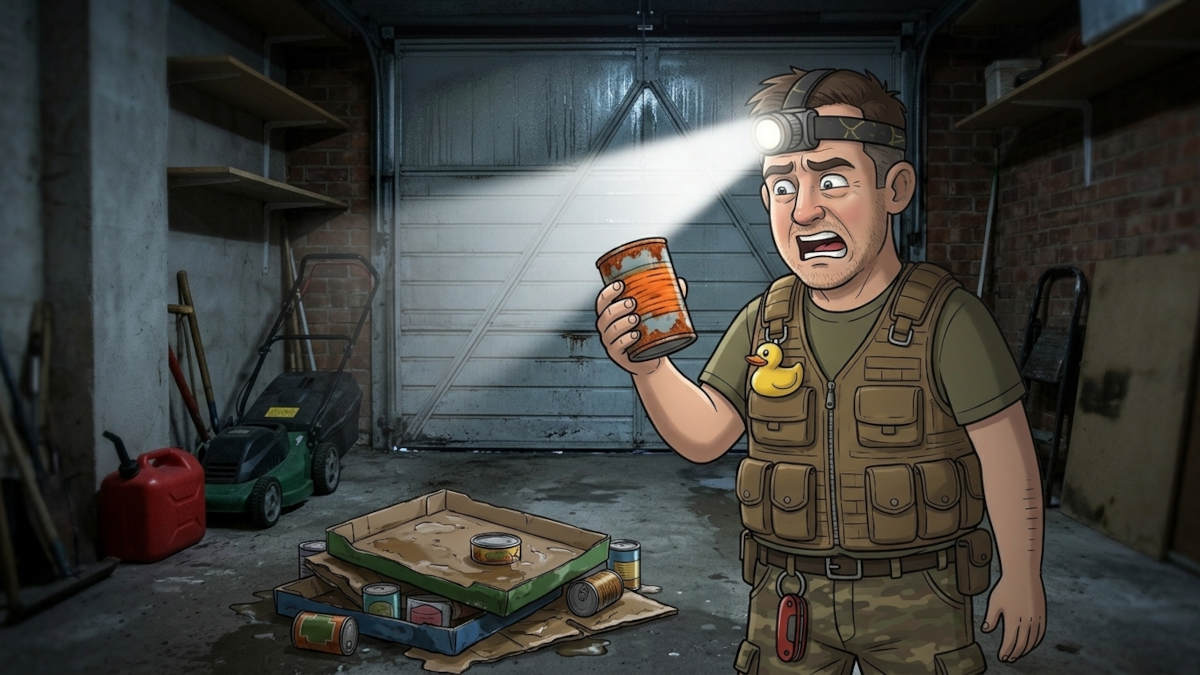
Damp storage ruins more emergency supplies than any actual emergency ever does. Not a flood, not a burst pipe, just ordinary British damp: the slow, unglamorous kind that turns the tins in the under-stairs cupboard rusty, makes the pasta go soft, grows a fur coat on the spare sleeping bag in the loft and leaves the batteries in the garage drawer weeping white crust.
This guide covers where damp comes from in cupboards, garages, sheds and lofts, what it does to tins, dry food, batteries and paperwork, how to measure it, whether damp traps and silica gel are worth having, when a dehumidifier for a garage makes sense, and a twice-a-year check that takes ten minutes. It’s about the places you store things. If the problem is damp and mould in the rooms you live in, that’s a different job, and there’s a guide for it at the end.
What Damp Storage Does to Your Supplies
- Tins rust, starting at the seams and the rims. Surface rust on the outside can be wiped off; rust that pits the metal or spreads round the seam is how a tin fails.
- Dry food such as pasta, rice, flour, oats and biscuits soaks up moisture through paper and thin plastic packaging, goes soft or stale, and can go mouldy.
- Batteries corrode at the contacts. A battery with green or white crust on it may still work, but it can damage whatever you put it in.
- Paper and documents go limp, spot with mould and stick together. Ink runs if they ever get properly wet.
- Cardboard is the worst offender. It soaks up moisture, sags, collapses and then holds the damp against everything inside it.
- Fabric, so sleeping bags, blankets and spare clothes, picks up a musty smell and mildew spots, and damp bedding doesn’t keep you warm.
- Tools and electronics rust and corrode, and torches with batteries left in them are the classic casualty.
How Damp Gets Into Storage
Most damp storage problems aren’t water coming in. It’s water that’s already in the air, turning back into water on the coldest surface it can find. Warm air holds more moisture than cold air, so when moist air meets something cold, such as an outside wall, a concrete floor, the underside of a roof or the inside of a plastic box, the moisture condenses on it. That’s why the back of the cupboard against an outside wall is damper than the front, and why a garage that swings from mild afternoons to frosty nights is a condensation factory.
- Cold outside walls: anything pushed hard up against one gets damp on the wall side first.
- Concrete floors in garages and outbuildings draw moisture up and stay cold. Anything sitting directly on one gets damp from underneath.
- Temperature swings in garages, sheds and lofts, which are neither heated nor sealed.
- Sealed boxes packed in the warm and moved somewhere cold. The moist air inside gets trapped with the contents and condenses on the lid.
- Actual leaks: a dripping gutter, a split shed felt, a slipped roof tile. Worth ruling out before you spend anything on dehumidifying.
Measure It First
Damp in a cupboard is easy to guess at and easy to get wrong. A cheap digital hygrometer tells you the relative humidity, which is how much moisture the air is holding compared with the most it could hold at that temperature. Mould and fungi need high humidity to grow: museum conservation guidance puts the line at 70%, and building regulations in England use the same 70% figure as a limit for how damp a room should get. Keep your storage comfortably below that and most of the problems on this page don’t start.
Put the hygrometer in the space for a few days, including a cold night, before deciding anything. A reading that sits in the 50s is fine. One that spends nights in the high 70s and 80s means something needs to change.
ThermoPro TP50 Digital Hygrometer
A compact, accurate hygrometer that tells you exactly what the humidity is in any room — so you know whether you have a damp problem before mould appears. Under £15 and the easiest first step in managing moisture at home. Now sold on Amazon UK as the TempPro TP50.
Our Full Review: ThermoPro TP50 Digital Hygrometer →
Damp Under Stairs Cupboard: The Classic UK Store
The cupboard under the stairs is where most British households keep their emergency supplies, the hoover, the ironing board and a bag of bags. It’s dark, it’s handy, and it often has an outside wall, the gas or electric meter and very little air movement. Damp under stairs cupboard problems usually come down to that last one.
- Leave a gap of a few centimetres between boxes and the back and side walls, so air can move behind them.
- Get things off the floor with a cheap shelf unit or a couple of slats. Floors next to outside walls are the coldest surfaces in the cupboard.
- Open the door now and then, especially after a wet week, and don’t fill every cubic inch.
- Check behind everything twice a year. Damp and mould start at the back, where you never look.
- A damp trap or two earns its keep in a closed cupboard like this (see below).
If there’s a tide mark on the wall, peeling paint or a smell that comes back however often you air it, the problem is the wall, not the storage, and it’s worth getting looked at.
Garages: When a Dehumidifier for a Garage Makes Sense
Garages are the obvious overflow store, and the classic damp storage space: the dampest place most people keep anything. Single-skin walls, a concrete floor, a big draughty door and temperature swings between day and night all add up.
- Get everything off the floor. Shelving, or at the very least pallets or battens, so nothing touches the concrete.
- Keep it away from the walls for the same reason as the under-stairs cupboard.
- Food goes in sealed plastic boxes, never cardboard, and never next to petrol, paint, weedkiller or anything else with fumes.
- Watch for frost. Tins of soup and bottled water can freeze and split in a hard winter in an unheated garage.
- Mice love a garage. Hard plastic boxes, not bags.
If the garage is properly damp, a dehumidifier is the fix, and the type matters. The common compressor type works like a fridge and struggles in the cold: most struggle once a room drops below about 10 to 15°C, and some ice up. A desiccant dehumidifier pulls moisture out with an absorbent wheel instead, so it keeps working in a cold garage, and it gives off a little warmth too. For an unheated UK garage, desiccant is the one to look at. It needs a socket, so it’s for keeping supplies dry in normal times, not something that helps once the power’s off.
EcoAir DD1 Simple
The rotary-dial desiccant dehumidifier that keeps cold, solid-walled rooms dry where compressor models give up, and switches itself on from a smart plug or a timer.
Our Full Review: EcoAir DD1 Simple →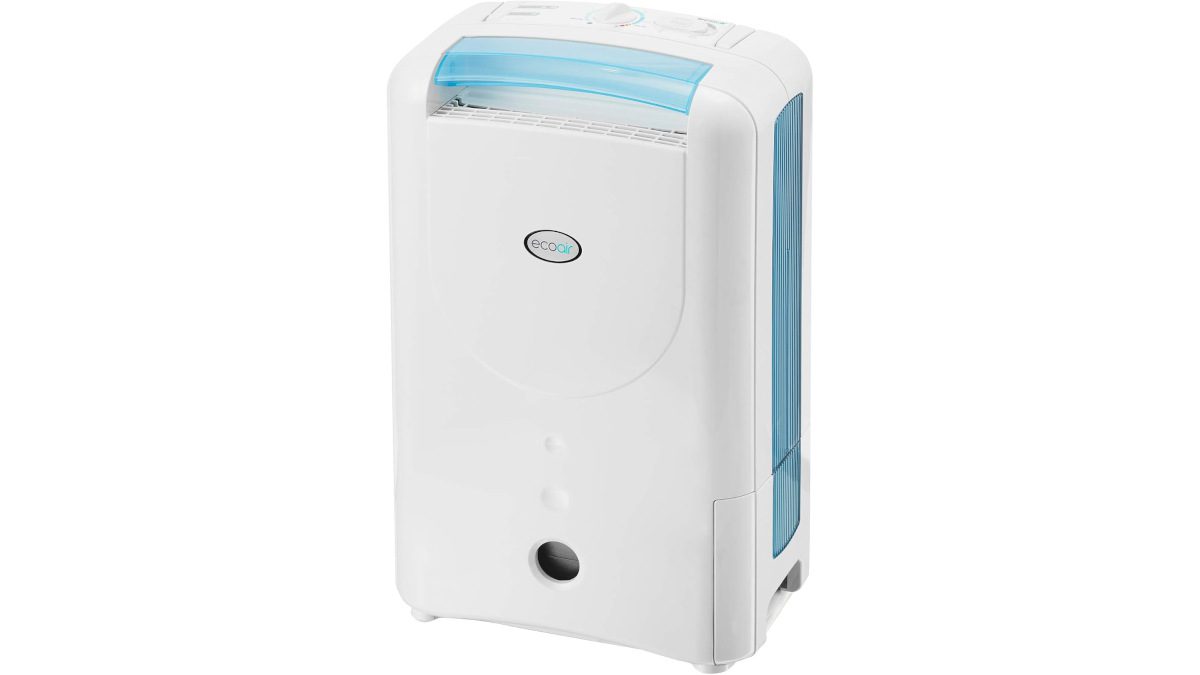

🤡 Camping Clown
He Has The £4,000 Version
My garage has a climate control system with an app, two industrial dehumidifiers, a humidity sensor on every shelf and an alert that goes off at 55%. It cost more than the car that used to live in there. My emergency food is in the kitchen, because I can never remember the app password.
How to Stop Damp in a Shed
A shed is the hardest place in the garden to keep dry. Thin walls, no insulation, a felt roof and usually no power for a dehumidifier. The fixes are mostly maintenance.
- Check the roof felt and the gutter every autumn. Most “damp sheds” are leaking sheds.
- Raise the shed off the ground on a proper base, and keep soil and leaves cleared from around the bottom so the timber can dry.
- Let air through. A shed that’s sealed tight traps condensation. Small vents high up, or opening the door on dry days, let it out.
- Treat the timber with a wood preservative every couple of years.
- Keep food out of it. A shed is fine for tools, fuel in proper containers and garden kit; it’s a poor place for food, batteries or anything paper.
- Oil metal tools lightly before winter, and hang them on the wall rather than leaving them on the floor.
Lofts: Fine for Some Things, Bad for Others
Lofts are dry-ish but swing between baking hot in summer and near freezing in winter, and condensation can form on the underside of the roof. That makes them a poor home for food, medicines and batteries, which all prefer steady, room-temperature storage. They’re fine for spare bedding and clothes in sealed bags, camping kit and things that don’t mind the temperature. Keep everything off the insulation and away from the roof felt, and check after any storm that the roof hasn’t let water in.
Do Damp Traps Work?
Yes, in the right place. A damp trap is a tub of calcium chloride crystals that pull moisture out of the air and turn into liquid in the bottom of the tub. In a small, closed space like a cupboard, a wardrobe, a box or a car, they genuinely take water out of the air, and the full tub shows you how much. In a garage or an open room they’re overwhelmed, because there’s simply too much air and too much moisture, so you’ll empty tubs all winter and see no difference.
- Use them in closed spaces: the under-stairs cupboard, a wardrobe, a storage chest.
- Change or refill them when the crystals are gone. A full tub has stopped working.
- Keep them away from children and pets, and pour the liquid away carefully. It’s salty and irritating to skin and eyes.
- Silica gel sachets are the small version for inside boxes. Use food-safe ones in food boxes, and many can be dried out and reused, following the pack’s instructions.
Containers: Get Rid of the Cardboard
The single biggest improvement most people can make to damp storage costs nothing: take things out of cardboard. Cardboard absorbs moisture, collapses, and attracts mice and silverfish. A stack of decent lidded plastic boxes keeps out damp air, dust and pests, stacks neatly and lets you see what’s inside.
- Pack things dry. Never put anything in a sealed box damp, or on a humid day, because you’ll seal the moisture in with it.
- Add a silica gel sachet to boxes going somewhere cold.
- Label the outside with the contents and the date, so you’re not opening every box to find the batteries.
- Vacuum bags work well for bedding and spare clothes.
One honest note: a lidded storage box keeps out damp air and splashes, but most aren’t sold as waterproof. If it might have to survive a flood, it needs a properly waterproof case.
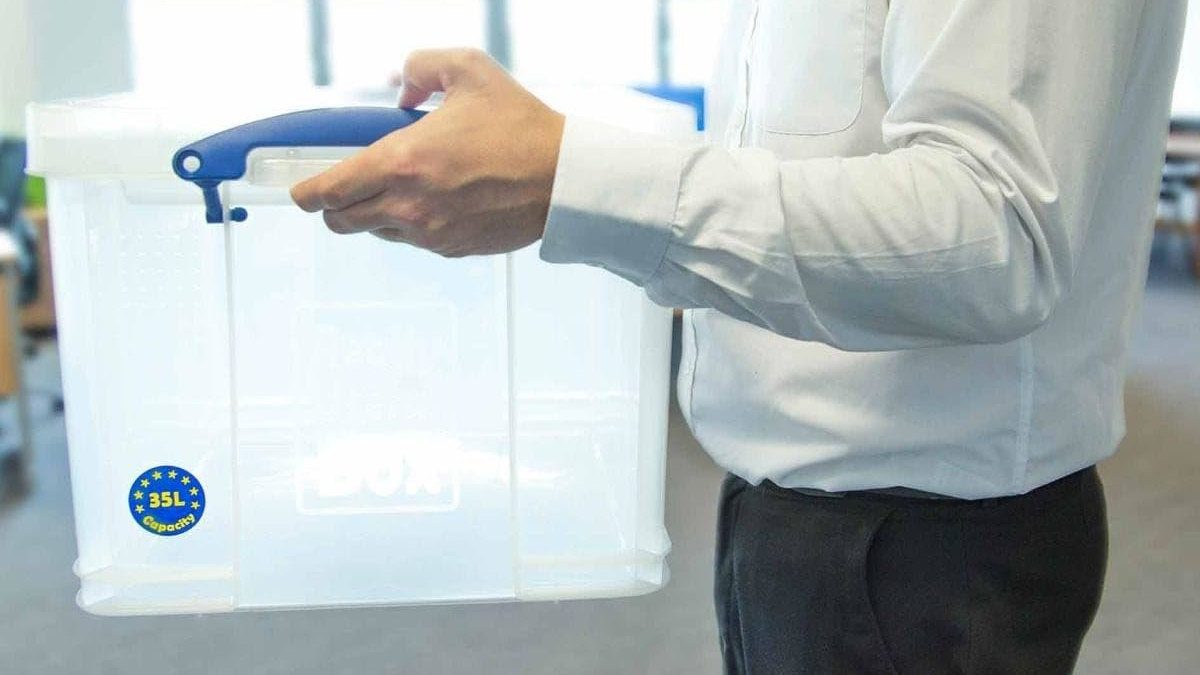
Really Useful Boxes
Really Useful Boxes are actually waterproof, they seal properly, and they’re engineered well. Built to last and protect anything stored in them.
How to Store Batteries
Battery makers are consistent on this. Energizer’s guidance is room temperature and moderate humidity, and both Energizer and Duracell say the fridge and freezer don’t make batteries last longer: they just add a risk of condensation on the contacts.
- Keep them indoors, in a dry cupboard at normal room temperature. Not the garage, the shed or the loft.
- Keep them in their original packs, or in a battery case, so loose ones can’t touch each other or keys and coins. A short circuit can make a battery overheat or leak.
- Take batteries out of torches, radios and anything else you’re storing for emergencies, and keep them in the pack beside it. Batteries left in a device are the ones that leak and wreck it.
- Check them twice a year for leaks, crust and dates.
Keeping Documents Dry
Paperwork is the hardest thing to replace and the easiest thing for damp to ruin. Keep the important ones (passports, birth and marriage certificates, deeds, insurance and wills) indoors, in a sealed plastic wallet inside a box, off the floor and away from outside walls. If they need to survive a flood as well as damp, use a properly waterproof case, and keep scans or photos of everything somewhere off-site.
MEIJIA Waterproof Case
An IP67 hard case with a full O-ring seal, made to be submerged, so the photos and papers you can never replace stay dry when floodwater gets in.
Our Full Review: MEIJIA Waterproof Case →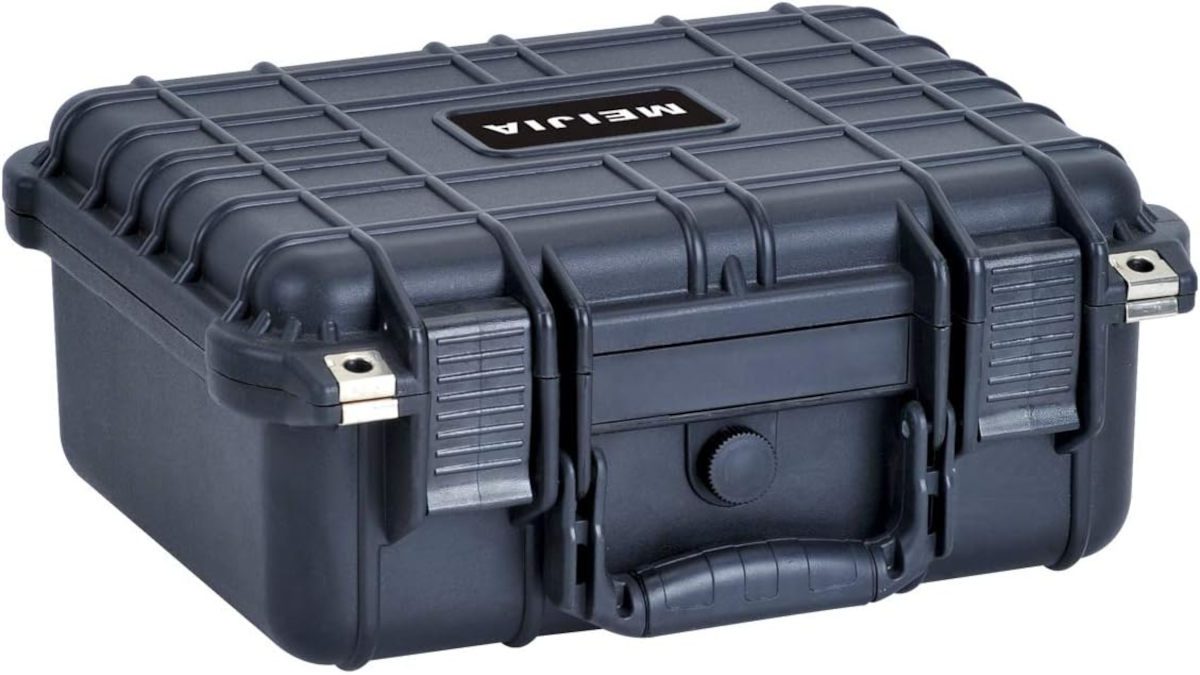
Food: Tins and Dry Goods
Tinned food lasts years if the tin stays sound, so damp is its main enemy. A bit of surface rust that wipes off is a warning, not a write-off: move that stock somewhere drier and use it first. Tins that are bulging, leaking, badly dented (especially on a seam) or rusted through go in the bin, unopened. Food safety advice is clear on bulging tins in particular, because the swelling can be gas from bacteria growing inside.
- Dry goods such as pasta, rice, flour, oats and sugar go into airtight containers, not left in their paper or thin plastic packets.
- Rotate: oldest at the front, newest at the back, and use something from the store in an ordinary meal regularly so nothing sits there for years.
- Keep the main food store indoors, with only overflow in a garage, in sealed boxes, off the floor.

🦆 Keith
Don’t Be Keith
Keith bought two years’ worth of tinned food in one go and stacked the lot, still in the supermarket’s cardboard trays, on the garage floor next to the lawnmower and the petrol can. By February the bottom trays had turned to porridge, the bottom two rows of tins had gone orange, and the beans tasted faintly of two-stroke. His wife now keeps the real food store in the spare-room wardrobe and doesn’t tell him where the key is.
When It’s the House That’s Damp
Everything above is about storage spaces. If the damp is in the rooms you live in, with black mould on window frames, wet walls in the bedroom, or condensation streaming down the glass every morning, that’s a ventilation and heating problem, and it affects your health as well as your stuff.
Complete Guide
Preventing Indoor Mould & Damp
Mould needs moisture to grow — remove the moisture and you remove the problem. This guide covers ventilation, heating patterns, dehumidifiers, humidity monitoring, and keeping stored supplies dry.
Read the Full Guide: Preventing Indoor Mould & Damp →
A Twice-a-Year Damp Check
Spring and autumn, when the clocks change, is an easy rhythm to remember. Ten minutes per storage space:
- Look behind and under everything in the under-stairs cupboard, the garage, the shed and the loft.
- Check the hygrometer readings, and move anything that’s sitting somewhere above 70%.
- Check tins for rust and swelling, and dry goods for damp, smells or pests.
- Check batteries for leaks, and take any out of stored torches and radios.
- Empty or replace full damp traps, and dry out or replace silica gel.
- Check shed felt, gutters and the garage door seal before winter.
- Rotate the food: use the oldest, replace it, put the new stock at the back.
Frequently Asked Questions
What is the best way to stop damp storage ruining supplies?
Get things out of cardboard and into lidded plastic boxes, lift them off the floor, keep them a few centimetres away from outside walls, and keep the humidity below about 70%, which is roughly where mould starts to grow. A cheap hygrometer tells you whether a space is damp enough to worry about.
Is a dehumidifier for a garage worth it?
If the garage is genuinely damp and you store things in it, yes. Choose a desiccant dehumidifier for an unheated garage: compressor dehumidifiers struggle once the temperature drops below about 10 to 15°C, while desiccant ones keep working in the cold. It needs mains power, so it protects your supplies in normal times rather than during a power cut.
Do damp traps work?
Yes, in small closed spaces such as cupboards, wardrobes and storage chests, where they pull a real amount of water out of the air. In a garage or an open room there’s too much air for them to make a difference. Replace them when the crystals have gone, and keep them away from children and pets.
Are rusty tins safe to eat?
Light surface rust that wipes off the outside is a warning to move the stock somewhere drier and use it first. Throw away tins that are bulging, leaking, badly dented on a seam or rusted through, without opening them, and don’t eat from any tin with rust inside.
How should I store batteries for emergencies?
Indoors, in a dry cupboard at room temperature, in their original packs or a battery case. Not in the fridge, the garage or the shed. Take batteries out of stored torches and radios and keep them alongside, because batteries left in a device are the ones that leak and ruin it.
Build Your Resilience

The whole plan, in one book
Prepared, Not Panicked (2026 edition) pulls our guides together into one plan for UK households. PDF, £4.99.
See inside the book →Further Reading: Related Guides
- Preventing Indoor Mould & Damp
- The 3-Day Emergency Pantry
- Long-Term Food Storage
- Protecting Your Important Documents
- Rechargeable vs Alkaline Batteries
All our guides can be found listed on our resilience hub.
Gear We've Tested & Reviewed
- EcoAir DD1 Simple Dehumidifier Review
- ThermoPro TP50 Hygrometer Review
- Really Useful Boxes Review
- MEIJIA Waterproof Case Review
All our reviews can be found on our reviews and resources page.


