
This post contains affiliate links. Learn more
When the power goes off, the first things most households miss aren’t the big appliances. It’s the Wi-Fi, the phones, the laptop and a decent light to see by. A power bank can keep a phone going, but it can’t run anything with a normal three-pin plug. The Anker SOLIX C300X can.
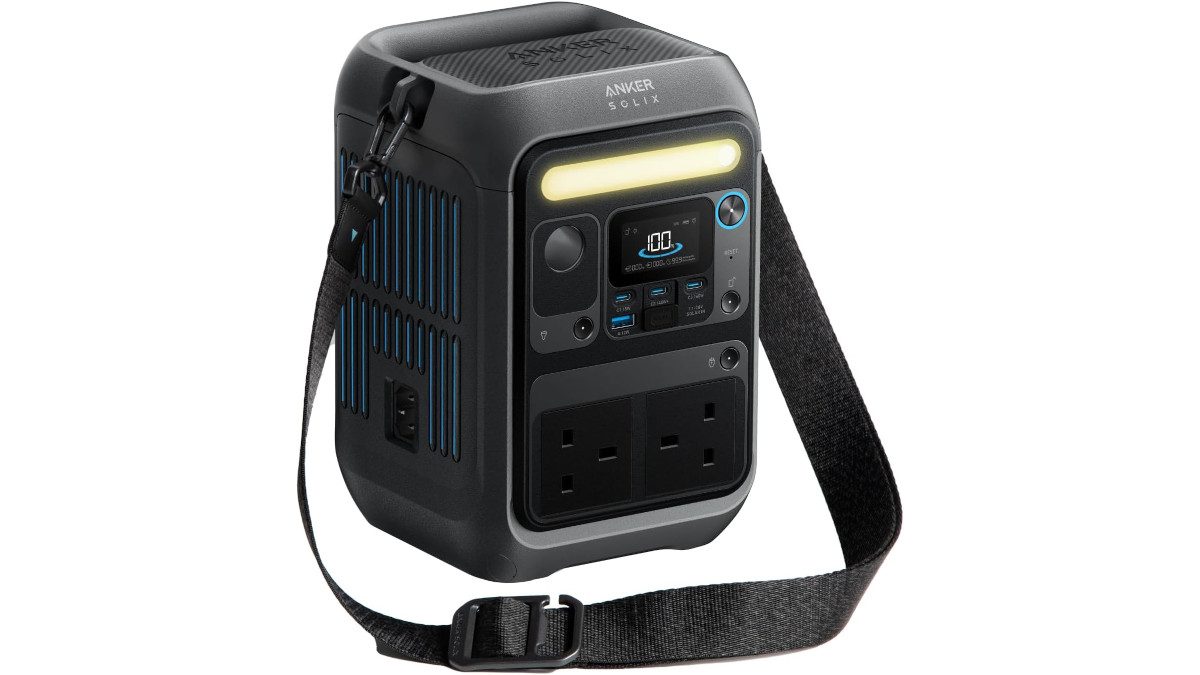
The Anker SOLIX C300X is a compact portable power station with a 288Wh LiFePO4 battery, 300W output and two proper AC sockets, plus USB-C, USB-A and a car socket. It’s the updated version of the original Anker SOLIX C300, and it’s the sensible first step up from a power bank for a UK household that wants the essentials to keep running through a power cut.
Anker SOLIX C300X
Two proper plug sockets, 288Wh of long-life LiFePO4 and 80% recharged in 50 minutes: the essentials kept running through a power cut.
Current Price at time of writing: £179.98
Rated: 4.7/5 ⭐ from 15 reviews
Anker SOLIX C300X or Anker SOLIX C300: What’s the Difference?
If you’ve been searching for the Anker SOLIX C300, you’ll find the original listing is no longer available on Amazon UK. The Anker SOLIX C300X has taken its place. On paper the two are the same core unit: 288Wh of capacity, 300W continuous output with 600W surge, LiFePO4 chemistry and the same seven-port layout.
There’s also a cheaper Anker SOLIX C300 DC, which is easy to mix up with it. The C300 DC has no AC sockets at all, only USB and a car socket. For power cut use that’s a big gap, because most of the things you’ll want to run, from the router’s power adapter to a lamp, plug into a normal wall socket. If your plan involves anything with a three-pin plug, the Anker SOLIX C300X is the one you want.
Anker SOLIX C300X Specs at a Glance
- Capacity: 288Wh LiFePO4 battery, rated for 3,000 cycles
- Output: 300W continuous, 600W surge
- AC sockets: 2 (300W combined)
- USB-C: 2 × 140W two-way ports, plus 1 × 15W
- USB-A: 1 × 12W
- Car socket: 1 × 120W
- Mains recharge: 80% in 50 minutes
- Other ways to charge: solar (pairs with a 100W panel), car, or the 140W USB-C port
- Noise: 25dB from about a metre away
- Warranty: 5 years
Anker also says the unit is 15% smaller than similar designs, has smart temperature control and an impact-resistant build, and is designed to last a decade.
What the Anker SOLIX C300X Will Run in a Power Cut
A power station’s capacity is measured in watt-hours. As a rough guide, you can expect to use around 80 to 85% of the 288Wh once you allow for conversion losses, so call it about 240Wh of real-world power. Divide that by what a device draws, and you have a ballpark run time:
- Wi-Fi router (about 10–15W): roughly 16 to 24 hours
- Phone charges (about 15Wh each): around 15 full charges
- Laptop charges (about 50–60Wh each): around 4
- LED lamp (about 5–10W): a full day or more
- A router, two phones and a lamp together: comfortably through a typical evening and night
Those figures are estimates, and real devices vary, so check the wattage on your own kit’s label or power adapter. The point is that the Anker SOLIX C300X turns a power cut from “sitting in the dark with no signal” into an ordinary evening with the internet on.
The 120W car socket is worth a mention too. It will run 12V gear such as a cool box or a 12V light, which makes the Anker SOLIX C300X just as useful on a camping trip as it is at home.
What It Won’t Run
The 300W limit is a real one. Anything that heats or has a big motor is out: kettles, microwaves, toasters, hair dryers, fan heaters and electric hobs all draw far more than 300W. The 600W surge rating is there to cope with a brief spike when something starts up, not to run a higher-wattage appliance.
A domestic fridge-freezer is also a stretch. Even if it starts, 288Wh won’t keep one going through a long outage. The Anker SOLIX C300X is built for the essentials: communications, light, charging and small devices. If you need to keep a fridge, freezer or medical equipment running for hours, you need a bigger power station in the 1kWh range or above.
Charging the Anker SOLIX C300X
One of the strongest points on the listing is recharge speed. Plugged into the mains, the Anker SOLIX C300X reaches 80% in 50 minutes. If a storm warning goes out, you can top it up in less time than it takes to watch the forecast.
You can also charge it from a solar panel (Anker recommends pairing it with a 100W panel), from the car, or through the 140W USB-C port. That port works both ways, so the same socket can fast-charge a laptop or charge the power station itself. One thing to check if you’re buying a panel: Anker says it isn’t compatible with its PS30 panel or other 5V USB-C solar panels.
Like any Anker portable power station, it’s happy to sit in a cupboard between uses. For power cut readiness, the simplest routine is to keep it charged and top it up every month or two, and again when a weather warning is issued.
LiFePO4: Why the Battery Type Matters
The Anker SOLIX C300X uses LiFePO4 (lithium iron phosphate) cells. Anker rates them for 3,000 charge cycles and designs the unit to last ten years. For a power station that might sit in a cupboard for months between uses, that long life is exactly what you want.
It also suits the way most households will actually use it: charged, stored, used for a few hours during an outage, then recharged. A battery built for thousands of cycles won’t be worn out after a few winters.
Anker SOLIX C300X
Two proper plug sockets, 288Wh of long-life LiFePO4 and 80% recharged in 50 minutes: the essentials kept running through a power cut.
Current Price at time of writing: £179.98
Rated: 4.7/5 ⭐ from 15 reviews
Who the Anker SOLIX C300X Is For
- Households that want the internet, phones, laptops and lights to keep going through a power cut
- Anyone who has outgrown a power bank and needs proper AC sockets
- Home workers who can’t afford to lose a working day when the power goes
- Campers and caravanners who want a compact power source that also earns its place at home
There’s no single best portable power station for power outages. It depends on what you need to keep running. If you want to run a fridge, a freezer or anything that heats, look at a larger power station. If you want the essentials covered in something you can carry with one hand, the Anker SOLIX C300X is the place to start.
Anker SOLIX C300X: Our Verdict
The Anker SOLIX C300X takes everything that made the original Anker SOLIX C300 a sensible first power station and keeps it: 288Wh of long-life LiFePO4, two AC sockets, fast USB-C and a recharge that takes under an hour to reach 80%. It won’t run your kettle, and it isn’t trying to. As a first Anker portable power station, it gets the basics right. For keeping a UK household connected, charged and lit through a power cut, it covers the essentials without the size or cost of a big unit.
Anker SOLIX C300X
Two proper plug sockets, 288Wh of long-life LiFePO4 and 80% recharged in 50 minutes: the essentials kept running through a power cut.
Current Price at time of writing: £179.98
Rated: 4.7/5 ⭐ from 15 reviews
What the Rest of the Team Think

🦆 Keith the Prepper
Charged, labelled and sitting next to the blackout box. When the grid goes, I’ll have Wi-Fi and the kettle… well, not the kettle. 300 watts, apparently. My wife read the box before I did. But the router stays on, and that’s what counts when the neighbours come knocking for the password.
⭐⭐⭐⭐⭐

🪖 Black Panther
Compact. Two AC outlets. Recharges to 80% in under an hour. In my previous role we had generators the size of a car to achieve the same result. Civilians do not need that. This keeps comms and lighting running. Carry on.
⭐⭐⭐⭐

🤡 Camping Clown
I bought a 3,600Wh unit first. It weighs as much as a small child and I live in a flat. This does everything I actually use in a power cut and lives under the stairs. I’m keeping both, obviously.
⭐⭐⭐⭐

🐾 Weekend Warrior
Router, two phones and the lamp, all at once, with ports to spare. The car socket runs the 12V cool box on perimeter patrol too. Pickle has claimed the spot next to it as her command post. Bro.
⭐⭐⭐⭐⭐

🐕 Pickle
Snorgle!
⭐⭐⭐⭐⭐ (quiet, does not beep, approved for sitting beside)

🐔 Chicken Licken
Three thousand cycles. Did you know the cheap batteries in a lot of budget units are rated for a fraction of that? I’ve been saying this for years: get the chemistry right first time and you buy once, not three times.
⭐⭐⭐⭐⭐

📋 Calm Clarissa
Added to the emergency kit inventory. Charge level checked on the first of the month, same as the smoke alarms. Topped up whenever there’s a weather warning. 80% in 50 minutes means there’s no excuse. Janet has asked for one for the summer house.
✅✅✅✅✅

💄 Survivl Gurl
Okay so it charged my ring light, my phone AND my laptop at the same time and it’s actually small enough to not ruin the room?? Power cut content without the power cut drama. We love a 140W USB-C. 🔋
⭐⭐⭐⭐⭐

🌿 Aroura
Sunlight, stored in a box and given back when we need it. I charge mine from a small solar panel in the garden and use it for the lamp and the diffuser when the grid is unsettled. It hums at little more than a whisper. Namaste 🙏
⭐⭐⭐⭐
Pros and Cons
Pros
- Two proper AC sockets, so the Anker SOLIX C300X runs anything with a normal plug up to 300W
- Recharges to 80% in 50 minutes from the mains
- Long-life LiFePO4 battery rated for 3,000 cycles, with a 5-year warranty
- Two 140W two-way USB-C ports for fast laptop charging
- Compact, quiet at 25dB, and easy to store in a cupboard
- Charges from mains, solar, car or USB-C
Cons
- 300W limit rules out kettles, microwaves, heaters and other heating appliances
- 288Wh won’t keep a fridge-freezer going through a long outage
- Solar input suits a 100W panel, so solar top-ups are slow in a UK winter
- Not compatible with Anker’s PS30 or other 5V USB-C solar panels
- The standalone Anker SOLIX C300X listing is newer, so it has far fewer reviews than the original C300 had
Frequently Asked Questions
What’s the difference between the Anker SOLIX C300X and the Anker SOLIX C300?
The Anker SOLIX C300X has replaced the original Anker SOLIX C300 on Amazon UK. Both have 288Wh of LiFePO4 capacity, 300W output with 600W surge, and the same seven ports, including two AC sockets.
Does the Anker SOLIX C300X have plug sockets?
Yes, it has two AC sockets with 300W combined output, plus two 140W USB-C ports, a 15W USB-C, a USB-A port and a 120W car socket. The cheaper Anker SOLIX C300 DC has no AC sockets.
How long will the Anker SOLIX C300X run a Wi-Fi router?
As a rough guide, a router drawing 10 to 15W will run for around 16 to 24 hours. Check the wattage on your own router’s power adapter for a closer estimate.
Can the Anker SOLIX C300X run a kettle or a fridge?
No. Kettles, microwaves and heaters draw far more than its 300W limit. A domestic fridge-freezer would run the 288Wh battery down quickly, so for that you need a power station in the 1kWh range or above.
Can I use the Anker SOLIX C300X for medical equipment such as a CPAP machine?
Check your device’s wattage and talk to your equipment supplier first. Power use varies a lot between machines, especially with heated humidifiers, so don’t rely on any power station until you’ve confirmed it can run yours for as long as you need.
How long does the Anker SOLIX C300X take to charge?
It reaches 80% in 50 minutes from a wall socket. It can also charge from a solar panel (Anker recommends a 100W panel), from a car, or through its 140W USB-C port.
Build Your Resilience
Further Reading: Related Guides
- Portable Power Stations for Power Cuts: What Size Does a UK Home Actually Need?
- Portable Power Station With Solar Panel
- Power Cut Survival Guide
- Power Bank for Power Cuts
- Blackout Box
All our guides can be found listed on our resilience hub.
📡 Find Us Everywhere
Daily briefings, prep guides, and real-time updates across every platform. Pick yours.
Free. No commitment. Stay anonymous on WhatsApp & Telegram.
Stay Informed on UK Preparedness
Join our newsletter for UK-specific preparedness tips, product recommendations, and real-world advice for households.
Subscribe to Our Newsletter