
This page contains affiliate links. As an Amazon Associate, UK Prepper Hub earns from qualifying purchases. Learn more
Most power cuts are over before the freezer notices. The ones that matter are the long ones: a storm brings a line down on a Friday night, the network operator says Tuesday, and by Saturday lunchtime the freezer’s dripping, the router’s dead and every phone in the house is on 4%.
The AIVOLT generator is a petrol inverter generator built for that second kind of power cut. It weighs 12kg, gives clean pure sine wave power through a standard UK three-pin socket plus USB-A and USB-C, and runs for hours on a 2.5 litre tank. This AIVOLT generator review covers what it will run, how long it lasts, and how to use a petrol generator at home without poisoning anybody.
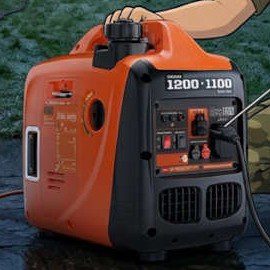
AIVOLT 1200W Petrol Inverter Generator
A 12kg petrol inverter generator with clean pure sine wave power to keep the fridge, router and phones going through a long power cut.
Amazon.co.uk Price: £299.99 (as of 19/11/2026 07:00 GMT)
Our Prepared Shield Rating: 4/5 🛡️
The AIVOLT Generator at a Glance
- Model: AIVOLT AGen1200 petrol inverter generator
- Power: 1,200W starting (surge), 1,100W running
- Outlets: one 230V UK three-pin socket, one USB-A, one USB-C
- Engine: 60cc four-stroke OHV, air-cooled, pull start
- Fuel tank: 2.5 litres of petrol
- Output: pure sine wave, under 3% total harmonic distortion
- Weight and size: 12kg, about 43 x 25 x 40cm
- Controls: Eco mode switch, output, overload and oil warning lights, earth terminal, parallel ports
- In the box: spark plug wrench, oil funnel, screwdriver, quick-start guide and manual
One socket is the thing to plan around. With a good outdoor extension lead it’s plenty for a household’s essentials, but it makes the AIVOLT generator a “choose what matters” machine rather than a whole-house one. That’s no bad thing in a power cut. The parallel ports mean you can link a second AGen1200 later with parallel cables (not in the box) if you ever need more.
What the AIVOLT Generator Will Run in a Power Cut
The number to remember is 1,100 watts. That’s the AIVOLT generator’s running output, and it’s what everything plugged in at once has to add up to. The 1,200W figure is a short burst for things that need a kick to get going, like a fridge compressor starting up.
Rough running figures for the things people actually want during a power cut:
- Fridge or fridge-freezer: around 100-200W, with a brief spike when the compressor starts
- Wi-Fi router and broadband box: 10-20W
- Laptop on charge: 45-100W
- Phones, tablets and power banks: a few watts each, and the USB ports handle these on their own
- LED lamps: under 10W each
- TV: 50-150W for most modern sets
Put the fridge-freezer, the router, a laptop, the phones and a couple of lamps together and you’re comfortably under 600W, with room left for the fridge’s start-up kick. That’s the realistic job for a generator for power cuts this size: keep the food cold, keep the house connected and keep the lights on.
What the AIVOLT generator won’t run: anything that heats with electricity. A kettle is typically 2,000-3,000W, a fan heater the same, an immersion heater 3,000W and an electric shower a lot more. A microwave’s label might say 800W, but that’s the cooking power, and it pulls noticeably more from the socket, so treat it as a maybe on its own and a no with anything else plugged in. Check the rating plate on anything you’re unsure of, and if the overload light comes on, unplug something.
So what size generator do I need? If the answer is “run the whole house as normal”, you need something far bigger, fitted by an electrician. If it’s “keep the essentials going until the power comes back”, a 1,100W petrol generator for home use like this one is the sensible size, and far easier to store and lift.
Why an Inverter Generator Suits Home Electronics
Old open-frame site generators make rough, wobbly power. Fine for a cement mixer, less fine for a laptop charger or a boiler’s circuit board. An inverter generator turns the engine’s output into clean, steady mains-style power. The AIVOLT generator’s listing quotes pure sine wave output at under 3% total harmonic distortion, which is exactly what you want to see if sensitive electronics are going on the end of the lead.
The other inverter trick is that the engine speeds up and slows down with the load. Switch Eco mode on and it ticks over gently when you’re only running a fridge and a router, which saves petrol and keeps the noise down. Switch Eco off when something bigger needs the full output straight away.
How Long the AIVOLT Generator Runs on a Tank
AIVOLT’s own figures for a full 2.5 litre tank:
- 25% load (about 275W): 7 hours
- 50% load: 5.5 hours
- 75% load: 4 hours
- 100% load: 3.1 hours
Eco mode stretches that further at light loads, and AIVOLT says beyond 10 hours. A typical power cut load (fridge, router, a few lights and chargers) sits around the 25% mark, so a fair planning figure is a tank roughly every 7 hours. Run the AIVOLT generator round the clock and that’s 8-9 litres of petrol a day.
You don’t need to run it round the clock. A fridge stays cold for hours with the door shut, so running the generator for an hour or two at a time, a few times a day, keeps the food safe, tops up the phones and power banks, and makes the petrol go much further.
Which brings us to fuel. You can keep up to 30 litres of petrol at home in suitable containers, and petrol doesn’t keep forever, so rotate it into the car every few months and refill. Thirty litres is several days of the on-and-off running described above. Keep it in a shed or detached garage, never in the house.
How Quiet Is a Petrol Inverter Generator?
Quieter than you’d expect, louder than silence. AIVOLT quotes 58 decibels at 7 metres at 25% load, which it compares to a normal conversation. That’s the inverter design at work: at light loads the AIVOLT generator’s engine just ticks over, rather than roaring away flat out like an old site generator.
If you’re searching for a quiet petrol generator because the neighbours are a few feet away, this type is the right answer. You’ll still hear it at the bottom of a terraced garden at 10pm, though, so be a good neighbour and switch it off overnight. The fridge will be fine.
Using a Petrol Generator at Home Safely
This is the bit that matters most, because every winter there are stories of people hurt by generators run in the wrong place. Petrol engines make carbon monoxide, a gas you can’t see or smell.
- Outdoors only. Never in the house, the garage, a shed, a porch or a conservatory, not even with the door open.
- Away from the house, with the exhaust pointing away from doors, windows and air vents.
- Keep it dry under a shelter that’s open to the air on all sides, or a cover made for running generators. Never under a tarpaulin.
- Have a working carbon monoxide alarm inside the house, especially in rooms near where the generator runs.
- Use a heavy-duty outdoor extension lead, fully unwound, from the generator to the things you’re powering.
- Never plug it into a household socket or wire it into the fuse board yourself. It can send power back down the line to engineers working on it. If you want a generator connected to the house, an electrician fits a proper changeover switch.
- Let it cool before refuelling, and only refuel with the engine off.
Check the oil before the first pull, too. The funnel is in the box, the level is in the manual, and the oil warning light on the AIVOLT generator’s panel tells you when it’s low.
Generator or Power Station?
If you already have a portable power station, the AIVOLT generator isn’t a replacement, it’s the other half of the plan. A power station is silent and safe indoors but eventually runs flat. A petrol generator for home backup keeps going as long as there’s fuel, but has to live outside. Charge the power station from the AIVOLT generator for an hour or two, then bring the power station indoors and run things quietly overnight.
The pure sine wave output is what makes that work for the power station’s charger. Just check its charging draw first: anything that charges faster than about 1,000W needs its charge rate turning down in the settings or app, or it’ll trip the overload.
Who the AIVOLT Generator Is For
Rural homes on long overhead lines. Houses at the end of the network that get the multi-day cuts after every named storm. Anyone with a chest freezer full of food worth protecting, and anyone whose power station alone won’t last the distance. It’s also small enough to live in a shed and light enough to lift with one hand, which matters, because the generator that’s too heavy to drag out is the one that never gets used.
It’s not for anyone in a flat with no outdoor space, and it’s not for running electric heating. As a generator for power cuts and a petrol generator for home essentials, though, the AIVOLT generator is the right size, the right weight and the right kind of power.
AIVOLT 1200W Petrol Inverter Generator
A 12kg petrol inverter generator with clean pure sine wave power to keep the fridge, router and phones going through a long power cut.
Amazon.co.uk Price: £299.99 (as of 19/11/2026 07:00 GMT)
Our Prepared Shield Rating: 4/5 🛡️
What the Rest of the Team Think

🦆 Keith the Prepper
I had a 20kVA diesel generator picked out for the garage. My wife pointed out it was bigger than the garage. So the AIVOLT generator lives in the shed now, with a can of fresh petrol beside it, and for the first time the freezer full of venison I’ve never cooked is actually protected.
⭐⭐⭐⭐⭐

🪖 Black Panther
In my previous role we had a trailer-mounted diesel set that could light up a forward operating base. A house needs a fridge, a router and a kettle. Two out of three is a pass. 1,100 watts, pure sine wave, one-hand carry. Carry on.
⭐⭐⭐⭐

🤡 Camping Clown
I’ve got the £4,000 version. It has a touchscreen, Bluetooth and an app I can’t log into. It weighs 98kg and I can’t get it out of the garage without three neighbours and a sack truck. The AIVOLT one weighs 12kg. I’m not entirely sure why I didn’t think of that.
⭐⭐⭐⭐⭐

🐾 Weekend Warrior
Bro, I’ve got a generator plan for every scenario: grid down, EMP, the lot. What I didn’t have was anything for a power cut on a Tuesday at teatime. This thing starts on one pull and Pickle didn’t even bark at it, which from her is a full endorsement.
⭐⭐⭐⭐

🐕 Pickle
Snorgle!
Snorgle! Snorgle! Snorgle! Snorgle! (The orange box hums. The fridge with my sausages in it stays cold. I approve.)

📋 Calm Clarissa
I’ve written the generator checklist: oil checked, fresh petrol rotated, outdoor extension lead unwound, CO alarm tested, exhaust pointing at nobody’s window. Janet asked why it’s laminated. Obviously, because it’ll be dark and probably raining.
✅✅✅✅✅
Pros and Cons
Pros
- 12kg with a one-hand carry handle, so it actually gets taken out and used
- Pure sine wave output, safe for laptops, routers and power station chargers
- The AIVOLT generator’s 1,100W running output is the right size for power cut essentials
- Eco mode keeps fuel use and noise down at light loads
- USB-A and USB-C built in for phones and tablets
- Simple pull start and clear warning lights
- Parallel ports to add a second unit later
Cons
- One UK socket, so you’ll need an outdoor extension lead with a few sockets
- Won’t run a kettle, electric heater or immersion heater
- Petrol to store and rotate
- Like any petrol generator, the AIVOLT generator is outdoors only, so plan for rain cover and a CO alarm indoors
- The 2.5 litre tank needs refilling every few hours under heavier loads
Frequently Asked Questions
Will the AIVOLT generator run a fridge-freezer?
Yes. A fridge-freezer typically uses 100-200W while it’s running, with a short spike when the compressor starts, which sits well inside the AIVOLT generator’s 1,200W starting and 1,100W running output. Leave room for that start-up spike if other things are plugged in at the same time.
Can I run my boiler on a generator?
Only if a qualified electrician has set it up. Most gas boilers are wired into a fused spur rather than a plug, so there’s nowhere to plug a generator in. An electrician can fit a plug-in supply or a changeover switch so the boiler can run from a generator safely. Never wire a generator into the house yourself.
What size generator do I need for a power cut?
Add up the running watts of everything you want on at once, then leave headroom for anything with a motor or compressor. For the essentials (fridge-freezer, router, laptop, lights and phone charging) that’s usually under 600W, so a 1,100W inverter generator is enough. Running a whole house as normal, including electric heating or cooking, needs a much bigger generator installed by an electrician.
How long does the AIVOLT generator run on a tank of petrol?
AIVOLT quotes 7 hours at 25% load, 5.5 hours at 50%, 4 hours at 75% and 3.1 hours at full load from the 2.5 litre tank. Eco mode stretches light-load running beyond 10 hours. But, as with all generators, it depends on your usage and loading.
Can I run a generator in my garage with the door open?
No. The AIVOLT generator, like any petrol generator, produces carbon monoxide, which builds up to dangerous levels in a garage, shed or porch even with the door open. Run it outdoors, away from doors, windows and vents, and keep a working carbon monoxide alarm inside the house.
Can I charge a power station from the AIVOLT generator?
Yes. The AIVOLT generator’s pure sine wave output suits a power station’s mains charger. Check how much the power station draws while charging first, and if it’s more than the generator’s 1,100W running output, turn the charge rate down in its settings or app.
Build Your Resilience

The whole plan, in one book
Prepared, Not Panicked (2026 edition) pulls our guides together into one plan for UK households. PDF, £4.99.
See inside the book →Further Reading: Related Guides
- How to Prepare for a Power Cut
- Portable Power Stations for Power Cuts
- Fuel Storage at Home
- Heating Without Electricity
- Home Fire Safety
All our guides can be found listed on our resilience hub.


📡 Find Us Everywhere
Daily briefings, prep guides, and real-time updates across every platform. Pick yours.
Free. No commitment. Stay anonymous on WhatsApp & Telegram.
Stay Informed on UK Preparedness
Join our newsletter for UK-specific preparedness tips, product recommendations, and real-world advice for households.
Subscribe to Our Newsletter