

Flooding is the most common natural disaster in the UK. Around 5.2 million properties in England alone are at risk — that’s roughly one in six homes. Yet most households have done nothing about it, because flooding feels like something that happens to someone else, somewhere else, until the morning it doesn’t.
The difference between a flood that wrecks your home for six months and one you recover from in a week usually isn’t luck — it’s preparation. And most of that preparation costs very little, takes an afternoon, and needs to happen before any warning is issued. This guide walks you through flood defence as five layers, from knowing your risk through to drying out afterwards. Each layer builds on the last. You don’t have to do all of them at once — but you should know where you stand on every one.
Layer 1: Know Your Flood Risk
Most people have no idea whether their home is in a flood risk area. They assume they’d know — that it would be obvious from their location, or that someone would have told them. Neither is reliably true.
The Environment Agency’s Check Your Long-Term Flood Risk tool lets you enter your postcode and see your area’s flood risk from rivers, the sea, and surface water. It won’t tell you your specific property will flood — it assesses area-level risk. But if your area comes back red, the question is when, not if.
It’s also worth understanding the different types of flooding, because they behave differently and require different responses:
- River flooding — watercourses overflow following heavy or prolonged rain. Often slower to arrive, giving more warning time
- Surface water flooding — drains and gutters can’t cope with intense rainfall. Can happen almost anywhere, often with very little warning
- Coastal flooding — storm surges, high tides, and sea level events. Affects coastal and estuarine properties
- Groundwater flooding — the water table rises and saturates the ground from below. Hardest to predict, and almost impossible to barrier against
Once you know your risk type, you can sign up for free flood warnings directly from the Environment Agency at gov.uk/sign-up-for-flood-warnings. Alerts come by phone, text, or email. Do this now, before you need it — the registration takes two minutes, and a warning at 2am is worth nothing if you only signed up for it at 3am.
It’s also worth understanding the three warning levels:
- Flood Alert — flooding is possible. Be prepared
- Flood Warning — flooding is expected. Act now
- Severe Flood Warning — severe flooding is expected. There is a danger to life
Most people only start paying attention at Flood Warning level. The households that fare best start at Flood Alert.
Layer 2: Prepare Before Any Warning Is Issued
This is where most households fall down — not through ignorance, but through delay. Everything in this layer is most useful when you do it on a quiet Sunday afternoon, not in the thirty minutes before water arrives at your front door.
Document your home for insurance
Walk through every room with your phone and record a video. Open cupboards. Show furniture, appliances, valuables, electronics. Note serial numbers for anything significant. Do the same in the garage, loft, and garden shed.
Then store that footage somewhere that isn’t inside your house — email it to yourself, upload it to cloud storage, or keep a copy on a USB drive at a relative’s address. Your insurer will ask you to prove what you owned and what its condition was before the flood. Without pre-flood evidence, you are relying on their generosity. That is not a position you want to be in.
While you’re at it, check whether your contents insurance actually covers flood. A surprising number of standard policies either exclude it entirely or cap payouts in ways that aren’t obvious until claim time. If yours doesn’t cover flood — or if you’re not sure — call your insurer before you need to make a claim, not after.

🦆 Keith
Don’t Be Keith
Keith didn’t photograph his possessions before the flood — spent three weeks arguing with his insurer about whether his “vintage” hi-fi system was worth £200 or £2,000, with no evidence either way.
Store important documents securely
Passports, insurance documents, mortgage papers, NHS records, vehicle documents, and any irreplaceable paperwork should be stored in a waterproof container and ideally on an upper floor. A lockable waterproof box is sufficient — you don’t need anything elaborate. If water reaches the ground floor, your documents need to be somewhere it isn’t.
Know your utilities
You should know, without having to look it up, where your electricity consumer unit (fuse box) is, where your water stopcock is, and where your gas meter is. In a flood situation, you may need to shut them off quickly, in the dark, with water already on the floor. This is not the moment to discover you don’t know where the stopcock is.
Complete Guide
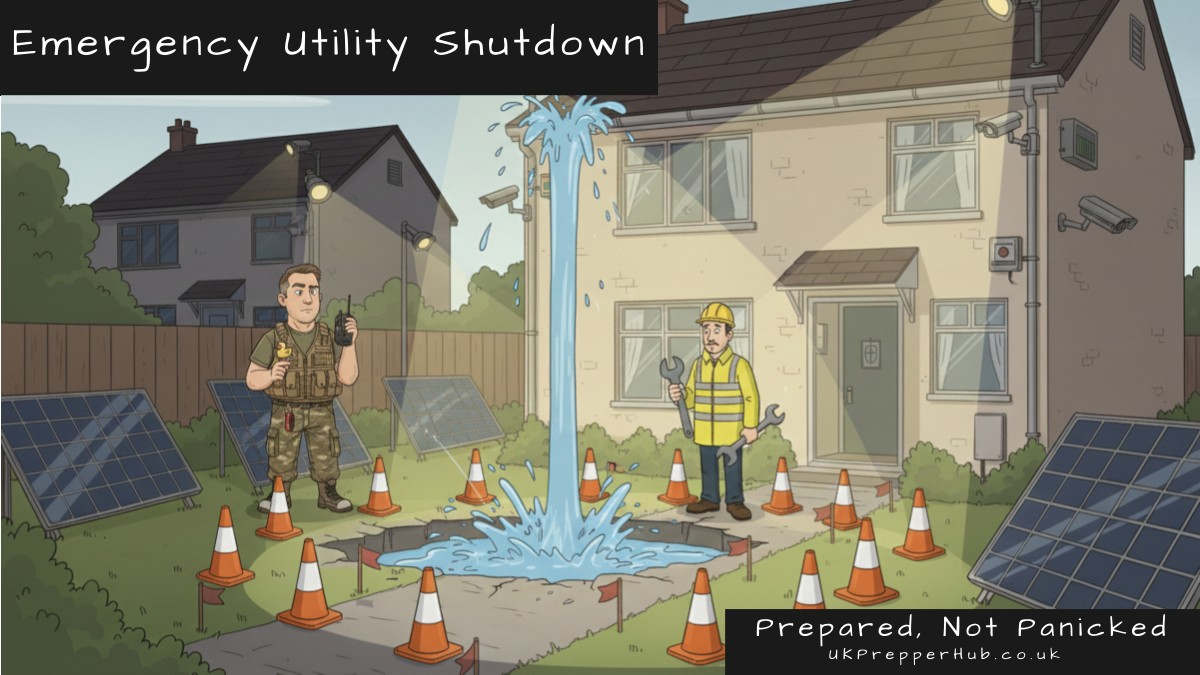
Emergency Utility Shutdown
When something goes wrong in the home — flooding, fire risk, storm damage, or a major leak — knowing when to shut off your utilities is just as important as knowing how.
Ensure you have drinking water stored
Floodwater doesn’t just come through your doors and windows — it can contaminate the local water supply even if your home itself isn’t directly affected. A flood event involving sewage overflow, agricultural runoff, or industrial spillage upstream can render tap water unsafe to drink across a wide area, sometimes for days after the water recedes.
Your water company will issue a notice if supply is affected, but in the immediate hours of a flood event, communications are often disrupted and notices can lag behind the actual risk. Having stored drinking water means you’re not dependent on that notification arriving promptly.
A reasonable starting point is enough water for your household for 72 hours — around three litres per person per day for drinking and basic food preparation. Store it somewhere accessible on an upper floor if possible, so it isn’t compromised by the same flooding you’re preparing for.
Complete Guide
Emergency Water Storage
How much to store, how to store it in small spaces, and the reality of UK water rotation.
Make a basic flood plan
Where will you go if you need to leave? Who collects the children, the elderly relative, the dog? What goes in the car and in what order? Who is responsible for shutting off utilities before you leave? A plan doesn’t need to be written down — but everyone in the household should have the same answers to those questions before the phone goes off at midnight with a flood warning.
Complete Guide
Home Evacuation Plan
Most households freeze during an evacuation — not from fear, but from making fifteen decisions simultaneously under pressure for the first time. This guide walks you through the five decisions to make now, calmly, before you ever need them.
Read the Full Guide: Home Evacuation Plan →
Layer 3: Physical Barriers
Flood barriers don’t keep water out permanently — they buy you time and reduce the volume that gets in. Even a relatively modest barrier on a door can be the difference between a damp doormat and six inches of water on the ground floor. The key is deploying them before water arrives, not while you’re paddling.

🐔 Chicken Licken
Did You Know?
About 5.2 million properties in England are at flood risk — that’s roughly 1 in 6. Most people who live in one don’t know it
Entry points to address
Water doesn’t just come through the front door. The most common entry points in a UK home are:
- Doors — particularly those at ground level with worn seals or a gap at the threshold
- Air bricks — the ventilation bricks built into the base of most UK cavity walls. Often overlooked, they let water straight into the sub-floor void
- Letter boxes — small opening, but at exactly the wrong height
- Drains and gullies — can back up and push water up through floor drains if surcharging
- Gaps around pipes and cables — anywhere utilities enter the building is a potential water path
Manthorpe Airbrick Flood Defence
The only UK-made flood-specific airbrick cover from an established manufacturer — permanent terracotta frame, bright yellow clip-on cover, fits standard 9″×3″ airbricks..
Our Full Review: Manthorpe Airbrick Flood Defence →
Entry-level: flood socks and door seals
A flood sock is a polymer-filled tube you lay along the base of a door or low threshold. It activates on contact with water, swelling to create a seal. Easy to store, and quick to deploy. For most households at moderate risk, this is the sensible starting point — inexpensive, effective for the scenarios most commonly faced, and ready to use in minutes.
Air brick covers are similarly cheap and simple — they clip over standard air brick sizes and block the opening during a flood. A pack of covers for a typical house costs less than £20 and takes ten minutes to fit. Buy them before you need them and store them next to the flood socks.
Floodshield Flood Sock
A 1.5m flood sock that stores flat in a drawer, then swells into a water-tight seal across your door minutes after you wet it.
Our Full Review: Floodshield Flood Sock →
Sandbags
Free sandbags are available from some local councils during flood events — but “during” is the problem. Ring time, delivery queues, and the sheer logistics of collection mean that if you’re relying on council sandbags, you may be waiting while water rises. It’s worth knowing your council’s policy in advance and having an alternative ready.
If you buy your own, note that empty sandbags are far easier to store than filled ones — you can fill them from your own garden in an emergency. A stack of twenty empty sandbags and a spade takes up the space of a shoebox.
The premium tier
For properties at higher or repeated flood risk, permanent or semi-permanent aluminium flood barriers — the kind that clip into door frames without requiring fixings — represent a significant step up in protection. They’re considerably more effective than fabric or polymer options for sustained water pressure. We’ll have a full review of the best available options shortly. For now, if you’re at serious risk and considering this route, look for products tested to the BSI Kitemark PAS 1188 standard.
Layer 4: During a Flood Warning
When a Flood Warning lands — not an Alert, an actual Warning — the time for deliberation is over. The following order of actions has been agreed by emergency services, insurers, and household resilience advisors as the most effective sequence for most UK households.
Move valuables upstairs immediately
Before anything else: rugs up, small appliances off the floor, anything of value moved to the first floor or above. Furniture can be elevated on blocks — insurers have noted that a significant proportion of flood damage costs come from items that could have been saved in ten minutes. Mattresses, sofas, and base units are the common casualties.
Deploy your barriers
Flood socks at doors, air brick covers in place, letter box sealed. Do this before water arrives, not as it arrives.
Utilities
Switch off electricity at the consumer unit if water is approaching the height of sockets or switches. If you’re unsure, turn it off anyway — a temporary inconvenience is manageable; an electrical fault in standing water is not.
Gas should only be turned off at the meter if you’re advised to do so by the Gas Emergency Service (0800 111 999) or if you can smell gas. Turning off gas unnecessarily can cause problems with boilers and heating systems that may then require an engineer to reset. Electricity is safer to isolate as a precaution; gas less so.
Water can stay on unless advised otherwise, but be aware that flood events sometimes result in local contamination of the supply. Keep stored drinking water accessible.
Complete Guide
Emergency Utility Shutdown
When something goes wrong in the home — flooding, fire risk, storm damage, or a major leak — knowing when to shut off your utilities is just as important as knowing how.
Know when to leave
If a Severe Flood Warning is issued, or if emergency services or your local council advise evacuation, leave. Don’t drive through floodwater — thirty centimetres is enough to move a car, and fast-moving water is deceptive. If in doubt, leave on foot via the safest available route, with your grab bag, documents, and pets.
📋 Calm Clarissa
If you’re told to leave, the bag needs to be packed already. My printable grab bag checklist has every item, including the waterproof folder for your documents. Free to download, obviously.
Download the Free Checklist →Complete Guide
72-Hour UK Grab Bag
The ‘get out quick bag’ for rapid home evacuation in the event of fire, flood, or other incidents. Every essential for 3 days away from home in one bag.
One more thing on driving: if your car is parked on the street and flooding is likely, move it to higher ground before water arrives, not after. A flooded engine is an insurance claim at best and a total write-off at worst.
Layer 5: Post-Flood Recovery
The flood has passed. The temptation is to get back in immediately and start salvaging. Don’t. A flooded property carries risks that aren’t obvious from the outside — structural instability, contaminated water still pooled in wall cavities, compromised electrics. Wait for the all-clear from emergency services or your local council before re-entering.
Document the damage first
Before you move, clean, or dispose of anything, photograph and video everything. This is where your pre-flood documentation earns its keep — your insurer will compare what was there with what was damaged. Record water tide marks on walls. Keep damaged items until your insurer has assessed them; disposing of them can invalidate a claim.
Contact your insurer as soon as possible. Most have dedicated flood claims lines with shorter wait times than standard claims. Ask specifically what temporary works they’ll cover — many will fund emergency accommodation and some immediate drying costs before the main claim is settled.
Drying out
Ventilation comes first. Open windows and internal doors (where structurally safe) and let air move through the property. This reduces moisture concentration and slows the rate at which it is absorbed into plaster, joists, and flooring.
Once the initial ventilation phase is underway, a dehumidifier becomes your most important tool. Running one continuously in a flood-affected room will draw moisture from walls, flooring, and contents far more effectively than ambient airflow alone. For significant flooding, you may need more than one unit, or to move a single unit between rooms systematically.
EcoAir DD1 Simple
The rotary-dial desiccant dehumidifier that keeps cold, solid-walled rooms dry where compressor models give up, and switches itself on from a smart plug or a timer.
Our Full Review: EcoAir DD1 Simple →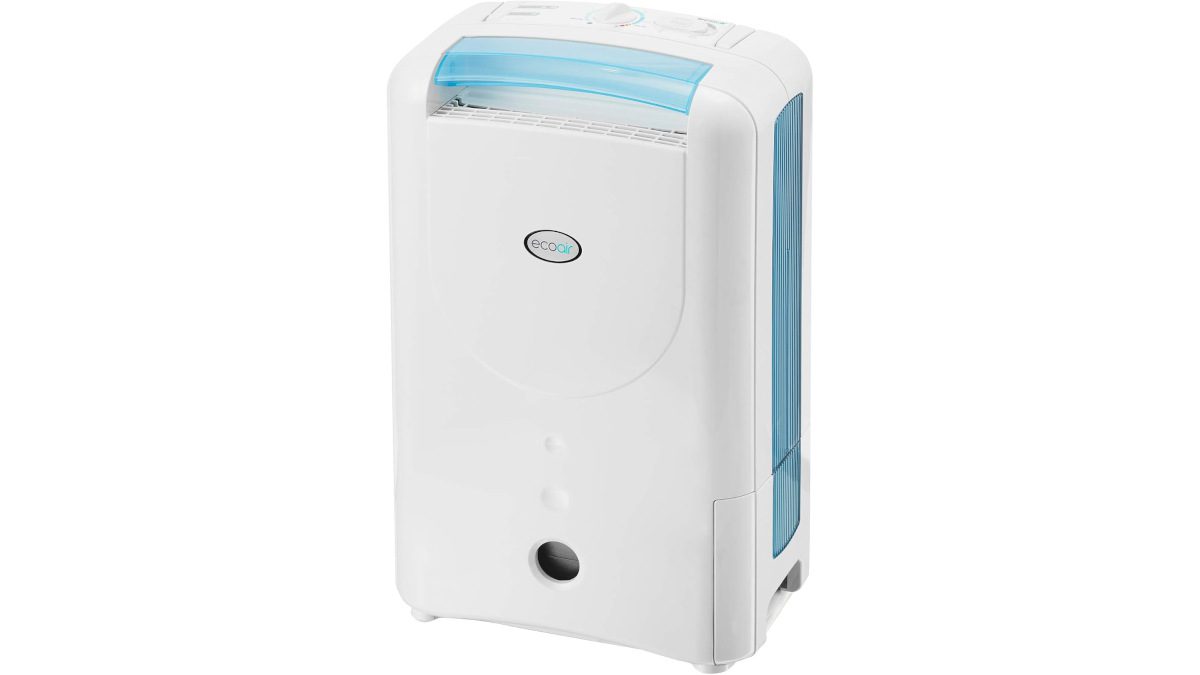
Be cautious about using high-heat drying methods — radiant heaters or heat guns applied directly to wet plaster can cause surface cracking that makes the eventual repair significantly more expensive. Slow, ventilated drying is almost always preferable to forced heat.
The mould problem
Mould can begin developing within 24 to 48 hours of a flood in warm, damp conditions. It frequently colonises behind plasterboard, under floor coverings, and inside wall cavities where it isn’t immediately visible. By the time you can see it or smell it, it has usually been established for days.
Watch for musty smells, soft or discoloured plaster, and lifting floor coverings in the weeks after a flood. If mould does establish, treat it properly rather than cosmetically — painting over mould causes significantly more problems than it solves.
ThermoPro TP50 Digital Hygrometer
A compact, accurate hygrometer that tells you exactly what the humidity is in any room — so you know whether you have a damp problem before mould appears. Under £15 and the easiest first step in managing moisture at home. Now sold on Amazon UK as the TempPro TP50.
Our Full Review: ThermoPro TP50 Digital Hygrometer →
Complete Guide
Preventing Indoor Mould & Damp
Mould needs moisture to grow — remove the moisture and you remove the problem. This guide covers ventilation, heating patterns, dehumidifiers, humidity monitoring, and keeping stored supplies dry.
Read the Full Guide: Preventing Indoor Mould & Damp →
Utilities before you restore them
Don’t restore electricity until a qualified electrician has inspected any circuits that were exposed to water. Don’t restore gas until a Gas Safe registered engineer has checked the system. Both are legal requirements for signed-off reinstatement, and both exist because the consequences of skipping them are severe.
Tap water in flood-affected areas may be subject to a temporary notice from your water company. Check before drinking; if in doubt, use stored water or boil tap water until you receive confirmation from your supplier that supply is safe.
Frequently Asked Questions
How do I know if my home is at risk of flooding?
Use the Environment Agency’s free postcode checker at check-long-term-flood-risk.service.gov.uk — it shows your area’s risk from rivers, sea, and surface water. You can also sign up for free flood warnings at
gov.uk/sign-up-for-flood-warnings.
What’s the difference between a Flood Alert and a Flood Warning?
A Flood Alert means flooding is possible — prepare. A Flood Warning means flooding is expected — act now. A Severe Flood Warning means severe flooding is expected and there may be danger to life. Don’t wait for a Warning to start preparing; by then you’ve lost half your preparation window.
Do flood barriers actually work?
Yes, for most scenarios. They don’t make your home waterproof against sustained high water pressure, but they significantly reduce the volume of water that enters and buy you critical time to move valuables and act. A £30 flood sock deployed before water arrives is worth considerably more than a £500 barrier deployed after it.
Will my home insurance cover flood damage?
Most standard home insurance policies include flood cover, but check yours specifically — some exclude it or apply caps. The time to discover a gap is before a claim, not during one.
Can I get free sandbags from my council?
Some councils provide free sandbags during active flood events, but availability and delivery time varies significantly. Check your local council’s policy in advance, and consider keeping a supply of empty sandbags at home so you can fill them from your garden if needed.
How long does it take to dry out a flooded house?
It depends on the depth of flooding, the materials affected, and the drying method used. A lightly flooded ground floor might dry in two to three weeks with good ventilation and a dehumidifier. Significant flooding affecting wall cavities and subfloors can take several months.
Is tap water safe to drink after a flood?
Not necessarily. Flood events can contaminate local water supplies. Wait for confirmation from your water company before drinking from the tap, and use stored water or boil water in the meantime.
Build Your Resilience
Further Reading: Related Guides
- Home Evacuation Plan
- Emergency Utility Shutdown
- Preventing Indoor Mould & Damp
- 72-Hour Grab Bag
- Emergency Water Storage
- Emergency Sanitation Guide
- Protecting Your Important Documents
- Emergency Home Tool Kit
- Water Coming Through the Ceiling
All our guides can be found listed on our resilience hub.
Gear We’ve Tested & Reviewed
- Floodshield Flood Sock
- EcoAir DD1 Simple Dehumidifier
- Manthorpe Airbrick Flood Defence
- Unibos 1-Meter Universal Stopcock Key
- Self Amalgamating Tape Review
All our reviews can be found on our reviews and resources page.