
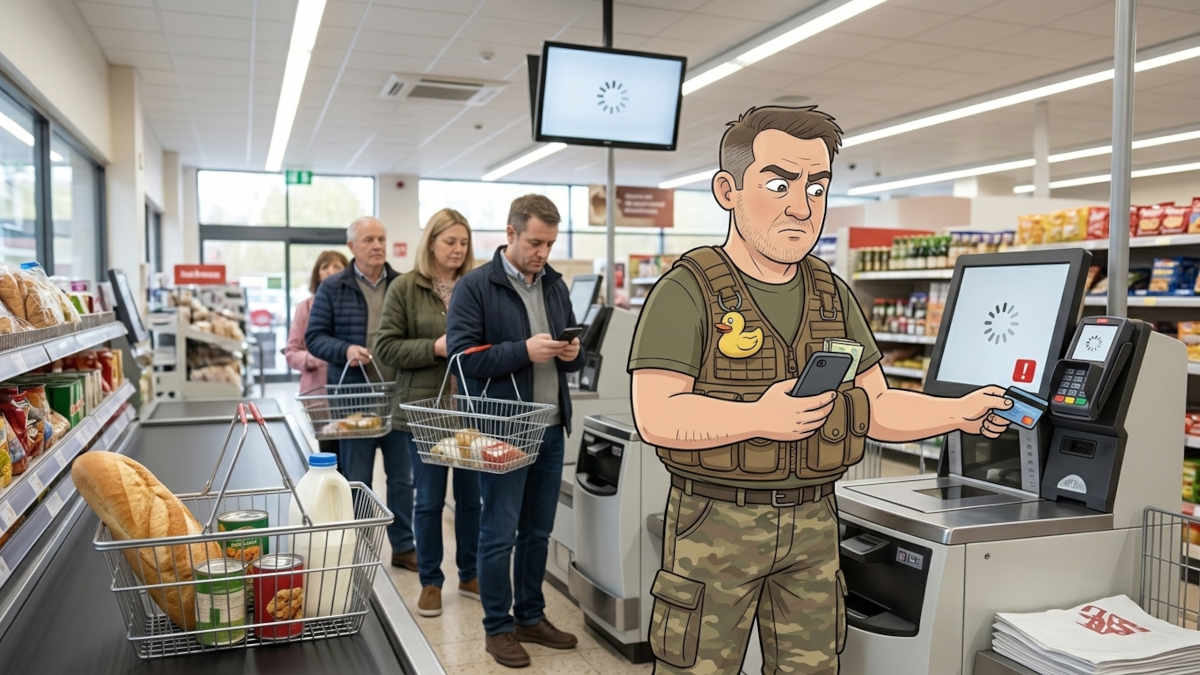
Since the start of September, our daily news briefing has logged nine IT outages big enough to reach ordinary UK households. Flights grounded, banking apps locked, card payments refused, government services switched off and, on one street in North Yorkshire, five weeks without broadband. We went back through every one of them to see what actually caused each IT outage, how long it lasted and what it stopped people doing.
The answer is more reassuring than the headlines. Only one of the nine was a confirmed cyber attack. Most were faults, bugs and a power cut in one building, and most were fixed within a day. But three of them stopped people getting at their own money, and the longest by far was the smallest. Here’s what we found, and the short list of things that keeps a UK home running when the screens go blank.
Nine IT Outages in Twelve Weeks: What We Logged
These are the outages that made our briefing between 1 September and 23 November 2026. Our briefing only covers things that affect households, so this isn’t every outage in the country, just the ones that reached people’s lives.
- 9 to 11 September, air traffic control. A technical fault at Nats’ Swanwick centre cancelled more than 2,000 flights and disrupted around 330,000 passengers over three days. A cyber attack was ruled out, the BBC reported.
- 4 September to October, Great Broughton broadband. A contractor damaged a cable and seven homes lost broadband for five weeks, leaving elderly residents’ internet-linked personal alarms offline, the Northern Echo reported.
- From 11 October, Hobbs, Whistles and Phase Eight. A cyber attack took down IT systems at the fashion brands. Stores stayed open, but systems were still down days later, Moneyweb reported.
- 20 October, Google Cloud. A power failure at a datacentre in Google’s London region stopped Revolut card payments and cash machine withdrawals, and hit Lloyds, HSBC, Royal Mail, the NHS app and court hearings until mid-afternoon, The Guardian reported.
- 22 and 23 October, government websites. A critical flaw in the PHP programming language took 32 government services offline, mostly as a precaution while patches went on, The Register reported. The system garages use to log MOT results went down, so garages recorded tests on paper, the Manchester Evening News reported.
- 10 November, Lloyds. More than 4,200 problems were reported on Downdetector by 9.20am as customers were locked out of the app and online banking, with Bank of Scotland customers affected too. Services were back later that morning, The Argus reported.
- 12 and 13 November, Microsoft 365. A 24-hour global outage took down Outlook and Teams. Hospitals turned to paper records and schools lost contact with parents. Microsoft found three causes: a months-old bug, failing internal connections and not enough server capacity, The Guardian reported.
- 13 and 14 November, UK to US flights. A communications failure grounded every flight in America and the knock-on reached Heathrow and Manchester, WalesOnline reported. US officials blamed overloaded routers in an ageing system.
- 17 November, Gmail and Apple. Gmail and Apple services including iCloud, Apple Pay and the App Store went down, days after the Microsoft failure, The Guardian reported.
Every one of these was covered as it happened in our daily UK Prepper News.
What We Found: Most IT Outages Are Accidents
When we sorted the nine by cause, the picture was clear:
- Four were technical faults: the Nats glitch, the Google datacentre power cut, the Microsoft bug and the US routers.
- One was physical damage: a cable in North Yorkshire.
- One was a precaution: government sites switched off while a security flaw was patched, with no confirmed break-in.
- One was a confirmed cyber attack: the fashion retailers.
- Two had no public cause: Lloyds, and Gmail and Apple. US Secretary of State Marco Rubio said there was “zero evidence” the run of American outages was linked or part of an attack, the BBC reported.
Three more patterns stood out.
Money is the first thing to go. Three of the nine stopped people paying for things or reaching their own money: Revolut in October, Lloyds in November and Apple Pay a week later. Phones and internet worked fine in all three. People still couldn’t buy a pint of milk.
Big outages are short. When a national system fails, thousands of engineers are on it straight away. Google was back by mid-afternoon, Lloyds by late morning and Microsoft within a day. Even the Nats failure, the most disruptive of the nine, was cleared in about three days.
The longest outage was the smallest. Seven homes in Great Broughton went five weeks without broadband, far longer than any national failure. Nobody makes the news for one damaged cable, so nobody rushes. For the residents with alarm pendants, that was five weeks without a safety net. The IT outage most likely to hit you for a long time isn’t a global one. It’s the one on your street.

🐔 Chicken Licken
Did You Know?
Did you know the October outage that stopped thousands of people paying for their shopping started with a power cut in one building? I’ve been saying this for years: “the cloud” is just somebody else’s computer, plugged into somebody else’s wall. Now you know whose wall.
See our Special Report “We Are One Button Away” first published on 4 July 2026.
Card Payments Down: When the Outage Hits Your Money
If card payments are down at the supermarket, or you find your banking app down for the morning, your money hasn’t gone. During the Google outage Revolut said customers’ “money and data are safe”, and that’s the normal story: the money is there, you just can’t reach it for a few hours. The trouble is what you do in those hours.
The people in charge are now saying so out loud. Launching the Be Ready campaign on 22 October, Wes Streeting asked: “How would we cope if the payment systems at the local supermarket went down?”, the BBC reported. Three weeks later Nikhil Rathi, head of the Financial Conduct Authority, told people to think about having more than one bank account: “Do you have your own ability to substitute in the event that your single provider goes down? Because we’re not going to be able to avoid some of these incidents happening,” AOL reported, citing his interview with The Times. On 19 November the Bank of England and the FCA proposed rules telling banks to assume a major cyber attack will get through and to plan for rebuilding their core systems from scratch, City AM reported.
If the regulators are planning for a bank being offline, it makes sense for households to as well. Bank outages usually hit one bank at a time, so a card from a different banking group often works when your main one doesn’t.
Check the group, not just the name. Lots of familiar bank names belong to the same company, and banks in the same group often share the same systems. If your two cards are both on the same line below, they could both go down together. Pick your second card from a different line.
- Lloyds Banking Group: Lloyds Bank, Halifax, Bank of Scotland, MBNA credit cards
- NatWest Group: NatWest, Royal Bank of Scotland, Ulster Bank, Coutts, plus Sainsbury’s Bank cards, loans and savings, which moved to NatWest in 2025
- Barclays: Barclays, Barclaycard, Tesco Bank (bought by Barclays in 2024)
- HSBC UK: HSBC, first direct, M&S Bank
- Santander UK: Santander, TSB (bought by Santander in April 2026, still run separately until the two are merged, expected in 2027)
- Nationwide: Nationwide, Virgin Money (formerly Clydesdale Bank and Yorkshire Bank)
- Coventry Building Society: The Co-operative Bank, smile
- On their own: Monzo, Starling, Revolut, Chase, Metro Bank
Being in the same group doesn’t always mean the same computers: TSB and Tesco Bank still run on their own systems for now. But it’s the safer way to choose. A Halifax card as a backup for your Lloyds account is like keeping your spare key on the same keyring.
The official Be Ready page gives the old-fashioned answer too: keep some cash.

🦆 Keith
Don’t Be Keith
Keith keeps a £400 emergency fund for exactly this sort of thing. Unfortunately he keeps it in a savings pot inside his banking app, so when the app went down, his emergency fund went down with it. The petrol station was cash only. His wife had a tenner in her coat. She paid.
There’s more on what happens when shops can’t take cards in our article When Payment Systems Fail.
See our Special Report “The Cyber Attacks Have Already Started: From Supermarket Fridges to a UK Power Plant” first published on 10 November 2026.
Internet Outage: Plan for the One on Your Street
Great Broughton is the lesson most people miss. A local internet outage, a mobile mast knocked out by a storm, or a power cut that takes the broadband router with it are far more common than a global IT outage, and they can last much longer. They also matter more than they used to, because so much now runs through the same connection.
- Your landline. Most homes are being moved to digital landlines that run through the broadband router. If the router has no power or no connection, the home phone goes too.
- Care and personal alarms. Many now work over broadband or a mobile signal. If someone in your family has one, ask the provider what happens in a power cut or broadband outage, and whether a battery back-up is available.
- News and information. If your only source of news is an app on your phone, an outage leaves you guessing. A battery radio doesn’t need the internet, a mobile signal or a working power socket.
Tendak Battery Radio
A proper little AM/FM radio that runs on two AA batteries, with a big speaker and a headphone jack for quiet listening when everyone else is asleep.
Our Full Review: Tendak Battery Radio →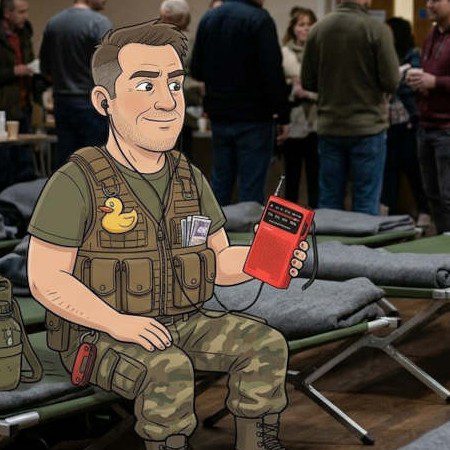
The same goes for anything you’d normally look up: your GP surgery’s number, your energy supplier’s power cut line, your boarding pass, the train times. When Microsoft went down, hospitals went back to paper. That’s not a bad plan for a household either.
Complete Guide
Burglar Alarm Power Cut
What your burglar alarm, video doorbell and smart lock actually do when the power goes, how to stop the beeping, and the home security that works with no electricity at all: locks, light, scams and what to do if you have to leave.
Read the Full Guide: Burglar Alarm Power Cut →
So, How Worried Should You Be About an IT Outage?
Not very. Nine outages in twelve weeks sounds alarming, but look at what they actually did: a few hours without a banking app, a cancelled flight, a day without work email. Annoying, sometimes expensive, but nothing a household can’t ride out with a bit of cash and a list on paper.
Experts The Guardian spoke to on 23 November made the same point. William Wetherill, who runs security for a firm that protects banks, said: “An individual shouldn’t have a mindset where they’re prepping for the end of the world constantly.” We agree entirely. Prepared, not panicked.
What our log does show is that these failures are now regular, mostly accidental and impossible to predict. You can’t stop the next one. You can make sure it’s a minor nuisance in your house rather than a crisis.
One real risk does follow every big IT outage: scams. Within hours, fake “refund”, “compensation” and “verify your account” texts start arriving. Don’t click links in any message about an outage. Go to the company’s own app or website, or ring the number on the back of your card.
Complete Guide
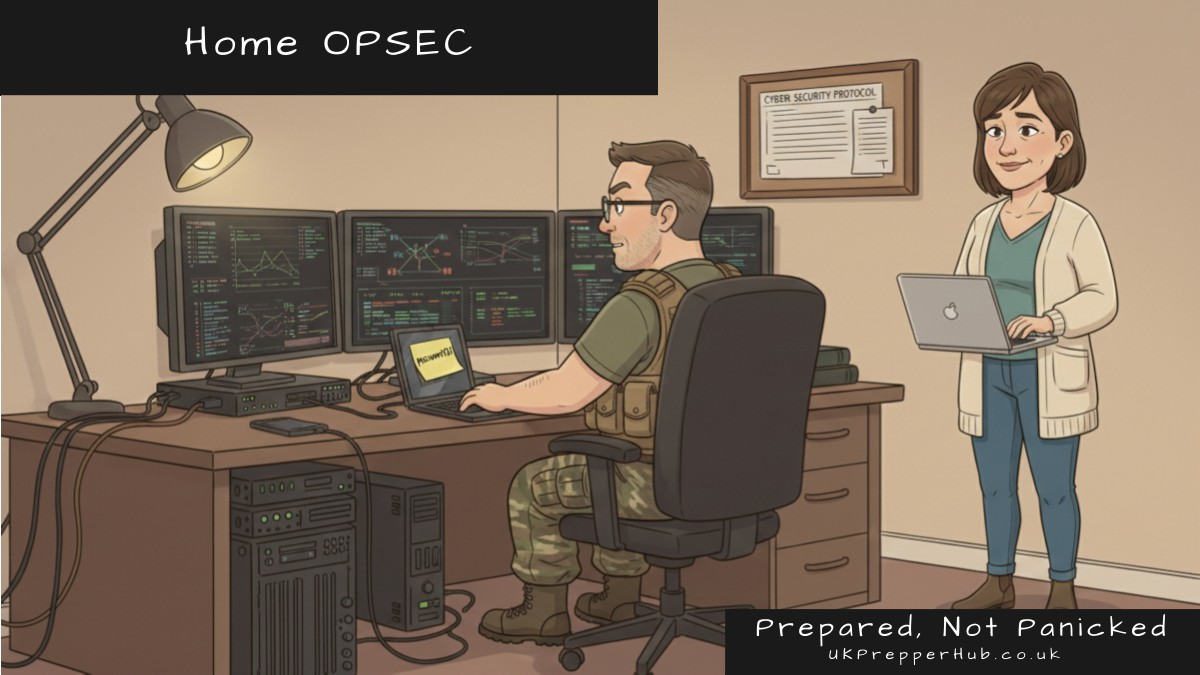
Household OPSEC Guide
OPSEC is a military term that’s filtered down to civilian life. OPSEC is short for “OPerational SECurity”. At its core, it means protecting information that could be used to harm you.
Your IT Outage Plan: Seven Things to Sort This Week
None of this is expensive and most of it is free. It’s the Be Ready kit with the digital gaps filled in.
- Cash at home, in small notes. Enough for a few days of food, fuel and medicine. Small notes, because a shop running on cash during an outage won’t have change for a £50.
- A second way to pay. A debit or credit card from a different banking group to your main account. If one bank’s systems fall over, the other usually won’t.
- Important numbers on paper. Family, GP, pharmacy, your bank’s phone number, your energy supplier, your insurer and 105 for power cuts. Keep the list by the phone and a copy in your bag.
- Offline copies on your phone. Download maps for your area, save boarding passes and tickets to the phone itself, and keep photos of prescriptions and key documents somewhere that doesn’t need the internet to open.
- A battery or wind-up radio. For local and national news when the apps and websites are down.
- A charged power bank. An outage that comes with a power cut drains phones fast, and your phone is your torch, your map and your contact book.
- A check on anyone with a care alarm. Ask the provider what happens if the broadband or power goes, and make sure a neighbour or family member knows to check in.

🪖 Black Panther
In My Previous Role…
In my previous role, our most critical systems were air-gapped: no network connection, nothing to hack, nothing to crash. Civilians don’t need a server room for that. A £2 notebook with your important numbers in it is fully air-gapped, works in a power cut, and has never once needed a software update. Carry on.

📋 Clarissa
I’ve Made A Checklist
Here’s my Household Emergency Plan: all the numbers, account details and medicines you’d need if your phone, your banking app and your email gave up on the same morning. Fill it in on screen, then print it. Yes, on paper. That’s rather the point.
Download: Household Emergency Plan →We’ll keep logging them, and there will be a tenth IT outage soon enough. It will probably be an accident and it will probably be fixed by teatime. The households that barely notice will be the ones with a bit of cash, a list on paper and a radio that doesn’t care whether the internet is working.
Frequently Asked Questions
What causes an IT outage?
Usually something ordinary. Of the nine IT outages that reached UK households between September and November 2026, four were technical faults (an air traffic control glitch, a datacentre power cut, a software bug and failed network equipment), one was a damaged cable, one was a precaution over a security flaw and only one was a confirmed cyber attack. Two had no public cause.
What should I do if card payments are down?
Try a card from a different bank, as outages usually hit one bank or payment provider rather than all of them. If nothing works, pay with cash. That’s why the government’s Be Ready campaign recommends keeping some cash at home, in small notes.
Is my money safe if my banking app is down?
In almost every case, yes. An app or website being down means you can’t reach your money for a while, not that it has gone. Be wary of texts or calls about the outage asking you to verify your account or claim a refund: they are a common scam after any big failure.
How much cash should I keep at home for an emergency?
Enough to cover a few days of essentials such as food, fuel and medicine if cards and apps stop working. Keep it in small notes, somewhere safe and out of sight, and don’t keep it in a banking app.
Can an internet outage affect my landline or personal alarm?
Yes. Digital landlines run through your broadband router, and many personal and care alarms now use broadband or a mobile signal. If the router loses power or connection, they can stop working. Ask your provider about battery back-up, and keep a charged mobile phone as a second way to call for help.
Are IT outages caused by cyber attacks?
Some are, but most aren’t. Only one of the nine outages we logged in autumn 2026 was a confirmed cyber attack. Whatever the cause, the effect on a household is the same, so the same simple preparations cover both.
How long does an IT outage last?
Big national outages are usually fixed within hours, or a day or two at most, because so many engineers work on them at once. Local faults can last far longer: one North Yorkshire street went five weeks without broadband in autumn 2026 after a cable was damaged.
Build Your Resilience
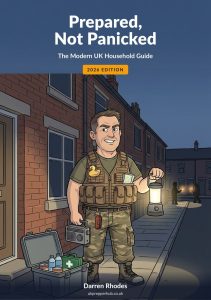
The whole plan, in one book
Prepared, Not Panicked (2026 edition) pulls our guides together into one plan for UK households. PDF, £4.99.
See inside the book →Further Reading: Related Guides
- How to Prepare for a Power Cut
- Emergency Radio Guide
- Off Grid Communications
- Burglar Alarm Power Cut (digital landlines and care alarms)
- Household OPSEC Guide
- Protecting Your Important Documents
- Home Emergency Kit
- Power Bank for Power Cuts
All our guides can be found listed on our resilience hub.
Gear We've Tested & Reviewed
All our reviews can be found on our reviews and resources page.


📡 Find Us Everywhere
Daily briefings, prep guides, and real-time updates across every platform. Pick yours.
Free. No commitment. Stay anonymous on WhatsApp & Telegram.
Stay Informed on UK Preparedness
Join our newsletter for UK-specific preparedness tips, product recommendations, and real-world advice for households.
Subscribe to Our Newsletter