
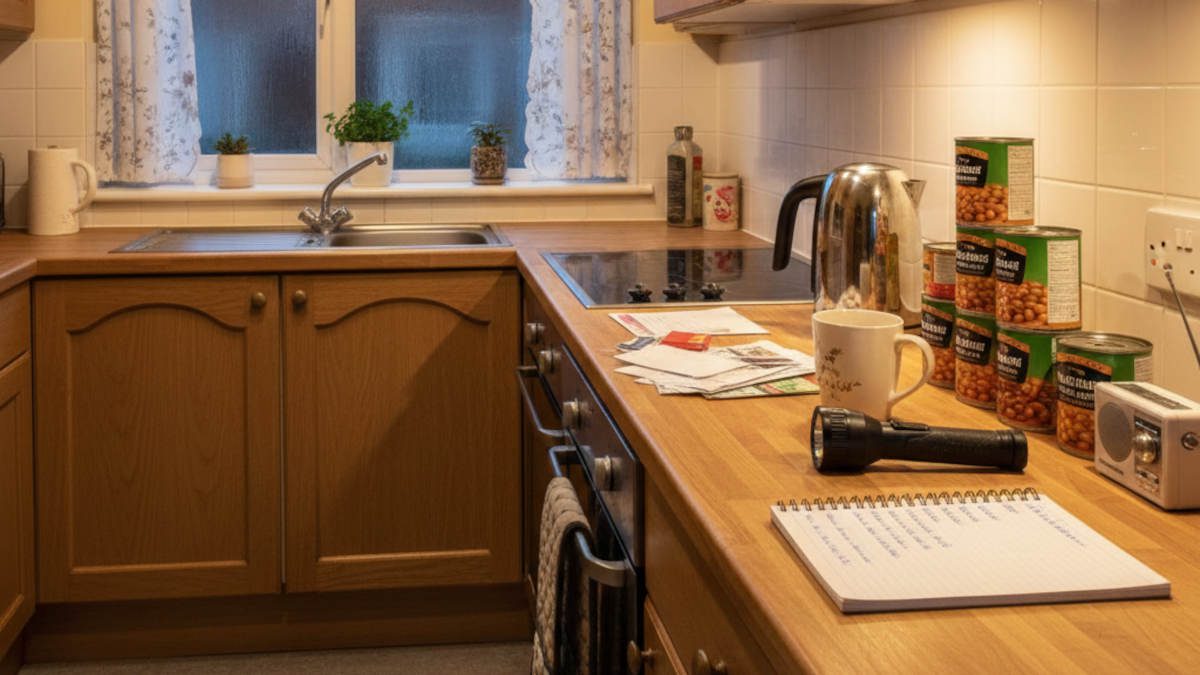
Practical preparedness for realistic UK threats — from someone who lives it.
Let’s Start With An Honest Question
When you think of a “prepper” — what comes to mind?
If the answer involves camouflage face paint, a man in a balaclava talking about WW3, or someone with a bunker full of ammunition — you’re not alone. That image is everywhere online. It’s also almost entirely useless for the average British household facing a power cut, a burst water main, or three days of snow.
There are NINE types of prepper you’ll meet on the internet. None of them are particularly helpful.
The Nine Types (And Why None Of Them Are You)
Keith The Prepper
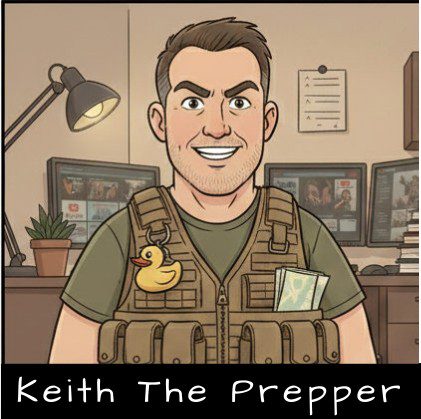
Loves Amazon Prime. Has seventeen torches, none of which are charged. Owns a tactical vest with a rubber duck clipped to it — origin unknown, never explained. Watches every preparedness YouTube video ever made and orders whatever they recommend before the credits roll. Genuinely wants to be prepared. Genuinely missing the point. His wife is not impressed.
Black Panther
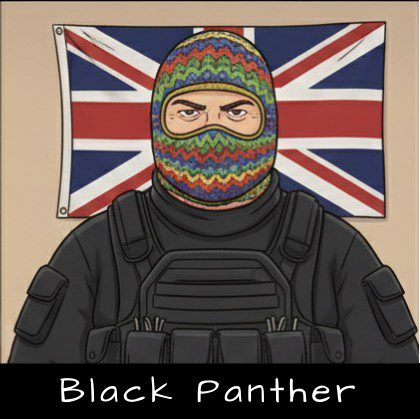
Dreams of bugging out to the hills with his 40kg tactical rucksack and living off the land. Cannot walk to the end of his road without losing his breath. Has not told his wife about the bug out plan. Cannot find a sleeping bag he fits into. Wears a balaclava online to protect his identity. The balaclava was knitted by his Nan in 1974 to keep his ears warm. Hints to everyone he was in the SAS, but the closest he ever got was the Cub Scouts. He also thinks he is a martial arts expert, but he’s more Kung Foo Panda than Bruce Lee.
Camping Clown
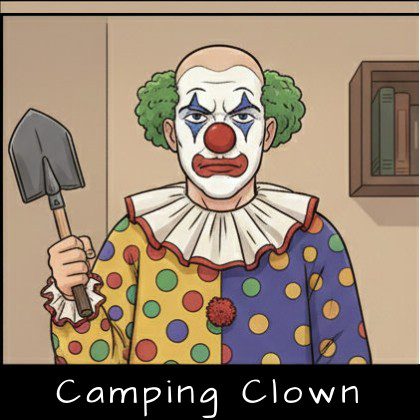
All the gear. Absolutely no idea. Owns a titanium spork because it saves 12 grams. Bought a £300 titanium knife because it looks cool and is lightweight — has never cut anything with it. Cannot boil water without consulting three YouTube videos and a laminated protocol document. Has everything. Can do nothing.
Weekend Warrior
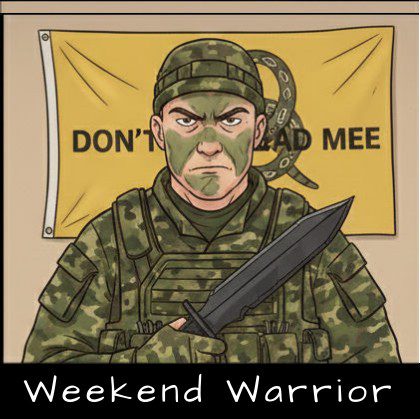
Speaks exclusively in a gruff growl. Every conversation ends with ‘WW3 is coming’. Convinced the primary purpose of preparedness is defending his borders, his rights, and his extensive collection of Gadsden flags. Has camouflage face paint on at all times including the school run. Is prepared for the collapse of civilisation. Is not prepared for a power cut on a Tuesday night at dinner time.
Chicken Licken
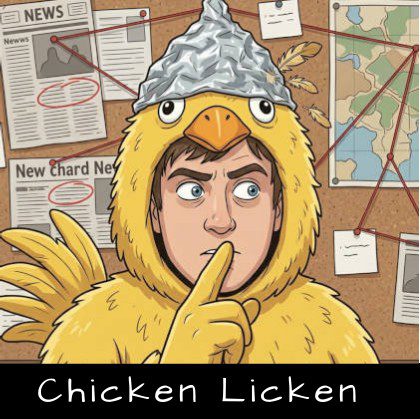
Chicken Licken knows things. Things they don’t want you to know. He can’t tell you who “they” are — not here, anyway — but if you check the cork board he’s been building since 2019, it’s all there. The red string doesn’t lie.
The world is flat. The zombie apocalypse is coming. Aliens are real. Every piece of kit he buys gets checked for government trackers before use. The tin foil hat is his own design. He’s very proud of it.
To be fair to Chicken Licken, he is genuinely prepared for almost every scenario — it’s just that his reasoning for preparing is completely detached from reality.
Surviv’l Gurl
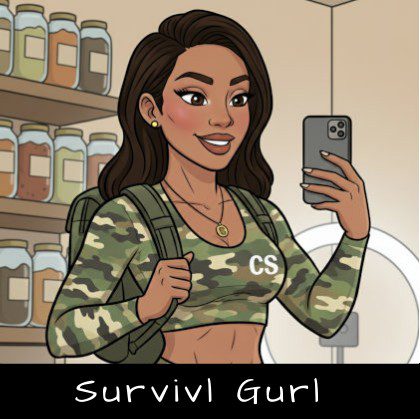
47,000 followers. Zero of them own a charged torch. All of them have saved her mason jar flat lay. Does not prepare for emergencies — she curates them. Full makeup, perfect hair, matching camo lycra from a boutique that also sells jade rollers. Carries a pristine day sack that has never left Zone 2. Her followers believe they’re learning preparedness. They are learning content.
Calm Clarissa
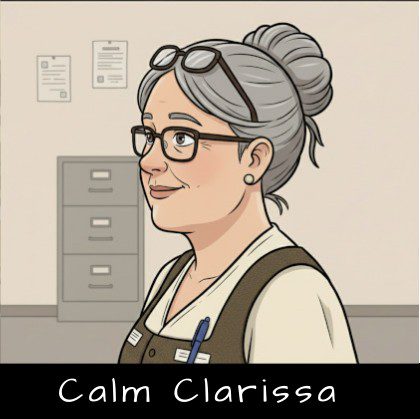
Retired local authority emergency planning. The most practically useful person in a ten mile radius during any crisis. Also the most exhausting person in any room. These facts are directly connected. Clipboard always in hand. Two pens — she has learned this lesson. Has a laminated badge that says “Calm Clarissa — Community Emergency Coordinator.” She made it herself. Secretly called “The Laminator” behind her back by the village hall working committee. Janet is on rota. Don’t ask about Janet.
Aroura

Prepared entirely through vibrational energy, herbal tinctures, and the power of intention. Genuinely kind. Genuinely useless in an actual emergency. Has cleansed her emergency supplies under the new moon. Has a crystal grid. Has a canvas tote containing approximately one cereal bar and a laminated affirmation. The universe will provide. It hasn’t yet. She remains positive. Her only “energy” crisis is when her chakras are unaligned. Aroura, not Aurora. This is intentional. She chose this spelling herself, possibly at a rebirthing ceremony in 2003. It is a spiritual spelling. Nobody has corrected her. She would not receive the correction well. The universe guided her to those letters.
Greasy Gary
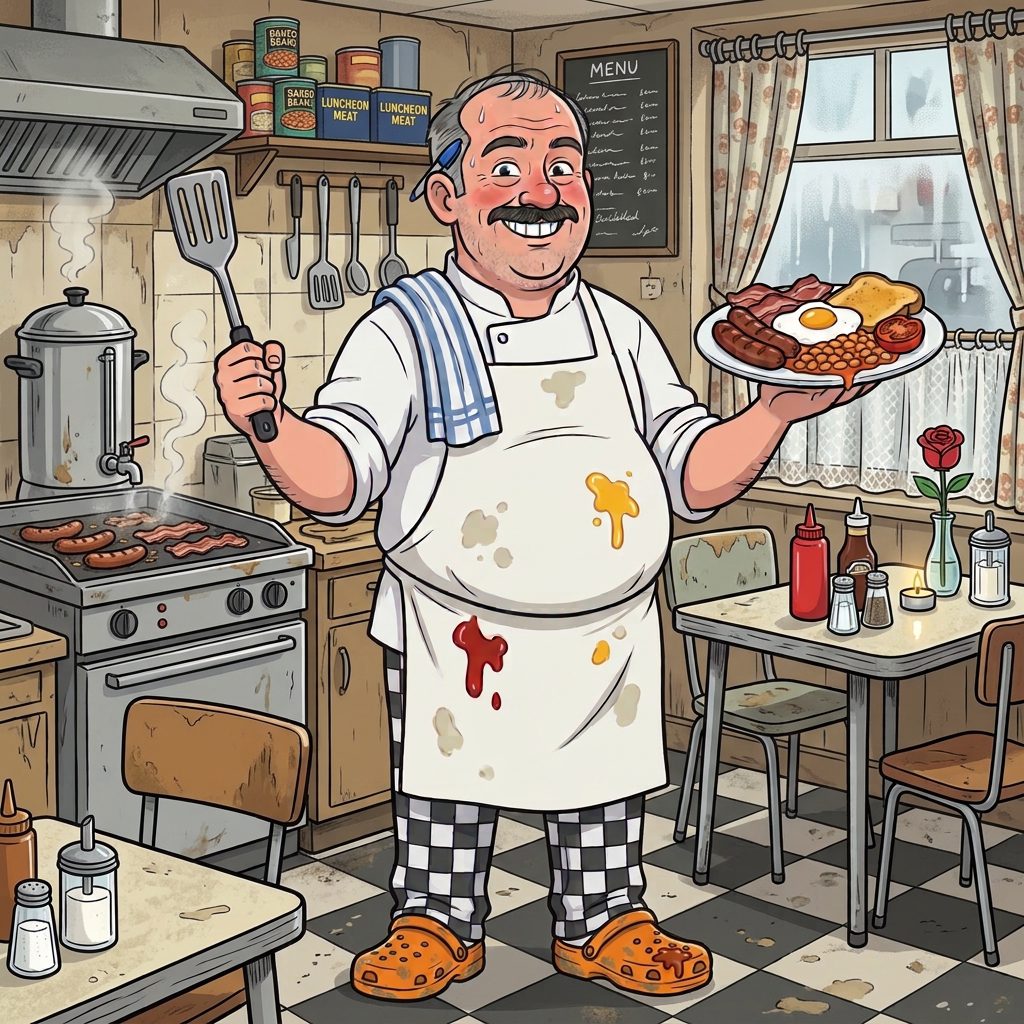
Runs a greasy spoon café and is convinced it’s fine dining. Everything goes on one plate, all touching, beans running into the lot. For romance there’s a plastic flower in a little glass vase and a tea light. Thinks a Pot Noodle is posh. Bisto is a sauce. The chef’s special is whatever tins are left. Here’s the annoying part: in a power cut, Gary’s the one who gets everybody fed. Three tins, a camping stove and a loaf to mop it up, and the whole street’s having a hot dinner.
Meet the whole team, and see the kit they’ve reviewed →
Then There’s A Tenth Type
This one doesn’t make it into the cartoons very often. It isn’t dramatic enough.
The tenth type quietly checks on the elderly couple down the road. Keeps a week’s worth of food in the cupboard — not forty tins of beans. Knows where the stopcock is. Has a charged torch in the kitchen drawer. Doesn’t own a tactical vest. Doesn’t call themselves a prepper at all.
Historically, during every flood, every storm, every power cut, every supply disruption — it’s the tenth type that keeps communities functioning.
UK Prepper Hub is for the tenth type.
Prepared. Not Panicked.
The UK Reality
This isn’t abstract. It’s been happening — regularly, predictably, and with very little warning. Just look at 2026 so far:
Winter — floods. By February, Somerset had received 184% of its average winter rainfall. The Thames Barrier closed. Seventy-five flood warnings were active across England at the same time, and households across Wales and the Midlands woke up to snow warnings with no backup plan for heating, cooking or water.
May — record heat. On 26 May, Kew Gardens hit 35.1°C, the hottest May day in the UK since 1922.
Spring and summer — wildfires. Moorland and grass fires burned almost non-stop from May. By mid-July, more than 18,600 hectares had gone up in at least 65 large fires, from the Mourne Mountains to Wales, and the Cairngorms fire forced 600 residents of Nethy Bridge to evacuate. (See our Special Report “Moorland Fires Have Burned 18,600 Hectares” first published on 25 July 2026.)
Summer — water running out. On 29 July, the Environment Agency declared drought across half of England. Nine water companies brought in hosepipe bans covering tens of millions of households, and Southern Water applied for a Drought Order that would limit businesses in parts of Hampshire and the Isle of Wight to essential water use only. (See our Special Report “Why Is There a Hosepipe Ban?” first published on 8 August 2026.)
October — two named storms in three days. Storm Austen hit the south-west on 22–23 October, and Storm Boelo hit Scotland, northern England and Northern Ireland on the night of 24 October with 85mph gusts. Between them they cut power to 838,700 properties, and two men were killed by falling trees. (See our Special Report “Storm Austen Left 18,000 Homes Without Power” first published on 23 October 2026.)
None of that was a surprise to anyone paying attention. The UK has been here before:
2018 — Beast from the East. Sub-zero temperatures across the UK for over a week. Roads impassable. Supermarkets unable to restock. Communities cut off in rural Scotland and Northern England.
2020 — COVID-19. Supermarket shelves stripped bare within hours. Supermarkets limited how many of each item you could buy. Supply chains stretched to breaking point.
2021 — Petrol and diesel shortages. HGV driver shortages combined with panic buying emptied forecourts across the UK within days. Essential workers couldn’t get to work.
2021–2022 — Storms Arwen, Barra, and Malik. Hundreds of thousands without power for days. Some households without electricity for over a week — in winter.
2025 — Co-op and M&S cyber attacks. Major retailers hit simultaneously. Payment systems failed. A society that had quietly gone almost entirely cashless discovered it couldn’t buy food.
The common thread isn’t disaster — it’s disruption. Short-term failures of systems we rely on daily. The households that struggled most were the ones who had assumed everything would just keep working.
UK Prepping vs What You See Online
Search “prepping” on YouTube and you’ll find Americans building underground bunkers, stockpiling ammunition, and practising wilderness survival in states bigger than the entire UK.
That content is useless here — and worse than useless, because it makes preparedness look extreme, expensive, and slightly unhinged.
UK preparedness is a fundamentally different discipline. Most of us live in high-density housing with limited storage. The relevant threats are infrastructure failures, not societal collapse. UK law restricts many items that appear routinely in US content. Our climate, geography, and social infrastructure are entirely different. And most UK households can’t afford to spend £500 on emergency equipment in one go.
Most real preparedness is boring logistics, not tactical drama. Real resilience looks like food storage, water filtration, backup heating, medical supplies, and knowing your neighbours — not camouflage, combat drills, and secret bunkers.
Sensible UK preparedness starts with a torch, some tinned food, and knowing where your stopcock is. It builds from there — gradually, affordably, practically.
Even The Government Agrees
The UK Government publishes preparedness guidance — and since October 2026 it’s finally saying it out loud: the Be Ready campaign asks every household to keep enough for three days. Across Europe the picture is clearer: France distributes preparedness information to every household. Germany recommends citizens maintain emergency food and water supplies. Sweden and Finland have comprehensive public preparedness campaigns that treat household resilience as a civic responsibility.
This isn’t fringe thinking. It’s mainstream policy across the developed world. The UK has been slower than most to say it to ordinary households, but it’s catching up.
The Person Behind The Site
This site is written by Darren — a late-diagnosed ADHD and autistic adult who started prepping because it works. It quiets the “what if” spiral, reduces anxiety, and means that when something goes wrong, there’s already a plan. If that resonates with you, you’re in the right place.
The background is real. Over 40 years of practical experience — from Cub and Scout through to Scout Association Mountain Form holder, qualified to lead expeditions, climbing, and abseiling in serious terrain. Mountain first aid qualified to Dr Ewan Jones standard, the level required for mountain rescue team work. CPR and First Aid at Work qualified continuously since 1988. Bronze Medallion life saving and Pool Lifeguard Bronze Medallion — two distinct qualifications, the latter covering emergency action plans, normal operating procedures, spinal injury management, and deep water rescue with spinal boards.
Twelve years at management level in local authority leisure, writing and implementing Emergency Action Plans across multiple public facilities — covering flooding, structural failure, gas leaks, bomb threats, power loss, and mass casualty incidents. Not theoretical. Operational. Plans that got used, in real emergencies, with real people.
The cottage he lives in has no central heating, no gas, and no oil. Heat comes from a single wood burner. The small Cambridgeshire village it sits in has no local services — no shop, no pub, no school, nothing. The preparedness advice here is written from that reality, not from a centrally-heated office.
His motto: make sense common again.
As Featured In
- Reach regional titles including Cambridge News, Cheshire Live and Bristol Post: UK Prepper Hub’s log of nine IT outages, and why your backup bank card should come from a different banking group
- Metro: what the government’s emergency kit list misses
- Metro: why hand sanitiser is a prepping essential
- Metro: walkie-talkies ahead of the landline switch-off
- The Sun on Sunday: prepping and the government’s emergency advice
- Tyla: black sky event advice for families with young children
- Daily Mail: prepping feature
- The i Paper: low-cost preparedness kit
- The Independent (IndyBest): wind-up radio buying guide
- The Independent: offline prepping feature
- bTV, Bulgarian national television: report on emergency kits
- LBC: interviews with Clare Foges, Matt Frei and Nick Ferrari
- BFBS Radio: the Be Ready campaign, with Richard Hatch
- Black Cat Radio: live in the studio with Ste Greenall
- BBC Radio Guernsey: the three-day emergency pantry
- GB News
Journalists: see our Press & Media page.
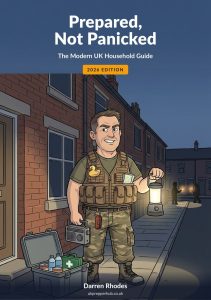
I put the whole plan in one book
Prepared, Not Panicked (2026 edition) pulls everything on this site into one plan for UK households: water, food, power and heat, health, home security and more. Colour PDF, £4.99.
See inside the book →Who This Site Is For
UK Prepper Hub is written for ordinary British households — not hobbyists, not enthusiasts, not people who’ve already decided to dedicate their lives to preparedness.
We specifically write for households in council housing and flats, where storage space is limited and most preparedness advice simply doesn’t apply. For households on tight budgets, where building supplies gradually is the only realistic approach. For neurodivergent households and those managing health conditions — disruption to routine carries extra weight, medication management during power cuts is a genuine concern, and most emergency guidance completely ignores that reality. And for working-class households who want practical, unsensationalised information without being talked down to.
Darren has ADHD, autism and anxiety. He preps because it helps. Not as a cure — as a tool. If you’re in the same boat, that’s understood here, not glossed over.
What We’ve Built
The Resilience Hub contains in-depth guides covering everything from cooking without electricity and managing frozen pipes, to what to pack in a 72-hour grab bag and how to keep emergency supplies dry in a British climate. Every guide is written specifically for UK households — real events, real places, real regulations.
The Gear & Resources section reviews equipment for UK households: what it does well, its limitations, whether it’s easy to buy here, and who it’s really for. If something isn’t worth buying, we say so.
We post daily news briefings covering genuine UK risk — weather warnings, flood alerts, NHS pressures, infrastructure incidents — sourced from the Met Office, Environment Agency, UKHSA, and other authoritative UK bodies. No conspiracies. No politics.
The Approach
Non-alarmist. We don’t manufacture urgency or catastrophise. UK households face real but manageable risks. We cover those accurately and calmly.
UK-specific. Every piece of content is written through a UK lens — UK threats, UK regulations, UK housing, UK retailers, UK services.
Honest. We point out where a product falls short, we don’t claim hands-on use we haven’t had, and where the evidence is uncertain we say so.
Inclusive. Council tenants, flat-dwellers, renters, disabled households, neurodivergent households — preparedness guidance should work for everyone, not just homeowners with garages and disposable income.
Practical. The goal is always a specific, achievable action. Not vague advice — real steps that real households can take this week, with what they’ve already got or can afford to buy.
Start Here
New here? These are the best places to begin.
- Grab the free checklists. Clarissa’s printable checklists for the emergency kit, grab bag, power cuts, water, the car and more. Print one and tick it off as you go.
- Pick one guide. The Resilience Hub has a guide for each everyday UK disruption: power cuts, storms, floods, snow, the water going off. Start with the one most likely where you live.
- Find kit that’s worth the money. Gear & Resources lists every review by category: what each product does well, what to watch out for, and who it’s actually for.
- Take the Emergency Evacuation Challenge. You’ve got to leave home right now. What do you take? A quick game that shows how ready you really are.
- Get the monthly newsletter. One email a month: the risks that kept coming up in the news, and what to actually do about them.
Prepared. Not Panicked.
That’s the whole philosophy. Sensible, calm, affordable preparedness for the disruptions that actually happen in the UK. Nothing more, nothing less.
No politics. No camo. No shelters built from sticks. No rubbing two sticks together for fire. No guns, no crossbows, and absolutely no bugging out to a woodland you don’t own.
Just a torch, some tinned food, and a plan.
Build Your Resilience
The whole plan, in one book
Prepared, Not Panicked (2026 edition) pulls our guides together into one plan for UK households. PDF, £4.99.
See inside the book →Further Reading: Related Guides
- How to Prepare for a Power Cut
- Grab Bag Guide
- Home Emergency Kit
- 3-Day Emergency Pantry
- Emergency Water Storage
- Cooking Without Electricity
- Keep Warm Without Heating
- Storm Damage Prevention
- Emergency Radio Guide
All our guides can be found listed on our resilience hub.
Gear We've Tested & Reviewed
- FosPower Emergency Radio Review
- General Medi First Aid Kit Review
- Portable Gas Stove Review
- Unibos Stopcock Key Review
- 72 Hour Emergency Kit List
- Winter Car Essentials
All our reviews can be found on our reviews and resources page.